
Global Footwear Market Size and Forecast 2025–2033
Fashion, Function, and the Future: How the Global Footwear Industry Is Stepping Into a New Era of Growth

Introduction: A Market That Moves the World
Footwear is far more than a basic necessity. It sits at the intersection of fashion, functionality, identity, and performance, making it one of the most dynamic consumer goods categories in the global economy. From everyday sandals and formal leather shoes to high-performance athletic sneakers and eco-friendly casual wear, footwear reflects changing lifestyles, cultural trends, and technological progress.
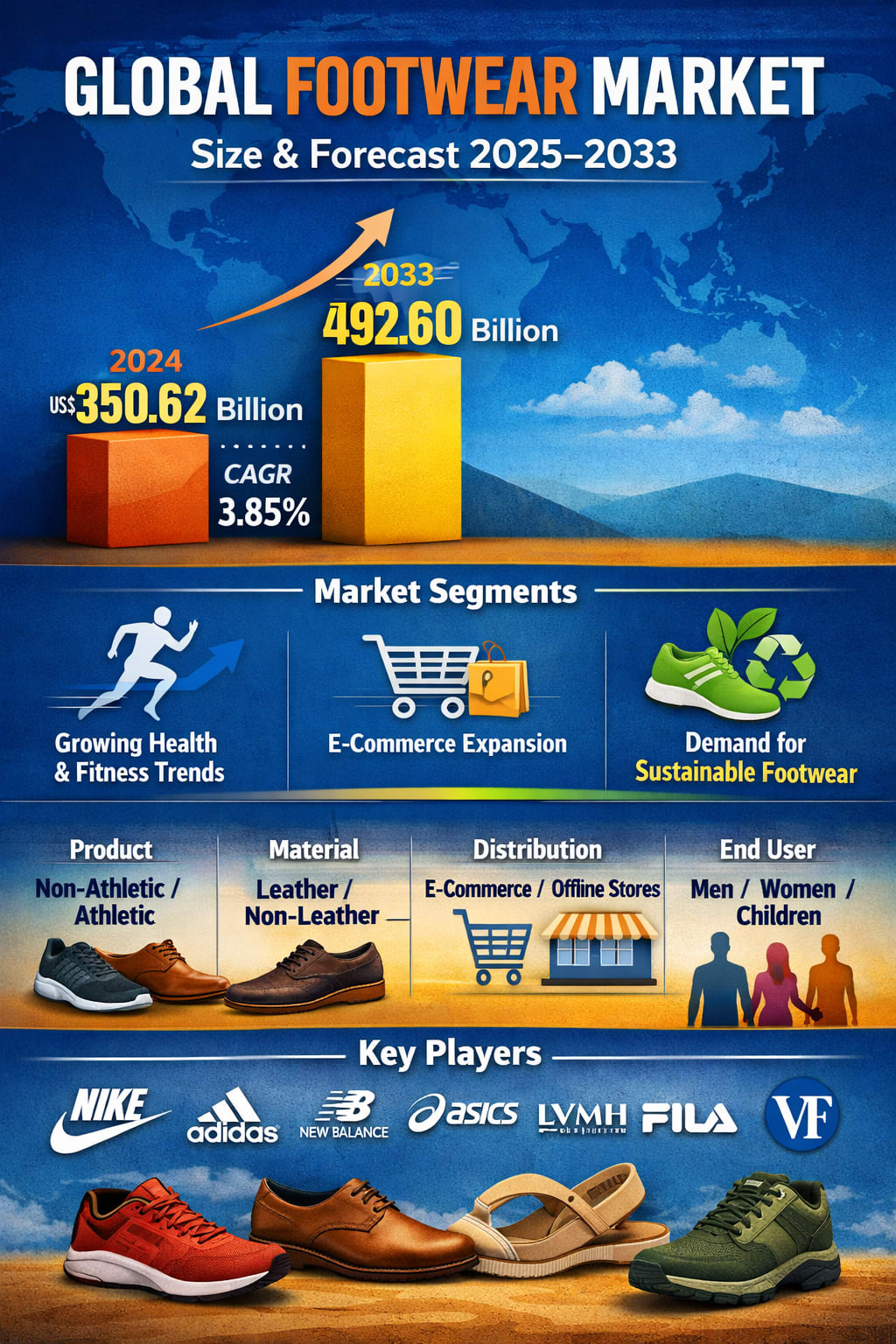
According to Renub Research, the Global Footwear Market was valued at US$ 350.62 billion in 2024 and is projected to reach US$ 492.60 billion by 2033, expanding at a compound annual growth rate (CAGR) of 3.85% from 2025 to 2033. This steady growth trajectory is being powered by a mix of rising disposable incomes, increasing fashion consciousness, rapid e-commerce adoption, and growing demand for performance-driven and sustainable footwear across regions and age groups.
As consumers become more style-aware, health-conscious, and digitally connected, footwear brands are being pushed to innovate not only in design, but also in materials, distribution strategies, and customer experience. The result is a global industry that is no longer just about making shoes—it is about building lifestyle ecosystems around comfort, identity, and performance.
Understanding Footwear: More Than Just Protection
Footwear refers to garments worn on the feet for protection, comfort, and aesthetic appeal. It includes shoes, boots, sandals, sneakers, slippers, and a wide range of specialized products designed for specific activities and environments. Historically, footwear served a primarily protective function—shielding feet from rough terrain, harsh weather, and injuries. Today, however, it plays an equally important role in self-expression, social identity, and cultural signaling.
Modern footwear also supports mobility, posture, and injury prevention, especially in sports and physically demanding professions. In industrial and healthcare settings, for example, purpose-built shoes such as steel-toe boots or non-slip footwear are essential for safety and performance. Meanwhile, advances in materials science and design have made shoes lighter, more breathable, more durable, and more responsive to human movement.
This blend of utility and style is what makes the footwear market so resilient and diverse, catering to everyday users, athletes, professionals, and fashion-conscious consumers alike.
Key Growth Drivers in the Global Footwear Market
1. Rising Health Awareness and Sports Participation
One of the strongest forces shaping the footwear industry today is the global shift toward healthier lifestyles. More people are participating in sports, fitness routines, walking, jogging, and gym activities, which has significantly boosted demand for athletic and performance footwear.
Consumers are no longer satisfied with generic sports shoes. They are looking for activity-specific products—running shoes, training sneakers, walking shoes, and sport-specific footwear that offer better cushioning, stability, and performance. In response, brands are investing heavily in research, biomechanics, and smart technologies to create shoes that enhance comfort and track performance.
Retail experiences are also evolving. For instance, in August 2023, AR Mirrors from ZERO10 brought the JD Sports x Nike “Need it Now” range to life, allowing customers in flagship stores in New York and Chicago to virtually try on products using augmented reality. Such innovations are redefining how consumers interact with footwear before making a purchase.
2. The Rapid Expansion of E-Commerce Platforms
The rise of online shopping has fundamentally transformed the global footwear market. Today’s consumers enjoy unmatched convenience, broader product choices, easy price comparisons, and hassle-free returns, all from the comfort of their homes. This shift has enabled both global brands and regional players to reach wider audiences without relying solely on physical retail networks.
E-commerce platforms also allow companies to collect valuable consumer data, personalize marketing campaigns, and recommend products based on browsing and purchasing behavior. Technologies such as virtual try-ons, AI-driven size recommendations, and interactive product displays are further enhancing the digital shopping experience.
In February 2024, for example, South African brand Veldskoen Shoes expanded into the United States, marking a strategic move to strengthen its presence in North America through broader market access and digital channels. Such expansions highlight how online platforms are becoming central to global growth strategies in footwear.
3. Growing Demand for Sustainable and Ethically Produced Footwear
Sustainability is no longer a niche concern—it is now a mainstream purchasing criterion. Consumers across regions are increasingly aware of the environmental and social impact of their buying decisions, and this is reshaping the footwear industry.
There is rising demand for shoes made from recycled, bio-based, and low-impact materials, as well as for brands that practice ethical labor standards and transparent supply chains. Companies that align their values with those of eco-conscious consumers are gaining a competitive edge.
In February 2025, Metro Brands Limited launched a major campaign focused on footwear recycling, highlighting its long-term sustainability initiatives and addressing the growing issue of shoe waste. Such efforts reflect a broader industry movement toward circular economy models and responsible manufacturing.
Challenges Facing the Global Footwear Industry
Intense Competition and Price Sensitivity
The footwear market is highly competitive and crowded, with numerous global giants, regional players, and local brands fighting for consumer attention. This intense rivalry often leads to price wars, which can squeeze profit margins and make it difficult for premium brands to maintain positioning, especially in price-sensitive emerging markets.
In many developing economies, consumers prioritize affordability over brand loyalty, forcing companies to carefully balance cost, quality, and perceived value. This makes market entry and long-term profitability a complex strategic challenge.
Supply Chain Disruptions and Regulatory Complexities
Global footwear supply chains have proven to be vulnerable to disruptions, whether from pandemics, geopolitical tensions, or logistical bottlenecks. Such disruptions can delay production, increase costs, and affect inventory availability.
In addition, manufacturers must navigate varying regulations across countries related to materials, labor standards, and environmental practices. Complying with these diverse rules adds complexity and cost, particularly for brands operating across multiple regions.
Segment Insights: How Different Categories Are Performing
Global Athletic Footwear Market
The athletic footwear segment is one of the fastest-growing areas of the industry. Driven by rising fitness participation and health awareness, consumers are increasingly seeking specialized, high-performance shoes that offer both comfort and functionality. Innovations such as smart shoes with embedded sensors and eco-friendly performance materials are shaping the future of this segment.
Global Leather Footwear Market
Leather footwear continues to symbolize quality, durability, and premium appeal. Demand remains strong for formal, semi-formal, and high-end casual shoes made from leather. However, the segment faces challenges from counterfeit products and the growing popularity of synthetic and vegan alternatives. Design innovation and sustainable leather processing methods are helping maintain the segment’s relevance.
Global E-Commerce Footwear Market
Online channels have become a cornerstone of footwear retail. Detailed product descriptions, customer reviews, personalized recommendations, and virtual try-on technologies are improving consumer confidence in online purchases. As digital infrastructure strengthens worldwide, e-commerce is expected to capture an even larger share of total footwear sales.
Men’s and Women’s Footwear Markets
The men’s footwear market is evolving with greater emphasis on style, comfort, and versatility, especially driven by casual and athleisure trends. Meanwhile, the women’s footwear market continues to dominate in terms of variety and fashion influence. Women typically own multiple pairs for different occasions, supporting higher overall consumption. The growth of women’s sports participation is also boosting demand for athletic footwear in this segment.
Regional Perspectives
United States
The U.S. footwear market is characterized by high consumer spending, strong brand presence, and rapid adoption of new technologies. Sustainability, smart features, and athleisure trends are shaping purchasing behavior. In April 2024, Adidas launched a new lineup including multiple sneaker styles and slides, reflecting the market’s appetite for both innovation and classic designs.
France
France’s footwear market is deeply tied to its fashion and luxury culture. While high-end and stylish footwear remains popular, there is also a growing interest in sport-inspired and comfort-focused shoes. In June 2024, Bata partnered with SARENZA.com to expand accessibility and strengthen its digital presence in the French market.
India
India represents one of the most dynamic growth markets for footwear, driven by urbanization, rising incomes, and a rapidly expanding middle class. E-commerce has significantly improved access to brands and styles. However, challenges such as counterfeit products and high price sensitivity remain. In May 2025, Skechers agreed to be taken private by 3G Capital in a landmark US$ 9.42 billion deal, underscoring the strategic shifts underway in the global footwear landscape.
Saudi Arabia
Saudi Arabia’s footwear market is experiencing a shift toward premium, branded, and sustainable products. Growing disposable incomes, global fashion influence, and the rapid rise of online shopping are reshaping consumer preferences. In September 2023, Level Shoes hosted a high-profile pre-launch event for New Balance’s new collection in Riyadh, highlighting the market’s growing appetite for global brands and exclusive experiences.
Market Segmentation Overview
By Product:
Non-Athletic
Athletic
By Material:
Leather
Non-Leather
By Distribution Channel:
E-Commerce
Offline Stores
By End User:
Men
Women
Children
By Region:
North America (United States, Canada)
Europe (France, Germany, Italy, Spain, United Kingdom, Belgium, Netherlands, Turkey)
Asia Pacific (China, Japan, India, South Korea, Thailand, Malaysia, Indonesia, Australia, New Zealand)
Latin America (Brazil, Mexico, Argentina)
Middle East & Africa (Saudi Arabia, UAE, South Africa)
Key Players in the Global Footwear Market
Leading companies shaping the industry include:
Nike Inc.
Adidas AG
New Balance Athletics, Inc.
Asics Corporation
LVMH Moët Hennessy Louis Vuitton SE
Fila Holdings Corp.
The Bata Corporation
VF Corporation
Each of these players is analyzed across four dimensions: Overview, Key Persons, Recent Developments & Strategies, and Revenue Analysis, reflecting the competitive and innovation-driven nature of the market.
Final Thoughts: A Market Built on Movement and Meaning
The global footwear market is on a steady and resilient growth path, supported by powerful trends in health, fashion, digital commerce, and sustainability. With the market expected to grow from US$ 350.62 billion in 2024 to US$ 492.60 billion by 2033, footwear is no longer just about covering feet—it is about enhancing lifestyles, expressing identity, and supporting performance in a fast-changing world.
As brands continue to innovate in materials, technology, and customer experience, and as consumers become more conscious of both style and sustainability, the footwear industry will remain a vital and dynamic pillar of the global consumer goods economy. The next decade will not just be about selling more shoes—it will be about shaping how the world walks, runs, and lives.
About the Creator
Video Management Software (VMS) Market - Industry Overview, AI Trends, Drivers, Key Players & Outlook
Overview Video Management Software Market Video Management Software (VMS) refers to platforms that enable centralized storage, management, and analysis of video streams from multiple cameras and sensors. Modern VMS has evolved beyond simple recording systems to become intelligent surveillance and operational tools that leverage AI, edge computing, cloud infrastructure, and analytics to provide real-time insights for security, safety, and business operations. Use cases span public safety, retail loss prevention, transportation hubs, critical infrastructure, healthcare, and smart cities, with demand growing across both private and public sectors.
By James Smithabout 19 hours ago in Trader
Airbus Share Price: Understanding Market Performance
Airbus Share Price represents the market valuation of Airbus SE, a leading European aerospace and defense company. Airbus designs and manufactures commercial aircraft, defense systems, and space technologies. Investors closely monitor Airbus Share Price to assess the company’s financial health, global market trends, and the broader aerospace industry.
By Hammad Nawaz3 days ago in Trader



Comments
There are no comments for this story
Be the first to respond and start the conversation.