
Global Intrauterine Devices Market Size & Forecast, 2026–2034
Long-Acting Contraception, Women’s Health Innovation, and Policy Support Drive Steady Global Growth

Introduction
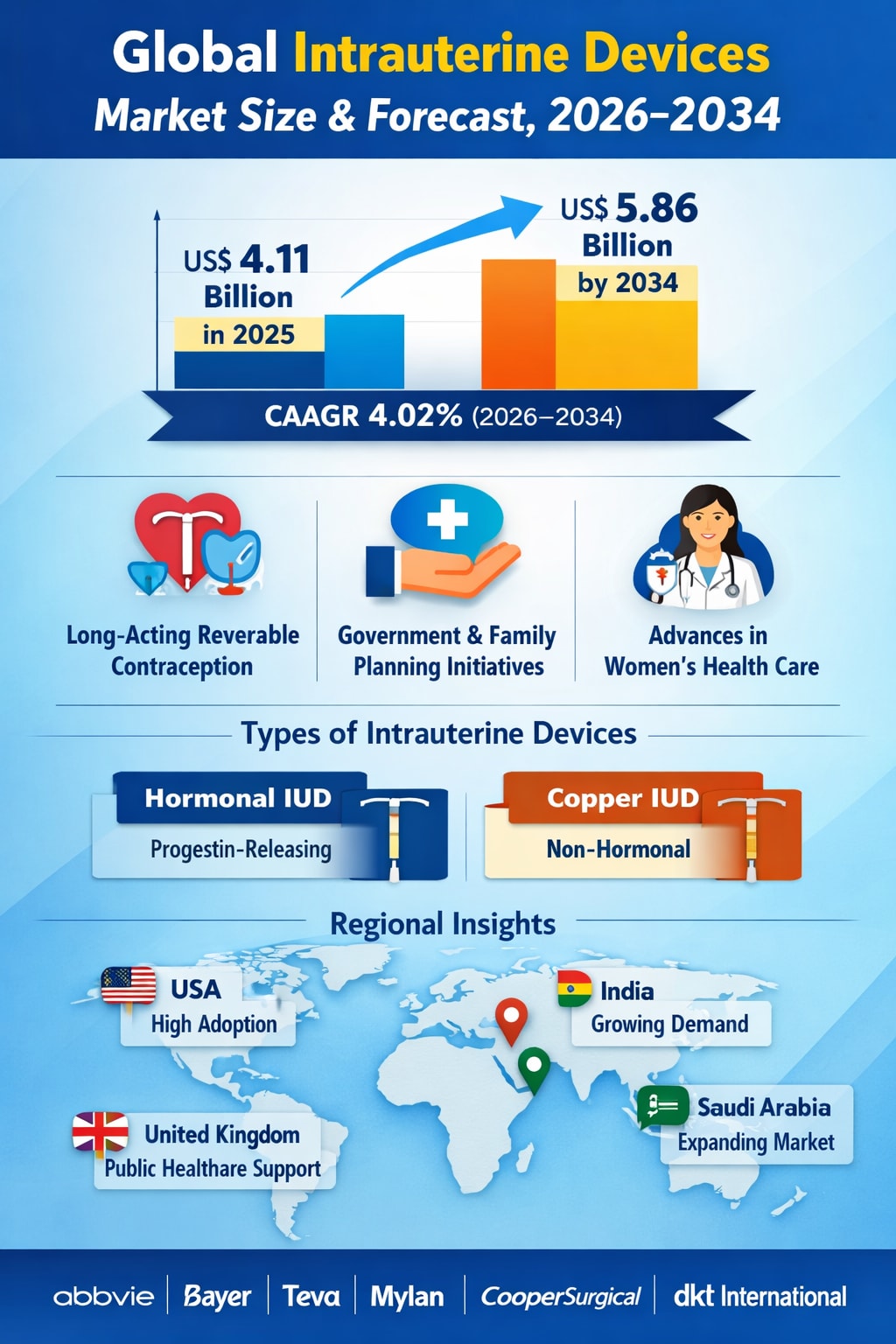
The global market for intrauterine devices (IUDs) is entering a phase of stable and sustained expansion, supported by rising awareness of long-acting reversible contraception (LARC), improvements in women’s healthcare access, and continued innovation in medical device design. According to Renub Research, the global intrauterine devices market is expected to grow from US$ 4.11 billion in 2025 to US$ 5.86 billion by 2034, registering a compound annual growth rate (CAGR) of 4.02% during the period 2026–2034.
This growth reflects a broader transformation in how contraception is viewed worldwide. Increasingly, women and healthcare providers are prioritizing methods that combine long-term effectiveness, convenience, safety, and cost efficiency. IUDs, often described as a “set-and-forget” contraceptive solution, fit perfectly into this evolving preference landscape.
Beyond contraception alone, the IUD market is also being shaped by wider conversations around women’s health, reproductive rights, and access to quality healthcare services. Governments, non-governmental organizations, and healthcare institutions are working together to promote family planning programs, expand reproductive health services, and improve education around safe contraceptive options. In this context, intrauterine devices are no longer seen merely as a medical product, but as an essential component of modern public health strategies.
Intrauterine Devices Market Overview
Intrauterine devices are small, T-shaped medical instruments inserted into the uterus to prevent pregnancy. They are categorized under long-acting reversible contraceptives because they provide protection for an extended period—typically ranging from three to ten years—while still allowing fertility to return quickly after removal.
There are two main types of IUDs: hormonal IUDs and copper IUDs. Hormonal IUDs release progestin, a hormone that thickens cervical mucus, thins the uterine lining, and in some cases suppresses ovulation, thereby preventing fertilization. Copper IUDs, on the other hand, rely on the natural spermicidal properties of copper, creating an environment that is hostile to sperm and preventing pregnancy without the use of hormones.
Globally, IUDs have gained popularity due to their high efficacy rates, long duration of action, and overall cost-effectiveness. Once inserted, they require minimal maintenance, making them especially attractive to women who prefer a reliable method without the need for daily or monthly attention. The combination of convenience, safety, and long-term value has made IUDs one of the most trusted contraceptive options in both developed and developing healthcare systems.
Key Growth Drivers in the Intrauterine Devices Market
Rising Adoption of Long-Acting Reversible Contraception
One of the most powerful forces driving the IUD market is the growing global preference for long-acting reversible contraceptives. Compared to short-acting methods such as oral pills or injectable contraceptives, IUDs offer superior reliability over several years with minimal user intervention. This “set-and-forget” benefit is especially appealing to women seeking consistent, worry-free protection.
Healthcare professionals increasingly recommend IUDs due to their strong safety profile and high effectiveness in preventing unintended pregnancies. The rapid return of fertility after removal further strengthens their appeal among women who wish to plan pregnancies more flexibly.
Regulatory approvals and product lifecycle extensions are also reinforcing this trend. For example, in August 2022, the U.S. FDA approved Bayer AG’s supplemental new drug application to extend the usage duration of the Mirena IUD to eight years. Such developments increase consumer confidence and enhance the long-term value proposition of IUDs.
Government Support and Family Planning Programs
Government-backed family planning initiatives play a critical role in expanding access to IUDs, particularly in developing economies. Many national health systems promote IUDs because they are cost-effective, long-lasting, and highly efficient in reducing unintended pregnancies and improving maternal health outcomes.
Subsidized distribution programs, public awareness campaigns, and the integration of IUD services into primary healthcare systems have significantly improved accessibility. International organizations and NGOs also contribute by training healthcare professionals, addressing misconceptions, and supporting community-level education initiatives.
A notable example of industry support came in June 2023, when Pregna International Limited received its first private equity funding of USD 16 million (₹130 crore) from India Life Sciences Fund III. This investment is expected to strengthen the company’s global footprint and enhance access to modern reproductive healthcare solutions.
Technological Advancements and Women’s Health Awareness
Innovation in IUD design has led to smaller, more flexible, and more comfortable devices, improving patient experience and reducing complications associated with insertion. Advances in hormone release mechanisms have also improved safety and efficacy profiles, making hormonal IUDs suitable for a wider range of users.
At the same time, rising awareness around women’s health and empowerment is encouraging more informed decision-making about contraception. Women today are more likely to seek methods that align with both their lifestyle and long-term health goals.
In January 2024, Medicines360 and DKT WomanCare partnered to expand access to AVIBELA, a highly effective hormonal IUD with an efficacy rate exceeding 99%. Such collaborations highlight how innovation and global distribution strategies are working together to broaden access to reliable contraception.
Market Challenges
Side Effects, Misconceptions, and Cultural Barriers
Despite their benefits, IUDs still face resistance in certain regions due to concerns about side effects such as pain, bleeding, or discomfort after insertion. In addition, persistent misconceptions—particularly around fertility and long-term health risks—continue to limit adoption in some cultures.
Cultural and social attitudes toward contraception, especially in conservative societies, can also influence acceptance. Overcoming these barriers requires sustained education, community engagement, and the involvement of trusted healthcare providers.
Limited Access to Skilled Healthcare Professionals
IUD insertion and removal must be performed by trained medical personnel, which creates access challenges in resource-limited settings. Shortages of skilled healthcare workers, uneven distribution of medical infrastructure, and limited training opportunities can restrict the availability of IUD services, even when the devices themselves are affordable.
Addressing this issue will require continued investment in healthcare training programs and the expansion of reproductive health services, particularly in rural and underserved areas.
Segment Analysis
Hormonal Intrauterine Devices Market
The hormonal IUD segment is experiencing strong growth due to increasing demand for convenient, long-acting, and multifunctional contraceptive solutions. In addition to preventing pregnancy, these devices are widely used to manage heavy menstrual bleeding, dysmenorrhea, and certain gynecological conditions.
Their dual therapeutic and contraceptive benefits make hormonal IUDs especially attractive to both patients and healthcare providers. High efficacy, ease of use, and reduced need for daily medication contribute to their expanding adoption worldwide.
Copper Intrauterine Devices Market
Copper IUDs continue to hold a significant share of the market, driven by demand for non-hormonal contraceptive options. With a lifespan that can extend up to ten years, copper IUDs are among the most cost-effective forms of contraception available.
They are also widely recognized for use in emergency contraception, further enhancing their clinical value. For women who prefer to avoid hormonal methods, copper IUDs offer a reliable and long-lasting alternative.
End-Use: Hospitals and Gynecology Clinics
Hospitals remain a key setting for IUD insertion and removal, particularly for first-time users, high-risk patients, and postpartum or post-abortion family planning services. The availability of diagnostic facilities and specialist care in hospitals builds patient confidence and supports higher adoption rates.
Gynecology clinics, especially in urban areas, are becoming increasingly important distribution channels. These clinics offer personalized care, preventive services, and follow-up consultations, making them a preferred choice for many women seeking both hormonal and copper IUDs.
Regional Market Insights
United States
The U.S. IUD market is supported by high awareness of LARC methods, strong healthcare infrastructure, and insurance coverage. Both hormonal and copper IUDs are widely prescribed, and continuous innovation keeps the market dynamic.
In May 2023, Sebela Pharmaceuticals announced positive Phase 3 trial results for its new Copper 175 mm² IUD, demonstrating high efficacy and excellent tolerability. Such developments reinforce the U.S. market’s position as a leader in IUD innovation and adoption.
United Kingdom
In the UK, the widespread availability of public healthcare services and government-backed sexual health programs has made IUDs a popular and trusted contraceptive option. Long-acting reversible contraceptives are actively promoted to reduce unintended pregnancies and improve public health outcomes.
In June 2025, ASPIVIX announced a partnership with AGHealth for the UK launch of Carevix®, a non-traumatic cervical stabilizer, marking another step forward in women’s health innovation.
India
India’s IUD market is growing steadily, driven by government family planning initiatives and increased awareness of reproductive health. Copper IUDs are widely distributed through public healthcare systems, often at low or no cost, while hormonal IUDs are gaining popularity in urban and private healthcare settings.
In November 2022, India Medtronic Private Limited launched the TruClear system for managing intrauterine abnormalities, highlighting the country’s progress in gynecological care infrastructure.
Saudi Arabia
Saudi Arabia’s IUD market is benefiting from improvements in healthcare infrastructure, rising awareness of women’s health, and increased investment in private healthcare facilities. Although cultural factors still influence contraceptive choices, growing education and access to modern medical services are supporting steady market growth.
Market Segmentation
By Type:
Hormonal IUD
Copper IUD
By End Use:
Hospitals
Gynecology Clinics
Community Healthcare Centers
Others
By Region:
North America (United States, Canada)
Europe (France, Germany, Italy, Spain, United Kingdom, Belgium, Netherlands, Turkey)
Asia Pacific (China, Japan, India, South Korea, Thailand, Malaysia, Indonesia, Australia, New Zealand)
Latin America (Brazil, Mexico, Argentina)
Middle East & Africa (Saudi Arabia, UAE, South Africa)
Competitive Landscape
Key players operating in the global intrauterine devices market include AbbVie Inc., Bayer AG, Teva Pharmaceuticals, ANI Pharmaceuticals, Mylan NV, CooperSurgical Inc., DKT International, and Melbea AG.
These companies are analyzed across multiple dimensions, including company overview, key personnel, recent developments, SWOT analysis, revenue performance, and overall market strategy. Continuous investment in research and development, product innovation, and global distribution networks remains central to maintaining competitive advantage.
Final Thoughts
The global intrauterine devices market is set to follow a steady and sustainable growth path through 2034, supported by favorable demographics, supportive public health policies, and ongoing innovation in women’s healthcare. With the market projected to rise from US$ 4.11 billion in 2025 to US$ 5.86 billion by 2034 at a CAGR of 4.02%, IUDs will continue to play a critical role in modern contraception and reproductive health strategies worldwide.
As awareness increases, access improves, and technology advances, intrauterine devices are likely to become an even more integral part of global family planning and women’s health initiatives—cementing their position as one of the most reliable, cost-effective, and empowering contraceptive solutions of the modern era.
About the Creator
CrowdStrike Stock Analysis: Is CrowdStrike Leading the Cybersecurity Market?
Introduction CrowdStrike stock has become one of the most recognized names in cybersecurity. CrowdStrike specializes in cloud-native endpoint protection, threat intelligence, and security solutions for enterprises. As cyber threats continue to increase in frequency and sophistication, organizations globally are investing heavily in cybersecurity. This trend has positioned CrowdStrike as a key player in the industry and a stock of interest for investors seeking exposure to digital security growth.
By Hammad Nawaz7 days ago in Trader
Kombucha Market Size, Share & Forecast 2025–2033 | Renub Research
Introduction: A Fermented Drink Goes Mainstream Once a niche health-store staple, kombucha has rapidly evolved into one of the most talked-about functional beverages in the global drinks industry. With its fizzy taste, fermented profile, and reputation for supporting gut health, kombucha has found fans among wellness enthusiasts, fitness-conscious consumers, and younger demographics looking for healthier alternatives to sugary sodas and artificial energy drinks.
By Sakshi Sharma6 days ago in Trader




Comments
There are no comments for this story
Be the first to respond and start the conversation.