
Global Neurology Devices Market Size and Forecast 2025–2033
How Technology, Aging Populations, and Rising Neurological Disorders Are Reshaping Brain Care Worldwide

Introduction
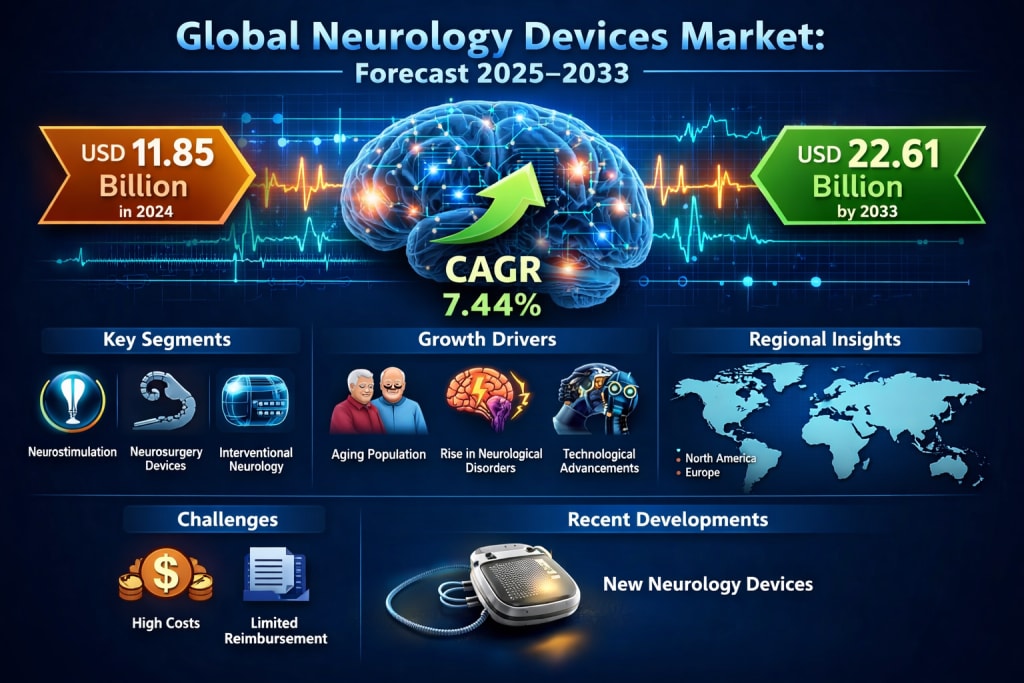
The global neurology devices market is entering a decisive decade, driven by a powerful mix of demographic shifts, technological breakthroughs, and the rising burden of neurological disorders worldwide. According to industry estimates, the Global Neurology Devices Market is expected to reach US$ 22.61 billion by 2033, up from US$ 11.85 billion in 2024, growing at a compound annual growth rate (CAGR) of 7.44% from 2025 to 2033.
This growth is not happening in isolation. It reflects a broader transformation in healthcare, where brain health is becoming a top priority for governments, clinicians, and patients alike. Conditions such as Alzheimer’s disease, Parkinson’s disease, epilepsy, stroke, dementia, and other neurological disorders are no longer viewed as niche or unavoidable consequences of aging. Instead, they are now recognized as major public health challenges that demand early diagnosis, precise intervention, and long-term management.
Neurology devices—ranging from neurostimulation systems and neurosurgical tools to interventional neurology equipment and cerebrospinal fluid (CSF) management devices—are playing a central role in this transformation. With innovations such as minimally invasive surgery, wearable neuro-monitoring, brain-computer interfaces, and AI-assisted imaging, the field is moving rapidly toward safer procedures, better outcomes, and shorter recovery times.
Global Neurology Devices Market Overview
The worldwide neurology devices market is experiencing robust growth due to the increasing incidence of neurological diseases and the expanding elderly population. Disorders such as Alzheimer’s disease, Parkinson’s disease, epilepsy, multiple sclerosis, and stroke are becoming more common as life expectancy rises and lifestyle-related risk factors increase.
Neurology devices cover a wide spectrum of technologies, including neurostimulation devices, neurosurgery instruments, interventional neurology systems, CSF management devices, and other supportive tools used for diagnosis, treatment, and long-term management. These devices are essential not only for complex surgical procedures but also for chronic disease management, rehabilitation, and continuous monitoring.
Technological advancements are a major force behind this expansion. The integration of digital health platforms, remote monitoring, minimally invasive surgical techniques, and smart implantable devices is significantly improving treatment precision and patient comfort. Innovations such as closed-loop neurostimulation systems, robotic-assisted neurosurgery, and AI-powered imaging tools are redefining how neurological care is delivered.
From a regional perspective, North America currently dominates the market due to its advanced healthcare infrastructure, strong research and development ecosystem, and early adoption of cutting-edge medical technologies. However, the Asia-Pacific region is emerging as a high-growth market, supported by expanding healthcare access, rising awareness of neurological diseases, and increasing government investment in healthcare modernization.
Despite these positive trends, the market still faces challenges. High device costs, limited reimbursement policies in many countries, and strict regulatory requirements can slow adoption, particularly in developing regions. Even so, with continuous innovation and growing clinical demand, the global neurology devices market is expected to maintain strong momentum throughout the forecast period.
The Rising Burden of Neurological Disorders
One of the most important drivers of the neurology devices market is the sheer scale of neurological disease worldwide. According to data released by the United Nations in February 2021, around 1 billion people—nearly one in six globally—were affected by neurological disorders in 2020. These include conditions such as Alzheimer’s disease, Parkinson’s disease, stroke, epilepsy, migraine, multiple sclerosis, brain injuries, and neuro-infections.
Further data highlights the magnitude of the problem: in 2019, approximately 24 million people were living with Alzheimer’s disease and other dementias, 50 million had epilepsy, 326 million suffered from migraines, and 62 million had cerebrovascular diseases. These numbers continue to rise, driven by aging populations, urban lifestyles, and improved diagnostic capabilities.
As the prevalence of neurological disorders increases, so does the demand for devices that can improve diagnosis, support treatment, restore function, and enhance quality of life. From devices that help manage chronic pain and movement disorders to tools that enable precise brain surgery, neurology devices are becoming indispensable in modern healthcare systems.
Key Growth Drivers
1. Launch of Better Devices Through Technological Advancements
Leading medical device companies are heavily focused on innovation, introducing products that combine advanced engineering with digital health capabilities. Many of today’s neurology devices are designed not only to treat patients but also to enable remote monitoring, data tracking, and personalized therapy adjustments.
A notable example is Abbott’s update to its NeuroSphere myPath digital health app, launched in April 2022. The enhanced platform allows physicians to closely monitor patient-reported outcomes for those using spinal cord stimulation (SCS) or dorsal root ganglion (DRG) therapy devices. Such solutions reflect a broader trend toward connected care, where patients, doctors, and healthcare teams collaborate through digital tools to optimize treatment results.
2. Growing Elderly Population
The global population is aging at an unprecedented rate, and this demographic shift is a major tailwind for the neurology devices market. Older adults are significantly more vulnerable to neurological disorders such as Alzheimer’s disease, Parkinson’s disease, stroke, and dementia.
According to projections by the World Health Organization (WHO), by 2050, around 426 million people worldwide will be aged 80 or older. This age group typically requires more frequent and complex medical care, particularly for neurological conditions that affect mobility, cognition, and independence. As a result, demand for neurology devices—from diagnostic imaging tools to implantable neurostimulation systems—is expected to rise steadily.
3. Increasing Prevalence of Neurological Disorders
Beyond aging, other factors such as diabetes, infections, genetic conditions, malnutrition, and traumatic injuries are contributing to the growing burden of neurological disease. The WHO estimated that 206 million people worldwide were affected by diabetic neuropathy in 2021 alone.
Neurological disorders often lead to symptoms such as loss of sensation, muscle weakness, poor coordination, and cognitive decline. These conditions significantly reduce quality of life and productivity, increasing the need for reliable diagnostic and therapeutic devices. Advanced neurology tools enable clinicians to visualize brain structure and activity more accurately, supporting earlier diagnosis and more effective treatment planning.
Challenges Facing the Market
High Cost of Devices and Procedures
One of the most significant barriers to market growth is the high cost of neurology devices and related procedures. Technologies such as neurostimulation systems, advanced brain imaging equipment, and robotic surgical tools require substantial investment—not only for purchase but also for maintenance and staff training.
In many developing countries, healthcare budgets are limited, and specialized infrastructure or skilled professionals may be scarce. This makes it difficult for hospitals to adopt advanced neurology technologies, and for patients to access them. Inadequate insurance coverage further worsens the situation, often forcing patients to pay out of pocket or forgo treatment altogether.
Limited Reimbursement Policies
Restrictive reimbursement policies also pose a serious challenge. Many advanced neurology treatments and devices, including deep brain stimulators and long-term neuro-monitoring systems, are expensive and not fully covered by public or private insurance schemes.
When hospitals are uncertain about reimbursement, they may delay or avoid investing in new technologies. For patients, limited coverage can mean postponed treatment, reduced access to innovative therapies, or significant financial strain. Without improvements in reimbursement frameworks, the adoption of life-changing neurological technologies could remain slower than its potential.
Country-Level Market Insights
United States Neurology Devices Market
The United States remains one of the largest and most dynamic markets for neurology devices. Growth is fueled by the rising incidence of neurological conditions such as Alzheimer’s disease, Parkinson’s disease, epilepsy, and stroke, along with strong technological innovation.
Advanced solutions like deep brain stimulators, brain-computer interfaces, and next-generation neurostimulation systems are increasingly used to improve diagnostic accuracy and treatment outcomes. The aging population further boosts demand, while the shift toward minimally invasive procedures and AI integration is reshaping clinical practice.
However, challenges persist, including high device costs, regulatory hurdles, and complex reimbursement policies. Despite these issues, the U.S. continues to lead the global market due to its robust healthcare infrastructure, heavy investment in R&D, and strong presence of major medical device companies.
In 2024, the aneurysm coiling and arteriovenous malformation subsegment held a significant market share, driven by the growing preference for minimally invasive treatments. According to the Brain Aneurysm Foundation, around 6.8 million Americans—approximately 1 in 50—have a brain aneurysm, with an annual rupture rate of 8–10 per 100,000 people. Globally, brain aneurysms cause about 500,000 deaths each year, with half of the victims under the age of 50, underscoring the critical need for advanced interventional neurology devices.
United Kingdom Neurology Devices Market
In the UK, the neurology devices market is supported by an aging population and rising cases of epilepsy, Parkinson’s disease, and Alzheimer’s disease. Technological progress in robotic-assisted neurosurgery, neurostimulation, and neuroimaging is enhancing diagnostic and treatment capabilities.
There is also a growing emphasis on patient-centric care, reflected in the increasing demand for wearable devices and minimally invasive procedures. Government investment in healthcare research and infrastructure continues to support innovation, although high device costs and regulatory complexities remain obstacles to faster adoption.
India Neurology Devices Market
India’s neurology devices market is expanding due to the rising prevalence of stroke, epilepsy, Parkinson’s disease, and other neurological conditions, along with a growing elderly population. Advances in neuroimaging, neurostimulation, and robotic-assisted surgery are improving care quality in major urban centers.
Nevertheless, challenges such as high device prices, limited reimbursement, and shortages of trained specialists continue to restrict access, particularly in rural and remote areas. Government initiatives to strengthen healthcare infrastructure and encourage domestic manufacturing are expected to gradually improve accessibility and support long-term market growth.
Saudi Arabia Neurology Devices Market
Saudi Arabia is witnessing steady growth in its neurology devices market, driven by increasing rates of neurological disorders and an aging population. Investments in healthcare infrastructure and modernization are boosting the adoption of neurostimulation, neuroimaging, and advanced neurosurgical technologies.
While high costs and workforce limitations remain concerns, ongoing government reforms and strategic partnerships are expected to enhance access to advanced neurological care and support sustained market expansion.
Recent Industry Developments
In April 2024, Medtronic received FDA approval for its Inceptiv closed-loop spinal cord stimulator, designed to treat chronic pain. This innovative device can detect biological signals and automatically adjust stimulation in real time, aligning therapy with patients’ daily activities. Notably, Inceptiv is the smallest fully implanted spinal cord stimulator available and the first to offer full-body MRI access, highlighting the rapid pace of innovation in the neurology devices sector.
Market Segmentation
By Product:
Neurostimulation
Neurosurgery Devices
Interventional Neurology
CSF Management Devices
Others
By End Use:
Hospitals
Ambulatory Surgery Centers
Others
By Region:
North America (United States, Canada)
Europe (France, Germany, Italy, Spain, United Kingdom, Belgium, Netherlands, Turkey)
Asia Pacific (China, Japan, India, Australia, South Korea, Thailand, Malaysia, Indonesia, New Zealand)
Latin America (Brazil, Mexico, Argentina)
Middle East & Africa (South Africa, Saudi Arabia, United Arab Emirates)
Competitive Landscape
Key players in the global neurology devices market include:
Medtronic Plc.
B. Braun Melsungen AG
Boston Scientific Corporation
Stryker Corporation
Abbott Laboratories
Johnson and Johnson
Smith & Nephew
MicroPort Scientific Corporation
These companies are evaluated across four main dimensions: company overview, key leadership, recent developments and strategies, and revenue analysis, reflecting a highly competitive and innovation-driven market environment.
Final Thoughts
The global neurology devices market is on a strong growth trajectory, supported by rising neurological disease prevalence, rapid technological innovation, and increasing healthcare investment worldwide. With the market projected to grow from US$ 11.85 billion in 2024 to US$ 22.61 billion by 2033, the coming years will likely see significant advances in how neurological conditions are diagnosed, treated, and managed.
While challenges such as high costs and reimbursement limitations remain, continued innovation, supportive government policies, and expanding healthcare access—especially in emerging markets—are expected to unlock new opportunities. As brain health gains greater global attention, neurology devices will remain at the forefront of modern medicine, shaping a future where neurological care is more precise, accessible, and effective than ever before.
About the Creator
Tom Shane
Tom Shane is a content writer specializing in SEO-driven blogs, product descriptions, and thought leadership. He crafts engaging, research-backed content that connects with audiences and drives results.
DC Tax Filing 2026: Step-by-Step Guide to Maximize Your Refund/
DC Tax Filing 2026 is an important task for every Washington, DC resident. Filing taxes correctly not only ensures you avoid penalties but also helps you get the maximum refund possible. Many people miss simple opportunities to increase their refund because they don’t plan or track their expenses properly. They will walk you through a step-by-step approach to DC Tax Filing 2026 that is easy to follow and practical. From organizing documents to claiming deductions and credits, these steps will help you file accurately and confidently.
By John.doe7985 days ago in Trader
Junk Silver in 2026: Is It Still a Good Investment?
Junk silver refers to US currency coins in circulation prior to 1965. They are often considered a great way to get into silver investments. The reason for this is that junk silver coins have a 90% silver composition, which allows them to track the spot price of silver.
By Sound Money6 days ago in Trader




Comments
There are no comments for this story
Be the first to respond and start the conversation.