
Global Podcasting Market Size and Forecast 2025–2033: How On-Demand Audio Is Rewriting the Media Playbook
From niche hobby to a US$ 204.75 billion industry, podcasting is becoming one of the most powerful storytelling, marketing, and media formats of the digital age.

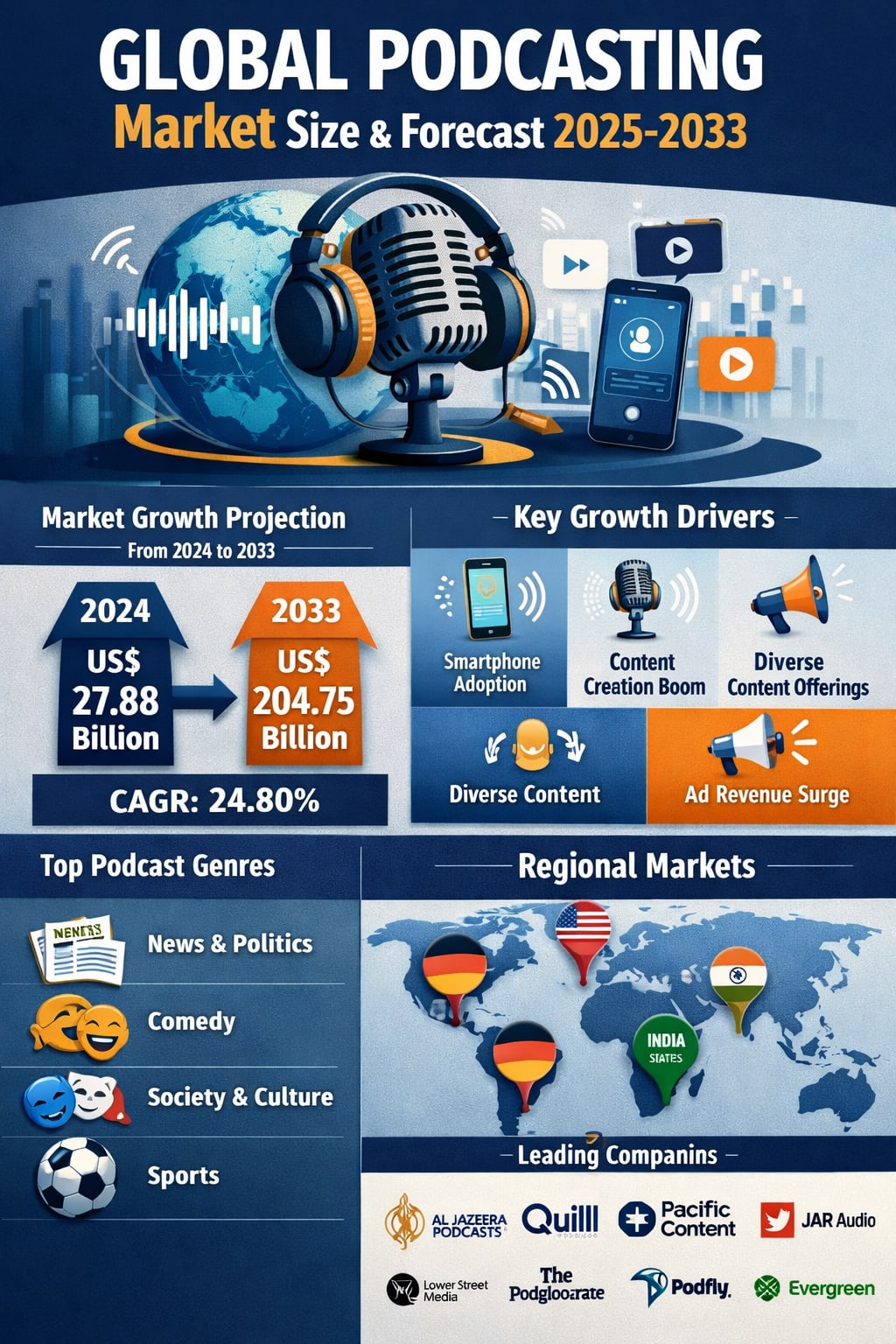
Global Podcasting Market: A New Era of Audio Storytelling
The global media landscape is undergoing a profound transformation, and few formats illustrate this shift better than podcasting. Once considered a niche medium for hobbyists and early adopters, podcasts have evolved into a mainstream content powerhouse that reaches hundreds of millions of listeners worldwide. Today, podcasting stands at the intersection of technology, storytelling, advertising, and creator-driven media—reshaping how people consume information and entertainment.
According to industry estimates, the Podcasting Market is expected to reach US$ 204.75 billion by 2033, rising from US$ 27.88 billion in 2024, expanding at an impressive CAGR of 24.80% from 2025 to 2033. This explosive growth reflects not only changing consumer habits but also the increasing confidence of advertisers, platforms, and investors in audio-first and audio-plus (video podcast) content strategies.
Several forces are driving this surge: the widespread availability of streaming platforms, the global adoption of smartphones, the democratization of content creation tools, the convenience of on-demand audio, and rapidly expanding advertising opportunities. Together, these trends are turning podcasting into one of the most influential media formats of the digital era.
Podcasting Market Overview
Podcasting is a form of digital media in which audio (and increasingly video) episodes are created, distributed, and consumed online, typically in a series format. These episodes can cover virtually any topic—news, politics, business, education, entertainment, sports, culture, storytelling, and countless niche interests.
Platforms such as Spotify, Apple Podcasts, YouTube, and Google Podcasts have made it easy for users to stream or download episodes anytime, anywhere. Unlike traditional radio, podcasts are not bound by schedules or geographic limitations. Listeners can tune in while commuting, exercising, working, or relaxing, making podcasting one of the most flexible media formats available today.
For creators, podcasting offers an equally powerful advantage: low barriers to entry and high creative freedom. With basic recording equipment and accessible distribution platforms, individuals, startups, media houses, and even large corporations can launch their own shows. This combination of accessibility, creative control, and global reach has turned podcasting into a key channel for communication, marketing, education, and brand building.
Key Growth Drivers Shaping the Podcasting Market
1. Democratization of Content Creation
One of the most important forces behind the global podcasting boom is the democratization of content production and distribution. Traditional media—television, radio, and print—often require significant capital, infrastructure, and industry connections. Podcasting, in contrast, has dramatically lowered the barrier to entry.
Today, almost anyone with a microphone, a smartphone, or a laptop can become a content creator. This has led to an explosion of diverse voices, perspectives, and storytelling styles. Independent creators, educators, journalists, entrepreneurs, and community leaders are using podcasts to share their ideas directly with global audiences.
This democratization has also amplified underrepresented and marginalized voices, enriching the podcasting ecosystem with stories and viewpoints that were previously difficult to find in mainstream media. As a result, podcasting is not just growing in size—it is growing in cultural and social relevance.
2. The Rapid Proliferation of Smartphones
The widespread adoption of smartphones has been another critical catalyst for podcasting’s growth. Over the past decade, smartphones have become an essential part of daily life across both developed and emerging economies. These devices provide a portable, always-connected gateway to audio content.
Unlike traditional radio, which is limited by schedules and frequencies, smartphones allow users to carry an entire library of podcasts in their pockets. With just a few taps, listeners can discover new shows, subscribe to their favorites, and download episodes for offline listening.
This level of convenience has significantly broadened the podcast audience, making the format accessible to people of all ages and backgrounds. As mobile internet penetration continues to rise, especially in regions like Asia-Pacific, Latin America, and the Middle East, the global podcasting audience is expected to expand even further.
3. Expanding Offerings Across Multiple Genres
Another powerful driver of market growth is the sheer diversity of podcast content. Unlike traditional media formats that often follow rigid programming structures, podcasting thrives on flexibility and experimentation.
Today’s podcast ecosystem includes everything from news and politics to comedy, society and culture, sports, business, education, true crime, and highly specialized niche topics. This diversity ensures that there is a podcast for almost every interest, hobby, or professional need.
Moreover, modern podcast platforms make content discovery easier through recommendations, curated playlists, and topic-based tags. This encourages listeners to explore new genres and creators, further increasing engagement and time spent on audio platforms.
Challenges in the Podcasting Market
1. Listener Retention in a Crowded Market
While the number of podcasts continues to grow, listener retention has become a major challenge. With millions of shows available across platforms, competition for attention is fierce. Many listeners sample new podcasts but fail to return due to inconsistent publishing schedules, declining content quality, or a lack of compelling storytelling.
Shorter attention spans and the availability of alternative content formats—such as short-form video, audiobooks, and streaming video—also contribute to audience churn. To succeed in this environment, podcasters must focus on consistent publishing, high production quality, strong narrative structures, and active community engagement through feedback, social media, and interactive formats.
2. Intellectual Property and Licensing Issues
As podcasting becomes more commercialized, intellectual property (IP) and licensing concerns are gaining importance. Many creators unintentionally use copyrighted music, audio clips, or third-party content without proper permissions, exposing themselves to legal risks.
The lack of clear, standardized licensing frameworks can make it difficult for creators to navigate what is legally permissible. This uncertainty can increase production costs and discourage creative experimentation. Going forward, better education around copyright rules and more accessible licensing solutions will be essential for the long-term sustainability of the industry.
Regional Market Insights
United States Podcasting Market
The United States remains the largest and most mature podcasting market in the world, driven by high listener engagement, strong advertising demand, and continuous technological innovation. Platforms are increasingly investing in AI-driven discovery tools, personalization, and video podcasting.
In August 2024, Amazon Music introduced Maestro, an AI-powered playlist generator, along with a new AI tool that adds topic tags to podcast episodes. These features improve content discoverability and user experience by helping listeners find relevant shows more easily. At the same time, platforms like YouTube and Spotify are accelerating their push into video podcasting, blending audio storytelling with visual engagement. This multimedia approach is further strengthening the market’s growth trajectory.
Germany Podcasting Market
Germany has emerged as a major hub for high-quality audio content in Europe. The country’s podcasting ecosystem is particularly strong in journalism-based, educational, and professionally produced content. Both independent creators and established media organizations are активно producing podcasts across technology, politics, entertainment, and true crime genres.
The growing adoption of smartphones and smart speakers has improved accessibility, making podcasts a regular part of daily media consumption for many Germans. With continued investment in production quality and platform infrastructure, Germany is set to remain a key player in the European podcasting landscape.
India Podcasting Market
India represents one of the fastest-growing podcast markets globally, fueled by massive smartphone adoption, affordable mobile data, and a rising appetite for on-demand audio content. A major trend in India is the rapid growth of regional language podcasts, which are expanding the medium’s reach beyond English-speaking urban audiences.
In December 2024, Tata Steel launched FiredUp, a corporate podcast featuring industry leaders and innovators, highlighting how companies are increasingly using podcasts for thought leadership and internal communication. Such initiatives are helping position podcasting as a powerful tool not only for entertainment but also for education, business, and professional development in India.
Saudi Arabia Podcasting Market
Saudi Arabia’s podcasting market is growing quickly, supported by a young, tech-savvy population and rising digital engagement. Increased smartphone usage and better internet access are driving demand for on-demand audio content across education, culture, business, and technology topics.
Riyadh is emerging as a key center for podcast production and distribution, supported by a growing number of hosting platforms and content studios. This expansion is creating new opportunities for advertisers and creators to connect with the Kingdom’s increasingly engaged digital audience.
Recent Developments in the Podcasting Industry
The podcasting ecosystem continues to evolve rapidly, driven by platform innovation and strategic partnerships:
December 2023: Anchor by Spotify collaborated with Riverside, coinciding with Spotify’s rollout of video podcasting in English-speaking markets. This integration allows creators to access Riverside’s user base and produce higher-quality video podcasts.
December 2023: Riverside, Inc. launched an iOS app, enabling users to record professional-grade content directly from their smartphones.
November 2023: Proximic by Comscore partnered with Acast to enable cookie-free audience targeting for podcast advertisers worldwide.
September 2023: Spotify introduced AI-powered voice translation, allowing podcast episodes to be translated into multiple languages while preserving the original podcaster’s voice.
These developments highlight how technology—especially AI and video integration—is reshaping the future of podcasting.
Podcasting Market Segmentation
By Genre:
News & Politics
Comedy
Society & Culture
Sports
Others
By Format:
Interviews
Conversational
Solo
Panels
Repurposed
By Region and Country:
North America: United States, Canada
Europe: France, Germany, Italy, Spain, United Kingdom, Belgium, Netherlands, Turkey
Asia Pacific: China, Japan, India, Australia, South Korea, Thailand, Malaysia, Indonesia, New Zealand
Latin America: Brazil, Mexico, Argentina
Middle East & Africa: South Africa, United Arab Emirates, Saudi Arabia
Competitive Landscape and Key Players
The global podcasting market features a mix of production studios, content networks, and service providers. Companies are typically analyzed across five key dimensions: Company Overview, Key Persons, Recent Developments & Strategies, SWOT Analysis, and Sales Analysis.
Key Players Include:
Al Jazeera Podcasts
Quill Inc.
Pacific Content
JAR Audio
Lower Street Media Ltd.
The Podglomerate
Podfly Productions LLC
Content Allies
Q'd Up
Evergreen Podcasts
These players are focusing on content quality, branded podcasts, distribution partnerships, and monetization strategies to strengthen their market positions.
Final Thoughts: The Future Sounds Powerful
The global podcasting market is no longer just an extension of digital media—it is becoming a central pillar of the modern content economy. With the market projected to grow from US$ 27.88 billion in 2024 to US$ 204.75 billion by 2033, the scale of opportunity is enormous.
Driven by smartphone adoption, creator democratization, diverse content genres, and expanding advertising models, podcasting is reshaping how stories are told and how audiences connect with ideas. While challenges such as listener retention and licensing remain, ongoing innovation in AI, video podcasting, and discovery tools is helping the industry evolve.
About the Creator
Cardano (ADA) Price Stability, Development Vision, and Investment Outlook
Introduction Cardano is often positioned as one of the most academically grounded blockchain projects in the cryptocurrency space. While many networks focus on rapid innovation and aggressive marketing, Cardano follows a slower but more structured development path. From an investment perspective, ADA appeals to investors who prioritize long-term fundamentals, energy efficiency, and governance-driven growth. Understanding Cardano’s market structure, price behavior, and ecosystem progress is essential for evaluating its role in a diversified crypto portfolio.
By Hammad Nawaz2 days ago in Trader
Where there's Art there's Heart
Here's a stupid thing: I adore art, but I start to panic whenever I step into a gallery. In the one place I should be at my contented best - surrounded by walls teeming with creative expression - I fall apart. What ought to be an enriching experience, tacitly designed to facilitate the exploration of human empathy and perspective, is for me an overwhelming purgatory of anxiety that compresses me to the point I cannot breathe. At the same time, I experience a sense of extraction, as though my head is being prized open to create a hole so big my sanity could evaporate. Somewhere between these two opposing forces of vice and vortex, I feel myself dissolving in a stream of panic that makes me want to cry; and I feel so daft feeling this way, that all I want to do is run for the hills.
By Caroline Jane6 days ago in Humans




Comments
There are no comments for this story
Be the first to respond and start the conversation.