
Global Robotic Vacuum Cleaner Market Size and Forecast 2025–2033
Smart Homes, Smarter Cleaning: How AI, Automation, and Busy Lifestyles Are Powering the Next Cleaning Revolution

A Market on the Move: The Rise of Intelligent Cleaning
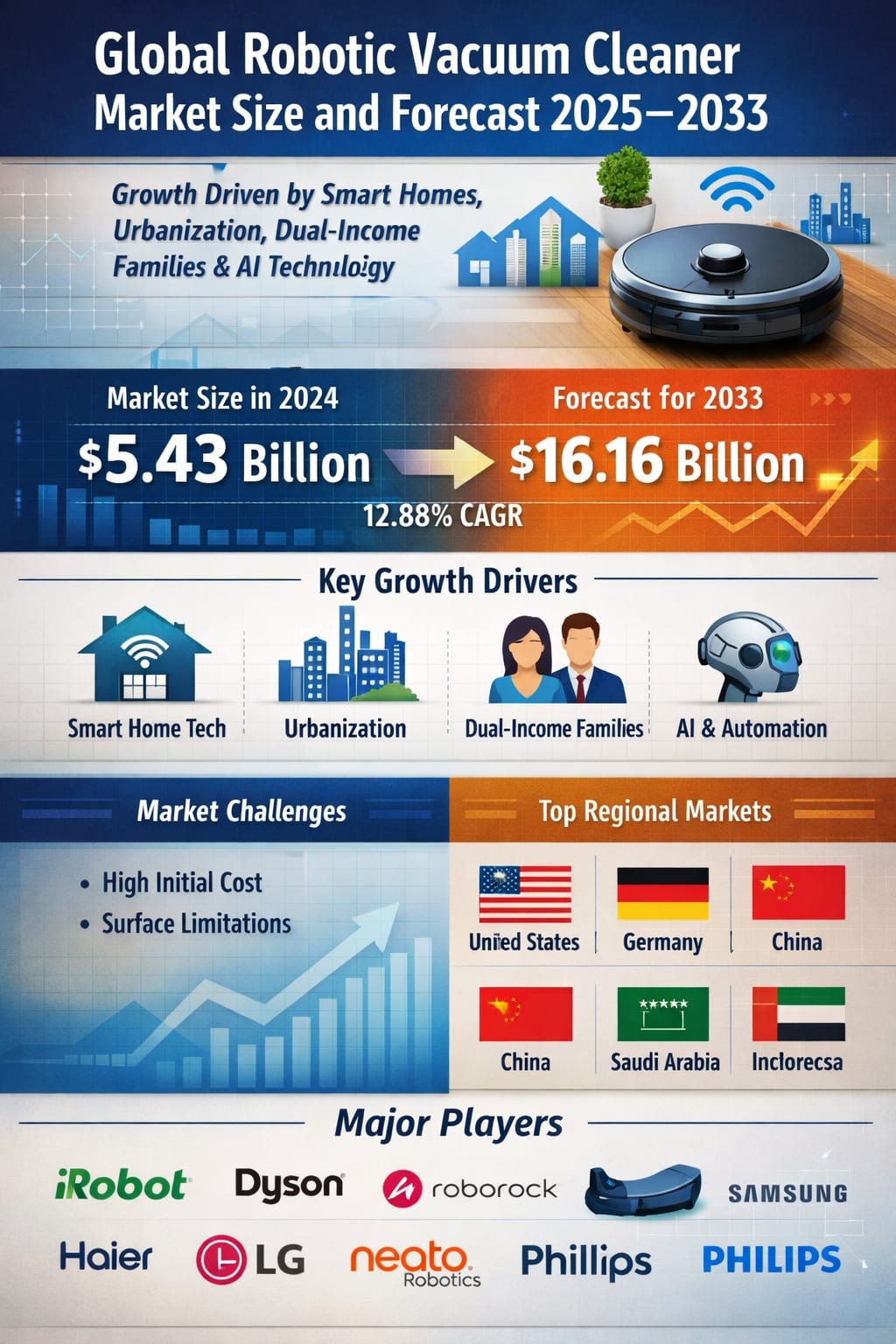
The global home appliances industry is undergoing a quiet but powerful transformation, and robotic vacuum cleaners are right at the center of it. Once considered a luxury gadget for tech enthusiasts, these autonomous cleaning devices are rapidly becoming everyday household essentials. According to Renub Research, the Global Robotic Vacuum Cleaner Market stood at USD 5.43 billion in 2024 and is projected to reach USD 16.16 billion by 2033, expanding at a compound annual growth rate (CAGR) of 12.88% over the forecast period.
This impressive growth is being fueled by a perfect storm of trends: the rise of smart homes, accelerating urbanization, the global increase in dual-income households, and rapid advancements in artificial intelligence, automation, and voice-assistant technologies. In an era where time is increasingly scarce and convenience is king, robotic vacuum cleaners are no longer a novelty—they are becoming a necessity.
What Is a Robotic Vacuum Cleaner?
A robotic vacuum cleaner is a battery-powered, autonomous cleaning device designed to clean floors with minimal or no human intervention. Equipped with sensors, rotating brushes, and motorized suction systems, these machines navigate through homes to remove dust, dirt, and debris from hardwood, tile, laminate, and carpeted surfaces.
More advanced models now incorporate AI-driven navigation, LiDAR mapping, and smart room recognition, allowing them to plan efficient cleaning routes and even clean specific rooms on command. Many are compatible with smart home ecosystems, enabling users to control them via smartphone apps or voice assistants such as Amazon Alexa or Google Assistant.
Some of today’s premium robotic vacuums go even further, offering mopping functions, automatic dustbin emptying, smart charging, and self-maintenance features. These innovations have turned robotic vacuum cleaners from high-end tech toys into practical, time-saving household tools with mass-market appeal.
Key Growth Drivers in the Robotic Vacuum Cleaner Market
1. Smart Home Technology Integration
One of the strongest forces behind market expansion is the global adoption of smart home technology. Consumers increasingly want devices that can communicate with each other, be controlled remotely, and adapt to their lifestyles. Robotic vacuum cleaners fit perfectly into this ecosystem.
Features such as smart mapping, scheduling, real-time monitoring, and voice control significantly enhance user convenience. For many households, especially in urban areas, the ability to start a cleaning cycle with a simple voice command or mobile app tap has become a major selling point.
As smart home penetration continues to rise worldwide, the demand for compatible robotic cleaners is expected to grow in parallel. These devices are no longer just cleaning tools—they are becoming integral parts of connected living spaces.
2. Growing Urbanization and Dual-Income Families
Urbanization is reshaping how people live, work, and manage their homes. Smaller living spaces, longer working hours, and the rise of dual-income households have created a strong demand for time-saving, automated solutions.
Robotic vacuum cleaners offer exactly that: hands-free cleaning that runs in the background while people focus on work, family, or leisure. In fast-growing economies, where a rising middle class is embracing modern lifestyles, these devices are increasingly seen as practical investments rather than luxury purchases.
3. Technological Innovations and Product Development
Continuous innovation is another major growth engine for the robotic vacuum cleaner market. Manufacturers are investing heavily in AI, sensor technology, battery efficiency, and navigation systems to improve performance and reliability.
Technologies such as LiDAR-based mapping, advanced obstacle avoidance, auto dirt disposal, and hybrid vacuum-mop systems are now becoming common in mid-range and premium models. These features not only improve cleaning efficiency but also boost consumer confidence in the technology.
Ongoing research and development are making robotic vacuum cleaners smarter, more powerful, and more affordable—broadening their appeal across different income groups and regions.
Challenges Facing the Market
1. High Initial Cost and Maintenance
Despite their many benefits, price remains a barrier, especially in emerging markets. Advanced models equipped with AI, smart mapping, and self-emptying features can still be expensive for price-sensitive consumers.
In addition to the upfront cost, ongoing expenses such as filter replacements, brush maintenance, and occasional software updates can discourage long-term adoption. While prices are gradually coming down, cost sensitivity continues to limit market penetration in some regions.
2. Performance Limitations on Uneven Surfaces
Although technology has improved significantly, robotic vacuum cleaners can still struggle with high-pile carpets, uneven surfaces, cables, and complex obstacles. Stairs and multi-level homes also present challenges for many models.
These limitations can affect customer satisfaction, particularly in households with diverse flooring types. Compared to traditional vacuum cleaners, robotic models may also have smaller dust capacities and lower peak suction, which can influence repeat purchases and brand loyalty.
Key Market Segments Shaping the Industry
Robotic Floor Vacuum Cleaner Market
The robotic floor vacuum cleaner segment is witnessing strong growth as consumers seek hands-free cleaning solutions for daily use. Manufacturers are now offering floor-specific models with optimized suction power and brush configurations for hard floors, tiles, and laminate surfaces.
Advanced floor-detection technologies allow these devices to automatically adjust cleaning intensity based on surface type, improving both efficiency and battery life. The growing availability of mid-range models is also expanding adoption in both residential and light commercial settings.
Automatic Robotic Vacuum Cleaner Market
Fully automatic robotic vacuum cleaners—featuring self-navigation, auto-charging, and intelligent sensors—are gaining rapid traction. These devices use AI and machine learning to optimize cleaning routes, avoid obstacles, and improve performance over time.
As automation becomes a defining feature of modern living, these products represent the perfect blend of convenience, efficiency, and smart technology, making them increasingly popular in both developed and emerging markets.
Robotic Vacuum Cleaner Retail Sales Market
Retail sales are growing strongly across online and offline channels. E-commerce platforms such as Amazon and Alibaba have dramatically improved accessibility, especially in smaller cities and emerging markets.
Online discounts, detailed reviews, and comparison tools boost buyer confidence, while physical retail stores use live demos and experience zones to showcase product benefits. This multi-channel retail strategy is helping brands reach a wider audience and accelerate global sales.
Robotic Vacuum Cleaner and Mopping Market
The hybrid vacuum-and-mop segment is booming as consumers look for all-in-one cleaning solutions. These devices can vacuum dry dust and mop wet spills in a single cycle, making them especially popular in homes with tile, laminate, or hardwood floors.
Advanced models now include electronic water tanks, smart mop scheduling, and auto-drying features, further increasing convenience. By eliminating the need for multiple cleaning devices, these hybrids are becoming a favorite among efficiency-focused homeowners.
Residential Robotic Vacuum Cleaner Market
The residential segment remains the largest end-user category. Homeowners are increasingly adopting robotic cleaners for daily maintenance, attracted by features such as scheduled cleaning, voice control, and pet-friendly designs.
Rising health awareness and environmental concerns are also driving demand for HEPA filters and energy-efficient operations, making robotic vacuums an appealing choice for modern, health-conscious households.
Regional Insights: Where Growth Is Happening
United States Robotic Vacuum Cleaner Market
The U.S. market is among the most mature and technologically advanced. High disposable incomes, widespread smart home adoption, and a tech-savvy population support strong demand for premium models.
Features like Wi-Fi connectivity, app control, and voice assistant compatibility are now standard expectations. Leading brands such as iRobot, Shark, Roborock, and Dyson dominate through strong retail presence and continuous innovation. Post-pandemic hygiene awareness continues to reinforce demand across apartments and single-family homes alike.
Germany Robotic Vacuum Cleaner Market
Germany’s market is driven by a strong focus on energy efficiency, engineering quality, and environmental responsibility. Consumers prioritize low noise, durability, and sustainable design.
Manufacturers are responding with energy-efficient motors, recyclable components, and eco-friendly packaging. Compact living spaces and minimalist lifestyles further support adoption, making Germany a key market for premium and high-performance robotic vacuum technologies.
China Robotic Vacuum Cleaner Market
China plays a dual role as both a manufacturing powerhouse and a massive consumer market. Domestic brands such as Xiaomi, Ecovacs, and Roborock dominate with competitively priced, feature-rich models.
Rapid urbanization, strong e-commerce ecosystems, and a tech-forward population are driving widespread adoption. Aggressive online promotions during major shopping festivals further boost sales, making China one of the most dynamic markets globally.
Saudi Arabia Robotic Vacuum Cleaner Market
In Saudi Arabia, the market is supported by high-income households and growing smart home adoption. Consumers show strong interest in premium products with advanced features such as powerful suction, remote control, and built-in mopping.
Government initiatives like Vision 2030, which promote digital infrastructure and modern lifestyles, are expected to further accelerate smart appliance adoption. The region’s dusty climate also makes robotic vacuum cleaners particularly attractive for maintaining indoor cleanliness.
Market Segmentation Overview
By Type:
Robotic Floor Vacuum Cleaner
Robotic Pool Vacuum Cleaner
By Type of Charging:
Manual Charging
Automatic Charging
By Distribution Channel:
Institutional / Direct Sales
Retail Sales
By Application:
Vacuum Cleaning Only
Vacuum Cleaning and Mopping
By End-User:
Residential
Commercial
By Region and Country:
North America: United States, Canada
Europe: France, Germany, Italy, Spain, United Kingdom, Belgium, Netherlands, Turkey
Asia Pacific: China, Japan, India, South Korea, Thailand, Malaysia, Indonesia, Australia, New Zealand
Latin America: Brazil, Mexico, Argentina
Middle East & Africa: Saudi Arabia, UAE, South Africa
Competitive Landscape and Key Players
The global robotic vacuum cleaner market is highly competitive, with companies focusing on innovation, design, performance, and ecosystem integration. Major players profiled across multiple strategic dimensions include:
Metapo Inc
iRobot Corporation
Haier Electronics Group Co. Ltd.
Neato Robotics
Hayward Industries Inc.
Dyson Ltd.
Koninklijke Philips N.V.
Samsung Electronics Co. Ltd.
Maytronics Ltd.
LG Electronics Inc.
These companies are analyzed across five key perspectives: company overview, key personnel, recent developments, SWOT analysis, and revenue analysis, highlighting their strategies to capture market share in a fast-evolving industry.
Final Thoughts: A Smarter Future for Home Cleaning
The global robotic vacuum cleaner market is clearly on a strong growth trajectory. With the market expected to expand from USD 5.43 billion in 2024 to USD 16.16 billion by 2033 at a CAGR of 12.88%, the future of automated home cleaning looks brighter—and smarter—than ever.
As smart homes become more common, urban lifestyles more demanding, and technology more intuitive, robotic vacuum cleaners are set to move from “nice-to-have” gadgets to essential household appliances. While challenges such as cost and performance limitations remain, continuous innovation and increasing competition are steadily addressing these barriers.
In the coming decade, cleaning your home may no longer feel like a chore at all—it may simply be something your home does for you. And in that quiet, efficient hum of a robot vacuum at work, we’re witnessing the future of everyday living.
About the Creator
Tom Shane
Tom Shane is a content writer specializing in SEO-driven blogs, product descriptions, and thought leadership. He crafts engaging, research-backed content that connects with audiences and drives results.
How Money Moves When No One Is Watching
Most people imagine money moving loudly. It moves through markets, headlines, and visible transactions. Share prices rise and fall, deals are announced, and governments issue statements. From the outside, finance appears to be a public performance. Yet much of the most important movement of capital happens quietly, away from screens and attention, long before anyone realises that anything has changed.
By Hamish Clarke4 days ago in Trader



Comments
There are no comments for this story
Be the first to respond and start the conversation.