
Global Trauma Fixation Device Market Set for Strong Growth Through 2033
Rising Accidents, Aging Populations, and Surgical Innovation Are Reshaping Orthopedic Trauma Care Worldwide

Introduction: A Market Built Around Saving Mobility
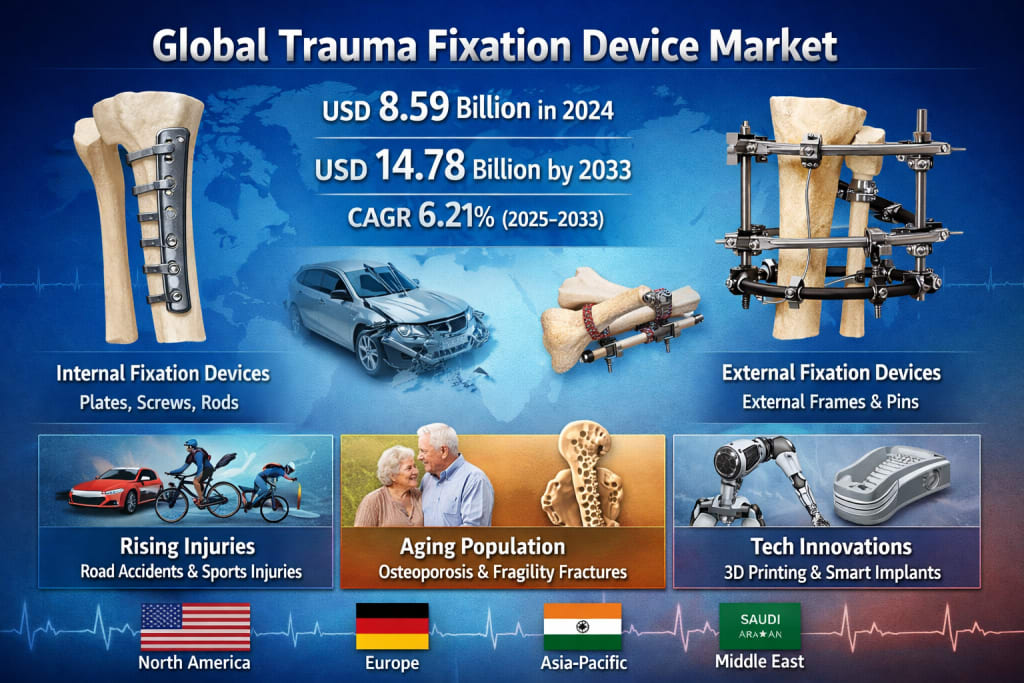
The Global Trauma Fixation Device Market was valued at USD 8.59 billion in 2024 and is projected to reach USD 14.78 billion by 2033, expanding at a CAGR of 6.21% during the forecast period 2025–2033. This steady growth reflects a world where road accidents, sports injuries, and age-related bone disorders are becoming more common—and where modern medicine is increasingly capable of restoring mobility and quality of life.
Trauma fixation devices are essential tools in orthopedic care. They are used to stabilize fractured or broken bones and support proper healing after traumatic injuries. Broadly, these devices fall into two categories: internal fixation devices—such as plates, screws, rods, and nails implanted inside the body—and external fixation devices, which rely on pins and frames positioned outside the body to hold bones in place.
As healthcare systems worldwide face rising trauma cases and an aging population more prone to fractures, demand for reliable, durable, and patient-friendly fixation solutions continues to climb. At the same time, innovations in materials, surgical techniques, and implant design are transforming how orthopedic surgeons approach fracture management.
Global Trauma Fixation Devices Market Overview
A trauma fixation device is a medical tool designed to immobilize and correctly align broken bones, ensuring optimal conditions for healing. These devices play a critical role in treating complex fractures caused by road accidents, falls, sports injuries, and bone diseases such as osteoporosis.
Internal fixation systems, including plates, screws, and intramedullary rods, are implanted directly into or onto the bone, offering long-term stability and enabling earlier patient mobility. External fixation systems, on the other hand, use externally mounted frames and pins and are often preferred in emergency settings, open fractures, or cases involving severe soft tissue damage.
Globally, the adoption of trauma fixation devices is accelerating due to a combination of rising accident rates, longer life expectancy, and improvements in healthcare infrastructure. Developed markets such as North America and Europe continue to lead in terms of technology adoption and procedural volumes, while Asia-Pacific and Latin America are emerging as fast-growing regions driven by expanding access to orthopedic care and increased healthcare spending.
Key Drivers Fueling Market Growth
1. Rising Incidence of Road Accidents and Sports Injuries
One of the most powerful growth drivers for the trauma fixation device market is the global increase in road traffic accidents and sports-related injuries. According to the World Health Organization, approximately 1.19 million people die each year due to road traffic crashes, while 20 to 50 million more suffer non-fatal injuries, many of which result in long-term disability.
The growing popularity of high-impact sports and active lifestyles—especially among younger populations—has further contributed to the number of fractures and complex orthopedic injuries. These cases frequently require advanced surgical intervention using internal or external fixation devices, directly boosting market demand across both developed and developing regions.
2. Aging Population and Rising Osteoporosis Cases
The global geriatric population is expanding rapidly, and with age comes a higher risk of bone fragility and fractures. Osteoporosis, in particular, weakens bone density and significantly increases the likelihood of hip, wrist, and spinal fractures.
As life expectancy rises in countries such as Japan, Germany, and Italy, healthcare systems are seeing a sharp increase in age-related fracture cases. Projections suggest that the annual number of osteoporosis-related hip fractures could nearly double between 2018 and 2050. Globally, an estimated 37 million fragility fractures occur every year among people aged over 55, which is roughly 70 fractures every minute.
This demographic shift is pushing hospitals and orthopedic surgeons to adopt minimally invasive, patient-friendly fixation solutions that reduce recovery time and post-operative complications—further strengthening long-term market growth.
3. Technological Advancements in Fixation Devices
Innovation is reshaping the trauma fixation landscape. Developments such as 3D-printed implants, bioresorbable materials, minimally invasive surgical techniques, and smart fixation systems are improving both clinical outcomes and patient comfort.
Personalized implants tailored to individual anatomy, along with robot-assisted orthopedic procedures, are becoming increasingly common in advanced healthcare systems. These technologies not only enhance surgical precision but also reduce hospital stays and rehabilitation periods.
In October 2024, Johnson & Johnson MedTech introduced the VOLT™ Variable Angle Optimized Locking Technology Plating System, a next-generation solution designed to improve fracture stability, performance, and surgical efficiency—highlighting how innovation continues to drive market momentum.
Challenges Facing the Global Market
High Cost of Devices and Surgical Procedures
Despite strong demand, the high cost of trauma fixation devices and associated surgical procedures remains a major barrier—particularly in low- and middle-income countries. Internal fixation surgeries can be expensive due to implant materials, specialized surgical tools, and hospital fees.
In regions with limited insurance coverage or underdeveloped healthcare infrastructure, affordability issues restrict access to advanced orthopedic treatments. This cost sensitivity can slow market penetration and limit the adoption of premium fixation technologies in price-conscious markets.
Risk of Post-Surgical Complications
Although outcomes have improved significantly, trauma fixation procedures still carry risks such as infection, implant rejection, improper bone healing, and the need for revision surgery. External fixators, while effective, may cause discomfort, skin irritation, or prolonged recovery in some patients.
These potential complications can make both patients and clinicians more cautious—especially when treating elderly individuals or those with multiple health conditions—thereby influencing treatment decisions and, in some cases, slowing adoption rates.
Market Segmentation Insights
External Trauma Fixation Device Market
External fixation devices are widely used for temporary stabilization of complex fractures, especially in emergency and trauma care settings. They are particularly useful for open fractures, severe soft tissue injuries, or medically unstable patients.
Their quick application, non-invasive nature, and adaptability make them indispensable in military medicine, roadside trauma care, and resource-limited environments. Continuous improvements in lightweight materials, adjustability, and biocompatibility are supporting steady growth in this segment.
Internal Trauma Fixation Device Market
Internal fixation devices—such as plates, screws, nails, and rods—are designed for long-term stabilization and typically allow for faster patient mobilization compared to external systems. They are commonly used in fractures of the hip, femur, tibia, and wrist.
Rising surgical volumes, better implant materials like titanium and stainless steel, and the growing prevalence of osteoporotic fractures are driving strong demand. The shift toward minimally invasive orthopedic procedures is further accelerating the adoption of internal fixation systems worldwide.
Titanium Trauma Fixation Device Market
Titanium is increasingly favored in trauma fixation due to its high strength, corrosion resistance, and excellent biocompatibility. Compared to stainless steel, titanium implants are lighter and carry a lower risk of allergic reactions, making them suitable for long-term use and sensitive patients.
As patient comfort, durability, and performance become top priorities, titanium-based fixation systems are witnessing consistent growth. Ongoing R&D efforts are also helping manufacturers develop more flexible, precise, and patient-specific titanium implants.
Hospitals as the Leading End Users
Hospitals remain the primary end users of trauma fixation devices due to their access to specialized surgeons, advanced operating theaters, and emergency care units. Most severe and complex fractures are treated in hospital settings, where patients can receive comprehensive pre- and post-operative care.
The expansion of trauma centers, coupled with increased availability of orthopedic specialists, continues to strengthen this segment. Hospitals also tend to be early adopters of new technologies, including advanced titanium implants and digitally assisted surgical systems.
Regional Market Highlights
United States
The United States dominates the global trauma fixation device market, driven by high rates of road accidents, sports injuries, and an aging population. The country’s advanced healthcare system supports rapid adoption of innovative fixation technologies, while the presence of leading orthopedic device manufacturers further boosts market growth.
In March 2024, TELA Bio, Inc. introduced the LIQUIFIX FIX8 Laparoscopic and LIQUIFIX Precision Open Hernia Mesh Fixation Devices in the U.S.—the first FDA-cleared devices using liquid anchors for mesh fixation. With over 1.2 million hernia procedures performed annually in the country, such innovations highlight the strong demand for advanced fixation solutions.
Germany
Germany stands out as a major European market thanks to its high-quality medical infrastructure, strong orthopedic manufacturing base, and aging population. German hospitals are known for early adoption of advanced fixation devices, particularly those made from titanium and bioresorbable materials.
In October 2023, Johnson & Johnson MedTech launched DePuy Synthes’ VELYS™ Robotic-Assisted Solution in Europe, with successful use in Germany, Belgium, and Switzerland—further strengthening the region’s position in digital and robotic orthopedic surgery.
India
India’s trauma fixation device market is expanding rapidly due to rising road accidents, industrial injuries, and improving healthcare access. The growth of private hospitals and orthopedic clinics, along with increasing awareness of modern trauma care, is fueling demand.
Government initiatives such as Ayushman Bharat PMJAY, which aims to provide health insurance coverage to over 500 million people, are expected to significantly boost access to orthopedic surgeries. The scheme offers hospitalization coverage of up to INR 5 lakh per family per year, supporting millions of procedures and improving market penetration—especially in tier-2 and tier-3 cities.
Saudi Arabia
Saudi Arabia’s market is benefiting from healthcare modernization, population growth, and rising vehicle usage. The country’s Vision 2030 reforms emphasize infrastructure expansion and private sector participation, improving access to advanced trauma and orthopedic care.
In July 2023, HealTec opened the Kingdom’s first prosthetics factory, underlining the region’s commitment to building local medical device manufacturing capabilities and meeting growing surgical demand.
Market Segmentation
By Product:
External Fixators
Internal Fixators
Others
By Material:
Stainless Steel
Titanium
Others
By End User:
Hospitals
Special Clinics
Ambulatory Surgery Centers
By Region:
North America (United States, Canada, Mexico)
Europe (France, Germany, Italy, Spain, UK, Belgium, Netherlands, Turkey)
Asia Pacific (China, Japan, India, Australia, South Korea, Thailand, Malaysia, Indonesia, New Zealand)
Latin America (Brazil, Argentina)
Middle East & Africa (South Africa, Saudi Arabia, UAE, Rest of World)
Competitive Landscape
Leading players in the global trauma fixation device market include:
Zimmer Biomet
Orthofix Medical Inc.
B. Braun Melsungen AG
Stryker
Medtronic
Smith & Nephew
Integra LifeSciences
These companies compete through product innovation, strategic partnerships, geographic expansion, and continuous investment in R&D to strengthen their market positions.
Final Thoughts
The Global Trauma Fixation Device Market is on a clear growth trajectory, supported by rising accident rates, an aging global population, and rapid technological advancements in orthopedic surgery. While challenges such as high costs and surgical risks remain, continuous innovation and expanding healthcare access—especially in emerging economies—are steadily reshaping the competitive landscape.
With the market expected to grow from USD 8.59 billion in 2024 to USD 14.78 billion by 2033, trauma fixation devices will remain a cornerstone of modern orthopedic care—helping millions of patients worldwide recover mobility, independence, and quality of life.
About the Creator
Philippines Warehousing Market 2026: Set to Surge to USD 706.8 Million by 2034 on E-Commerce & Logistics Growth
Philippines Warehousing Market Overview The Philippines warehousing market growth is gearing up for sustained growth over the next decade as logistics, e-commerce, and supply chain modernization take center stage in the country’s economic expansion. According to IMARC Group, the market was valued at USD 441.7 million in 2025 and is projected to reach USD 706.8 million by 2034, growing at a compound annual growth rate (CAGR) of 5.20 % during 2026–2034. This steady trajectory underscores the rising strategic importance of warehousing infrastructure in supporting trade, distribution, and industrial activities across the Philippines.
By Manisha Dixit3 days ago in Trader




Comments
There are no comments for this story
Be the first to respond and start the conversation.