
Intraoperative Imaging Market Trends & Summary
How Real-Time Imaging Is Reshaping the Future of Surgery Worldwide

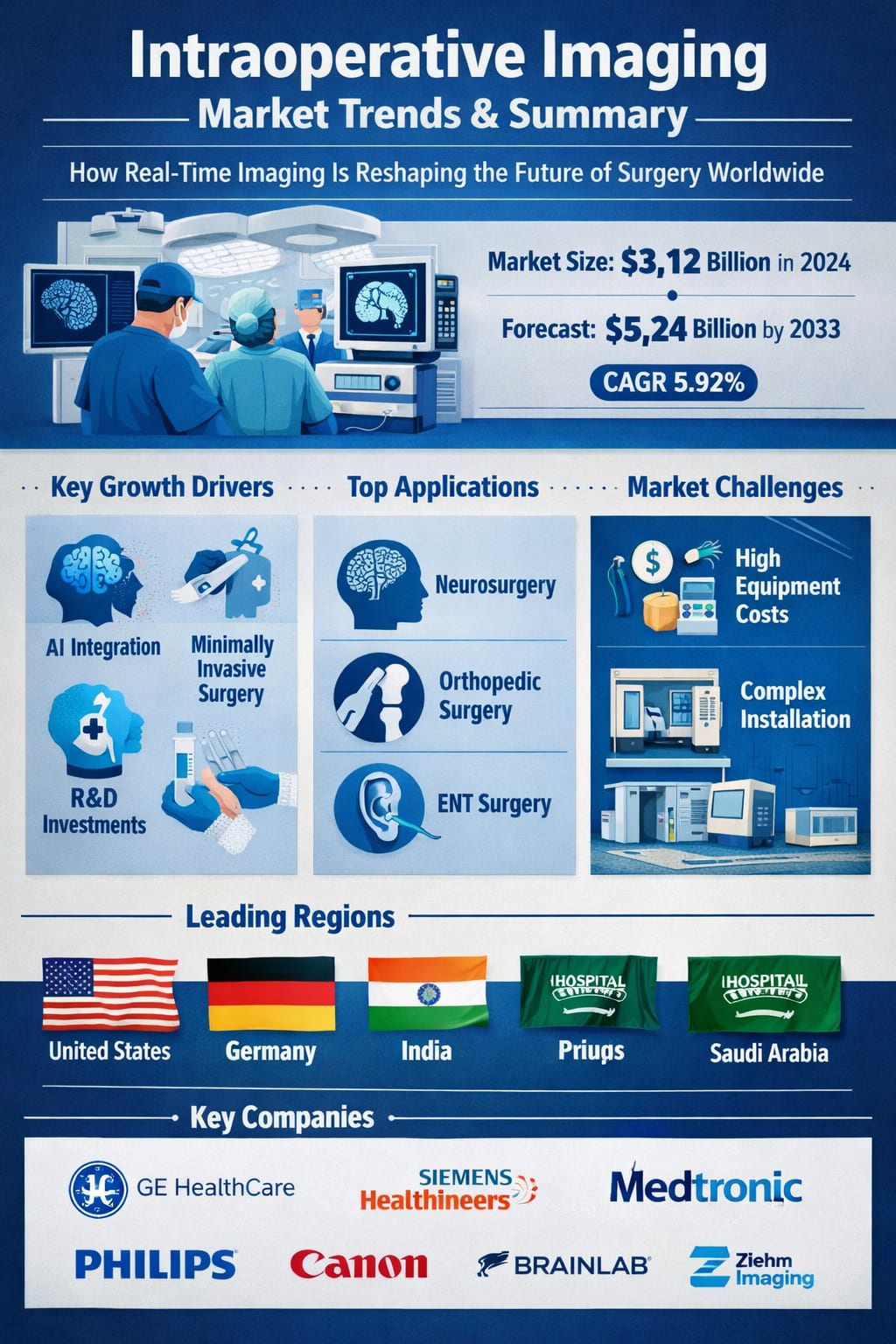
Introduction: A New Era of Precision in the Operating Room
The global healthcare industry is undergoing a profound transformation, driven by rapid advances in medical technology and an increasing emphasis on precision, safety, and patient-centered care. Among the most impactful innovations shaping modern surgery is intraoperative imaging—a technology that allows surgeons to visualize anatomical structures in real time during an operation. This capability is no longer a luxury reserved for a few elite hospitals; it is fast becoming a cornerstone of advanced surgical practice worldwide.
According to Renub Research, the Global Intraoperative Imaging Market is expected to reach US$ 5.24 billion by 2033, up from US$ 3.12 billion in 2024, growing at a compound annual growth rate (CAGR) of 5.92% from 2025 to 2033. This steady growth reflects a broader shift in healthcare toward data-driven, image-guided procedures that reduce risks, improve outcomes, and enhance surgical confidence.
Intraoperative imaging systems—ranging from C-arms and intraoperative CT (iCT) to intraoperative ultrasound and intraoperative MRI (iMRI)—are now being integrated into operating rooms across neurosurgery, orthopedics, ENT surgery, and many other specialties. These technologies are not only changing how surgeries are performed but also redefining what is possible in terms of accuracy, safety, and efficiency.
What Is Intraoperative Imaging?
Intraoperative imaging refers to the use of advanced imaging technologies to visualize a patient’s internal anatomy during a surgical procedure. Unlike traditional preoperative scans, these systems provide real-time feedback, allowing surgeons to adjust their approach on the spot.
Modalities such as MRI, CT, and ultrasound are commonly used, often integrated with surgical navigation systems and, in some cases, robotic platforms. This real-time visualization is particularly valuable in complex procedures such as neurosurgery, spine surgery, and orthopedic interventions, where millimeter-level accuracy can make the difference between success and complications.
By seamlessly integrating imaging into the surgical workflow, clinicians can make data-driven decisions, reduce the need for repeat surgeries, and improve overall patient outcomes. In essence, intraoperative imaging acts as an extra set of “eyes” for the surgeon—more precise, more consistent, and capable of revealing details that the human eye alone cannot detect.
Market Overview: Strong Growth Driven by Clinical Needs
The global intraoperative imaging market is being propelled by several converging factors. One of the most important is the growing demand for accuracy in complex surgical procedures. As surgeries become more sophisticated—particularly in areas like neurosurgery and minimally invasive interventions—the margin for error continues to shrink. Real-time imaging helps bridge this gap by providing immediate visual confirmation of surgical progress.
Another major driver is the rising prevalence of complex and chronic diseases, which often require advanced surgical interventions. Conditions related to the brain, spine, joints, and cardiovascular system increasingly rely on image-guided techniques to ensure optimal outcomes.
Healthcare systems around the world are also placing greater emphasis on patient-centric care. This means shorter hospital stays, fewer complications, and faster recovery times—all of which are supported by the use of precise, real-time imaging during surgery. At the same time, technological advancements in imaging hardware, software, and data processing are making these systems more powerful, more compact, and more accessible.
In addition, increased healthcare spending, the development of hybrid operating rooms, and the expansion of medical training programs focused on advanced imaging technologies are further accelerating market adoption. Government support, favorable regulations, and international collaborations in healthcare technology are also playing a crucial role in shaping this growing market.
Technology Trends: From 2D to 3D and Beyond
One of the most exciting trends in the intraoperative imaging space is the shift from traditional 2D imaging toward 3D and real-time volumetric visualization. These advancements provide surgeons with a more comprehensive understanding of anatomical structures, improving both planning and execution during procedures.
A notable example came in March 2021, when the U.S. FDA approved GE Healthcare’s OEC 3D surgical imaging system, capable of both 2D and 3D imaging. Designed for orthopedic and spine procedures, this system set a new benchmark for intraoperative 3D imaging by offering precise volumetric images that enhance surgical confidence and accuracy.
Beyond hardware improvements, software innovations—particularly in image reconstruction, navigation, and data integration—are making intraoperative imaging more intuitive and more powerful. These developments are laying the foundation for even more advanced applications, including AI-assisted surgery and fully integrated digital operating rooms.
Key Growth Drivers
1. Integration of Artificial Intelligence (AI)
Artificial intelligence and machine learning are rapidly transforming intraoperative imaging. AI-driven systems can analyze images in real time, highlight critical anatomical structures, and even flag potential abnormalities. This not only improves accuracy but also reduces the risk of human error during complex procedures.
By providing intelligent guidance, AI enhances decision-making, supports personalized surgical planning, and improves visualization during minimally invasive operations. As the demand for greater surgical precision continues to rise, AI is becoming an essential component of next-generation intraoperative imaging systems—helping to improve patient safety, reduce operation times, and deliver better clinical outcomes.
2. Rise of Minimally Invasive Surgery (MIS)
The growing adoption of minimally invasive surgical techniques is another major driver of market growth. MIS procedures are preferred for their benefits, including reduced trauma, shorter hospital stays, less postoperative pain, and faster recovery times. However, these techniques also require highly reliable real-time imaging, since surgeons have limited direct visibility of internal anatomy.
Intraoperative imaging technologies such as C-arms, real-time CT, MRI, and ultrasound play a critical role in guiding instruments, monitoring progress, and confirming surgical results before closure. As MIS continues to expand across specialties—from orthopedics to neurosurgery—the demand for advanced intraoperative imaging solutions is expected to grow in parallel.
3. Government Initiatives and Research Investments
Governments and private sector partners are increasingly investing in research and development to advance intraoperative imaging technologies. These initiatives aim to improve surgical precision, reduce complications, and expand the clinical applications of imaging systems across fields such as oncology, orthopedics, and neurosurgery.
Public funding programs and national healthcare strategies are also encouraging collaboration between academic institutions, hospitals, and technology companies. This support is accelerating the development of next-generation imaging systems with features like AI integration, improved portability, and enhanced workflow efficiency—strengthening healthcare systems while improving access to cutting-edge surgical care.
Market Challenges
High Cost of Equipment and Procedures
Despite their clear clinical benefits, intraoperative imaging systems come with significant capital and operational costs. The expense is not limited to purchasing the equipment; it also includes software licenses, maintenance, infrastructure upgrades, and specialized staff training.
For small and mid-sized hospitals—especially in developing regions—these costs can be difficult to justify or afford. In healthcare systems with limited reimbursement for intraoperative imaging procedures, the return on investment may take years. As a result, access to these advanced technologies remains uneven, contributing to disparities between well-funded urban centers and under-resourced or rural facilities.
Complex Installation and Infrastructure Requirements
Installing sophisticated intraoperative imaging systems often requires major facility upgrades. These may include radiation shielding, reinforced floors, electromagnetic protection, and integration with surgical navigation or robotic systems. Such requirements make it challenging to retrofit older hospitals or equip smaller surgical centers without significant construction, downtime, and additional costs.
The complexity of installation and regulatory compliance can also delay clinical deployment and temporarily disrupt hospital operations. These logistical hurdles continue to impact the scalability and speed of adoption of intraoperative imaging technologies worldwide.
Regional Market Insights
United States
The United States remains a leading market for intraoperative imaging, supported by a strong healthcare infrastructure and widespread adoption of advanced surgical technologies. High awareness among clinicians, the presence of major medical technology companies, and substantial investments in R&D all contribute to steady market growth. Despite challenges related to cost and training, the U.S. continues to lead in the use of intraoperative imaging across neurosurgery, orthopedics, and cardiovascular procedures.
Germany
Germany stands out as a key player in the European market, thanks to its robust regulatory framework, strong focus on medical innovation, and presence of leading companies such as Siemens Healthineers, Brainlab, and Ziehm Imaging. The country’s commitment to strict EU medical device regulations ensures high standards of safety and efficacy, fostering clinician trust and supporting market expansion—particularly in spine surgery, orthopedics, and neurosurgery.
India
India’s intraoperative imaging market is growing rapidly, driven by expanding healthcare infrastructure, rising demand for advanced surgical procedures, and government initiatives to modernize medical facilities. The increasing burden of chronic diseases and the need for precise surgical interventions are further fueling adoption of technologies such as C-arms, intraoperative MRI, and ultrasound.
Saudi Arabia
Saudi Arabia is emerging as a significant market, supported by strategic partnerships and a strong commitment to healthcare modernization under Vision 2030. Collaborations such as the installation of advanced surgical theaters and joint ventures to expand diagnostic imaging services highlight the country’s focus on integrating cutting-edge medical technologies to improve patient outcomes and position itself as a regional healthcare innovation hub.
Recent Industry Developments
In February 2024, GE Healthcare and Biofourmis announced a strategic partnership aimed at enhancing continuity of care by enabling safe, efficient, and accessible treatment in home settings—extending the impact of advanced healthcare technologies beyond hospital walls.
In January 2024, Siemens Healthineers AG expanded its collaboration with the City Cancer Challenge (C/Can) to support municipal cancer initiatives in low- and middle-income countries, reinforcing the company’s commitment to improving access to advanced diagnostic and imaging solutions globally.
Market Segmentation Snapshot
By Product:
C-Arms
iCT
Intraoperative Ultrasound
iMRI
By Application:
Neurosurgery
Orthopedic Surgery
ENT Surgery
By End Use:
Hospitals
Ambulatory Surgical Centers
Specialty Clinics
Others
By Region and Country:
North America (U.S., Canada)
Europe (France, Germany, Italy, Spain, U.K., Belgium, Netherlands, Turkey)
Asia Pacific (China, Japan, India, Australia, South Korea, Thailand, Malaysia, Indonesia, New Zealand)
Latin America (Brazil, Mexico, Argentina)
Middle East & Africa (South Africa, Saudi Arabia, UAE)
Key Companies Profiled
GE HealthCare
Siemens Healthcare GmbH
Medtronic plc
Koninklijke Philips N.V.
Canon Medical Systems Corporation
Brainlab AG
Ziehm Imaging GmbH
NeuroLogica Corp.
These players are analyzed across four dimensions: Overview, Key Persons, Recent Developments & Strategies, and Revenue Analysis.
Final Thoughts: The Future of Surgery Is Being Written in Real Time
The global intraoperative imaging market is no longer just a niche segment of medical technology—it is becoming a central pillar of modern surgical care. With the market projected to grow from US$ 3.12 billion in 2024 to US$ 5.24 billion by 2033, the momentum is clear and sustained.
As AI integration, minimally invasive techniques, and digital operating rooms continue to evolve, intraoperative imaging will play an even greater role in shaping how surgeries are planned, performed, and perfected. While challenges related to cost and infrastructure remain, ongoing innovation, government support, and global collaboration are steadily lowering these barriers.
In the years ahead, the operating room will increasingly become a data-driven, image-guided environment—where precision is enhanced, risks are reduced, and patient outcomes are improved. Intraoperative imaging is not just supporting this transformation; it is leading it.
About the Creator
Mexico Retail Market Size, Share, Industry Trends, Growth and Forecast 2026-2034
How the Mexico Retail Market Reflects Changing Consumer Culture and Urban Growth Retail in Mexico is more than a system of buying and selling goods — it is a reflection of social habits, urban development, and shifting economic priorities. The Mexico retail market has evolved alongside population growth, digital adoption, and changing consumer expectations. From neighborhood street vendors to modern shopping centers and online platforms, retail activity mirrors the country’s cultural diversity and economic transformation.
By Jackson Watson7 days ago in Trader



Comments
There are no comments for this story
Be the first to respond and start the conversation.