
Iran Access Control Market 2026: Intelligent Security, Digital Infrastructure & Strategic Growth
How rising security demands, technological integration and economic development are shaping Iran’s access control landscape

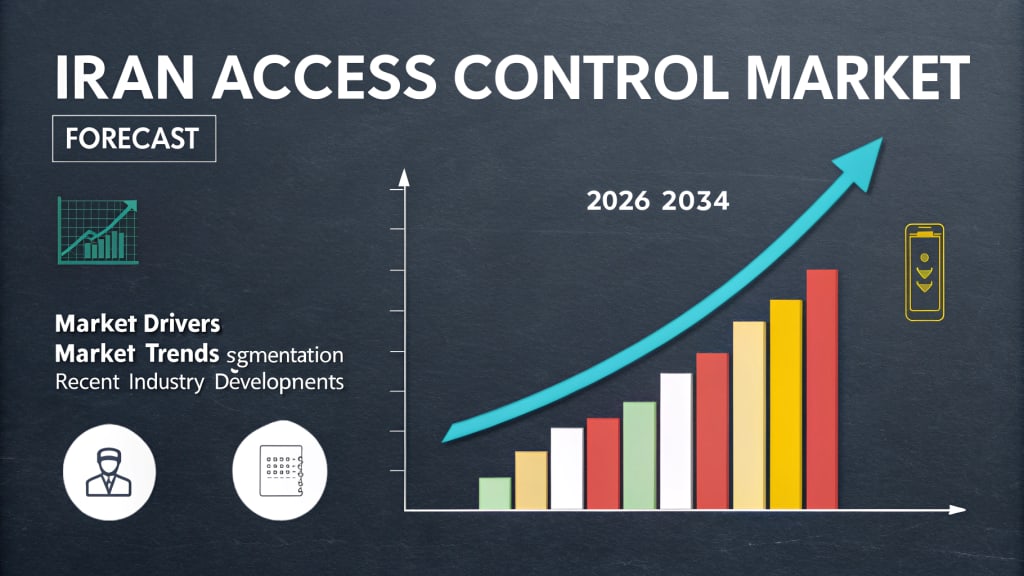
In a rapidly transforming digital and physical world, Iran access control market is carving out an increasingly vital role at the intersection of security, technology and infrastructure development. According to IMARC Group, the market reached USD 81.23 million in 2025, signaling steady adoption among enterprises, institutions and government facilities. Forecasts suggest that the sector will continue its robust climb, reaching USD 182.19 million by 2034 — an impressive compound annual growth rate of 9.39% during 2026–2034. This trajectory reflects broad shifts in how organizations think about safety, access management and risk mitigation in both public and private sectors.
Access control has evolved far beyond traditional locks and keys. Today’s systems leverage digital credentials, biometric authentication and cloud-based monitoring to create intelligent security ecosystems.
Understanding the Market’s Structure and Scope
The access control sector in Iran is varied, incorporating a wide array of technologies, products, and services that ensure secure entry to physical spaces like buildings, campuses, industrial sites, and restricted areas. The core of the market continues to be hardware products — including biometric scanners, card readers, and smart entry devices — that are vital elements in access systems. Nevertheless, software platforms and integrated services are quickly becoming more prominent as companies pursue centralized control, remote management features, and analytics-driven insights.
Biometric authentication systems—such as facial recognition, fingerprint scanning, and iris detection—are increasingly appealing due to their superior accuracy and enhanced fraud resistance compared to conventional card-based systems. These technologies are particularly embraced in government facilities, corporate offices, and essential infrastructure points where prioritizing security strength and operational continuity is crucial.
Drivers Fueling Market Growth
Several forces are propelling the growth of the access control market in Iran. First is the rising imperative for secure infrastructure. In a world with escalating cybersecurity threats and physical security concerns, organizations are compelled to upgrade legacy systems to modern platforms capable of protecting personnel, assets and data alike. This drive for modernization intersects with broader digital transformation agendas across sectors such as banking, healthcare, education and manufacturing.
Secondly, regulatory frameworks and compliance standards are evolving in ways that encourage — if not require — advanced access control systems. Public safety protocols, building codes and facility security policies are increasingly referring to integrated systems that support multi-factor authentication and audit trails. This, in turn, creates demand for business solutions that can prove compliance and simplify reporting.
Another key driver is economic investment in smart infrastructure and smart cities. As urban planning and development strategies incorporate more connected systems — from transport hubs to commercial districts — access control becomes an essential layer of intelligent city design. Investors and developers see controlled access as a foundational technology that enhances safety, improves user experience and supports scalable growth.
Opportunities Shaping the Future Course
The future of Iran’s access control market holds numerous opportunities that extend beyond basic installation and device deployment. One of the most exciting prospects lies in cloud-based access solutions. As organizations adopt hybrid work models and distributed facilities, cloud platforms enable remote system management and centralized control — eliminating the limitations of on-premise architectures and enabling real-time security updates.
Integration with Internet of Things (IoT) platforms also presents a significant growth frontier. Access control systems that communicate with sensors, lighting systems, environmental controls and alarm networks form the backbone of truly intelligent buildings. This kind of interoperability not only enhances safety but also improves building efficiency and user convenience.
Another key opportunity is analytics-driven security decision making. Modern access control generates rich datasets — from entry logs to biometric engagement patterns — that can be analyzed to detect anomalies, optimize staffing, and even forecast security risks. Service providers that offer these value-added analytical tools stand to capture market share ahead of competitors.
Recent News and Developments in Iran Access Control Market
In February 2025, Iran’s Ministry of Urban Development unveiled a new initiative that allocates funding toward modernizing security protocols in commercial centers. This government-backed investment, part of broader infrastructure upgrades, emphasized digital access systems capable of integrating with fire safety and emergency response networks.
By June 2025, several domestic technology firms announced strategic partnerships with global security solution providers to introduce advanced biometric access systems optimized for enterprise environments. These collaborations not only augment technological capability but also build local capacity for future system development.
In October 2025, industrial parks across multiple provinces reported a surge in access control adoption as part of workplace automation strategies. Facilities implementing centralized access systems also reported improvements in operational efficiency and employee scheduling.
Why Should You Know About Iran Access Control Market?
Understanding Iran’s access control market offers insight into how countries balance modernization, security and economic growth. This sector is a bellwether for broader digital transformation across industries — from healthcare hubs that safeguard patient information to commercial complexes that prioritize occupant safety and convenience.
The projected growth — nearly 2.3 times larger by 2034 — underscores that access control is not a niche or peripheral technology. It sits at the nexus of smart infrastructure, workforce management, regulatory compliance and digital security strategy. For investors, integrators and policy makers alike, this market tells a larger story about how secure systems are becoming a core expectation in both public and private spaces.
About the Creator
Thomas
Market Research Analyst | Industry Trends & Forecasting | Turning market data into clear, actionable business insights across global sectors.
Philippines Pharmacovigilance Market 2026: Drug Safety Expansion, Regulatory Alignment and Digital Monitoring Adoption
Philippines Pharmacovigilance Market Overview The Philippines pharmacovigilance market is expanding as healthcare stakeholders increasingly prioritise patient safety, regulatory compliance and post-marketing drug surveillance. Pharmacovigilance encompasses the detection, assessment and prevention of adverse drug reactions throughout the product lifecycle, making it a critical component of pharmaceutical and biotechnology operations. As drug complexity rises and clinical research activity expands across the Philippines, pharmacovigilance systems are becoming essential infrastructure supporting safe medicine usage and regulatory transparency.
By Manisha Dixit3 days ago in Trader
Fundus Camera Market Size & Forecast 2026–2034
The global Fundus Camera Market is poised for steady expansion over the next decade. According to Renub Research, the market is projected to grow from US$ 493 Million in 2025 to US$ 828.68 Million by 2034, registering a CAGR of 5.94% during the forecast period 2026–2034.
By Sakshi Sharmaabout 12 hours ago in Trader
I was in a Toxic Relationship, with my Workplace
“You got that?” My ex yelled. His hands were balled into fists at his side. At six foot three, he towered over me. A normal person would have been afraid, but I looked up a video of George Lopez repeatedly saying, “I got this,” and showed it to him. I had grown used to this treatment, so much so that I didn’t blink when he ripped the phone from my hand and threw it across the room.
By Jade M.2 days ago in Confessions




Comments
There are no comments for this story
Be the first to respond and start the conversation.