
Japan Coffee Bean Market Size and Forecast 2025–2033 | Renub Research
From Third-Wave Cafés to Smart Brewing: How Japan’s Coffee Culture Is Powering a Steady Market Expansion

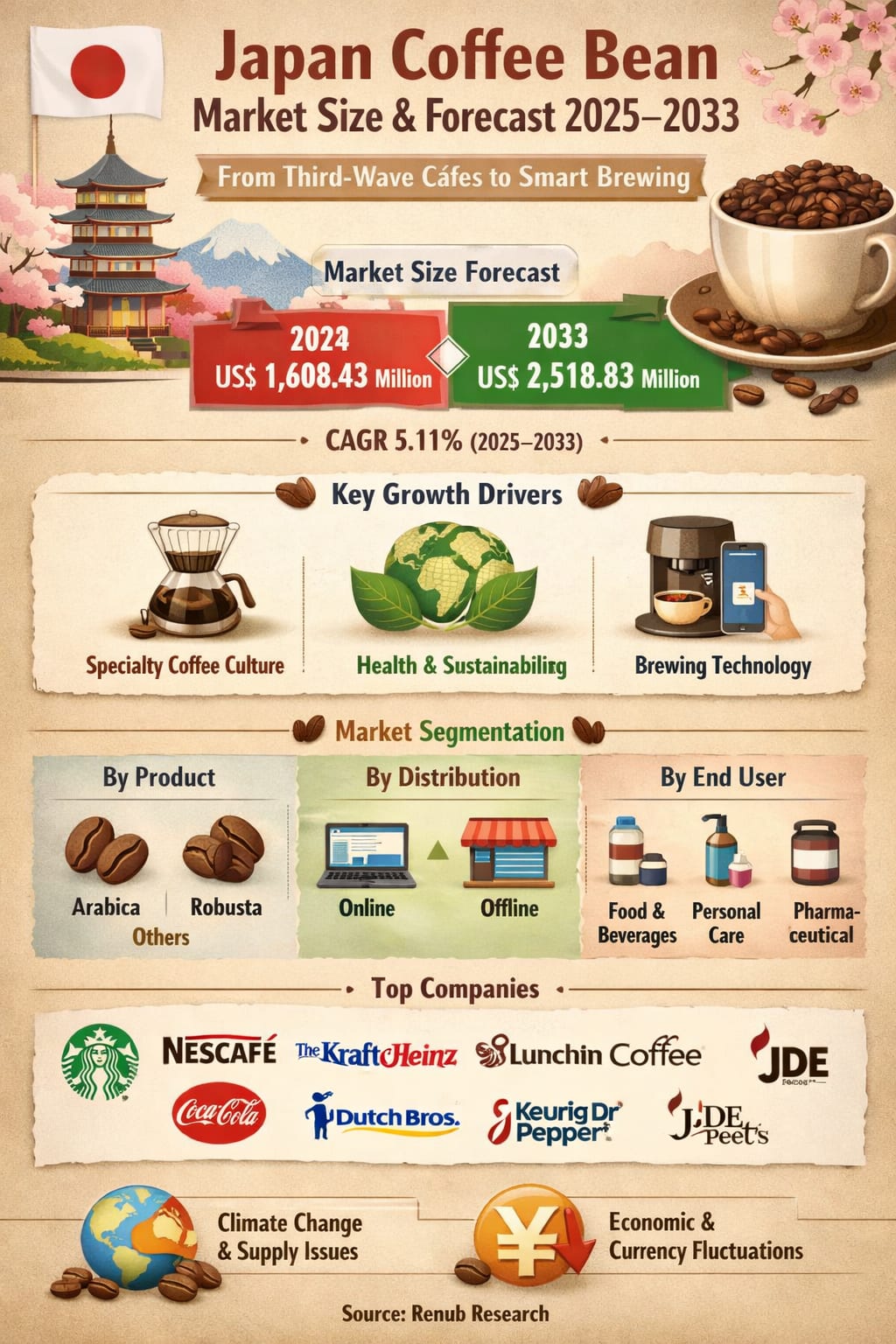
Japan Coffee Bean Market Size and Growth Outlook
According to Renub Research, the Japan Coffee Bean Market is expected to reach US$ 2,518.83 million by 2033, up from US$ 1,608.43 million in 2024, growing at a CAGR of 5.11% from 2025 to 2033. This consistent growth highlights how deeply coffee has embedded itself into Japan’s daily lifestyle, moving far beyond a simple beverage into a cultural and experiential product.
The industry is primarily being driven by advancements in coffee cultivation and processing methods, which are improving productivity, enhancing quality, and stabilizing bean supply. At the same time, Japanese consumers are becoming more selective, increasingly favoring premium, traceable, and sustainably sourced coffee beans.
Japan has long been known for its tea culture, but over the past few decades, coffee has carved out an equally powerful space. From vending machines serving canned coffee on every corner to high-end specialty cafés in Tokyo, Osaka, and Kyoto, coffee has become both a daily habit and a lifestyle statement.
Japan Coffee Bean Industry Overview
Coffee beans are the seeds of the Coffea plant, harvested from coffee cherries and processed into the familiar roasted beans used for brewing. After harvesting, the cherries are dried, hulled, and processed to extract green coffee beans. These green beans are then roasted at high temperatures, triggering chemical reactions that develop coffee’s signature aroma, flavor, and color. The roasting profile—ranging from light to dark—plays a critical role in shaping taste, acidity, and body.
Once roasted, coffee beans can be ground and brewed into a wide variety of drinks, including drip coffee, espresso, and cold brew. In Japan, the appreciation for precision and craftsmanship has elevated coffee preparation into an art form. Brewing methods such as pour-over, siphon, and hand-drip are not just popular—they are celebrated.
The Japanese coffee market is influenced by several structural and cultural factors. Rising coffee consumption among younger consumers, the expansion of café culture, and the popularity of specialty coffee have all played key roles. In addition, innovations in brewing equipment—ranging from capsule machines to smart brewers—have made it easier for consumers to enjoy café-quality coffee at home.
Urbanization and rising disposable incomes across the Asia-Pacific region also support market growth. According to the International Coffee Organization (ICO), Japan consumed around 7,303 thousand 60-kg bags of coffee in 2020–2021, underscoring the country’s position as one of Asia’s largest coffee consumers.
Health awareness is another important factor. Coffee is increasingly associated with benefits such as improved metabolism, enhanced alertness, and potential reductions in the risk of certain diseases. As a result, many consumers are shifting toward organic, plant-based, and functional coffee options. In response, major companies are launching innovative products. For instance, Nestlé Japan introduced plant-based Nescafé latte products to cater to the growing demand for alternative and wellness-focused beverages.
Key Factors Driving the Japan Coffee Bean Market Growth
1. Rise of Specialty Coffee Culture
One of the most powerful growth engines in Japan’s coffee bean market is the rise of specialty coffee. Consumers are increasingly seeking premium, artisanal, and high-quality coffee experiences rather than just mass-produced blends. Single-origin coffees, known for their unique regional flavor profiles, are gaining strong traction.
Major cities like Tokyo and Osaka are now home to thousands of specialty cafés and micro-roasters. These outlets showcase brewing methods such as pour-over, siphon, and AeroPress, emphasizing craftsmanship, precision, and flavor clarity. Transparency in sourcing and storytelling around origin, farmers, and roasting techniques have become key selling points.
This “third-wave coffee” movement has transformed coffee from a commodity into a craft product. Baristas are seen as artisans, and consumers are more willing to pay premium prices for quality, traceability, and experience. This premiumization trend has significantly expanded the value of the coffee bean market, even when overall volume growth remains moderate.
2. Health and Sustainability Consciousness
Health and sustainability are becoming central to purchasing decisions in Japan’s food and beverage sector, and coffee is no exception. Consumers are increasingly concerned about pesticide use, ethical labor practices, and environmental impact. As a result, demand for organic, Fair Trade, and sustainably sourced coffee beans is rising.
In parallel, there is growing interest in low-acid, low-caffeine, and functional coffee options, sometimes enriched with added benefits such as vitamins or collagen. Packaging is also evolving, with more brands adopting biodegradable or recyclable materials to align with Japan’s environmental goals.
Traceability plays a major role in this shift. Japanese consumers want to know where their coffee comes from, how it is grown, and whether farmers are treated fairly. This push toward ethical and sustainable consumption is forcing manufacturers, roasters, and retailers to rethink not just their product offerings, but also their supply chains and corporate responsibility strategies.
3. Technological Advancements in Brewing
Technology is reshaping how coffee is consumed in Japan. The widespread adoption of advanced espresso machines, capsule systems, and smart brewing devices has made it easier for consumers to enjoy high-quality coffee at home or in the office.
Japanese technology companies, known for their precision engineering, have introduced brewing equipment that allows users to fine-tune variables such as temperature, grind size, and extraction time. Some smart brewers are now connected to mobile apps, offering guided brewing experiences and personalized recipes.
These innovations have lowered the barrier to entry for premium coffee consumption. Even beginners can now replicate café-style results at home, supporting the growth of home brewing trends and expanding overall demand for high-quality coffee beans.
Challenges in the Japan Coffee Bean Market
1. Climate Change and Supply Chain Disruptions
Japan relies almost entirely on imported coffee beans, making the market highly vulnerable to climate-related disruptions in major producing countries such as Vietnam, Brazil, and Indonesia. Extended droughts, unpredictable rainfall, and rising temperatures are already affecting coffee yields, particularly for robusta beans.
These environmental pressures have driven significant increases in global coffee prices. In recent periods, robusta futures prices have surged dramatically, with increases of over 50% reported in some markets. Such cost pressures are inevitably passed down the supply chain to roasters, retailers, and ultimately consumers.
For small cafés and independent roasters, higher input costs can be especially painful, squeezing already thin margins. Over the long term, continued climate instability poses a serious risk to supply security and price stability, which could affect both market growth and consumer affordability in Japan.
2. Economic Pressures and Currency Fluctuations
Another major challenge is the weakening Japanese yen, which has made imports more expensive. Since coffee beans, brewing equipment, and many café supplies are sourced from abroad, currency depreciation directly increases operating costs across the industry.
Small and independent coffee shops are particularly exposed to these pressures. Rising costs for rent, labor, utilities, and raw materials force many businesses to raise prices, but doing so risks alienating price-sensitive consumers, especially in an inflationary environment.
If these economic pressures persist, they could slow down expansion plans, reduce profitability, and potentially lead to consolidation within the café and roasting segments of the market.
Japan Coffee Bean Market Segmentation
By Product
Arabica
Robusta
Others
Arabica beans dominate the premium and specialty segments due to their smoother flavor and aromatic complexity, while robusta remains important for blends, instant coffee, and cost-sensitive applications.
By Distribution Channel
Online
Offline
Offline channels, including supermarkets, specialty stores, and cafés, continue to hold a strong position. However, online sales are growing rapidly, driven by subscription services, direct-to-consumer roasters, and e-commerce platforms.
By End User
Personal Care
Food and Beverages
Pharmaceutical
While food and beverages remain the core demand driver, coffee extracts and derivatives are also finding applications in personal care and pharmaceutical products, supporting diversification of end-use demand.
Competitive Landscape and Company Analysis
The Japanese coffee bean market is highly competitive, with both global giants and niche specialty players shaping the landscape. According to Renub Research, key players include:
Starbucks
Nescafé (Nestlé)
The Kraft Heinz Company
Lunchin Coffee
J.M. Smucker
Coca-Cola
Dutch Bros.
Keurig Dr Pepper
JDE Peet’s N.V.
These companies compete on product quality, brand strength, distribution reach, and innovation. Many are investing heavily in sustainability initiatives, premium product lines, and digital sales channels to capture evolving consumer preferences.
Recent developments in the market include product launches focused on plant-based, organic, and functional coffee, as well as strategic partnerships and investments in supply chain transparency and traceability.
Future Outlook: What Lies Ahead for Japan’s Coffee Bean Market
Looking ahead to 2033, the Japanese coffee bean market is expected to continue its steady and resilient growth trajectory. The combination of premiumization, technological innovation, and lifestyle-driven consumption trends will remain central to market expansion.
At the same time, industry players will need to navigate significant challenges related to climate change, supply chain volatility, and economic uncertainty. Companies that can secure sustainable sourcing, manage costs efficiently, and maintain strong brand loyalty will be best positioned to thrive.
With a forecast market size of US$ 2,518.83 million by 2033 and a CAGR of 5.11%, Japan’s coffee bean industry is not just growing—it is evolving into a more sophisticated, quality-driven, and experience-focused market.
About the Creator
Cosmos ATOM Ethereum ETH USD Defi Erisprotocol strategy
The Great DeFi Opportunity: How Ethereum and Cosmos Communities Can Tap Into Terra's Revival We’ve all been through the wringer with crypto. The last few years tested our patience and our beliefs. Terra's collapse was a low point, no doubt about it. But here’s the thing about this space: it’s resilient. People get back up, they build, and sometimes, the best opportunities come from the ashes of the old.
By Bethany Strele2 days ago in Trader
Adobe Stock Analysis: Can Adobe Continue Leading the Creative Software Market?
Introduction Adobe stock has emerged as one of the most influential names in the software industry, particularly for creative professionals. Adobe is renowned for its suite of products, including Photoshop, Illustrator, Premiere Pro, Acrobat, and its cloud-based platform, Adobe Creative Cloud. With subscription-based revenue models, continuous innovation, and a strong global user base, Adobe remains an attractive stock for technology investors. The key question for investors is whether Adobe stock can sustain growth amid competition, market saturation, and changing software trends.
By Hammad Nawaz3 days ago in Trader
I Don't Need My Phone... Wait, Is That Actually True?
My parents gave me my first cell phone when I was twelve years old. It wasn't a fancy iPhone or anything, not even close. Just a simple black flip phone for when I needed to call or text them after school.
By Madison "Maddy" Newton7 days ago in Humans




Comments
There are no comments for this story
Be the first to respond and start the conversation.