
Morocco Water Desalination Market Size and Forecast 2025–2033
How Water Scarcity, Renewable Energy, and Mega Infrastructure Projects Are Reshaping Morocco’s Water Security Future

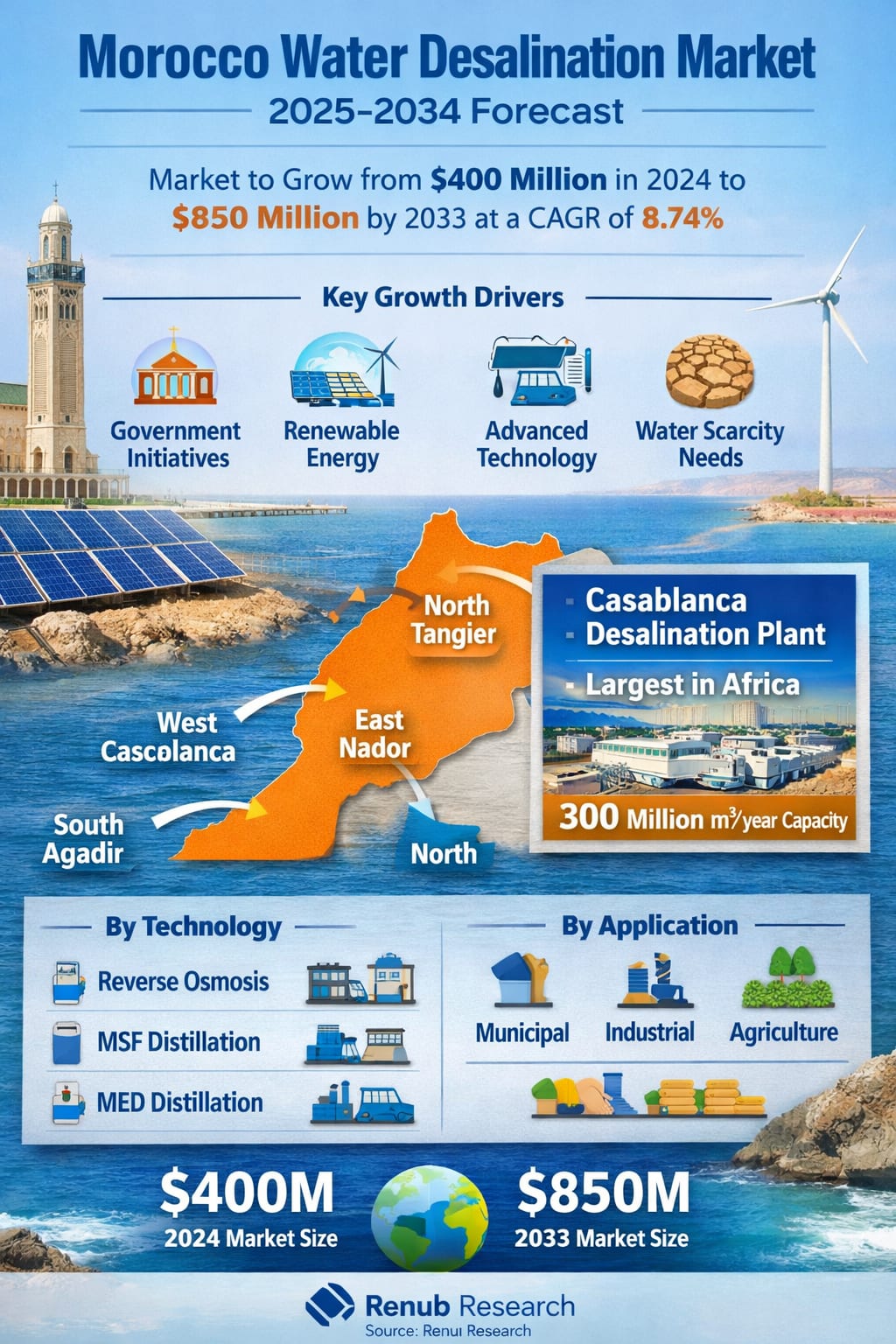
Morocco Water Desalination Market Outlook
The Morocco Water Desalination Market is entering a decisive decade as the country confronts one of the most pressing challenges of the 21st century: water scarcity. According to Renub Research, the market is expected to grow from US$ 400 million in 2024 to US$ 850 million by 2033, expanding at a CAGR of 8.74% from 2025 to 2033. This strong growth trajectory reflects Morocco’s strategic pivot toward desalination as a long-term solution to declining rainfall, shrinking groundwater reserves, and rising demand from cities, industry, and agriculture.
Once considered a niche or emergency solution, desalination is now becoming a core pillar of Morocco’s national water strategy. Prolonged droughts, climate variability, and population growth have exposed the limits of traditional water sources such as dams and aquifers. In response, the government has accelerated investments in large-scale seawater desalination plants, encouraged public-private partnerships, and linked water infrastructure development with the country’s ambitious renewable energy agenda.
From Casablanca and Agadir to Safi and Nador, desalination projects are no longer isolated experiments—they are becoming systemic infrastructure assets designed to secure drinking water, support agriculture, and stabilize economic growth. With advanced technologies such as reverse osmosis, improved energy efficiency systems, and solar- and wind-powered operations, Morocco is positioning itself as one of Africa’s most forward-looking desalination markets.
Morocco Water Desalination Market Overview
Morocco’s water stress has intensified over the past decade due to repeated drought cycles, declining reservoir levels, and overexploitation of groundwater. Agriculture, which remains a major pillar of the Moroccan economy, consumes a large share of available freshwater, while rapid urbanization continues to push up municipal demand. This imbalance between supply and demand has made desalination not just an option, but a strategic necessity.
Recognizing this reality, Morocco has embedded desalination into its long-term water planning. The National Water Plan (2020–2050) and the National Programme for Potable Water Supply and Irrigation 2020–2027 (PNAEPI) aim to diversify water sources, strengthen resilience against climate change, and guarantee reliable supplies for both households and productive sectors. In May 2023, the Moroccan government increased the program’s funding to around US$ 14.3 billion, underlining the political priority given to water security.
Geography also plays in Morocco’s favor. With long coastlines on both the Atlantic Ocean and the Mediterranean Sea, the country has abundant access to seawater, making large-scale desalination technically feasible. At the same time, Morocco’s global reputation as a renewable energy leader—particularly in solar and wind power—is helping reduce the traditionally high energy costs associated with desalination. This combination of coastal access, policy support, and clean energy integration is shaping a more sustainable and economically viable desalination ecosystem.
Projects like the Agadir desalination plant, one of the largest in Africa, demonstrate how Morocco is blending advanced technology with renewable power to deliver water at scale. Meanwhile, new mega-projects near Casablanca and Safi signal that desalination will increasingly serve not only drought-prone regions but also the country’s largest urban and industrial hubs.
Growth Drivers for the Morocco Water Desalination Market
1. Strong Government Initiatives and Policy Support
The Moroccan government is the primary catalyst behind the rapid expansion of the desalination sector. Faced with recurring droughts and growing water deficits, authorities have placed desalination at the heart of national water security planning.
One of the flagship projects is the Casablanca-Settat seawater desalination plant, located in the Lamharza Essahel commune near El Jadida. Designed to become the largest desalination facility in Africa, the project will ultimately supply drinking water to around 7.5 million people across Greater Casablanca, Settat, Berrechid, and Bir Jdid. At full capacity, the plant is expected to produce up to 300 million cubic meters of potable water per year.
The project is being developed in two phases on a 50-hectare site. The first phase, expected to be operational by the end of 2026, will deliver 548,000 cubic meters per day, while the second phase, planned for mid-2028, will raise output to 822,000 cubic meters per day, including facilities for agricultural irrigation. Built through a public-private partnership and powered entirely by renewable energy, the project reflects Morocco’s dual commitment to water security and sustainability.
This initiative is part of the broader National Drinking Water Supply and Irrigation Program (2020–2027), launched under the leadership of King Mohammed VI with a total investment envelope of 143 billion dirhams. The Casablanca-Settat plant alone is estimated to cost around 6.5 billion dirhams, highlighting the scale and seriousness of Morocco’s desalination push.
2. Technological Advancements in Desalination
Technology is playing a decisive role in making desalination more efficient, affordable, and environmentally responsible. Reverse osmosis (RO), which has become the dominant desalination technology in Morocco, has benefited from continuous improvements in membrane performance, energy efficiency, and system durability.
Modern RO systems now consume significantly less energy than earlier generations, thanks to energy recovery devices, better pre-treatment processes, and advanced automation. These improvements reduce operating costs, extend plant lifespans, and enhance water quality—key factors for a country scaling up desalination capacity across multiple regions.
Morocco’s new projects are increasingly designed with state-of-the-art digital monitoring, predictive maintenance systems, and optimized process controls, which help minimize downtime and improve overall plant efficiency. As water demand continues to rise, these technological gains will be crucial in ensuring that desalination remains a cost-effective and reliable component of the national water mix.
3. Integration of Renewable Energy
Energy has traditionally been the biggest cost driver in desalination. Morocco, however, is uniquely positioned to tackle this challenge thanks to its strong renewable energy sector, particularly in solar and wind power.
By coupling desalination plants with renewable energy sources, Morocco is reducing operational costs, cutting carbon emissions, and improving the long-term sustainability of its water infrastructure. The Agadir desalination project, which uses renewable energy, stands as a prominent example of how clean power can support large-scale water production.
This integration also aligns with Morocco’s broader climate commitments and energy transition goals. As the country continues to expand its renewable capacity, desalination plants powered by green energy will become increasingly competitive compared to conventional water supply alternatives, strengthening the economic case for desalination.
Challenges in the Morocco Water Desalination Market
Despite its strong growth outlook, the Morocco water desalination market faces several structural and operational challenges that must be managed carefully.
High capital costs remain a major barrier, especially for large-scale plants that require significant upfront investment in infrastructure, pipelines, and energy systems. While public-private partnerships help spread financial risk, funding and financing structures must remain robust and transparent to sustain long-term expansion.
Energy dependency, even with renewables, is another concern. Desalination is still energy-intensive, and fluctuations in energy availability or costs can affect operational stability. Integrating storage solutions and grid flexibility will be essential to ensure uninterrupted water supply.
Environmental issues, particularly the disposal of brine (highly concentrated saltwater byproduct), also require careful regulation and monitoring. Poorly managed brine discharge can harm marine ecosystems, making environmental impact assessments and mitigation measures critical for future projects.
Finally, technical expertise and operational capacity must keep pace with the rapid expansion of infrastructure. Training skilled engineers, operators, and maintenance teams will be key to ensuring that Morocco’s growing desalination fleet operates efficiently and safely over the long term.
Regional Insights
East Morocco Water Desalination Market
Eastern Morocco is emerging as a strategic growth area for desalination, driven by water stress, agricultural needs, and urban expansion. A major milestone is the Nador desalination plant, which began operations in February 2025 with an annual capacity of 250 million cubic meters, serving both municipal and agricultural users.
In addition, agreements with international partners, including China’s Lipu Industry, aim to further boost regional capacity with facilities capable of producing hundreds of thousands of tons of desalinated water per day. These investments are part of Morocco’s broader ambition to raise national desalination capacity to around 1.5 billion cubic meters per year by 2030.
West Morocco Water Desalination Market
Western Morocco is at the center of the country’s largest and most ambitious desalination projects. The Casablanca desalination plant will be a cornerstone of urban water supply, ultimately serving more than 7.5 million people and producing up to 300 million cubic meters annually.
The Safi desalination plant, currently under development, is expected to add 86,400 cubic meters per day to regional capacity. Together, these projects highlight the west’s role as a hub for large-scale, renewable-powered desalination infrastructure, supporting both urban growth and industrial activity.
North and South Morocco
Northern and southern regions are also gradually integrating desalination into their water strategies, particularly in coastal and arid zones where traditional water resources are under pressure. While projects here are generally smaller in scale, they play a crucial role in enhancing regional water resilience and reducing dependence on overdrawn aquifers.
Morocco Water Desalination Market Segmentation
By Technology:
Reverse Osmosis
Multi-stage Flash (MSF) Distillation
Multi-effect (MED) Distillation
Others
By Application:
Municipal
Industrial
Others
By Water Source:
Seawater
Brackish Water
River Water
Others
By Region:
East
West
North
South
Competitive Landscape and Company Analysis
The Moroccan desalination market features a mix of global technology providers, engineering firms, and water treatment specialists. Key players include:
International Development Enterprises (iDE)
DowDuPont
Doosan Group
Ovivo
Aquatech
Veolia
Guangzhou KangYang Seawater Desalination Equipment Co.
These companies contribute across the value chain, from technology supply and plant design to construction, operation, and maintenance. Competition is increasingly focused on energy efficiency, cost reduction, digitalization, and environmental performance, as Morocco seeks to build a modern, sustainable desalination ecosystem.
Final Thoughts
The Morocco Water Desalination Market is no longer just a response to drought—it is becoming a strategic pillar of national development. With the market projected to grow from US$ 400 million in 2024 to US$ 850 million by 2033 at a CAGR of 8.74%, desalination is set to play a defining role in securing Morocco’s water future.
Backed by strong government commitment, cutting-edge technology, and world-class renewable energy integration, Morocco is positioning itself as a regional leader in sustainable desalination. While challenges remain—particularly around costs, energy, and environmental management—the long-term direction is clear: desalination will be central to how Morocco protects its people, economy, and ecosystems from the growing risks of water scarcity.
In a world where climate uncertainty is becoming the norm, Morocco’s desalination strategy stands as a powerful example of how infrastructure, innovation, and policy alignment can work together to safeguard one of the planet’s most precious resources: water.
About the Creator
Tom Shane
Tom Shane is a content writer specializing in SEO-driven blogs, product descriptions, and thought leadership. He crafts engaging, research-backed content that connects with audiences and drives results.
Vanguard FTSE Canadian High Dividend Yield Index ETF: Your Guide to Steady Income and Smart Investing
Investing can be simple if you choose the right tools. The Vanguard FTSE Canadian High Dividend Yield Index ETF is designed to provide steady income while helping your portfolio grow over time. Focusing on Canadian companies with consistent dividend payments, this ETF is a smart choice for investors who want reliable returns without constantly monitoring the market. They will break down how this ETF works and why it could fit perfectly into your investment strategy.
By John.doe7987 days ago in Trader
Europe Ultrasound Devices Market Forecast 2025–2033: Technology, Demand, and the Future of Diagnostic Imaging
Introduction Ultrasound technology has long been a cornerstone of modern medical diagnostics, valued for its safety, versatility, and real-time imaging capabilities. Unlike X-rays or CT scans, ultrasound uses high-frequency sound waves rather than ionizing radiation, making it a preferred option for repeated examinations, prenatal care, and point-of-care diagnostics. Over the past decade, Europe has witnessed a steady expansion in the use of ultrasound devices across hospitals, diagnostic centers, and specialty clinics, driven by technological progress and changing healthcare needs.
By shibansh kumar6 days ago in Trader


Comments
There are no comments for this story
Be the first to respond and start the conversation.