
North America Fertilizer Market Size and Forecast 2025–2033
How Technology, Sustainability, and Rising Food Demand Are Reshaping Agriculture Across the Region

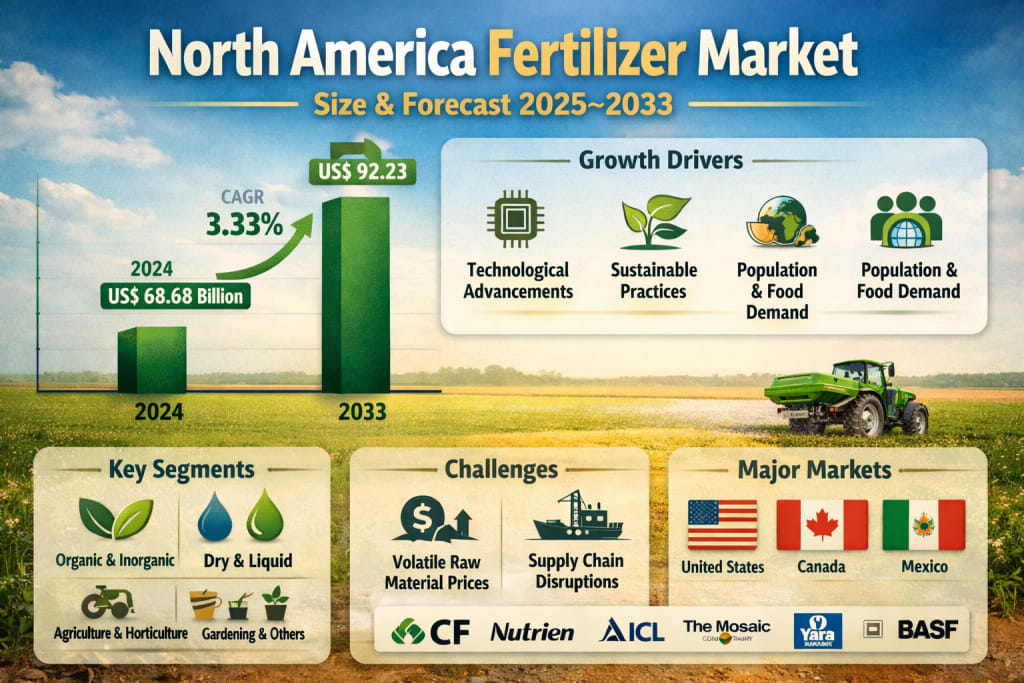
The North America Fertilizer Market is entering a decisive decade of transformation. According to Renub Research, the market is expected to reach US$ 92.23 billion by 2033, rising from US$ 68.68 billion in 2024, at a CAGR of 3.33% from 2025 to 2033. This steady growth reflects more than just rising demand for food—it signals a structural shift in how agriculture is practiced across the United States, Canada, and Mexico.
From precision farming and AI-driven nutrient management to sustainability-focused policies and investments in low-carbon fertilizer production, the region’s fertilizer industry is evolving in both scale and sophistication. Farmers today are not just buying nutrients; they are investing in efficiency, soil health, and long-term productivity. At the same time, governments and corporations are working to strengthen domestic supply chains and reduce environmental impact, making fertilizers a strategic component of food security and economic stability.
In this context, the fertilizer market is no longer a quiet, background industry. It is becoming a central pillar of modern agriculture, balancing the pressure to feed a growing population with the urgent need to protect ecosystems and manage resources responsibly.
Overview of the North America Fertilizer Industry
Fertilizers are natural or synthetic substances applied to soil or plants to supply essential nutrients that promote healthy growth and improve crop yields. They typically contain key macronutrients such as nitrogen (N), phosphorus (P), and potassium (K), along with important micronutrients like zinc, iron, and magnesium. These nutrients replenish soil fertility that is gradually depleted through continuous cultivation and harvesting.
In North America, fertilizers play a crucial role in sustaining large-scale commercial agriculture, from corn and soybean fields in the United States and Canada to fruit, vegetable, and grain production in Mexico. The industry includes both inorganic fertilizers, which are chemically formulated, and organic fertilizers, which are derived from plant or animal sources and are increasingly favored in sustainable farming systems.
What makes today’s fertilizer market different from the past is the growing emphasis on efficiency and environmental responsibility. Rather than simply applying more nutrients, farmers are using data, sensors, and precision tools to apply the right amount, at the right time, in the right place. This shift is helping to reduce waste, lower costs, and minimize environmental impact—while still meeting the rising demand for food.
At the same time, government initiatives across the region are supporting domestic production, innovation, and supply chain resilience. These combined forces are shaping a fertilizer market that is not only growing, but also becoming smarter and more sustainable.
Market Size and Growth Outlook
Renub Research estimates that the North America Fertilizer Market will grow from US$ 68.68 billion in 2024 to US$ 92.23 billion by 2033, registering a CAGR of 3.33% between 2025 and 2033. This growth trajectory reflects consistent demand from the agricultural sector, supported by structural trends such as population growth, changing dietary patterns, and the need to maximize crop yields on limited arable land.
Unlike boom-and-bust commodity cycles, fertilizer demand tends to be relatively stable, because food production is a fundamental necessity. However, the composition of demand is changing. There is increasing interest in specialty fertilizers, controlled-release products, and organic solutions, alongside continued demand for traditional nitrogen, phosphate, and potash fertilizers.
This balanced growth outlook suggests a market that is both resilient and adaptive—capable of meeting immediate agricultural needs while also evolving to address long-term sustainability challenges.
Growth Drivers for the North America Fertilizer Market
Technological Advancements
Technology is one of the strongest forces reshaping the fertilizer industry in North America. The integration of precision agriculture, supported by artificial intelligence (AI), the Internet of Things (IoT), drones, and satellite imagery, is transforming how farmers manage nutrients. Instead of uniform application across entire fields, fertilizers can now be applied in targeted doses based on real-time soil and crop data.
This approach improves efficiency, reduces waste, lowers costs, and supports environmental goals. It also encourages the use of controlled-release and specialty fertilizers, which deliver nutrients more gradually and reduce the risk of runoff and leaching.
On the production side, global investments are also influencing local markets. For example, in December 2022, Morocco-based OCP Group, one of the world’s largest fertilizer and phosphate producers, announced plans to invest USD 12.3 billion to expand fertilizer production using renewable energy by 2027. While this is a global initiative, it reflects a broader industry trend toward cleaner, more efficient fertilizer production methods that also affect North American supply chains and competitive dynamics.
Sustainable Practices
Sustainability is no longer a niche concern—it is becoming central to agricultural policy and business strategy across North America. Farmers, regulators, and consumers are increasingly focused on reducing the environmental footprint of food production. This has accelerated demand for organic fertilizers, bio-based inputs, and precision application technologies that minimize nutrient losses to air and water.
Investments in low-carbon and renewable energy-based fertilizer production further reinforce this trend. The industry’s push toward sustainability is not just about compliance; it is also about long-term soil health, water quality, and the resilience of farming systems in the face of climate change.
As environmental regulations tighten and consumer awareness grows, the adoption of sustainable fertilizer solutions is expected to become a major driver of market growth throughout the forecast period.
Population Growth and Rising Food Demand
Population growth remains a fundamental driver of fertilizer demand. As the population of North America continues to increase, and as global food demand rises, farmers are under pressure to produce more from the same—or even shrinking—amount of arable land. This makes fertilizers essential tools for boosting productivity and ensuring stable food supplies.
To meet this challenge, the agricultural sector is not only increasing fertilizer usage but also investing in more efficient and environmentally responsible production methods. In May 2022, for instance, CF Industries and Mitsui & Co., Ltd. announced plans to develop a greenfield ammonia manufacturing facility in the United States. The project aims to produce “blue ammonia” using carbon capture and sequestration technologies, reducing carbon emissions by more than 60% compared to conventional processes.
Such initiatives highlight how the fertilizer industry is aligning food security goals with climate and sustainability objectives—an alignment that will shape market growth for years to come.
Challenges in the North America Fertilizer Market
Volatile Raw Material Prices
One of the biggest challenges facing the fertilizer industry is the volatility of raw material prices. Key inputs such as natural gas (used in nitrogen fertilizer production), phosphate rock, and potash are subject to global supply-demand imbalances, geopolitical tensions, trade restrictions, and energy market fluctuations.
For example, sudden spikes in natural gas prices can significantly increase production costs for nitrogen fertilizers, making it difficult for manufacturers to maintain stable pricing. These cost pressures often flow through to farmers, potentially reducing fertilizer usage and squeezing farm profitability.
Price volatility also complicates long-term planning and investment decisions, both for producers and for agricultural businesses that depend on predictable input costs.
Supply Chain Disruptions
Supply chain disruptions have become a critical concern in recent years. The fertilizer industry depends heavily on global trade for raw materials and finished products, making it vulnerable to port congestion, transportation bottlenecks, geopolitical conflicts, and trade policy changes.
Disruptions in the supply of potash or phosphate, for instance, can lead to shortages and price spikes, creating uncertainty for farmers during critical planting seasons. This volatility can ultimately affect crop yields and regional food production, highlighting the strategic importance of building more resilient and diversified supply chains within North America.
United States Fertilizer Market
The United States represents the largest share of the North American fertilizer market, driven by its vast agricultural sector and high adoption of modern farming technologies. Demand is supported by large-scale production of corn, soybeans, wheat, and other staple crops, as well as by growing interest in sustainable and precision agriculture practices.
In August 2022, Koch Fertilizer announced an investment of over USD 30 million to upgrade its nitrogen plant in Dodge City, Kansas. The expansion increased the facility’s urea ammonium nitrate (UAN) production capacity by 35,000 tons per year, helping to meet rising demand in western Kansas and eastern Colorado.
Such investments reflect a broader trend toward strengthening domestic production capacity, reducing supply chain vulnerabilities, and ensuring reliable access to fertilizers for U.S. farmers.
Canada Fertilizer Market
Canada is a major global player in the fertilizer industry, particularly as a leading exporter of potash. With production concentrated in provinces like Saskatchewan and Alberta, the country plays a critical role in supplying both domestic and international markets.
In August 2022, Archer-Daniels-Midland Company (ADM) opened a new fertilizer terminal blender in Minnesota, aimed at improving access to high-quality fertilizers across the northern U.S. Corn Belt and western Canada. This move underscores the integrated nature of the North American fertilizer market and the importance of cross-border supply chains.
As Canada continues to invest in sustainable practices and precision agriculture, its fertilizer industry is expected to remain a cornerstone of both regional and global food security.
Mexico Fertilizer Market
Mexico’s fertilizer market is growing steadily, driven by rising agricultural demand and efforts to improve crop productivity. Fertilizers are essential for key crops such as maize, wheat, and sugarcane, which are central to the country’s food system and rural economy.
Although Mexico relies heavily on imports to meet its fertilizer needs, there are ongoing initiatives to expand domestic production capacity and reduce dependence on foreign suppliers. Population growth, crop diversification, and government programs aimed at boosting agricultural output are all contributing to market expansion.
As the demand for efficient and environmentally friendly fertilizers increases, Mexico’s market is expected to continue evolving in line with broader regional trends.
North America Fertilizer Market Segmentation
By Category:
Organic
Inorganic
By Form:
Dry
Liquid
By Application:
Agriculture
Horticulture
Gardening
Others
By Country:
United States
Canada
Mexico
Rest of North America
Competitive Landscape and Company Analysis
The North America Fertilizer Market features a mix of global giants and regional leaders, all competing on production capacity, technology, sustainability initiatives, and supply chain strength. Key companies covered include:
CF Industries Holdings, Inc.
ICL Group Ltd.
Nutrien Ltd.
Sociedad Química y Minera de Chile SA
BASF SA
The Andersons Inc.
The Mosaic Company
Yara International ASA
Each of these companies is analyzed across four key dimensions: Overview, Key Persons, Recent Developments, and Financial Insights. Together, they shape the competitive dynamics of the market and drive innovation in product development, production efficiency, and sustainability.
Final Thoughts
The North America Fertilizer Market is on a steady growth path, projected to rise from US$ 68.68 billion in 2024 to US$ 92.23 billion by 2033, driven by technological innovation, sustainability imperatives, and the relentless need to feed a growing population. While challenges such as raw material price volatility and supply chain disruptions remain, the industry is responding with strategic investments, cleaner production methods, and smarter agricultural practices.
In the years ahead, fertilizers will be more than just inputs—they will be part of an integrated, data-driven, and sustainability-focused agricultural ecosystem. For farmers, policymakers, and industry leaders alike, the fertilizer market will continue to be a critical lever in balancing productivity, profitability, and environmental responsibility across North America.
About the Creator
Introduction to Mutual Funds: A Beginner’s Guide to Smart Investing
Introduction Mutual funds are one of the most popular investment options for beginners and experienced investors alike. They pool money from multiple investors to invest in a diversified portfolio of stocks, bonds, or other securities. Mutual funds offer a simple way to achieve diversification, professional management, and potential long-term growth without the complexity of managing individual investments.
By Hammad Nawaza day ago in Trader
Mexico Digital Twin Market Size, Opportunities & Investment Trends 2026–2034 | IMARC Analysis
Mexico Digital Twin Market Growth, Trends, Forecast, Key Players, and Opportunities Mexico Digital Twin Market Overview The Mexico Digital Twin Market is witnessing strong expansion as organizations across industries accelerate digital transformation initiatives. Digital twin technology, which enables the creation of virtual replicas of physical assets, systems, and processes, is increasingly being adopted to improve operational efficiency, predictive maintenance, and real-time decision-making.
By Kim Soo hyun4 days ago in Trader




Comments
There are no comments for this story
Be the first to respond and start the conversation.