
North America Hydroponics Market Size and Forecast 2025–2033
How Soilless Farming Is Redefining Food Security, Sustainability, and Urban Agriculture Across the U.S., Canada, and Mexico

Introduction: The Rise of Soilless Farming in North America
Agriculture in North America is undergoing a quiet but powerful transformation. Faced with shrinking arable land, climate uncertainty, water scarcity, and rising consumer demand for fresh, locally produced food, farmers and investors alike are turning to innovative growing methods. Among these, hydroponics—the practice of growing plants without soil using nutrient-rich water solutions—has emerged as one of the most promising solutions for the future of food production.
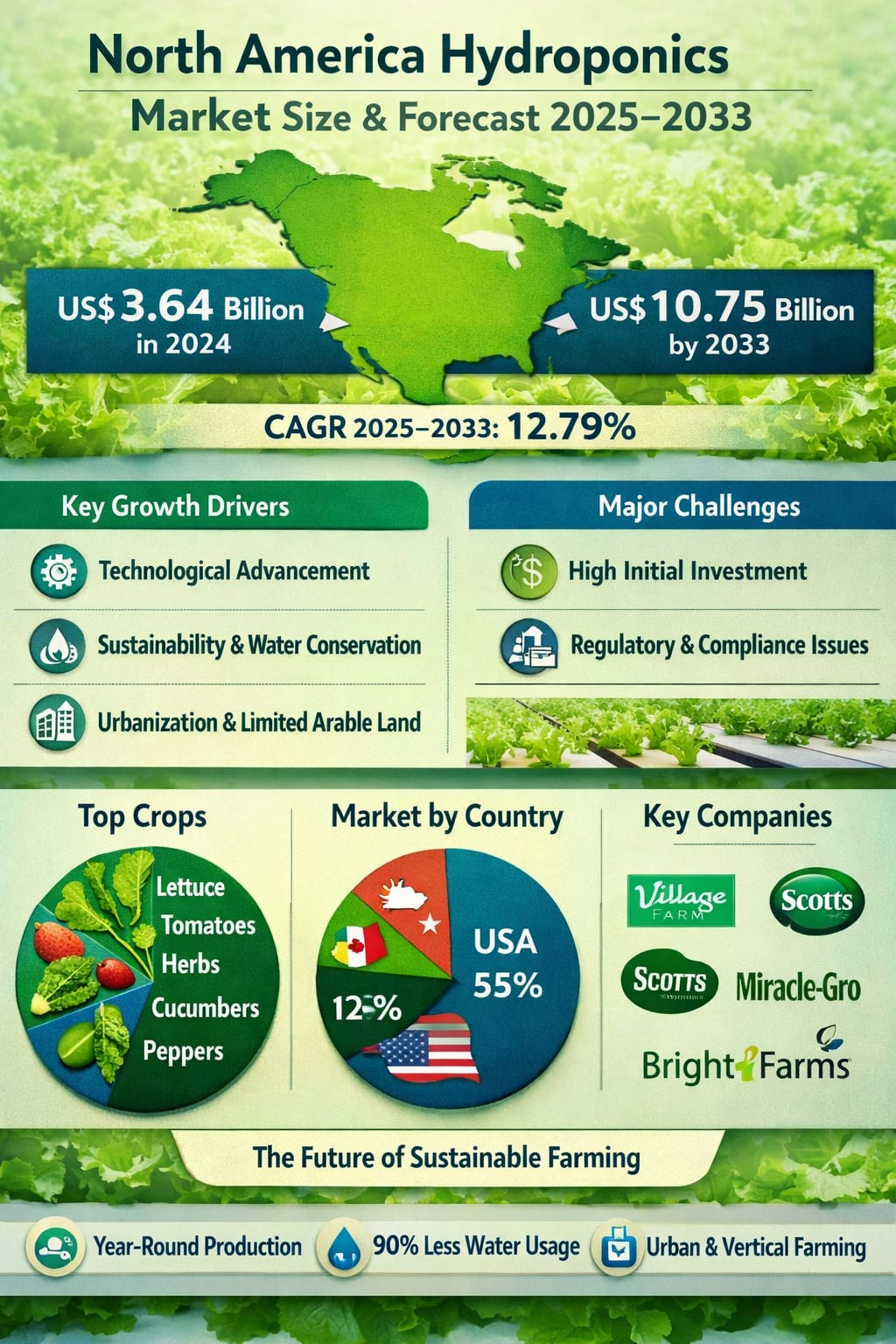
According to Renub Research, the North America Hydroponics Market is expected to reach US$ 10.75 billion by 2033, up from US$ 3.64 billion in 2024, growing at an impressive CAGR of 12.79% from 2025 to 2033. This rapid growth reflects more than just a technological trend; it signals a fundamental shift in how food is produced, distributed, and consumed across the region.
Hydroponics offers a powerful answer to some of the most pressing challenges in modern agriculture. By eliminating the need for soil, these systems allow crops to be grown in controlled environments—urban warehouses, rooftops, greenhouses, and even repurposed industrial spaces. The result is year-round production, significantly lower water usage, reduced dependence on pesticides, and higher yields per square foot compared to traditional farming.
As North America continues to urbanize and consumers become more conscious of sustainability, food quality, and supply chain resilience, hydroponics is no longer a niche experiment. It is quickly becoming a central pillar of the region’s agricultural future.
North America Hydroponics Market Overview
Hydroponics represents a new generation of agriculture—one that prioritizes efficiency, precision, and sustainability. In a hydroponic system, plant roots receive a carefully balanced nutrient solution directly, allowing growers to control every aspect of the growing environment, including light, temperature, humidity, and nutrient composition.
This level of control brings multiple advantages. First, hydroponic systems can use up to 90% less water than conventional soil-based farming, making them particularly attractive in regions facing water stress. Second, the controlled environment significantly reduces the need for chemical pesticides and herbicides, resulting in cleaner and often higher-quality produce. Third, crops can be grown year-round, independent of weather and seasonal limitations.
In North America, these benefits align perfectly with broader economic and social trends. Urban populations are expanding, arable land near cities is becoming scarcer and more expensive, and consumers are increasingly demanding fresh, locally produced, and sustainably grown food. At the same time, governments and private investors are pouring resources into controlled-environment agriculture (CEA) to strengthen food security and reduce dependence on long, fragile supply chains.
Together, these factors are driving strong and sustained growth in the hydroponics market across the United States, Canada, and Mexico.
Market Size and Forecast: Strong Growth Ahead
The numbers tell a compelling story. The North America Hydroponics Market, valued at US$ 3.64 billion in 2024, is projected to nearly triple to US$ 10.75 billion by 2033. With a CAGR of 12.79% between 2025 and 2033, hydroponics stands out as one of the fastest-growing segments within the broader agricultural and AgriTech landscape.
This growth is being fueled by several converging forces:
Rising demand for locally produced fruits and vegetables
Increasing focus on sustainable and resource-efficient agriculture
Rapid technological advancements in lighting, automation, and climate control
Limited availability of arable land, especially near urban centers
The urgent need to conserve water
Growing public and private investment in indoor and vertical farming
Together, these drivers are transforming hydroponics from an alternative farming method into a mainstream agricultural solution across North America.
Key Growth Drivers
1. Technological Advancement
Technology is at the heart of the hydroponics revolution. Innovations in automation, artificial intelligence (AI), Internet of Things (IoT) sensors, and data analytics have made it possible to monitor and optimize every stage of plant growth in real time. Growers can now precisely control nutrient delivery, lighting cycles, temperature, and humidity to maximize yields and ensure consistent quality.
One of the most impactful developments has been the widespread adoption of advanced LED grow lights. These systems can simulate optimal sunlight conditions while consuming far less energy than traditional lighting, making year-round indoor farming more economically viable. Meanwhile, smart control systems and predictive analytics are helping operators reduce waste, lower operating costs, and improve overall productivity.
As these technologies become more affordable and accessible, both startups and large-scale commercial growers are accelerating their adoption of hydroponic systems across North America.
2. Sustainability and Resource Conservation
Sustainability is no longer optional—it is a business and social imperative. Hydroponics fits squarely into this new reality by offering a method of food production that uses significantly less water, less land, and fewer chemicals than traditional agriculture.
With climate change intensifying concerns around droughts, soil degradation, and supply chain disruptions, hydroponics provides a resilient and environmentally responsible alternative. Crops can be grown closer to consumers, reducing transportation emissions and food waste while ensuring fresher produce reaches the market.
A notable example of this trend was the strategic partnership between AeroFarms and Amazon Fresh in May 2023, which aimed to expand the distribution of locally produced, sustainably grown food through Amazon’s vast retail and logistics network. Such collaborations highlight how hydroponics is increasingly being integrated into mainstream food supply chains.
3. Urbanization and Limited Arable Land
Urbanization is reshaping the agricultural landscape of North America. As cities expand, traditional farmland near urban centers is being replaced by residential, commercial, and industrial development. This has created an urgent need for space-efficient farming solutions.
Hydroponics answers this challenge by enabling food production in warehouses, basements, rooftops, and vertical farms. By stacking growing systems vertically and optimizing every square foot, hydroponic farms can produce significantly more food per unit area than conventional farms.
This not only brings food production closer to consumers but also reduces transportation costs, lowers carbon emissions, and improves the resilience of urban food systems. As urban populations continue to grow, the role of hydroponics in ensuring food security is expected to become even more critical.
Challenges in the North America Hydroponics Market
High Initial Investment Costs
Despite its many advantages, hydroponics is not without challenges. One of the biggest barriers to entry is the high upfront cost of setting up a hydroponic facility. Expenses include advanced lighting systems, climate control equipment, nutrient delivery infrastructure, automation technologies, and specialized buildings or retrofitted spaces.
For small-scale farmers and new entrants, these costs can be prohibitive. In addition, ongoing energy and maintenance expenses add to the financial burden. While long-term operational savings and higher yields can offset these costs, access to capital remains a critical issue for many potential growers.
Regulatory and Compliance Hurdles
Another significant challenge lies in regulatory complexity. Hydroponic producers must navigate a patchwork of zoning laws, agricultural regulations, and food safety standards, which can vary widely by region. There is also ongoing debate in some jurisdictions about whether hydroponically grown produce qualifies for organic certification, creating uncertainty for producers and consumers alike.
These regulatory inconsistencies can slow down expansion plans, increase compliance costs, and discourage new investments. Addressing these issues will be essential for the long-term growth and stability of the hydroponics sector in North America.
Country-Level Market Insights
United States Hydroponics Market
The United States represents the largest and most dynamic hydroponics market in North America. Growth is being driven by rising consumer demand for fresh, locally grown produce, strong investment in AgriTech, and increasing awareness of sustainability and food security issues.
In October 2023, Hydrofarm expanded its supply chain by opening a new distribution hub in California, strengthening its ability to serve local growers. Around the same time, Vertical Harvest secured funding to expand its vertical farming technology, underscoring the strong investor confidence in controlled-environment agriculture.
With its combination of technological innovation, private investment, and supportive market conditions, the U.S. is expected to remain the driving force behind the region’s hydroponics growth.
Canada Hydroponics Market
Canada’s hydroponics market is growing rapidly, particularly in urban areas and regions with harsh climates. Because hydroponic systems operate in controlled indoor environments, they allow for year-round production, even in cold or unpredictable weather conditions.
This makes hydroponics especially attractive for improving food security and reducing dependence on imported produce. The same industry developments seen in the U.S.—including investments in vertical farming and supply chain expansion—are also strengthening Canada’s position in the North American hydroponics landscape.
Mexico Hydroponics Market
In Mexico, hydroponics is gaining momentum as a solution to water scarcity, climate challenges, and the need for more efficient agricultural practices. As urbanization increases and traditional farming faces growing pressure, hydroponics offers a way to produce high-quality crops in controlled environments with significantly lower resource consumption.
Technological adoption and a broader shift toward sustainable agriculture are supporting steady growth in the Mexican hydroponics market, making it an increasingly important part of the regional picture.
Market Segmentation
By Type
Aggregate Systems
Liquid Systems
By Crops
Tomatoes
Herbs
Lettuce
Cucumbers
Peppers
Others
By Equipment
HVAC
LED Grow Light
Irrigation Systems
Material Handling
Control Systems
Others
By Countries
United States
Canada
Mexico
Rest of North America
Competitive Landscape
The North America hydroponics market is characterized by a mix of established agricultural companies, specialized technology providers, and innovative startups. Competition is centered around technology innovation, system efficiency, scalability, and cost reduction.
Key companies operating in the market include:
Village Farms International Inc.
Scotts Miracle-Gro
Signify NV
Bright Farms
FreshBox Farms
AmHydro
Lumigrow Inc.
GreenTech Agro LLC
These players are активно investing in product development, strategic partnerships, and capacity expansion to strengthen their positions in a rapidly growing market.
Final Thoughts: A Transformative Decade Ahead
The North America hydroponics market is entering a decisive decade. With the market expected to grow from US$ 3.64 billion in 2024 to US$ 10.75 billion by 2033, hydroponics is no longer a futuristic concept—it is becoming a core component of the region’s food system.
Driven by technological innovation, sustainability imperatives, urbanization, and changing consumer preferences, hydroponics offers a compelling vision of agriculture that is more efficient, more resilient, and more environmentally responsible. While challenges such as high initial costs and regulatory complexity remain, ongoing investment and policy evolution are likely to ease these barriers over time.
As North America continues to rethink how it grows its food, hydroponics stands out not just as a market opportunity, but as a strategic solution for feeding cities, protecting resources, and building a more secure and sustainable agricultural future.
About the Creator
CBA Shares Jump as Profit Beats Market Expectations
CBA Shares Jump as Profit Beats Market Expectations Shares of Commonwealth Bank of Australia (CBA) recorded a strong upward move after the country’s largest lender posted profits that exceeded market expectations. The better-than-expected financial performance boosted investor confidence and pushed CBA shares higher in early trading, reinforcing the bank’s position as one of the most resilient players in Australia’s financial sector.
By Hammad Nawaz6 days ago in Trader
Bartender
On the heels of grief, pain bears down hard. On the heels of death, pain awakens the quiet place between the end of our own life and now. Feeling anything is like seeing a film and in black and white, slow motion, all sound turned off. Just watching. Gritting teeth, awkward smiles and bloody red eyes move around, scanning the others who are feeling something I don't want to feel, but I do. Escapism is all I have ever known. ~
By ROCK aka Andrea Polla (Simmons)7 days ago in Poets



Comments
There are no comments for this story
Be the first to respond and start the conversation.