
North America Silicone Market Size and Forecast 2025–2033
From healthcare innovations to high-performance electronics, silicone emerges as a cornerstone material shaping North America’s industrial future

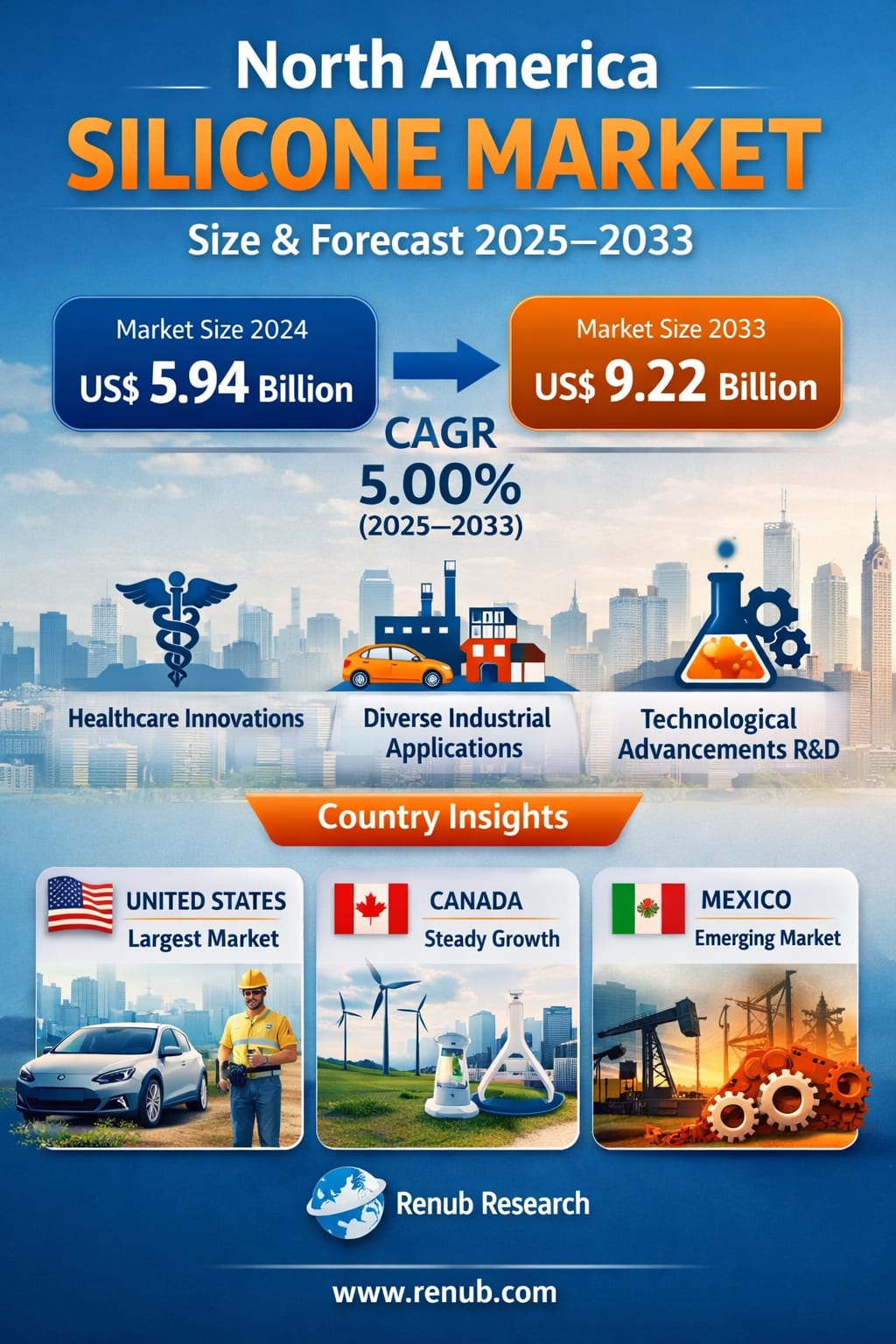
North America Silicone Market Outlook
The North America Silicone Market is entering a phase of steady and resilient growth, supported by expanding applications across construction, healthcare, electronics, transportation, and personal care industries. According to Renub Research, the market is expected to grow from US$ 5.94 billion in 2024 to US$ 9.22 billion by 2033, registering a compound annual growth rate (CAGR) of 5.00% from 2025 to 2033.
Silicone has become one of the most versatile and high-value materials in modern industry. Its unique combination of properties—thermal stability, flexibility, durability, chemical resistance, and biocompatibility—makes it indispensable in both traditional and emerging applications. From sealants and adhesives in construction to implants and wearable devices in healthcare, silicone plays a silent but critical role in everyday life.
The market’s momentum is also closely tied to sustainability trends. Compared to many conventional materials, silicone offers longer product lifecycles, lower toxicity, and strong performance in demanding environments, helping industries reduce waste and improve efficiency. As companies across North America push for greener, longer-lasting, and higher-performing materials, silicone continues to gain strategic importance.
In parallel, technological advancements in silicone manufacturing and formulation are opening new doors. Improved production techniques, advanced compounding, and the rise of specialty silicone grades are enabling the material to meet increasingly complex industrial requirements. These innovations are not only enhancing performance but also expanding the scope of silicone applications across high-growth sectors such as electric vehicles, renewable energy, and advanced medical devices.
What Is Driving the North America Silicone Market?
1. Healthcare Innovations Powering Demand
Healthcare has become one of the most dynamic growth engines for the silicone market in North America. Thanks to its biocompatibility, flexibility, and resistance to heat and chemicals, silicone is widely used in medical devices, implants, tubing, catheters, wound dressings, and prosthetics. These properties make it ideal for applications where patient safety, durability, and long-term performance are non-negotiable.
The region’s aging population, rising prevalence of chronic diseases, and growing preference for minimally invasive procedures are accelerating demand for advanced medical technologies—many of which rely heavily on silicone components. In addition, the rapid adoption of wearable medical devices and digital health solutions, such as insulin pumps, heart monitors, and fitness trackers, is further strengthening silicone consumption. Its skin-friendly nature and long-lasting performance make it a preferred material for devices designed for continuous use.
Regulatory support from bodies such as the U.S. FDA also plays a role in boosting confidence in silicone-based medical products, reinforcing its position as a trusted material in the healthcare ecosystem. As medical technology continues to evolve, silicone’s role is expected to grow even more prominent.
2. Diverse Industrial Applications Across Key Sectors
One of silicone’s greatest strengths is its extraordinary versatility. In North America, it is deeply embedded across multiple industries:
Automotive & Transportation: Silicone is used in gaskets, seals, hoses, and thermal management systems that must withstand extreme temperatures and harsh environments. With the rise of electric vehicles, demand for high-performance silicone materials for insulation and heat management is increasing further.
Construction: In the construction sector, silicone is a critical component of sealants, adhesives, coatings, and weatherproofing solutions. These products improve building durability, energy efficiency, and resistance to environmental stress.
Electronics: From smartphones and semiconductors to electric vehicle components, silicone is widely used for encapsulation, insulation, and thermal management. As electronics become more compact and powerful, the need for reliable heat-resistant and protective materials continues to rise.
Healthcare and Personal Care: Beyond medical devices, silicone is also widely used in personal care and consumer goods due to its smooth texture, stability, and safety profile.
This broad application base ensures steady and diversified demand, protecting the market from overreliance on any single industry and supporting long-term growth.
3. Technological Advancements and R&D Momentum
Ongoing research and development (R&D) is a major force shaping the future of the North America silicone market. Innovations in silicone chemistry and processing techniques are producing materials with enhanced mechanical strength, better electrical insulation, and superior thermal stability.
High-performance silicone elastomers are now being used in solar panels, next-generation electric vehicles, and aerospace components, where durability and long service life are critical. In healthcare, advanced silicone formulations are enabling the development of more precise, long-lasting, and patient-friendly devices.
Another exciting area is additive manufacturing (3D printing) with silicone, which allows for the creation of complex, customized parts that were previously difficult or costly to produce. These advancements not only expand application possibilities but also improve manufacturing efficiency and reduce material waste.
As industries continue to demand lighter, smarter, and more sustainable materials, silicone is well-positioned to remain at the forefront of material innovation.
Challenges Facing the North America Silicone Market
1. Raw Material Price Volatility
One of the most significant challenges for the silicone industry is the volatility of raw material prices, particularly silicon metal, a key input in silicone production. Fluctuations in global supply and demand, changes in energy costs, and trade policies can all cause sudden price swings.
These cost variations directly impact production expenses and profit margins, making pricing strategies more complex for manufacturers. In some cases, companies are forced to absorb higher costs or pass them on to customers, which can affect competitiveness and market stability.
Geopolitical tensions and environmental regulations in major producing countries can also disrupt supply chains, leading to shortages or delays. While companies are investing in supply chain diversification, recycling, and sustainable sourcing, raw material volatility remains an ongoing concern for the industry.
2. Market Saturation in Mature Segments
In established sectors such as construction and traditional automotive applications, silicone usage is already widespread and well-established. As a result, these segments are experiencing slower growth rates compared to emerging applications.
This saturation puts pressure on manufacturers to innovate and differentiate. Companies are increasingly focusing on specialized formulations, high-performance grades, and new use cases—such as silicone components for electric vehicles or advanced green building materials—to unlock fresh growth opportunities.
At the same time, competition from alternative materials, including certain polymers and composites, is intensifying. To stay competitive, silicone producers must continue to invest in technology, product development, and value-added solutions.
Country-Level Insights
United States Silicone Market
The United States dominates the North America silicone market, driven by strong demand from automotive, construction, healthcare, electronics, and personal care industries. Silicone’s unique properties—flexibility, heat resistance, durability, and biocompatibility—make it indispensable across these sectors.
In construction, silicone is widely used in sealants, adhesives, and weatherproofing solutions. In automotive and transportation, it plays a crucial role in gaskets, seals, and thermal management systems. The electronics sector relies heavily on silicone for insulation and heat control in devices ranging from smartphones to electric vehicles. Meanwhile, the healthcare industry continues to expand its use of silicone in implants, tubing, and medical devices.
Innovation remains a key theme in the U.S. market. For example, in January 2023, Dow Inc. introduced the SILASTIC SA 994X LSR series, a new range of liquid silicone rubbers designed for two-component injection molding with thermoplastic substrates. These materials offer features such as self-lubrication, primer-less adhesion, and self-adhesive properties, making them especially attractive for transportation and mobility applications. Such developments highlight how product innovation is strengthening the competitive landscape.
Despite challenges like raw material price fluctuations and evolving sustainability regulations, the U.S. market is expected to remain the growth engine of the regional silicone industry.
Canada Silicone Market
Canada’s silicone market is growing steadily, supported by demand from automotive, construction, electronics, and healthcare sectors. Silicone is widely used in gaskets, seals, adhesives, insulation materials, and medical devices, thanks to its durability and performance in harsh environments.
In electronics, silicone protects and insulates components in devices such as electric vehicles and consumer electronics. In healthcare, its biocompatibility supports increasing use in implants and medical equipment. The construction sector continues to rely on silicone for weatherproofing and structural applications.
Canada’s focus on sustainability and high-performance materials is also encouraging the adoption of advanced silicone solutions. With continued investment in R&D and capacity expansion by key players, the Canadian market is expected to maintain a stable growth trajectory over the forecast period.
Mexico Silicone Market
Mexico is emerging as an increasingly important market for silicone in North America, driven by growth in automotive manufacturing, construction, electronics, and healthcare. Silicone’s flexibility, heat resistance, and durability make it a preferred material for gaskets, seals, adhesives, and protective coatings.
In construction, silicone sealants and adhesives are widely used for structural glazing and weatherproofing. The automotive sector relies on silicone for components that must perform reliably under extreme conditions. In electronics, silicone is used in thermal interface materials and encapsulants to protect sensitive components. Healthcare applications, including medical devices and implants, are also expanding due to silicone’s biocompatibility.
Mexico’s growing emphasis on sustainable and long-lasting materials further supports silicone adoption. As industrial activity and manufacturing capabilities continue to expand, the country is expected to play a larger role in the regional silicone market.
North America Silicone Market Segmentation
By Type (5 Viewpoints):
Elastomers
Fluids
Resins
Gels
Others
By End Use (8 Viewpoints):
Industrial Processes
Construction
Personal Care & Consumer Goods
Transportation
Electronics
Healthcare
Energy
Others
By Country (4 Viewpoints):
United States
Canada
Mexico
Rest of North America
Competitive Landscape and Key Companies
The North America silicone market features a strong presence of global and regional players focused on innovation, capacity expansion, and strategic partnerships. Key companies covered in the market include:
Kaneka Corporation
Shin-Etsu Chemical Co., Ltd.
Dow Inc.
Evonik Industries AG
Wacker Chemie AG
Kemira Oyj
Illinois Tool Works Inc.
These companies are actively investing in new product development, advanced manufacturing technologies, and sustainable solutions to strengthen their market positions and meet evolving customer demands.
Final Thoughts
The North America Silicone Market is on a clear growth path, supported by strong fundamentals across healthcare, construction, electronics, transportation, and industrial applications. With the market projected to rise from US$ 5.94 billion in 2024 to US$ 9.22 billion by 2033, silicone is set to remain a strategic material for the region’s industrial and technological future.
While challenges such as raw material price volatility and saturation in mature segments persist, continuous innovation, R&D investment, and expansion into high-growth applications are reshaping the competitive landscape. As industries increasingly prioritize performance, durability, and sustainability, silicone’s unique properties ensure it will continue to play a critical role in North America’s economic and industrial development through 2033 and beyond.
About the Creator
Keep reading
More stories from shibansh kumar and writers in Trader and other communities.
North America Clinical Trials Market Size and Forecast 2025–2033
Introduction The North America Clinical Trials Market is entering a decisive growth phase as pharmaceutical and biotechnology companies race to develop safer, more effective, and more personalized treatments. According to Renub Research, the market is expected to grow from US$ 20.07 billion in 2024 to US$ 33.91 billion by 2033, expanding at a CAGR of 6.00% from 2025 to 2033. This steady rise reflects longer clinical trial cycles, increasing demand for innovative therapies, and the growing burden of chronic and infectious diseases such as cancer, diabetes, and post-pandemic viral conditions.
By shibansh kumar2 days ago in Trader
Australia Environmental Consulting Services Market Set to Reach USD 1.19 Billion by 2034 as Sustainability and Compliance Demands Surge
The Australia environmental consulting services market is experiencing robust expansion as sustainability imperatives, regulatory frameworks, and corporate environmental responsibility converge to create long-term demand for specialized consultancy expertise. According to the latest IMARC Group analysis, the market was valued at USD 751.9 million in 2025 and is projected to reach USD 1,186.3 million by 2034, reflecting a compound annual growth rate (CAGR) of 5.04% from 2026 to 2034.
By Rashi Sharmaabout 6 hours ago in Trader
What Happens To Your Brain When You Stop Multitasking
Digital technology is the culprit that is causing us to doom scroll when tired, disengaged and unmotivated with the content that motivated you to log onto your device to consume in the first place. That is only the beginning. In the modern workplace (and even when filing cabinets were around, I confirmed this with my adopted parents to get my facts right); reading files while you are supposed to be present to the caller on the other end of the phone line is another classic example of multitasking that causes your brain (although adaptable and intelligent) to lose focus and concentration.
By Justine Crowley3 days ago in Psyche


Comments
There are no comments for this story
Be the first to respond and start the conversation.