
North America Surge Arresters Market Size and Forecast 2025–2033
Grid Modernization, EV Infrastructure, and Renewable Energy Expansion Are Powering Steady Growth Across the Region

North America Surge Arresters Market: A Quiet Backbone of Grid Reliability
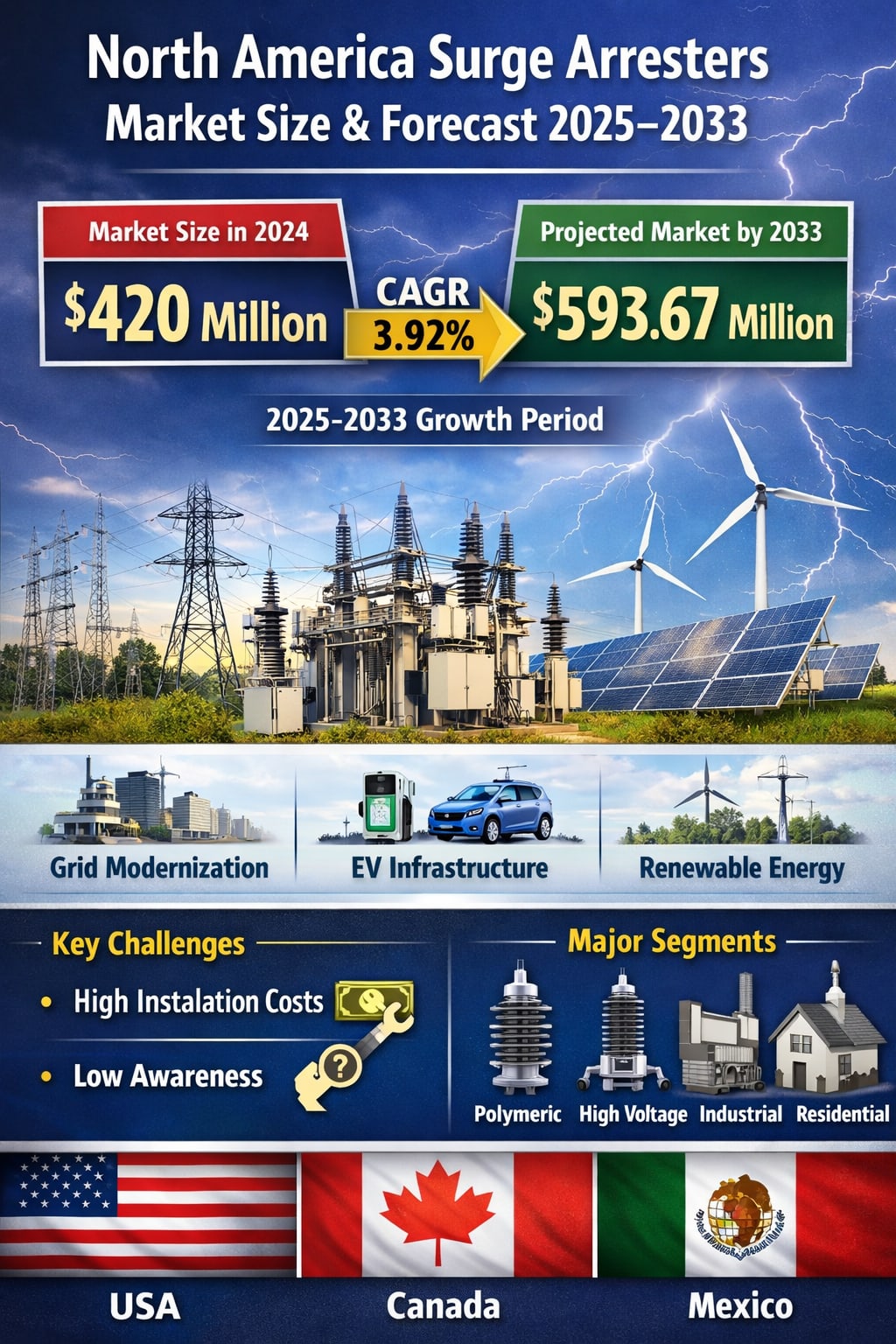
The North America Surge Arresters Market was valued at US$ 420 million in 2024 and is projected to reach US$ 593.67 million by 2033, growing at a CAGR of 3.92% during the forecast period from 2025 to 2033, according to Renub Research. While surge arresters rarely make headlines, they play a critical and increasingly strategic role in protecting modern electrical infrastructure from voltage spikes caused by lightning strikes, switching operations, and grid disturbances.
Surge arresters are essential electrical devices designed to divert excess voltage safely to the ground, preventing damage to sensitive and expensive equipment such as transformers, switchgear, circuit breakers, industrial machinery, and digital control systems. As North America’s power systems become more complex, more digitized, and more interconnected, the importance of reliable surge protection continues to grow.
Across the United States, Canada, and Mexico, investments in grid modernization, renewable energy integration, electric vehicle (EV) charging infrastructure, and industrial automation are reshaping how electricity is generated, transmitted, and consumed. Each of these trends increases the vulnerability of electrical systems to transient over-voltages—and, in turn, strengthens the case for robust surge protection solutions.
In many ways, surge arresters are the silent guardians of the energy transition. They do not generate power, store energy, or transmit data—but without them, the reliability and safety of modern electrical networks would be severely compromised.
Understanding the Role of Surge Arresters in Modern Power Systems
At their core, surge arresters are designed to protect electrical systems from abnormal voltage conditions. These conditions can arise from external sources such as lightning strikes or from internal events like switching operations, short circuits, or sudden load changes. When a surge occurs, the arrester provides a low-resistance path to ground, safely dissipating the excess energy and preventing it from reaching critical equipment.
In North America, surge arresters are deployed across a wide range of applications—transmission lines, substations, industrial plants, commercial buildings, and increasingly, residential installations. Their importance has grown alongside the rising use of sensitive electronics, digital control systems, and automation technologies that are far more vulnerable to voltage fluctuations than older, purely electromechanical equipment.
With the expansion of renewable energy sources such as wind and solar, and the rapid rollout of EV charging infrastructure, the electrical grid is experiencing new patterns of load variability and switching activity. These changes make surge protection not just a safety accessory, but a core requirement for system reliability, asset protection, and operational continuity.
Key Growth Drivers Shaping the North America Surge Arresters Market
Growing Demand for Efficient and Reliable Power Infrastructure
North America’s economy depends heavily on uninterrupted and high-quality power supply. From data centers and manufacturing plants to hospitals and transportation systems, modern society is deeply reliant on stable electricity. However, lightning strikes, switching operations, and grid disturbances continue to pose serious risks to electrical equipment.
Surge arresters help mitigate these risks by shielding critical assets from damaging voltage spikes. As industrial activity expands and renewable energy projects multiply, the need for dependable surge protection—especially in high-voltage environments—is rising steadily.
A notable example of this broader trend is the continued expansion of large-scale renewable projects. In January 2025, EDF Renewables North America and Power Sustainable Energy Infrastructure Inc. reported that their Desert Quartzite Solar+Storage Project went on-stream in December 2024. The project includes a 375 MW solar facility paired with a 150 MW battery storage system, supplying electricity under a long-term power purchase agreement. Such large and complex installations require robust surge protection to safeguard inverters, transformers, and grid interconnection equipment.
Modernization and Upgradation of Electrical Grids
Grid modernization is one of the most powerful structural drivers for the surge arresters market in North America. Utilities across the region are investing heavily in smart grids, digital substations, automated switching systems, and decentralized energy resources. While these technologies improve efficiency and resilience, they also introduce new sensitivities to voltage disturbances.
Surge arresters are a fundamental component of modern grid architecture, helping protect both legacy equipment and newly installed digital assets. In April 2024, the U.S. administration introduced measures aimed at enhancing the country’s electric grid infrastructure, including a final rule to simplify permitting and approval of large transmission projects. Such policy support accelerates grid expansion and modernization—directly boosting demand for surge protection solutions.
As grids become more interconnected and more dynamic, the role of surge arresters shifts from optional protection to essential infrastructure.
Rising Adoption of Electric Vehicles and Charging Infrastructure
The rapid growth of electric vehicles is creating a new and significant demand center for surge arresters. EV charging stations, battery storage systems, and associated power electronics are highly sensitive to voltage fluctuations. Without adequate surge protection, these assets face higher risks of failure, downtime, and costly repairs.
In the United States alone, the swift uptake of electric vehicles is expected to add between 100 TWh and 185 TWh to national electricity demand by 2030, representing roughly 2.5% to 4.6% of projected total consumption. Meeting this demand requires massive investments in charging infrastructure and grid upgrades—each of which increases the need for reliable surge protection.
As governments continue to offer incentives for EV adoption and infrastructure development, surge arresters will remain a critical, though often overlooked, part of this electrification wave.
Challenges Facing the North America Surge Arresters Market
High Installation and Maintenance Costs
One of the primary barriers to wider adoption of surge arresters, particularly in high-voltage applications, is the high upfront cost of installation and the ongoing expense of maintenance. Installing surge protection systems in substations, transmission networks, or industrial facilities requires not only specialized equipment but also skilled labor and careful system integration.
Maintenance involves regular inspections, performance testing, and occasional replacement of components—adding to the total cost of ownership. For smaller businesses or cost-sensitive projects, these expenses can act as a deterrent, slowing adoption in certain segments of the market.
Technological Complexity and Limited Awareness
Despite their importance, surge arresters are not always well understood outside of specialized engineering circles. Many businesses and homeowners either underestimate the risks posed by voltage surges or assume that their existing protection measures are sufficient.
Advanced solutions such as polymeric or hybrid surge arresters often require professional expertise for proper selection, installation, and maintenance. A lack of awareness and technical knowledge can therefore hinder broader market penetration, particularly in the residential and small commercial segments.
Segment Insights: Where Growth Is Concentrated
North America Polymeric Surge Arresters Market
Polymeric surge arresters are gaining strong traction across North America due to their advantages over traditional porcelain designs. They are lighter, more resistant to environmental stressors such as pollution and moisture, and generally more durable in harsh operating conditions.
These features make polymeric arresters especially attractive for transmission and distribution networks, where reliability and ease of installation are critical. Their lower weight also simplifies transportation and installation in remote or difficult-to-access locations. As utilities and industrial users prioritize low-maintenance, long-life solutions, polymeric surge arresters are expected to remain a key growth segment.
North America High Voltage Surge Arresters Market
High voltage surge arresters play a vital role in protecting transmission networks, substations, and large industrial facilities from extreme over-voltage events. These systems are exposed to some of the most severe electrical stresses, including direct lightning strikes and major switching transients.
With North America continuing to invest in large-scale renewable energy projects, cross-border transmission lines, and smart grid infrastructure, demand for high-performance, high-voltage surge arresters is set to remain strong throughout the forecast period.
North America Industrial Surge Arresters Market
Industrial facilities rely heavily on sensitive equipment such as motors, drives, programmable logic controllers, and digital control systems. Power surges in these environments can lead to costly downtime, equipment damage, and production losses.
As industrial automation, IoT integration, and advanced manufacturing technologies become more widespread, the need for reliable surge protection grows in parallel. Industrial surge arresters are therefore becoming a standard part of plant-level electrical design, supporting steady market growth.
North America Residential Surge Arresters Market
The residential segment is also gaining momentum, driven by the increasing number of electronic devices and smart home systems in modern households. From smart TVs and computers to home automation hubs and solar rooftop systems, today’s homes are more vulnerable to power surges than ever before.
Homeowners are becoming more aware of the financial risks associated with surge-related damage, leading to greater adoption of residential surge protection solutions. In March 2022, LG Energy Solution and Stellantis announced a USD 4.1 billion investment in a joint venture to build a major EV battery factory in Canada, highlighting how even residential and light commercial ecosystems are becoming more dependent on sensitive, high-value electrical equipment that requires reliable protection.
Country-Level Outlook
United States
The United States dominates the North American surge arresters market, supported by large-scale grid modernization programs, stringent safety standards, and ongoing investments in renewable energy and EV infrastructure. The rollout of smart grids and digital substations further reinforces the need for advanced surge protection solutions across utilities, industries, and commercial sectors.
Canada
Canada’s market is expanding in line with its transition toward clean energy and smarter grid systems. The country’s vast geography and variable weather conditions make surge protection especially critical. Investments in renewable energy, grid upgrades, and smart infrastructure are driving steady demand for surge arresters across the country.
Mexico
Mexico’s surge arresters market is growing as the country continues to invest in power infrastructure and industrial development. Energy-intensive sectors such as manufacturing, automotive, and oil & gas are key demand drivers. As Mexico modernizes its grid and integrates more renewable energy, surge protection will become increasingly important to ensure system reliability and equipment longevity.
Market Segmentation Overview
By Type:
Polymeric
Porcelain
By Voltage Rating:
Low & Medium
High
By Application:
Industrial
Utility
Commercial
Residential
By Country:
United States
Canada
Mexico
Rest of North America
Key Companies Covered (with 4 Viewpoints: Overview, Key Persons, Recent Developments & Strategies, Revenue Analysis):
ABB Ltd
Eaton Corporation PLC
Emerson Electric Co.
Siemens AG
Mitsubishi Electric Corporation
Schneider Electric SE
General Electric Company
Hitachi Ltd
Competitive Landscape: Focus on Reliability and Innovation
The North America surge arresters market is characterized by the presence of well-established global players with strong engineering capabilities and extensive distribution networks. Competition is centered around product reliability, technological innovation, compliance with evolving standards, and the ability to support large-scale infrastructure projects.
As grids become smarter and more complex, manufacturers are increasingly focusing on advanced materials, improved diagnostics, and longer service life to differentiate their offerings and meet the evolving needs of utilities and industrial customers.
Final Thoughts: A Market Built on Invisible but Essential Protection
The North America Surge Arresters Market may not attract the same attention as solar panels, wind turbines, or electric vehicles, but its role in enabling all of these technologies is fundamental. With the market expected to grow from US$ 420 million in 2024 to US$ 593.67 million by 2033 at a CAGR of 3.92%, surge arresters are set to remain a quiet but indispensable pillar of the region’s energy and industrial infrastructure.
As grid modernization accelerates, renewable energy expands, and electrification reshapes transportation and industry, the need for reliable surge protection will only intensify. In that sense, surge arresters are not just protecting equipment—they are protecting the future stability, resilience, and efficiency of North America’s power systems.
About the Creator
US Stocks Earnings Reaction: Tech and Financials Face Volatility Amid Global AI Headlines
US Stocks Earnings Reaction: Market Digesting Earnings and Global Developments The latest US stocks earnings reaction shows a market balancing optimism from strong corporate results with caution due to global developments. As major companies across technology, financials, healthcare, and consumer sectors reported quarterly earnings, investors reacted swiftly to surprises on both the upside and downside.
By Hammad Nawaz7 days ago in Trader


Comments
There are no comments for this story
Be the first to respond and start the conversation.