
Nucleic Acid Amplification Testing Market Size and Forecast 2025–2033
Why Rapid Molecular Diagnostics Are Becoming the Backbone of Global Healthcare

Introduction: The Molecular Revolution in Diagnostics
The global healthcare industry is undergoing a profound transformation, driven by the need for faster, more accurate, and more accessible diagnostic solutions. At the center of this transformation lies Nucleic Acid Amplification Testing (NAAT)—a powerful group of molecular techniques that detect genetic material from pathogens or abnormal cells with exceptional precision.
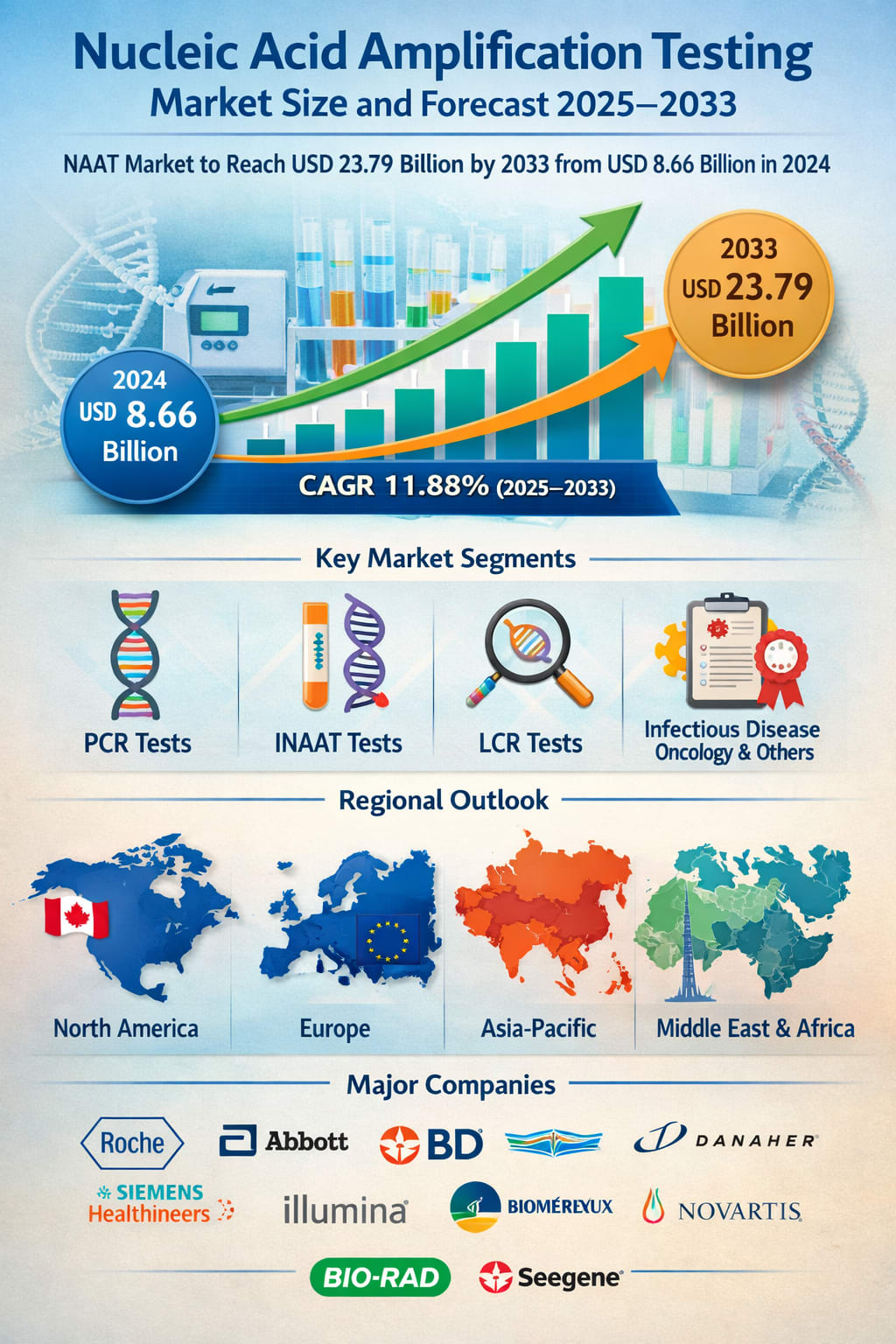
According to Renub Research estimates, the Nucleic Acid Amplification Testing Market is expected to grow from US$ 8.66 billion in 2024 to US$ 23.79 billion by 2033, expanding at a robust CAGR of 11.88% from 2025 to 2033. This rapid growth reflects not only technological progress but also a structural shift in how the world approaches disease detection, prevention, and personalized medicine.
From infectious disease outbreaks to cancer diagnostics and genetic disorder screening, NAAT technologies—especially PCR-based methods—have become indispensable tools in modern healthcare. The COVID-19 pandemic, in particular, accelerated global adoption and permanently reshaped expectations around diagnostic speed and accuracy.
What Is Nucleic Acid Amplification Testing (NAAT)?
Nucleic Acid Amplification Testing refers to a set of molecular diagnostic techniques that amplify and detect DNA or RNA from a biological sample. By increasing the amount of target genetic material, these tests can identify diseases even when only tiny amounts of pathogen or abnormal genetic sequences are present.
The most widely known NAAT method is Polymerase Chain Reaction (PCR), but the field also includes Isothermal Nucleic Acid Amplification Technologies (INAAT) and Ligase Chain Reaction (LCR), among others. Each method offers unique advantages in terms of speed, sensitivity, infrastructure needs, and point-of-care usability.
What makes NAAT so valuable is its combination of high sensitivity, high specificity, and rapid turnaround time—a trio that traditional diagnostic methods often struggle to deliver simultaneously.
Market Overview: A Sector Shaped by Urgency and Innovation
The global NAAT market is growing at a time when healthcare systems are under increasing pressure to deliver early, accurate, and scalable diagnostics. Rising incidences of infectious diseases, expanding cancer screening programs, and growing awareness of genetic disorders are all fueling demand.
The COVID-19 pandemic served as a global stress test for diagnostic infrastructure. PCR testing became a household term, and governments, hospitals, and laboratories invested heavily in molecular testing capacity. This surge did more than address a short-term crisis—it permanently raised the baseline demand for advanced molecular diagnostics worldwide.
Beyond COVID-19, emerging infectious diseases such as mpox (monkeypox), drug-resistant tuberculosis, and novel viral threats continue to reinforce the need for fast and reliable NAAT solutions. Regulatory approvals and emergency use authorizations for new tests have further accelerated market momentum.
Key Drivers of Market Growth
1. Shift Toward Point-of-Care Testing
One of the most important trends reshaping the NAAT market is the move toward point-of-care (POC) testing. Instead of sending samples to centralized laboratories and waiting days for results, healthcare providers increasingly want on-site, near-patient diagnostics that deliver answers within minutes or hours.
This shift is especially critical in:
Emergency departments
Remote or resource-limited settings
Airports and border checkpoints
Primary care clinics
Compact, user-friendly NAAT platforms are making molecular diagnostics more accessible than ever. For example, Cepheid’s recent proof-of-concept systems aim to simplify molecular testing in frontline care environments, supporting rapid decision-making and better patient outcomes.
As technology continues to miniaturize and automate, point-of-care NAAT is expected to play a growing role in controlling outbreaks, reducing treatment delays, and improving overall healthcare efficiency.
2. Transition to High-Throughput Systems and Automation
At the other end of the spectrum, large laboratories are facing soaring testing volumes. To cope with this demand, there is a strong push toward automation and high-throughput NAAT systems.
Modern automated platforms integrate:
Sample preparation
Amplification
Detection and analysis
into a single streamlined workflow. This not only reduces human error but also improves turnaround times and consistency, which are critical in high-volume diagnostic environments.
Companies are investing heavily in robotic liquid handling systems and intelligent software solutions that can process hundreds or even thousands of samples per day. These advancements are turning molecular diagnostics into a scalable, industrial-grade operation without sacrificing accuracy.
3. Rapid Technological Advancements
Technological innovation remains a cornerstone of the NAAT market’s expansion. New amplification methods such as loop-mediated isothermal amplification (LAMP) and fast PCR have dramatically reduced testing times while maintaining high sensitivity.
Meanwhile, digital PCR (ddPCR) and other next-generation techniques are pushing the boundaries of detection, allowing clinicians to identify extremely low levels of genetic material—crucial for early cancer detection, minimal residual disease monitoring, and viral load quantification.
Equally important is the integration of NAAT platforms with digital health systems, including:
Laboratory information systems (LIS)
Telemedicine platforms
Real-time data analytics tools
This digital convergence enhances clinical decision-making, supports remote consultations, and strengthens disease surveillance at a population level.
Challenges Facing the NAAT Market
High Cost of Equipment and Tests
Despite its advantages, NAAT technology remains expensive, particularly for low- and middle-income countries. The cost barriers include:
Sophisticated instruments
High-quality reagents
Maintenance and calibration
Need for skilled personnel
For smaller healthcare facilities and under-resourced regions, these requirements can be prohibitive. As a result, access to advanced molecular diagnostics remains uneven, contributing to global disparities in disease detection and treatment outcomes.
Complex Regulatory Landscape
Regulatory approval for NAAT products is both essential and demanding. Authorities such as the U.S. FDA and the European regulators require extensive clinical validation data to prove:
Accuracy
Sensitivity
Specificity
Reproducibility
While these standards protect patient safety, they also increase development costs and extend time-to-market, especially for smaller companies and startups. Additionally, differing regulatory requirements across countries complicate global commercialization strategies and can slow the spread of innovative diagnostic solutions.
Regional Market Overview
United States
The United States represents one of the most mature and technologically advanced NAAT markets in the world. Strong R&D infrastructure, favorable reimbursement policies, and a high burden of infectious and chronic diseases support widespread adoption across hospitals, reference laboratories, and point-of-care settings.
The country’s leadership in biotechnology innovation continues to drive new product development and early adoption of next-generation molecular diagnostics.
United Kingdom
In the UK, the National Health Service (NHS) has played a pivotal role in integrating NAAT into routine clinical practice, particularly for infectious disease detection and genetic screening. The COVID-19 pandemic significantly expanded molecular testing capacity and reinforced the strategic importance of rapid diagnostics.
Ongoing investment in biotechnology research ensures that the UK remains at the forefront of NAAT innovation while maintaining strong regulatory oversight.
India
India’s NAAT market is growing rapidly, driven by rising healthcare spending and a high burden of infectious diseases such as tuberculosis. Government initiatives, including the National Tuberculosis Elimination Program, have promoted the use of molecular tests like Truenat and CBNAAT, especially in underserved areas.
While challenges related to cost and infrastructure remain, continued policy support and technological progress are expected to sustain strong growth in the coming years.
United Arab Emirates
The UAE has emerged as a regional leader in advanced diagnostics, supported by high healthcare investments and strong partnerships with global healthcare providers. NAAT technologies are widely used for infectious disease surveillance and genetic testing, a trend further accelerated by the COVID-19 pandemic.
The country’s focus on innovation and healthcare quality positions it as a key hub for molecular diagnostics in the Middle East.
Recent Industry Developments
In October 2024, the World Health Organization approved the first diagnostic test for mpox (monkeypox), marking a significant milestone in global outbreak preparedness. Such developments highlight how NAAT continues to play a critical role in rapid response to emerging infectious threats.
Market Segmentation
By Type
Polymerase Chain Reaction (PCR) Tests
Isothermal Nucleic Acid Amplification Technology (INAAT) Tests
Ligase Chain Reaction (LCR) Tests
By Application
Infectious Disease Testing
Oncology Testing
Others
By End Use
Central & Reference Laboratories
Hospitals
Others
By Region
North America: United States, Canada
Europe: France, Germany, Italy, Spain, United Kingdom, Belgium, Netherlands, Turkey
Asia Pacific: China, Japan, India, Australia, South Korea, Thailand, Malaysia, Indonesia, New Zealand
Latin America: Brazil, Mexico, Argentina
Middle East & Africa: Saudi Arabia, United Arab Emirates, South Africa
Key Companies Profiled
F. Hoffmann-La Roche Ltd
Becton, Dickinson and Company
Danaher Corporation
Abbott Laboratories
Illumina, Inc.
Siemens Healthineers
bioMérieux SA
Novartis AG
Bio-Rad Laboratories, Inc.
Seegene Inc.
Each of these players is actively investing in innovation, automation, and global expansion to strengthen their position in the fast-evolving molecular diagnostics landscape.
Final Thoughts: The Future of NAAT Is Molecular—and Mainstream
The global Nucleic Acid Amplification Testing market is no longer a niche segment of diagnostics—it is becoming a foundational pillar of modern healthcare. With the market projected to nearly triple in value from 2024 to 2033, the message is clear: molecular diagnostics are here to stay.
Driven by technological innovation, expanding clinical applications, and the ongoing need for rapid, accurate testing, NAAT will continue to reshape how diseases are detected, monitored, and managed. While challenges related to cost and regulation persist, the long-term trajectory points toward broader access, smarter systems, and more personalized care.
About the Creator
Sakshi Sharma
Content Writer with 7+ years of experience crafting SEO-driven blogs, web copy & research reports. Skilled in creating engaging, audience-focused content across diverse industries.
Keep reading
More stories from Sakshi Sharma and writers in Trader and other communities.
Global Off-Road Motorcycle Market Size and Forecast 2025–2033
Introduction The global off-road motorcycle market is riding a powerful wave of transformation. Once considered a niche segment reserved for professional racers and hardcore adventure enthusiasts, off-road motorcycles have steadily moved into the mainstream. Today, they represent a dynamic blend of sport, recreation, lifestyle aspiration, and technological innovation.
By Sakshi Sharmaabout 19 hours ago in Trader
There's A Hole in My Bucket
It’s a well-known fact that Liza Dufresne was always the brains in the family. She was the one who always came up with the brilliant schemes the Dufresne kids carried out when they were younger. Like when they tricked Mrs. Claybourn into paying for a trip to Disney World. Liza convinced her that their parents had been kidnapped and were being held for ransom for the total price of three tickets. In reality, they were away on a weekend getaway for their anniversary. When they returned, Liza told the Claybourns that they did not like to talk about the ordeal. Their parents never found out how they got the money. Mrs. Claybourn never found out that the Dufresne parents were never really in any danger.
By David E. Perry4 days ago in Fiction



Comments
There are no comments for this story
Be the first to respond and start the conversation.