
Nucleic Acid Methylation Market Size and Forecast 2025–2033
How Epigenetics, AI, and Precision Medicine Are Powering a Multi-Billion-Dollar Transformation in Global Healthcare

Global Nucleic Acid Methylation Market Overview
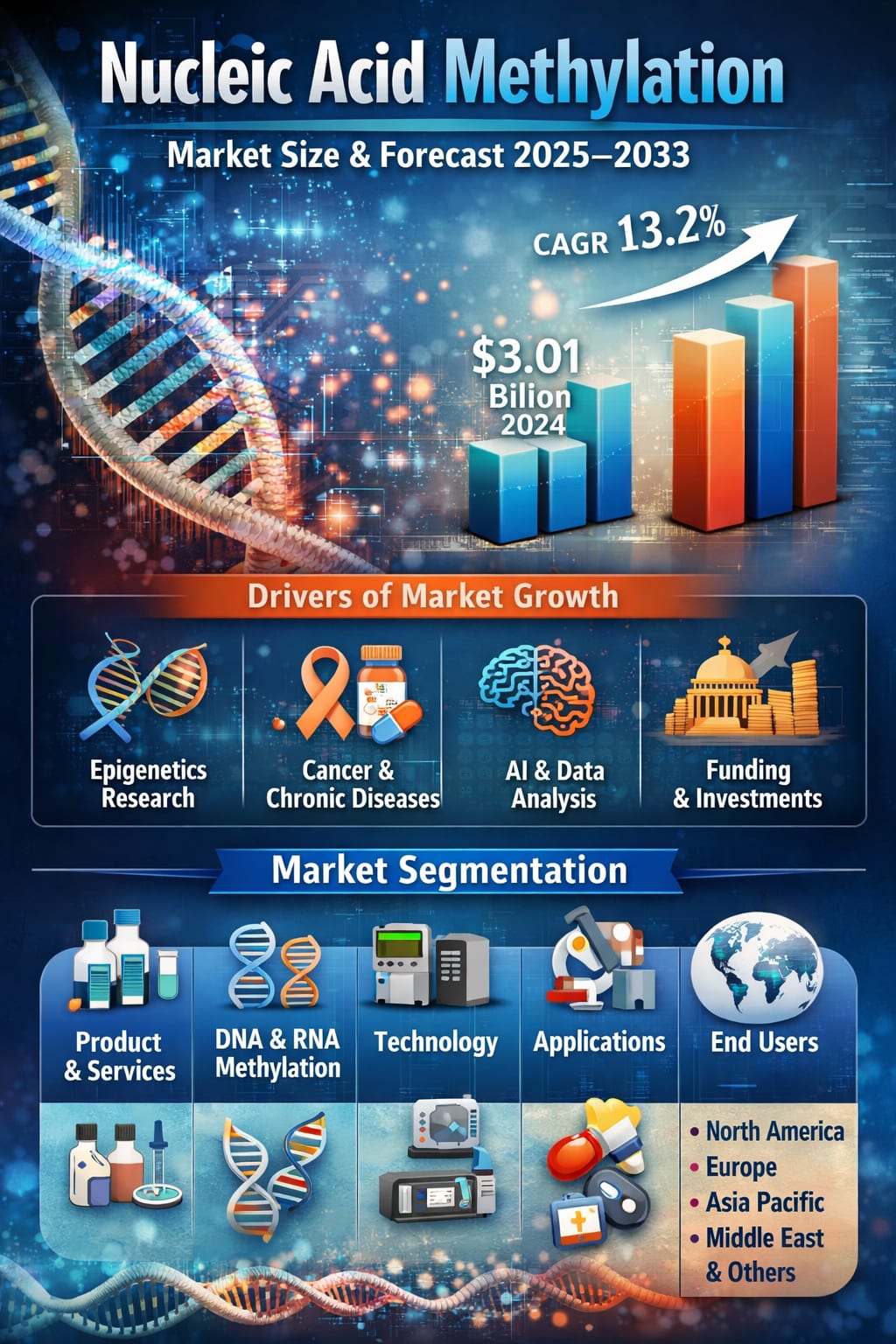
The Global Nucleic Acid Methylation Market is entering a powerful growth phase, driven by rapid advances in epigenetics, sequencing technologies, and precision medicine. According to Renub Research, the market is expected to reach US$ 9.19 billion by 2033, up from US$ 3.01 billion in 2024, expanding at a robust CAGR of 13.2% from 2025 to 2033.
Nucleic acid methylation—covering both DNA methylation and RNA methylation—plays a central role in regulating gene expression without altering the underlying genetic code. These epigenetic modifications influence development, aging, and the onset and progression of diseases such as cancer, neurological disorders, cardiovascular conditions, and autoimmune diseases. As a result, methylation analysis has become a cornerstone of modern biomedical research, drug discovery, and advanced diagnostics.
What makes this market especially dynamic is the convergence of biology and data science. Artificial intelligence (AI), machine learning, and advanced bioinformatics platforms are now being used to interpret massive methylation datasets, accelerating discoveries and improving clinical decision-making. At the same time, falling costs of sequencing and mass spectrometry, combined with increased funding for cancer research and precision medicine, are making methylation technologies more accessible across research institutes, biotech firms, and hospitals worldwide.
Why Nucleic Acid Methylation Matters in Modern Medicine
Methylation is a chemical process in which methyl groups are added to DNA or RNA molecules, influencing how genes are turned on or off. In healthy cells, this process is tightly regulated. In disease states—especially cancer—abnormal methylation patterns can silence tumor suppressor genes or activate oncogenes, contributing to uncontrolled cell growth.
Because of this, methylation patterns have emerged as powerful biomarkers for:
Early disease detection
Prognosis and risk stratification
Monitoring treatment response
Guiding personalized therapy decisions
Beyond oncology, methylation research is expanding rapidly in neurology, immunology, metabolic diseases, and rare genetic disorders, further broadening the commercial and clinical relevance of this market.
AI and the Future of Methylation Research
One of the most exciting developments in this field is the integration of artificial intelligence into methylation data analysis. AI-powered tools can process enormous datasets, detect subtle patterns, and predict how specific methylation changes affect gene expression and treatment outcomes.
In July 2024, researchers from Cambridge University and University College London reported an AI system capable of diagnosing 13 different cancer types with 98.2% accuracy by analyzing DNA methylation patterns. This breakthrough highlights how AI could soon transform cancer screening, enabling earlier and more accurate diagnoses and significantly improving patient outcomes.
As these tools mature, AI is expected to play a growing role in:
Drug target identification
Biomarker discovery
Patient stratification for clinical trials
Personalized treatment planning
In response, both biotechnology companies and academic institutions are investing heavily in AI-driven bioinformatics platforms, making data interpretation faster, more reliable, and more scalable for large clinical studies.
Key Growth Drivers in the Nucleic Acid Methylation Market
1. Advances in Epigenetics Research
A deeper understanding of epigenetics is one of the strongest forces behind market growth. Researchers now recognize that methylation is not just a secondary biological process—it is a core regulator of gene activity with direct implications for health and disease.
As studies continue to uncover how methylation influences cancer, neurological disorders, and developmental conditions, demand is rising for kits, reagents, enzymes, sequencing platforms, and analytical software. These tools are increasingly used in both basic research and translational medicine, fueling sustained market expansion.
2. Rising Prevalence of Chronic Diseases
The global increase in chronic diseases—particularly cancer, cardiovascular diseases, and neurological disorders—is pushing healthcare systems toward earlier diagnosis and more personalized treatment strategies. Since abnormal methylation patterns often appear early in disease development, methylation-based biomarkers are gaining traction as tools for early detection and risk assessment.
This shift toward preventive and precision healthcare is significantly boosting demand for methylation analysis in clinical diagnostics and therapeutic decision-making.
3. Government and Private Investments
Public and private investments in genomics and epigenetics research are accelerating innovation across the sector. Governments, pharmaceutical companies, and biotech firms are funding:
New methylation-based diagnostic platforms
Epigenetic drug discovery programs
Large-scale clinical studies
Advanced research infrastructure
These investments are also fostering industry–academia collaborations, speeding up the translation of laboratory discoveries into real-world clinical applications. As funding continues to flow into cancer research and precision medicine, the nucleic acid methylation market is poised for long-term growth.
Challenges Facing the Market
1. Limited Awareness and Clinical Adoption
Despite strong scientific evidence, methylation-based diagnostics and therapies are not yet widely adopted in routine clinical practice. Many healthcare professionals are still unfamiliar with the full clinical potential of methylation biomarkers, and some remain cautious about integrating new technologies into established workflows.
Expanding education, clinical guidelines, and real-world evidence will be crucial to driving broader adoption in hospitals and diagnostic laboratories.
2. Data Interpretation and Bioinformatics Complexity
Methylation studies generate massive and highly complex datasets. Interpreting these data requires advanced bioinformatics tools and specialized expertise. Variations in methylation across tissues, individuals, and disease states further complicate analysis.
To unlock the full clinical value of methylation data, the industry needs more user-friendly, standardized, and reliable bioinformatics platforms that can turn raw data into actionable insights for researchers and clinicians alike.
Regional Market Insights
United States
The United States leads the global nucleic acid methylation market, supported by strong investments in genomics, a vibrant biotech ecosystem, and widespread adoption of precision medicine. Methylation analysis is increasingly used in cancer diagnostics, drug development, and personalized therapy planning.
While high costs and regulatory complexities remain challenges, ongoing technological advances and improved data analysis tools are expected to drive continued growth in the U.S. market.
Germany
Germany’s market benefits from a strong pharmaceutical and biotechnology sector, world-class research institutions, and a robust healthcare system. The country is seeing rising adoption of next-generation sequencing and advanced bioinformatics tools for methylation analysis.
Close collaboration between academia and industry is accelerating the translation of epigenetics research into clinical applications, supporting steady market expansion despite regulatory and cost-related hurdles.
India
India is emerging as a fast-growing market, driven by expanding biotech and pharmaceutical industries, increasing research activity, and improving healthcare infrastructure. The adoption of NGS and advanced analytical tools is making methylation research more accessible and cost-effective.
Although challenges such as pricing and regulatory complexity remain, India’s focus on medical research and innovation is expected to support strong long-term growth.
Saudi Arabia
Saudi Arabia is investing heavily in healthcare modernization and precision medicine as part of its broader development strategy. Growing interest in advanced diagnostics and epigenetics research is fueling demand for methylation technologies.
With increasing industry–academia collaboration and improved research infrastructure, the country’s nucleic acid methylation market is expected to expand steadily in the coming years.
Recent Developments in the Industry
The pace of innovation in this market remains strong:
February 2025: Alida Biosciences launched EpiPlex, the first technology to use short-read sequencing to simultaneously detect and quantify multiple RNA modifications while also providing gene expression data. This all-in-one solution simplifies research into RNA modifications involved in disease, aging, and development.
January 2025: New England Biolabs introduced EM-seq v2, an advanced enzyme-based alternative to bisulfite sequencing for detecting 5mC and 5hmC. The new kit offers a faster workflow, reduced DNA damage, and broader input range, improving the efficiency of epigenetic analysis.
These developments highlight how the market is moving toward more accurate, faster, and more user-friendly methylation analysis solutions.
Market Segmentation
By Product & Service
Kits & Reagents
Enzymes
Services
Instruments & Software
Consumables
By Type
DNA Methylation
RNA Methylation
By Technology
Next-Generation Sequencing (NGS)
Bisulfite Sequencing & PCR-based Techniques
Microarray-based Methylation Analysis
Mass Spectrometry
Hybridization-based & Antibody-based Detection
By Application
Drug Discovery & Personalized Medicines
Clinical Diagnostics
Others
By End Use
Pharmaceutical & Biotechnology Companies
Academic & Research Institutes
Hospitals & Diagnostic Laboratories
By Region
North America: United States, Canada
Europe: France, Germany, Italy, Spain, United Kingdom, Belgium, Netherlands, Turkey
Asia Pacific: China, Japan, India, Australia, South Korea, Thailand, Malaysia, Indonesia, New Zealand
Latin America: Brazil, Mexico, Argentina
Middle East & Africa: South Africa, Saudi Arabia, United Arab Emirates
Competitive Landscape
Leading players in the nucleic acid methylation market are focusing on innovation, strategic partnerships, and expanding their technology portfolios. Key companies include:
New England Biolabs
Thermo Fisher Scientific Inc.
Illumina Inc.
Abcam plc
Agilent Technologies Inc.
F. Hoffmann-La Roche Ltd
Bio-Rad Laboratories, Inc.
Exact Sciences Corporation
These companies are analyzed across four key dimensions: overview, key persons, recent developments & strategies, and revenue analysis, reflecting a highly competitive and innovation-driven market environment.
Final Thoughts
The global nucleic acid methylation market is on a clear upward trajectory, fueled by breakthroughs in epigenetics, the rise of precision medicine, and the growing role of AI in biomedical research. With the market projected to grow from US$ 3.01 billion in 2024 to US$ 9.19 billion by 2033, methylation technologies are set to become a central pillar of future diagnostics and therapeutics.
While challenges remain—particularly around clinical adoption and data interpretation—the momentum is unmistakable. As costs fall, tools become more user-friendly, and clinical evidence continues to mount, nucleic acid methylation is poised to move from a specialized research tool to a mainstream component of modern healthcare.
About the Creator
Keep reading
More stories from shibansh kumar and writers in Trader and other communities.
Formulation Development Outsourcing Market Size and Forecast 2025–2033
Introduction: A Market Built on Speed, Science, and Specialization The global pharmaceutical industry is in the middle of a profound transformation. Drug pipelines are becoming more complex, regulatory expectations more demanding, and development timelines more compressed. In this environment, the Formulation Development Outsourcing Market is emerging as a critical enabler of innovation and efficiency.
By shibansh kumarabout 8 hours ago in Trader



Comments
There are no comments for this story
Be the first to respond and start the conversation.