
Philippines Pectin Market 2026: Clean-Label Demand, Food Processing Growth and Functional Ingredient Expansion
How natural ingredient trends, fruit supply advantages and processed food demand are shaping the Philippines pectin industry

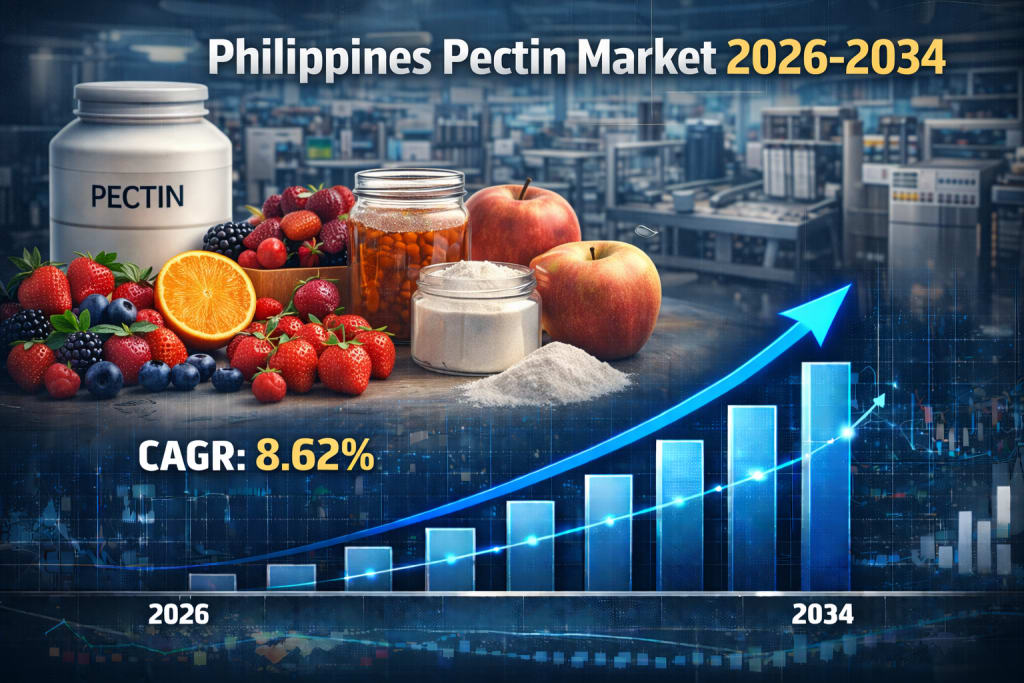
Philippines Pectin Market Overview
The Philippines pectin market is steadily expanding as food manufacturers increasingly prioritise natural and functional ingredients in product formulation. Pectin — a plant-derived polysaccharide extracted primarily from citrus and apple peels — serves as a gelling agent, stabiliser and thickener across a wide range of food and beverage applications. Its role in improving texture, shelf stability and fat replacement properties makes it an essential component in modern processed foods.
The Philippines pectin market size reached USD 6.2 million in 2025 and is projected to grow to USD 13.2 million by 2034, exhibiting a compound annual growth rate (CAGR) of 8.62% during 2026–2034. Market growth is driven by increasing clean-label product demand, expansion of the processed food sector and strong local fruit production supporting raw material availability.
Key Market Drivers
Rising Demand for Clean-Label and Natural Ingredients
Consumers in the Philippines are increasingly seeking minimally processed foods with recognisable ingredients. Pectin’s plant-based origin and non-synthetic characteristics position it as a preferred additive in clean-label formulations across jams, dairy beverages and fruit products.
Growth of Processed Food and Beverage Industry
Urbanisation and changing consumption patterns are accelerating demand for convenience and packaged foods. As manufacturers scale production of spreads, beverages, confectionery and dairy items, the need for stabilising and texturising agents such as pectin continues to rise.
Health Awareness and Nutritional Reformulation
Increasing awareness of diet-related health concerns is encouraging food companies to develop low-fat and reduced-sugar products. Pectin’s ability to act as a fat replacer and texture enhancer supports reformulation strategies targeting healthier product positioning.
Strong Domestic Fruit Production
The Philippines’ robust production of mangoes, citrus and other fruits provides a favourable raw material base for pectin extraction. Local supply availability enhances manufacturing potential and may reduce dependence on imports over time.
Request a Sample Report with the Latest 2026 Data & Forecasts
What the Opportunities Are
The Philippines pectin market presents meaningful opportunities as food innovation and ingredient localisation trends accelerate.
Expansion of Functional and Fortified Food Applications
Beyond traditional uses in jams and jellies, pectin is increasingly utilised in functional beverages, plant-based dairy alternatives and nutraceutical formulations. Manufacturers can leverage pectin’s stabilising and fibre-rich properties to develop value-added products aligned with wellness trends.
Development of Localised Pectin Extraction Capacity
The country’s strong fruit processing sector creates opportunities for domestic pectin extraction from citrus and mango by-products. Establishing local production capabilities could reduce import dependency, enhance value chain efficiency and support circular economy initiatives.
Growth in Dairy and Beverage Stabilisation Uses
Rising consumption of yoghurt drinks, fruit beverages and dairy desserts is driving demand for advanced texturising systems. Pectin’s compatibility with acidic environments makes it particularly valuable for beverage stabilisation, presenting strong application growth potential.
Innovation in Low-Sugar and Reduced-Fat Products
Food producers aiming to meet regulatory and consumer expectations around healthier formulations can utilise pectin as a multifunctional ingredient for texture maintenance in reduced-sugar or reduced-fat products, creating differentiation opportunities.
Cross-Industry Application Expansion
Although food and beverages dominate demand, pectin is gaining traction in pharmaceutical, personal care and nutraceutical formulations due to its biocompatibility and functional characteristics. This diversification can broaden market revenue streams over the forecast period.
Collectively, these opportunity areas indicate a transition toward a more integrated, innovation-driven and locally supported pectin ecosystem.
Recent News and Developments
January 2025: Food manufacturers across the Philippines increased reformulation efforts to incorporate natural stabilisers and clean-label ingredients, supporting broader adoption of pectin in processed food applications.
April 2025: Processed fruit and spread producers expanded production capacity, indirectly boosting demand for pectin as a core gelling agent in jam and preserve manufacturing.
August 2025: Ingredient suppliers introduced application-specific pectin solutions designed for beverage stabilisation and low-sugar confectionery, reflecting evolving formulation requirements among food processors.
November 2025: Industry stakeholders explored value-added utilisation of fruit processing by-products for ingredient extraction, highlighting emerging interest in localised pectin production and circular resource use.
Why You Should Know About the Philippines Pectin Market?
The Philippines pectin market represents a specialised yet strategically important segment within the broader food ingredient landscape. It reflects how consumer health awareness, processed food expansion and agricultural resource availability converge to shape ingredient demand dynamics.
With market value projected to reach USD 13.2 million by 2034, supported by clean-label trends, functional food innovation and potential domestic extraction initiatives, the sector offers opportunities for ingredient suppliers, food manufacturers and investors seeking exposure to high-growth specialty ingredients.
As food systems evolve toward natural functionality and sustainability, pectin is poised to remain a critical enabling ingredient within the Philippines’ expanding food processing ecosystem.
About the Creator
Keep reading
More stories from Manisha Dixit and writers in Trader and other communities.
Philippines Co-Working Office Space Market 2026: Hybrid Work Momentum, Startup Growth and Flexible Workplace Innovation
Philippines Co-Working Office Space Market Overview The market is rapidly gaining traction as businesses, freelancers and distributed teams increasingly prioritise flexibility and cost efficiency in workplace decisions. Co-working environments offer scalable office solutions, shared infrastructure and collaborative ecosystems that appeal to startups, SMEs and multinational organisations alike. As traditional long-term leases become less attractive in a hybrid work era, co-working spaces are emerging as a strategic component of workplace transformation across major Philippine business hubs.
By Manisha Dixitabout 9 hours ago in Trader
Australia Electric Motor Market Set for Steady Growth to USD 4.6 Billion by 2034 Driven by Electrification and Industrial Modernization
The Australia electric motor market is advancing steadily as the country transitions toward more electrified, automated, and energy efficient systems across transportation, industrial, infrastructure, and renewable energy segments. According to the latest IMARC Group analysis, the market reached a value of USD 3.3 billion in 2025 and is expected to grow to USD 4.6 billion by 2034, representing a compound annual growth rate (CAGR) of 3.33% over 2026–2034.
By Amélie Belle3 days ago in Trader



Comments
There are no comments for this story
Be the first to respond and start the conversation.