
Point of Sale Terminal Market Size & Forecast 2026–2034
From Cash Registers to Cloud Platforms: How POS Technology Is Reshaping Global Commerce

Introduction
The global Point of Sale (POS) terminal market is undergoing a powerful transformation, driven by the rapid shift toward digital payments, the expansion of modern retail and hospitality, and the growing need for faster, safer, and more integrated transaction systems. What was once a simple cash register has evolved into a sophisticated business management platform that connects payments, inventory, customer data, and analytics into one seamless ecosystem.
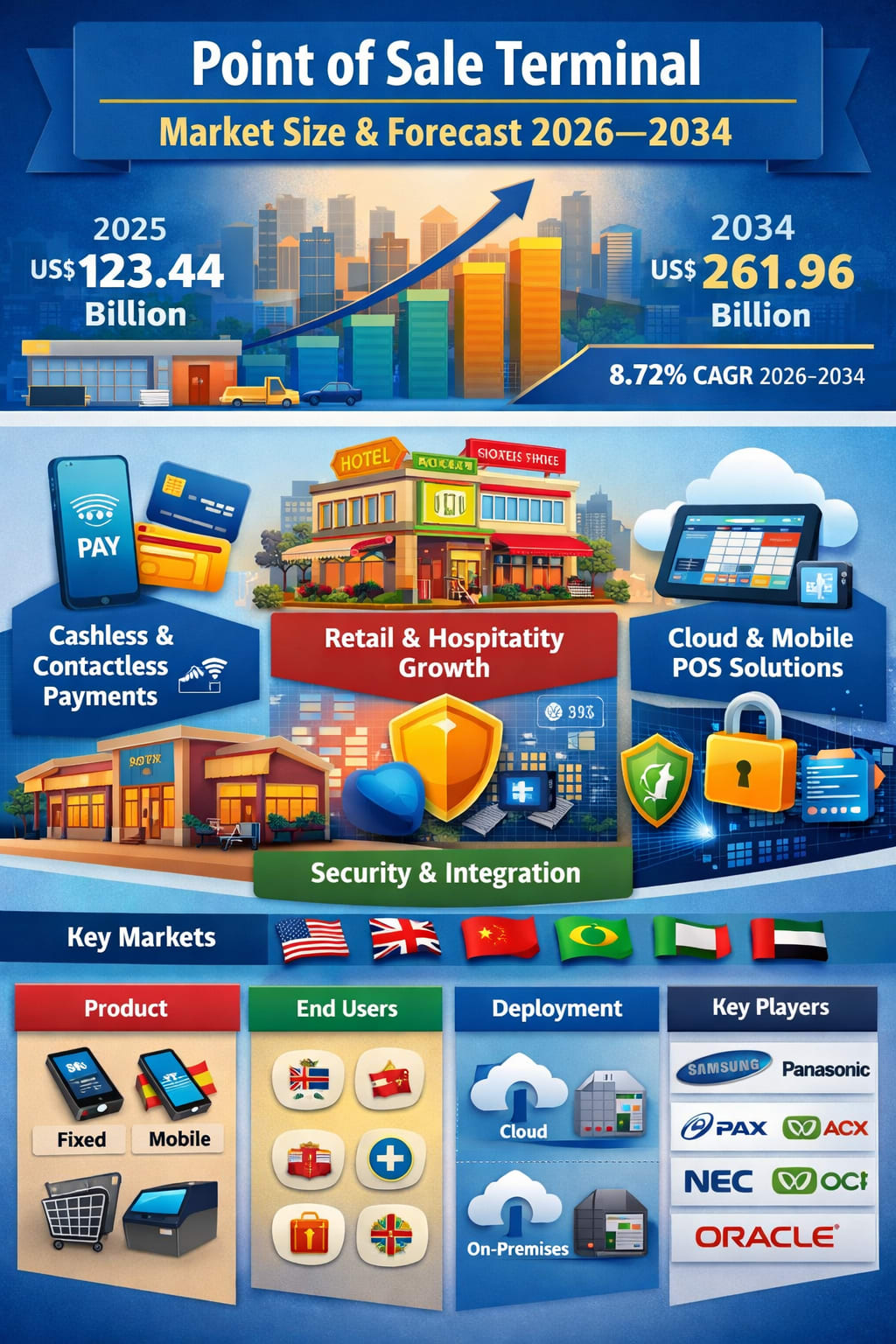
According to industry estimates based on Renub Research insights, the Point of Sale terminal industry is projected to grow steadily from US$ 123.44 billion in 2025 to US$ 261.96 billion by 2034, registering a Compound Annual Growth Rate (CAGR) of 8.72% during 2026–2034. This impressive growth trajectory reflects not only technological progress but also a fundamental change in how consumers pay and how businesses operate.
From small cafés adopting mobile POS systems to global retailers deploying cloud-based, AI-enabled checkout solutions, POS terminals are becoming the digital backbone of modern commerce.
Point of Sale Terminal Market Outlook
A Point of Sale terminal refers to a combination of hardware and software that enables businesses to conduct sales transactions, accept customer payments, and manage related commercial activities. Modern POS systems go far beyond simple billing. They integrate features such as inventory management, sales reporting, customer relationship management (CRM), receipt generation, and accounting system connectivity.
Today’s POS terminals come in multiple forms, including fixed POS systems, mobile POS (mPOS), tablet-based POS, and cloud-based POS solutions. These systems can be tailored to businesses of all sizes, from small retailers and restaurants to large enterprise chains.
Globally, the demand for POS terminals has surged due to the fast-paced shift toward cashless and contactless payments. Consumers increasingly prefer credit cards, debit cards, mobile wallets, QR code payments, and NFC-based tap-and-go transactions for their speed and convenience. At the same time, governments in many developing economies are actively promoting digital payments and financial inclusion, accelerating POS adoption among small and medium-sized enterprises (SMEs).
The rise of e-commerce, omnichannel retailing, and mobile commerce has further increased the need for integrated POS systems that can synchronize online and offline sales channels. Additionally, cloud-based and AI-powered POS platforms are gaining traction, offering businesses real-time insights, scalability, and improved operational efficiency.
Key Growth Drivers in the POS Terminal Market
Rapid Shift Toward Cashless and Contactless Payments
One of the most powerful drivers of the POS terminal market is the global move toward cashless and contactless payment methods. Consumers now expect fast, secure, and frictionless checkout experiences, whether they are shopping in a supermarket, dining at a restaurant, or paying for transportation services.
The COVID-19 pandemic significantly accelerated this trend by increasing awareness of touch-free and hygienic payment options. Even after the pandemic, these habits have remained deeply embedded in consumer behavior. Governments and financial institutions are also encouraging digital payments to improve transparency, reduce cash handling costs, and promote financial inclusion.
A notable example of this shift came in June 2025, when CaixaBank became the first financial institution in Spain to introduce the “Tap to Pay” solution on iPhone, allowing businesses to accept contactless payments directly on a smartphone without additional hardware. Backed by major payment networks such as Visa and Mastercard, such innovations highlight how mobility and simplicity are redefining payment acceptance.
Expansion of Retail, Hospitality, and Service Sectors
The continuous expansion of retail, hospitality, and service industries worldwide is another major growth catalyst for the POS terminal market. The rise of supermarkets, convenience stores, restaurants, cafés, hotels, and service outlets has created strong demand for efficient transaction processing and customer service management systems.
In developing economies, the rapid growth of organized retail and small businesses is driving widespread adoption of POS terminals. Modern POS solutions offer integrated functionalities such as sales analytics, inventory tracking, and customer management, making them highly attractive for businesses aiming to improve efficiency and decision-making.
The growth of omnichannel retail models, including click-and-collect and home delivery, has further increased the need for POS systems that can seamlessly connect online and offline sales channels. For example, in December 2025, Banner Health rolled out a cashless payment option across its facilities, aiming to improve efficiency, enhance security, and reduce operating costs while offering more convenient payment options to patients and visitors.
Technological Innovation and Cloud-Based POS Solutions
Technological advancements are transforming traditional POS terminals into intelligent, cloud-based business platforms. Cloud POS systems allow businesses to access data in real time, manage operations remotely, and automatically update software while synchronizing accounting, inventory, and loyalty programs.
Mobile and tablet-based POS systems are particularly attractive for small businesses and startups due to their lower upfront costs and greater portability. The integration of artificial intelligence (AI) and data analytics enables merchants to better understand customer behavior, optimize pricing strategies, and personalize marketing efforts.
A recent example of this trend is SAP’s launch of a cloud-based version of its Customer Checkout solution, designed to modernize retail operations and provide scalable, flexible alternatives to conventional POS systems. With native integration into SAP’s broader enterprise platforms, such solutions are helping businesses transition more quickly into omnichannel and data-driven retail models.
Challenges in the POS Terminal Market
High Initial Costs and Integration Complexity
Despite strong growth prospects, the POS terminal market faces notable challenges. One of the primary barriers is the high initial investment required for hardware, software, installation, and employee training—especially for small businesses. Integrating new POS systems with existing inventory management, ERP, and accounting platforms can also be time-consuming and resource-intensive.
In addition, many cloud-based and advanced POS solutions involve recurring subscription fees, maintenance costs, and upgrade expenses, which can strain the budgets of smaller enterprises.
Security Risks and Data Privacy Concerns
POS terminals handle highly sensitive financial and personal data, making them attractive targets for cyberattacks, fraud, and data breaches. Compliance with security standards such as PCI DSS requires continuous investment in cybersecurity measures.
Data privacy regulations in many regions further increase complexity and compliance costs. Even a minor security lapse can damage customer trust and result in significant financial and reputational losses for businesses, making security a critical concern across the industry.
Segment Insights
Point of Sale Terminal Software Market
POS software has evolved from simple billing tools into comprehensive business management platforms. Today’s solutions support transaction processing, inventory tracking, sales analytics, customer management, and detailed reporting. Growth in this segment is driven by demand for real-time insights, omnichannel integration, and customizable, industry-specific features.
Cloud-based, subscription-driven software models are gaining popularity due to lower upfront costs and automatic updates. Integration with accounting systems, loyalty programs, and digital payment gateways further enhances the value proposition of modern POS software.
Point of Sale Terminal Services Market
The POS services segment includes installation, system integration, maintenance, training, technical support, and managed services. As POS systems become more complex and security requirements more stringent, many businesses rely on third-party service providers to ensure smooth operations and compliance.
Managed POS services are especially popular among SMEs, as they reduce the burden on in-house IT teams and help minimize downtime while ensuring system reliability.
Point of Sale Terminal Cloud Market
The cloud POS market is expanding rapidly as businesses move away from on-premise systems toward more flexible, scalable cloud-based solutions. Cloud POS platforms enable remote access, real-time data synchronization, and advanced analytics, making them ideal for businesses operating across multiple locations or sales channels.
Application-Based Market Trends
Restaurants POS Market
Restaurants are among the fastest adopters of modern POS systems, driven by the need for fast order processing, table management, and seamless payment experiences. Features such as online ordering, delivery integration, and contactless payments have become essential. Mobile POS devices and self-service kiosks are increasingly common, especially in quick-service restaurants.
Healthcare POS Market
In healthcare, POS terminals are used for billing, appointment payments, pharmacy transactions, and insurance co-payments. Digitalization of healthcare services and the need for secure, compliant payment systems are driving adoption. Integration with hospital management systems and electronic health records improves efficiency and reduces billing errors.
Entertainment POS Market
Entertainment venues such as cinemas, amusement parks, and sports arenas rely on POS systems for high-volume ticketing, food and beverage sales, and merchandise transactions. Wireless and contactless POS solutions help reduce queues and improve customer experience, while integration with loyalty programs supports revenue optimization.
Regional Market Highlights
United States
The U.S. represents one of the most mature and technologically advanced POS markets globally. Widespread adoption of cashless payments, mobile wallets, and cloud-based POS systems continues to drive growth. In April 2025, Ingenico and Visa Cybersource pre-integrated payment apps on AXIUM terminals, significantly reducing merchant onboarding time.
United Kingdom
The UK is a highly developed contactless payment market, with strong adoption of NFC-based POS technology. Small and medium-sized businesses are increasingly turning to mobile and tablet POS systems. In May 2025, Square launched the Square Handheld, a portable POS device integrating payments, barcode scanning, and inventory management.
China
China remains a key growth market, supported by its massive retail sector and strong digital payment ecosystem. While mobile payments dominate, POS terminals continue to play a vital role in enabling QR code, card, and contactless payments. In March 2025, China introduced new payment services and overseas card “tap-to-ride” metro options for international visitors.
Brazil
Brazil’s POS market is growing due to rising electronic payment adoption and government support for financial inclusion. Affordable and mobile POS devices are particularly popular among SMEs, street vendors, and restaurants, although infrastructure and cost challenges remain.
UAE
The UAE is one of the fastest-growing POS markets, driven by strong government support for digital transformation, high smartphone penetration, and a thriving retail and tourism sector. Cloud-based and advanced POS solutions are seeing rapid adoption across industries.
Market Segmentation Overview
By Product: Fixed, Mobile
By Component: Hardware, Software, Services
By Deployment: On-Premises, Cloud
By End Use: Restaurants, Retail, Healthcare, Warehouse, Hospitality, Entertainment, Others
By Region: North America, Europe, Asia Pacific, Latin America, Middle East & Africa
Key Players in the Market
Major companies shaping the global POS terminal market include Samsung Electronics, Panasonic, NEC, PAX Technology, NCR Voyix, Fujitsu, Agilysys, and Oracle Corporation. These companies are focusing on innovation, cloud integration, security enhancements, and industry-specific solutions to strengthen their competitive positions.
Final Thoughts
The global Point of Sale terminal market is no longer just about processing payments—it is about enabling smarter, faster, and more connected business operations. With the market projected to grow from US$ 123.44 billion in 2025 to US$ 261.96 billion by 2034 at a CAGR of 8.72%, the future of POS technology looks robust and transformative.
Driven by the rise of cashless payments, cloud computing, AI integration, and omnichannel retailing, POS terminals are becoming essential digital infrastructure for businesses worldwide. While challenges such as cost, integration, and security remain, continuous innovation and expanding digital ecosystems are expected to keep the market on a strong growth path throughout the 2026–2034 forecast period.
About the Creator
Keep reading
More stories from shibansh kumar and writers in Trader and other communities.
United States Next-Generation Sequencing Market Size & Forecast (2026–2034)
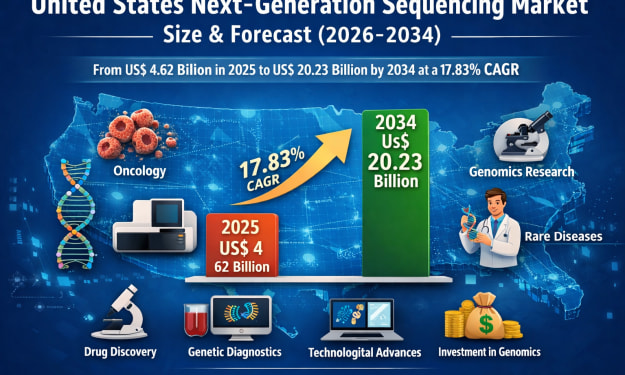
United States Next Generation Sequencing Market Overview The United States Next Generation Sequencing (NGS) market is entering a powerful growth phase, driven by rapid technological innovation, expanding clinical applications, and the accelerating shift toward precision medicine. According to Renub Research, the U.S. NGS market is projected to grow from US$ 4.62 billion in 2025 to US$ 20.23 billion by 2034, registering a robust compound annual growth rate (CAGR) of 17.83% during 2026–2034.
By shibansh kumarabout 10 hours ago in Trader
The Paradox of Tokenization: How a Technology of Freedom Can Become a System of Control
Blockchain was once introduced as a technology of liberation. A currency free from central authority, transactions resistant to censorship, and a system where trust is replaced by code. These ideas positioned it as an alternative to traditional financial structures and inspired many to imagine a more open economic order. Yet technology itself is neutral, while the structures that design and deploy it are not. Today, blockchain is no longer just a tool of freedom. It is also becoming a new arena where power is reorganized.
By crypto geniea day ago in Trader
Global Petroleum Coke Market Analysis, Trends & Growth Drivers
Overview Petroleum Coke Market Petroleum coke (petcoke) is a solid carbonaceous residue left after heavy crude oil fractions are thermally cracked during refining. It is valued for its high calorific value and cost-effectiveness compared to traditional fossil fuels like coal. The product is widely used as:
By James Smith6 days ago in Trader
The Cairn Beside the Lake
And so it came to pass that King Ertharion, Tenth King of Lombaia, stood beside the still lake below unrelenting and unassailable cliffs with the remainder of his harried host. In what was the tenth year of his reign and his forty-fourth upon this great green earth, Menigo the Betrayer, cousin of King Ertharion, pressed home his false claim.
By Matthew J. Fromm4 days ago in Fiction



Comments
There are no comments for this story
Be the first to respond and start the conversation.