
United States Next-Generation Sequencing Market Size & Forecast (2026–2034)
How Precision Medicine, Oncology, and Genomics Innovation Are Powering a $20.23 Billion NGS Boom in the U.S.

United States Next Generation Sequencing Market Overview
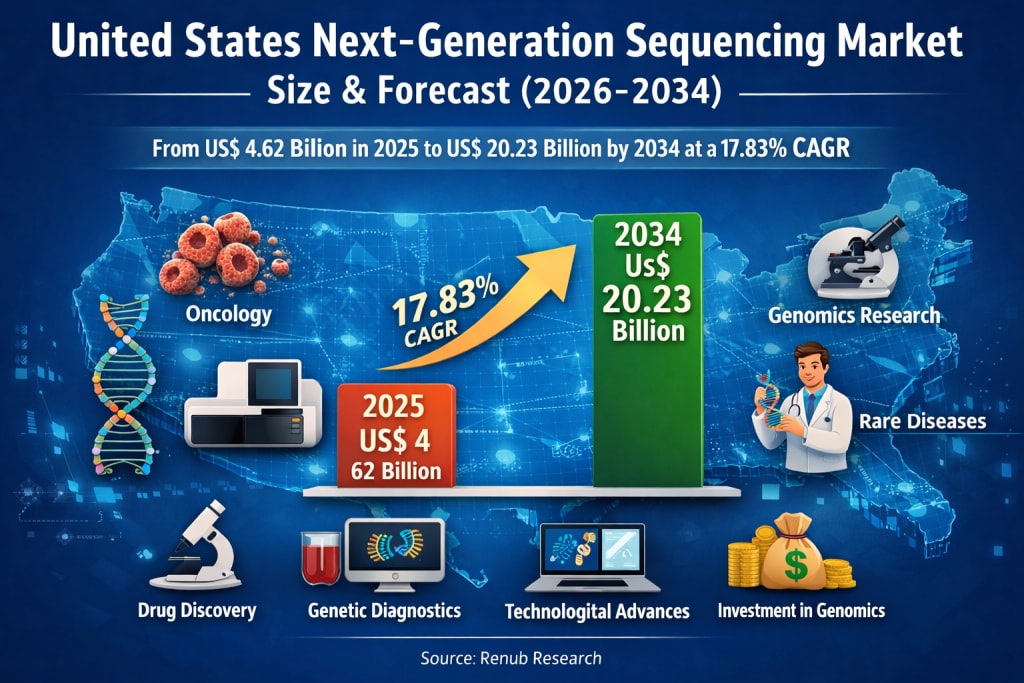
The United States Next Generation Sequencing (NGS) market is entering a powerful growth phase, driven by rapid technological innovation, expanding clinical applications, and the accelerating shift toward precision medicine. According to Renub Research, the U.S. NGS market is projected to grow from US$ 4.62 billion in 2025 to US$ 20.23 billion by 2034, registering a robust compound annual growth rate (CAGR) of 17.83% during 2026–2034.
This remarkable expansion reflects how deeply genomics is becoming embedded in modern healthcare, pharmaceutical research, and life sciences. From cancer diagnostics and rare disease screening to drug discovery and infectious disease surveillance, NGS is no longer a niche research tool—it is becoming a foundational technology for data-driven medicine in the United States.
Next-Generation Sequencing, also known as second-generation sequencing, enables the rapid and parallel sequencing of millions of DNA or RNA fragments. Compared to traditional sequencing techniques, NGS offers higher speed, greater accuracy, and significantly lower cost per base, making large-scale genomic analysis practical for both research and clinical settings.
In the U.S., the combination of advanced healthcare infrastructure, strong research funding, a vibrant biotech ecosystem, and supportive innovation environments has positioned the country as a global leader in genomics and sequencing technologies. As personalized medicine continues to gain momentum, the demand for fast, scalable, and cost-effective sequencing solutions is expected to intensify throughout the forecast period.
Next Generation Sequencing in the USA: Market Analysis
The adoption of NGS in the United States spans a wide range of applications, including cancer genomics, rare disease diagnostics, reproductive health testing, infectious disease monitoring, and drug development. Academic institutions, research laboratories, pharmaceutical companies, and clinical diagnostic centers are all increasingly dependent on NGS platforms for high-throughput genetic analysis.
One of the most transformative impacts of NGS has been in oncology. Tumor profiling, mutation detection, and treatment selection are now routinely guided by genomic insights. Similarly, in rare disease diagnostics, NGS has drastically reduced the time required to reach accurate diagnoses, offering hope to patients who previously faced long diagnostic journeys.
The U.S. healthcare system is also witnessing broader integration of genomics into routine clinical practice. Large-scale population genomics initiatives, expanding newborn screening programs, and the rise of companion diagnostics are further strengthening the role of NGS across the care continuum.
Key Growth Drivers in the United States NGS Market
Increased Utilization of Precision Medicine
Precision medicine is one of the strongest forces shaping the U.S. NGS market. By enabling detailed genetic profiling, NGS supports highly personalized treatment strategies, especially in oncology, rare diseases, and inherited disorders. Physicians increasingly rely on genomic data to identify mutations, select targeted therapies, and predict patient responses to specific drugs.
National precision medicine initiatives and large-scale sequencing programs are accelerating the integration of NGS into mainstream healthcare. Pharmaceutical companies are also using NGS to develop companion diagnostics and to stratify patients in clinical trials, improving both drug development efficiency and therapeutic outcomes.
The growing acceptance of personalized healthcare models across the U.S. is directly translating into rising demand for high-throughput, accurate, and cost-effective sequencing platforms.
World-Class Research Infrastructure and Genomics Funding
The United States benefits from one of the most advanced genomics research ecosystems in the world. Public and private investments continue to flow into population genomics, cancer research, infectious disease surveillance, and translational medicine.
Government agencies, academic institutions, and biotechnology firms consistently invest in expanding sequencing capacity and improving data analysis capabilities. This strong funding environment not only fuels technological innovation but also ensures widespread adoption of NGS across both research and clinical domains.
Continuous launches of new genetic tests and expanded clinical applications further reinforce the market’s long-term growth outlook.
Technological Progress and Cost Reductions
Rapid advances in sequencing chemistry, automation, and bioinformatics are making NGS faster, more accurate, and more affordable. Improvements in workflow efficiency and data processing have lowered operational barriers, enabling broader adoption beyond large research centers into hospitals and regional laboratories.
The emergence of compact benchtop sequencers is also making in-house sequencing more accessible for clinical settings. As costs continue to decline and performance continues to improve, NGS is steadily transitioning from a specialized research tool into a routine diagnostic technology.
Challenges in the United States NGS Market
Complexity in Data Management and Interpretation
While NGS generates enormous volumes of valuable genomic data, managing and interpreting this information remains a significant challenge. Many healthcare facilities struggle with data storage, integration, and analysis due to limitations in bioinformatics infrastructure.
Additionally, the shortage of trained bioinformaticians and genetic counselors increases operational complexity and costs. These challenges can slow adoption, particularly among smaller laboratories and community hospitals.
Regulatory and Reimbursement Uncertainty
Regulatory approval pathways and reimbursement policies for NGS-based tests in the U.S. remain complex and sometimes inconsistent. Differences between public and private insurance coverage create financial uncertainty for diagnostic laboratories and test developers.
Compliance with evolving regulatory standards can also increase development costs and delay the commercialization of new sequencing-based diagnostics, posing an ongoing challenge for market participants.
United States NGS Market by Segment
NGS Instruments Market
The U.S. market for NGS instruments is driven by strong demand from research institutions, clinical laboratories, and pharmaceutical companies. High-throughput and benchtop platforms are widely used for cancer research, infectious disease testing, and whole-genome sequencing. Continuous upgrades in speed, accuracy, and automation are supporting steady growth in this segment.
NGS Services Market
NGS services are gaining popularity among organizations seeking to avoid high capital investment in equipment and infrastructure. Outsourcing sequencing and data analysis has become common in clinical research, drug development, and academic studies, particularly among pharmaceutical and biotechnology companies.
NGS Diagnostics Market
NGS-based diagnostics are increasingly used for cancer profiling, rare disease diagnosis, prenatal screening, and pathogen detection. Growing clinical acceptance, expanding test menus, and improving reimbursement coverage for certain indications are driving strong growth in this segment.
NGS in Drug Discovery
NGS plays a critical role in modern drug discovery by supporting target identification, biomarker research, pharmacogenomics, and companion diagnostic development. U.S. pharmaceutical and biotech companies rely heavily on NGS to better understand disease mechanisms and optimize clinical trial design, accelerating the development of more effective therapies.
Technology Landscape
Sequencing by Synthesis (SBS)
Sequencing by synthesis currently dominates the U.S. NGS market due to its high accuracy, scalability, and broad application range. It is widely used for whole-genome sequencing, whole-exome sequencing, RNA sequencing, and targeted gene panels. Ongoing improvements in automation and bioinformatics have further strengthened its commercial leadership.
Ion Semiconductor Sequencing
Ion semiconductor sequencing is emerging as a fast and cost-efficient option for targeted and rapid sequencing applications. Its shorter run times and simpler workflows make it attractive for clinical laboratories, particularly for infectious disease testing and focused cancer panels.
Other Technologies
Single-molecule real-time sequencing and nanopore sequencing are also gaining attention for specialized applications that require long-read capabilities and real-time analysis, further diversifying the U.S. NGS technology landscape.
End-User Trends: Hospitals and Clinics
Hospitals and clinics are becoming one of the most important end-user segments for NGS in the United States. As genomics becomes more integrated into routine care, NGS is increasingly used for cancer profiling, rare disease diagnosis, prenatal testing, and infectious disease detection.
Advances in benchtop sequencers and automation are making in-house sequencing more practical for healthcare providers. Growing physician awareness and expanding reimbursement coverage for certain genetic tests are further accelerating adoption in clinical settings.
Regional Market Highlights
California
California remains one of the most dynamic NGS markets in the U.S., supported by a dense concentration of biotech companies, research institutions, and innovation hubs. Strong venture capital investment and government funding continue to drive large-scale genomics projects and clinical adoption.
New York
New York’s robust academic and medical ecosystem makes it a major center for NGS adoption, particularly in precision medicine, oncology diagnostics, and population genomics research. Large healthcare networks and research hospitals are key drivers of demand.
New Jersey
With its strong pharmaceutical and life sciences presence, New Jersey plays a vital role in NGS adoption for drug discovery, biomarker research, and clinical trials. Close proximity to regulatory authorities also supports innovation and commercialization.
Texas
Texas is one of the fastest-growing NGS markets in the U.S., driven by population growth, expanding healthcare infrastructure, and increasing investment in biotechnology and genomics research across major cities.
Market Segmentation Snapshot
By Product:
Instruments
Reagents & Consumables
Services
By Application:
Diagnostics
Drug Discovery
Personalized Medicine & Genetic Screening
Agriculture & Animal Research
Others
By Technology:
Sequencing by Synthesis
Ion Semiconductor Sequencing
Single Molecule Real-Time Sequencing
Nanopore Sequencing
Others
By End User:
Academic & Clinical Research Centers
Pharmaceutical & Biotechnology Companies
Hospitals & Clinics
Others
By States:
California, Texas, New York, Florida, Illinois, New Jersey, Massachusetts, and the Rest of the United States
Competitive Landscape
Leading companies operating in the U.S. Next Generation Sequencing market include:
Illumina
Thermo Fisher Scientific
Pacific Biosciences
QIAGEN N.V.
Roche
Bio-Rad Laboratories
Takara Bio
Hamilton Company
Geneious
bioMérieux SA
These companies compete on technology innovation, product performance, workflow integration, and service offerings, while continuously expanding their portfolios to address evolving research and clinical needs.
Final Thoughts
The United States Next Generation Sequencing market is on a powerful growth trajectory, driven by the rapid expansion of precision medicine, continuous technological innovation, and strong investment in genomics research. With the market projected to rise from US$ 4.62 billion in 2025 to US$ 20.23 billion by 2034, NGS is set to become an even more central pillar of modern healthcare and life sciences in the U.S.
As challenges related to data management and reimbursement are gradually addressed, and as sequencing technologies become faster, cheaper, and more accessible, NGS will continue to transform diagnostics, drug discovery, and personalized medicine. The coming decade is likely to mark a defining era for genomics in the United States—one where sequencing moves from the lab bench to the very heart of everyday clinical decision-making.
About the Creator
Keep reading
More stories from shibansh kumar and writers in Trader and other communities.
Europe Medical Ceramics Market Size & Forecast 2026–2034
Introduction: A Quiet Revolution in Medical Materials Europe’s healthcare sector is undergoing a material transformation—one that is less visible to patients but crucial to the future of medical treatment. From hip replacements and dental crowns to bone grafts and reconstructive surgery, medical ceramics are rapidly becoming the preferred materials for long-term, high-performance medical applications.
By shibansh kumarabout 16 hours ago in Trader
Mexico Avocado Oil Market Size and Forecast 2025–2033
Mexico Avocado Oil Market Outlook The Mexico Avocado Oil Market is expected to reach US$ 20.31 million by 2033, growing from US$ 12.42 million in 2024, at a CAGR of 5.62% from 2025 to 2033. This steady growth reflects the country’s unique position as the world’s largest avocado producer and the rising global and domestic appetite for healthier, plant-based oils.
By Sakshi Sharma5 days ago in Trader



Comments
There are no comments for this story
Be the first to respond and start the conversation.