
Reconstituted Milk Market Size and Forecast 2025–2033
How Shelf-Stable Dairy Is Reshaping Global Nutrition, Supply Chains, and Food Security

Introduction: A Quiet Revolution in the Global Dairy Aisle
The global dairy industry is undergoing a subtle but powerful transformation. While fresh milk continues to dominate consumer perception, reconstituted milk—produced by adding water to milk powder—has been steadily carving out a critical role in modern food systems. From food processing plants and bakeries to households in regions with limited cold-chain infrastructure, reconstituted milk has become an indispensable solution for affordability, accessibility, and long-term storage.
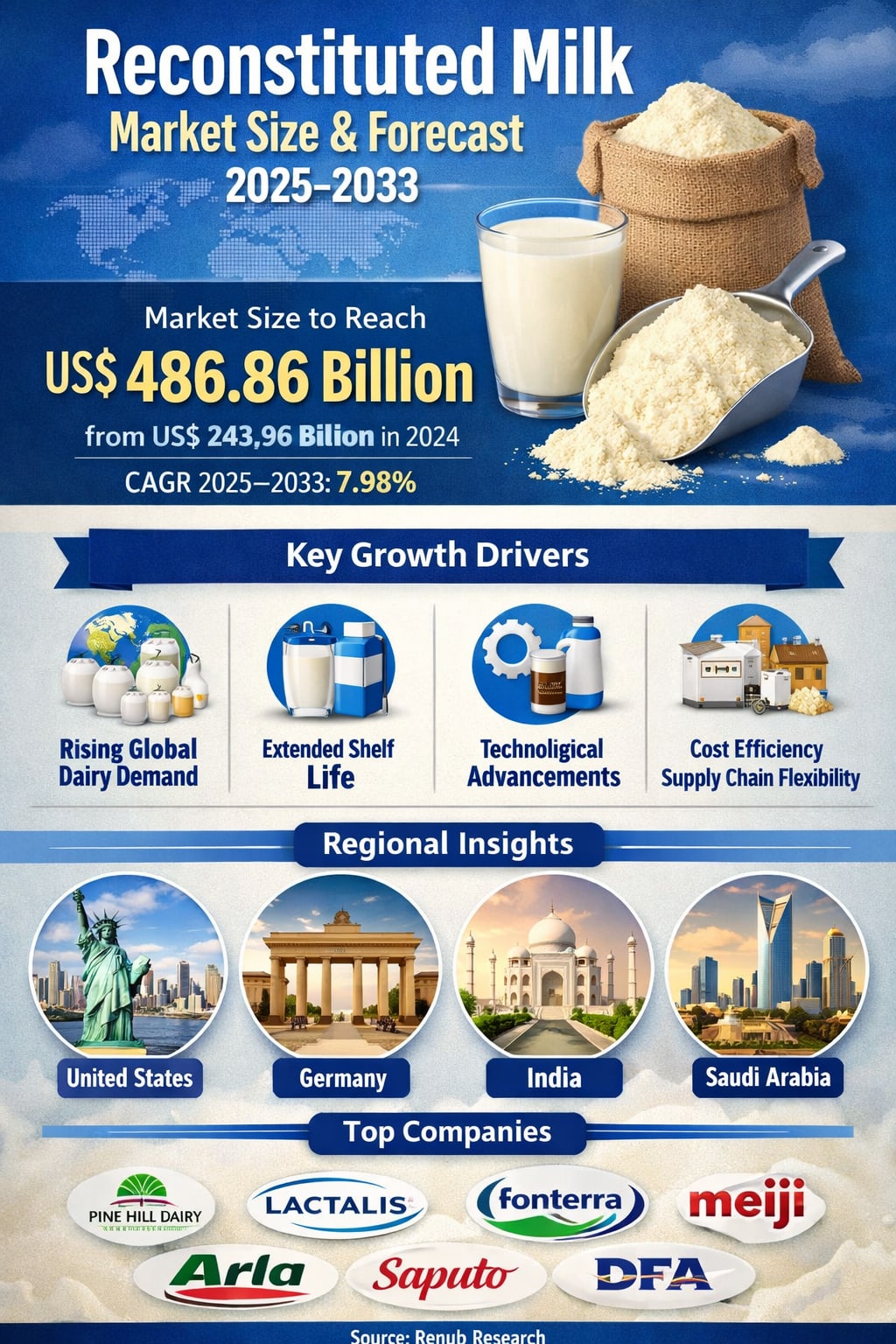
According to Renub Research, the Reconstituted Milk Market is expected to reach US$ 486.86 billion by 2033, up from US$ 243.96 billion in 2024, growing at a CAGR of 7.98% from 2025 to 2033. This impressive expansion reflects more than just rising dairy consumption—it signals a shift in how the world produces, distributes, and consumes milk.
Urbanization, changing dietary habits, cost pressures, and the need for shelf-stable nutrition are reshaping demand patterns globally. At the same time, technological advancements in milk powder processing and rehydration techniques are closing the quality gap between fresh and reconstituted milk. Together, these forces are pushing reconstituted milk from a “backup option” to a strategic pillar of the global dairy ecosystem.
Understanding the Reconstituted Milk Market
Reconstituted milk refers to milk produced by mixing water with milk powder—typically whole milk powder or skimmed milk powder. This process allows manufacturers and consumers to recreate liquid milk without relying on fresh milk supply chains. The advantages are clear: lower transportation costs, longer shelf life, easier storage, and more predictable quality.
The market serves a wide range of end users, including:
Food manufacturers (bakeries, confectionery, processed foods)
Foodservice operators (restaurants, cafés, catering services)
Households, especially in regions with inconsistent fresh milk availability
In many developing and emerging economies, reconstituted milk plays a crucial role in ensuring consistent access to dairy nutrition. It also acts as a stabilizer in markets where fresh milk supply is seasonal, volatile, or constrained by infrastructure limitations.
Market Size and Growth Outlook
The growth trajectory of the reconstituted milk market is striking. With the market nearly doubling in value between 2024 and 2033, it reflects strong, sustained demand across both developed and developing regions.
Key growth indicators include:
2024 market size: US$ 243.96 billion
2033 forecast: US$ 486.86 billion
CAGR (2025–2033): 7.98%
This growth is being driven by a combination of population expansion, rising disposable incomes, increased dairy consumption, and the practical advantages of milk powder-based solutions in global supply chains.
Key Growth Drivers
1. Rising Global Dairy Demand
One of the strongest drivers behind the reconstituted milk market is the continuous rise in global dairy consumption. Milk, cheese, yogurt, and other dairy products are increasingly seen as essential components of balanced diets, especially in emerging economies where nutritional awareness is improving.
However, in many regions, fresh milk supply struggles to keep pace with demand due to infrastructure gaps, seasonal production, or logistical constraints. Reconstituted milk offers a scalable, reliable alternative that can be transported and stored efficiently. Its consistent quality and long shelf life make it an attractive option for both consumers and industrial users.
As global dairy demand continues to grow, reconstituted milk is positioned as a practical solution to bridge supply-demand gaps.
2. Extended Shelf Life and Food Security
Shelf life is one of the most powerful advantages of reconstituted milk. Milk powder can be stored for months without refrigeration, making it ideal for regions with limited cold-chain facilities. This significantly reduces spoilage, waste, and logistical costs.
From a food security perspective, reconstituted milk plays a vital role in emergency food supplies, remote area distribution, and government nutrition programs. The ability to stockpile and transport dairy nutrition over long distances without quality degradation has made milk powder-based products a strategic asset in global food systems.
As concerns around food security, supply chain resilience, and sustainability grow, the appeal of shelf-stable dairy solutions is only getting stronger.
3. Technological Advancements in Processing
Technology is reshaping the reconstituted milk market in important ways. Advances in spray drying, powder solubility, and rehydration techniques have significantly improved the taste, texture, and nutritional retention of reconstituted milk.
Modern processing methods now produce finer, more soluble powders that dissolve easily and deliver a more “fresh milk-like” experience. Improvements in packaging—such as moisture-resistant and contamination-proof solutions—have further enhanced product stability and distribution efficiency.
In addition, fortification technologies allow manufacturers to enrich reconstituted milk with vitamins and minerals, making it even more attractive to health-conscious consumers. These innovations are helping reconstituted milk compete more effectively with fresh milk in many markets.
4. Cost Efficiency and Supply Chain Flexibility
Compared to fresh milk, reconstituted milk offers clear economic advantages. Transporting milk powder is cheaper and more efficient than shipping liquid milk, especially across long distances. Storage costs are also lower, as refrigeration is not always required.
For food manufacturers and foodservice operators, this translates into better cost control, reduced waste, and more predictable supply chains. In an era of volatile commodity prices and global logistics disruptions, this flexibility is a major competitive advantage.
Challenges Facing the Market
1. Supply Chain Dependency
Despite its advantages, the reconstituted milk market remains highly dependent on the availability and pricing of milk powder. Disruptions in global dairy production—caused by climate events, trade restrictions, or geopolitical tensions—can impact supply stability and cost structures.
Logistical challenges in storage and international shipping can also create bottlenecks, especially in import-dependent regions. To manage these risks, companies are increasingly investing in diversified sourcing strategies and more resilient supply chains, though this can increase operational complexity.
2. Competition from Fresh Milk
In regions with strong dairy infrastructure, fresh milk remains the preferred choice for many consumers due to perceptions around taste, freshness, and nutritional superiority. Brand loyalty to local dairy producers also strengthens the position of fresh milk in these markets.
This creates a challenge for reconstituted milk, particularly among health-conscious and premium-focused consumers. Overcoming this barrier requires continuous improvements in product quality, better consumer education, and stronger branding around safety, convenience, and nutritional value.
Regional Market Insights
United States
The U.S. reconstituted milk market is experiencing steady growth, driven by demand for affordable, convenient, and fortified dairy products. Health and wellness trends are encouraging the development of high-protein and nutrient-enriched variants, while flavored options and single-serve packaging are attracting younger, busy consumers.
However, the market still faces perception challenges, with some consumers viewing reconstituted milk as inferior to fresh milk. Supply chain dependencies and environmental concerns related to dairy production also remain key issues. Despite this, ongoing innovation and sustainability-focused strategies are expected to support continued market expansion.
Germany
Germany’s reconstituted milk market is growing in line with rising demand for convenient and cost-effective dairy solutions. Health-conscious consumers are showing interest in fortified and high-protein offerings, while eco-friendly packaging and product variety are gaining traction.
Challenges include strong competition from fresh milk and concerns about nutritional equivalence. Environmental regulations and sustainability expectations also shape industry strategies. Nevertheless, continued product innovation and alignment with health and sustainability trends are expected to drive further growth.
India
India represents one of the fastest-growing markets for reconstituted milk. Rapid urbanization, rising dairy consumption, and the need for affordable, shelf-stable products are key growth drivers. Fortified milk variants, single-serve sachets, and convenience-focused packaging formats are particularly popular among urban consumers.
Expanding distribution networks, including in semi-urban and rural areas, are further boosting adoption. With improving product quality, wider availability, and strong underlying demand, India’s reconstituted milk market is poised for robust long-term growth.
Saudi Arabia
In Saudi Arabia, changing lifestyles, urbanization, and increasing convenience awareness are supporting steady market growth. Milk powder’s long shelf life and versatility in cooking make it an attractive choice for households and foodservice operators.
At the same time, consumer preferences are evolving toward healthier and specialty dairy options, including lactose-free and organic variants. Companies are responding by diversifying their product portfolios and targeting more health-conscious consumers.
Recent Developments Shaping the Market
The regulatory and investment landscape continues to influence the reconstituted milk industry. In 2023, the Malaysian Ministry of Health invited public feedback on updates to regulations governing milk product safety, including reconstituted milk, reflecting growing attention to quality and fraud prevention.
On the corporate front, Arla Foods invested approximately USD 213 million in May 2022 to expand its dairy facility in Pronsfeld, Germany. The plant’s capacity to process 685 million kg of milk annually highlights the scale and industrial importance of modern dairy processing infrastructure supporting both fresh and powder-based products.
Market Segmentation Overview
By Type:
Skimmed Milk
Whole Milk
Anhydrous Milk Fat
Unsalted Frozen Butter
By Application:
Milk
Cheese
Yogurt
Ice Cream
Others
By Distribution Channel:
B2B
B2C
Online Sales
Hypermarkets/Supermarkets
Wholesale Stores
Others
By Region and Country Coverage:
North America: United States, Canada
Europe: France, Germany, Italy, Spain, United Kingdom, Belgium, Netherlands, Turkey
Asia Pacific: China, Japan, India, Australia, South Korea, Thailand, Malaysia, Indonesia, New Zealand
Latin America: Brazil, Mexico, Argentina
Middle East & Africa: South Africa, United Arab Emirates, Saudi Arabia
Competitive Landscape
Leading players in the global reconstituted milk market include:
Pine Hill Dairy
Lactalis
Fonterra
Meiji Holdings
Schreiber Foods
Arla Foods
Saputo
Dairy Farmers of America
Mengniu Dairy
These companies are analyzed across multiple dimensions, including company overview, leadership, recent strategies, SWOT analysis, and sales performance—highlighting a competitive environment focused on scale, efficiency, innovation, and global reach.
Final Thoughts: Why Reconstituted Milk’s Future Looks Strong
The reconstituted milk market is no longer just a fallback option for regions lacking fresh milk infrastructure. It is becoming a strategic component of the global dairy industry—driven by cost efficiency, shelf stability, technological improvements, and rising demand for accessible nutrition.
With the market projected to grow from US$ 243.96 billion in 2024 to US$ 486.86 billion by 2033, the outlook is undeniably strong. As supply chains prioritize resilience, consumers seek convenience, and governments focus on food security, reconstituted milk is set to play an even more prominent role in the years ahead.
In a world where efficiency, affordability, and sustainability increasingly define food systems, reconstituted milk is quietly proving that sometimes, the most transformative products are the ones that simply make everyday nutrition more reliable.
About the Creator
Keep reading
More stories from shibansh kumar and writers in Trader and other communities.
Mobile Application Market Size and Forecast 2025–2033
Mobile Application Market Overview The global mobile application market has become one of the most dynamic and influential segments of the digital economy. What began as simple tools for communication and basic utilities has evolved into a vast ecosystem powering entertainment, finance, education, healthcare, retail, and enterprise productivity. Today, mobile applications are not just software products; they are the primary interface between businesses and consumers in an increasingly mobile-first world.
By shibansh kumarabout 4 hours ago in Trader
MSFT Stock: Microsoft’s Market Performance and Global Insights
MSFT Stock, representing Microsoft Corporation, is one of the most influential technology stocks in global financial markets. Microsoft has evolved from a software company into a technology powerhouse, with business lines spanning Windows, Office, cloud computing through Azure, AI technologies, and gaming with Xbox. This diversification has made MSFT Stock a favorite for both retail and institutional investors seeking long-term growth and stability.
By Hammad Nawaz6 days ago in Trader
XRP Price Structure, Legal Impact, and Long-Term Investment Perspective
Introduction XRP has remained one of the most debated cryptocurrencies in the market, largely because of its strong focus on real-world financial use cases and ongoing regulatory discussions. Unlike many crypto assets built primarily for decentralized applications or speculation, XRP targets the global payments and remittance sector. From an investment point of view, XRP behaves differently compared to most large-cap cryptocurrencies, as its price trend is often influenced by legal developments and institutional adoption rather than pure market hype.
By Hammad Nawaz3 days ago in Trader




Comments
There are no comments for this story
Be the first to respond and start the conversation.