
Mobile Application Market Size and Forecast 2025–2033
From Everyday Utilities to AI-Powered Ecosystems, How Mobile Apps Are Reshaping the Global Digital Economy

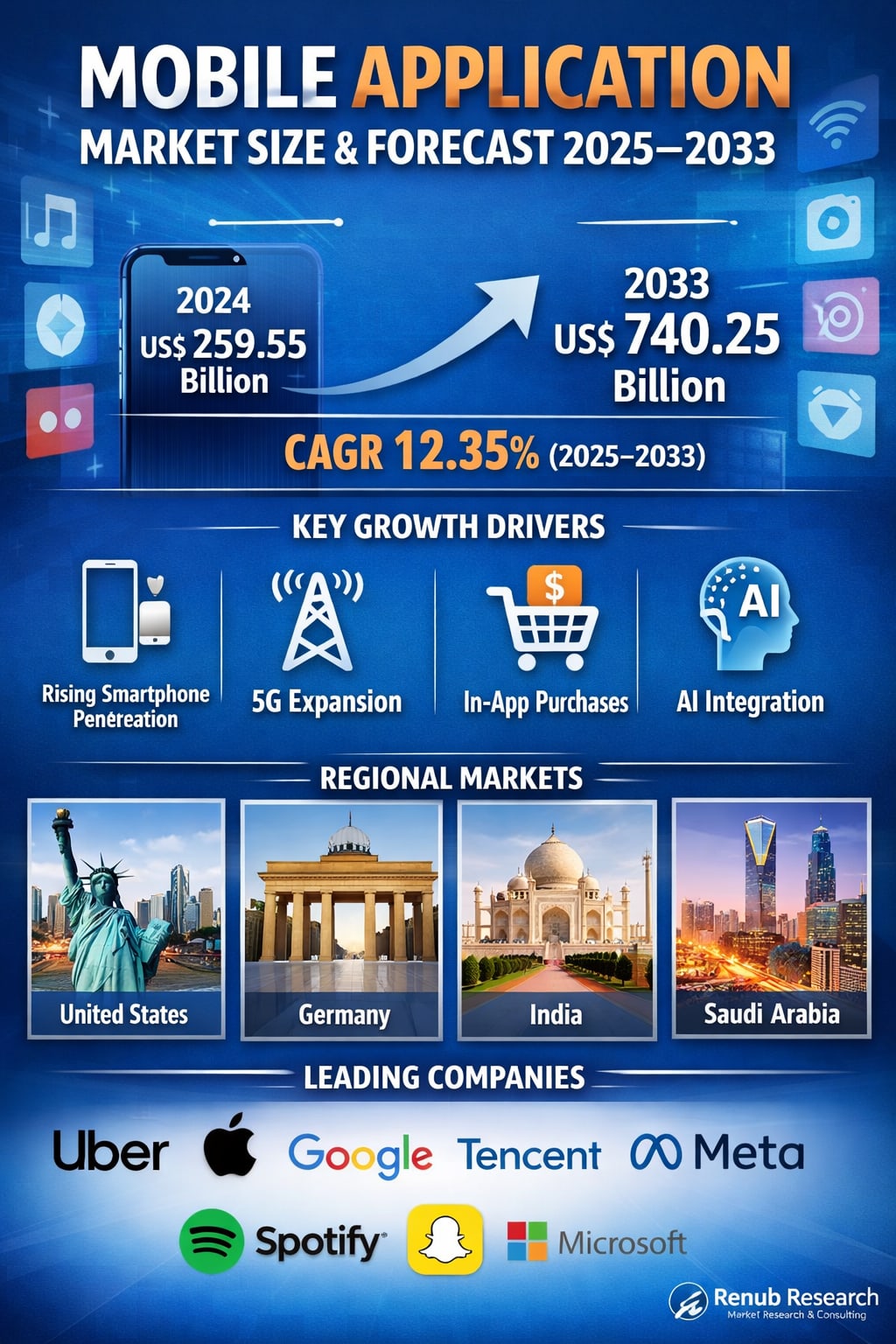
Mobile Application Market Overview
The global mobile application market has become one of the most dynamic and influential segments of the digital economy. What began as simple tools for communication and basic utilities has evolved into a vast ecosystem powering entertainment, finance, education, healthcare, retail, and enterprise productivity. Today, mobile applications are not just software products; they are the primary interface between businesses and consumers in an increasingly mobile-first world.
According to Renub Research, the Mobile Application Market is expected to reach US$ 740.25 billion by 2033, up from US$ 259.55 billion in 2024, growing at a robust CAGR of 12.35% from 2025 to 2033. This impressive growth reflects how deeply mobile apps are embedded in daily life and how rapidly businesses are shifting toward digital, app-based engagement models.
A mobile application, commonly known as a mobile app, is a software program specifically designed for smartphones, tablets, and other portable devices. These apps serve a wide range of purposes, including communication, entertainment, navigation, shopping, banking, fitness tracking, learning, and workplace collaboration. Users typically download apps from platforms such as Google Play or Apple’s App Store, and they can be developed as native apps (for a specific operating system), web-based apps, or hybrid applications that combine both approaches.
The popularity of mobile apps lies in their convenience, accessibility, and personalized user experience. With intuitive interfaces and always-on connectivity, apps allow users to perform tasks quickly and efficiently, whether they are ordering food, streaming a movie, managing finances, or collaborating with colleagues. Behind the scenes, modern app development integrates user interface (UI) design, backend systems, cloud infrastructure, and increasingly sophisticated security features to ensure smooth and safe user experiences.
The market’s rapid expansion is driven by several powerful forces: rising smartphone penetration, the global rollout of 5G networks, increasing internet usage, the growth of in-app purchases and subscriptions, the expansion of mobile commerce, surging demand for gaming and entertainment apps, and the broader digital transformation across industries. Technologies such as artificial intelligence (AI), augmented reality (AR), virtual reality (VR), and cloud computing are further enhancing app functionality and opening new opportunities for innovation.
Key Growth Drivers Shaping the Mobile Application Market
Rising Smartphone Penetration
One of the most important drivers of the mobile application market is the continued rise in smartphone adoption worldwide. As devices become more affordable and technologically advanced, millions of new users are coming online each year, particularly in emerging economies. This expanding user base naturally fuels demand for mobile applications across all categories, from social media and entertainment to banking and education.
Global connectivity is also improving at a rapid pace. The International Telecommunication Union (ITU) estimates that there were around 5.4 billion internet users worldwide in 2023, representing roughly 67% of the global population. This widespread access means that mobile apps are no longer limited to urban or high-income users; they are becoming essential tools for communication, commerce, and information in both developed and developing regions.
Usage patterns further highlight how central apps have become to daily life. Industry observations suggest that a significant portion of millennials and Gen Z users open their favorite apps dozens of times a day, relying on them for everything from messaging and navigation to shopping and entertainment. This habitual engagement continues to push download volumes, usage time, and monetization opportunities higher.
Growth of In-App Purchases and Subscriptions
Another major engine of market growth is the rise of in-app purchases and subscription-based models. Instead of relying solely on one-time download fees, developers now generate recurring revenue by offering premium features, digital content, virtual goods, or ad-free experiences within their apps. This model is especially dominant in gaming, streaming, fitness, productivity, and lifestyle applications.
Users are increasingly willing to pay for personalized, high-quality, and convenient digital experiences. Secure digital wallets, seamless payment gateways, and improved trust in online transactions have made it easier than ever for consumers to spend within apps. As a result, in-app purchases have become a cornerstone of the modern app economy, boosting not only revenue but also user engagement and long-term retention.
The widespread adoption of freemium models—where users can download an app for free but pay for advanced features—has further accelerated this trend. This approach lowers the barrier to entry for new users while creating scalable monetization pathways for developers and businesses.
Integration of AI and Machine Learning
Artificial intelligence and machine learning are transforming how mobile applications function and how users interact with them. From personalized content recommendations and voice assistants to predictive text, image recognition, and smart chatbots, AI-driven features are becoming standard across many app categories.
In e-commerce and media apps, AI helps tailor product suggestions and content feeds to individual preferences, improving user satisfaction and increasing conversion rates. In health and fitness apps, machine learning algorithms analyze user data to provide customized workout plans or wellness insights. In finance and enterprise apps, AI enhances fraud detection, customer support automation, and decision-making tools.
This growing intelligence within apps not only improves user experience but also increases the value proposition of mobile platforms, encouraging higher adoption, longer usage times, and greater willingness to pay for premium features.
Challenges Facing the Mobile Application Market
Intense Competition in a Crowded Ecosystem
Despite its strong growth prospects, the mobile application market faces intense competition. With millions of apps available on major platforms like Google Play and the Apple App Store, standing out has become increasingly difficult. New apps must compete not only with direct rivals but also with established global brands that already command massive user bases and marketing budgets.
Discoverability is a major challenge. Even high-quality apps can struggle to gain traction without effective marketing, strong branding, and consistent user engagement strategies. User attention spans are short, and switching costs are low, which means developers must continuously innovate, update features, and improve performance to retain users.
To stay competitive, companies are investing heavily in user experience design, data analytics, and community-building efforts. However, these investments increase development and operational costs, putting pressure on smaller developers and startups.
Data Privacy and Security Concerns
As mobile applications collect and process vast amounts of personal data—ranging from location and contacts to financial and health information—data privacy and security have become critical concerns. High-profile data breaches and misuse of user information can severely damage brand reputation and erode consumer trust.
Developers must comply with increasingly strict regulations such as the GDPR in Europe, the CCPA in the United States, and various local data protection laws worldwide. These regulations require robust encryption, secure data storage, transparent privacy policies, and user consent mechanisms. While necessary, these measures add complexity and cost to app development and maintenance.
At the same time, the growing sophistication of cyber threats means that security is not a one-time effort but an ongoing process. Regular updates, vulnerability testing, and incident response planning are now essential parts of running a successful mobile application business.
Regional Market Insights
United States Mobile Application Market
The United States remains one of the largest and most innovative mobile application markets in the world, supported by widespread smartphone usage, advanced digital infrastructure, and a strong culture of technology adoption. American consumers are heavy users of apps across categories such as social media, streaming, e-commerce, finance, and productivity.
Innovation continues to shape the market. For example, in March 2024, Snap Inc. introduced sponsored AR Filters, expanding augmented reality advertising by allowing brands to engage users even after a photo is taken. These filters appear in the post-capture Filter Carousel, extending brand visibility beyond traditional placements. With over 5 billion Snaps created every day, such innovations highlight how interactive and immersive experiences are becoming central to mobile engagement in the U.S.
Growing investments in AI, AR, and mobile commerce are expected to keep the U.S. market at the forefront of global app innovation over the coming years.
Germany Mobile Application Market
Germany represents one of the largest and fastest-growing mobile app markets in Europe. The country benefits from a tech-savvy population, high smartphone penetration, and strong demand for secure and reliable digital services. While Android holds a dominant market share, iOS continues to grow steadily, particularly among premium users.
Popular app categories in Germany include social media, e-commerce, gaming, and financial services. There is also a rising interest in “super apps” that combine multiple services—such as payments, shopping, and communication—within a single platform. Marketing-driven installs, especially on iOS, are becoming more common as competition intensifies.
Despite challenges related to strict data protection regulations and a competitive landscape, Germany’s mobile app market continues to show healthy growth, driven by consumer demand for personalized, high-quality digital experiences.
India Mobile Application Market
India is one of the fastest-growing mobile application markets globally, fueled by massive smartphone adoption and affordable mobile internet access. The country’s young and digitally engaged population uses apps extensively across social networking, gaming, e-commerce, fintech, and online education.
Government initiatives such as Digital India and the push toward cashless payments have further accelerated app usage, particularly in financial services and public service platforms. The rise of regional language apps and AI-powered personalization is also improving accessibility for users across different states and demographics.
While challenges remain—such as infrastructure gaps in rural areas and ongoing concerns about data privacy—the sheer scale and diversity of India’s user base continue to attract global developers and investors eager to tap into this high-growth market.
Saudi Arabia Mobile Application Market
Saudi Arabia’s mobile application market is expanding rapidly, supported by strong internet infrastructure, high smartphone penetration, and ambitious digital transformation initiatives under the country’s broader economic vision. Mobile apps are increasingly used across sectors such as e-commerce, fintech, healthcare, transportation, and on-demand services.
The government’s focus on e-governance and digital public services has also boosted demand for applications that simplify everyday tasks for citizens and residents. With a young, tech-savvy population and supportive policies, Saudi Arabia is emerging as a key hub for mobile innovation in the Middle East.
Recent Developments in the Mobile Application Market
The pace of innovation in the mobile app ecosystem remains strong. In November 2024, Ninja MTB Performance launched the Ninja MTB Studio Fitness and Skills App, combining skills training and fitness exercises into a single platform for mountain biking enthusiasts. The app reflects a broader trend toward niche, community-focused applications that blend content, coaching, and performance tracking.
In September 2023, Google unveiled new features for YouTube, including tools that allow creators to edit, produce, and share content more efficiently. One standout feature, “Dream Screen,” enables creators to add AI-generated video or image backgrounds to YouTube Shorts, showcasing how AI is increasingly embedded in mainstream mobile platforms.
Earlier, in December 2022, Apple introduced Freeform, a collaborative app for iPad, Mac, and iPhone that allows users to organize content on a flexible canvas and work together in real time. With tools for diagrams, comments, and creative brainstorming, Freeform highlights the growing importance of productivity and collaboration apps in the mobile ecosystem.
Mobile Application Market Segmentation
By Type:
Google Store
Apple Store
Other Types
By Application:
Gaming
Music and Entertainment
Health and Fitness
Retail and E-commerce
Learning and Education
Travel and Hospitality
Other Applications
By Country (25 viewpoints):
North America:
United States, Canada
Europe:
France, Germany, Italy, Spain, United Kingdom, Belgium, Netherlands, Turkey
Asia Pacific:
China, Japan, India, Australia, South Korea, Thailand, Malaysia, Indonesia, New Zealand
Latin America:
Brazil, Mexico, Argentina
Middle East & Africa:
South Africa, United Arab Emirates, Saudi Arabia
Key Players Covered
Uber Technologies, Inc.
Apple Inc.
Tencent Holdings Limited
Google LLC
Facebook, Inc.
Microsoft Corporation
Adobe Inc.
Spotify Technology S.A.
Snap Inc.
Lyft, Inc.
All companies are analyzed from five viewpoints: Company Overview, Key Persons, Recent Developments & Strategies, SWOT Analysis, and Sales Analysis.
Final Thoughts
The mobile application market is no longer just a segment of the tech industry—it is a foundational pillar of the global digital economy. With Renub Research projecting growth from US$ 259.55 billion in 2024 to US$ 740.25 billion by 2033, the sector’s trajectory underscores how central mobile apps have become to commerce, communication, entertainment, and work.
Driven by smartphone proliferation, 5G expansion, AI integration, and evolving consumer behavior, the market is set to remain one of the most vibrant and competitive arenas in the technology landscape. While challenges such as intense competition and data security concerns persist, continuous innovation and expanding use cases suggest that mobile applications will keep reshaping how people and businesses interact in the digital age.
About the Creator
Keep reading
More stories from shibansh kumar and writers in Trader and other communities.
Online Event Ticketing Market Size and Forecast 2025–2033
Online Event Ticketing Market: A Digital Gateway to Live Experiences The global entertainment industry is in the middle of a powerful digital transformation, and few segments reflect this shift as clearly as online event ticketing. From concerts and sports matches to movies and live performances, the way people discover, purchase, and access events has changed dramatically over the past decade. What was once dominated by physical box offices and long queues has now become a mobile-first, app-driven experience built around speed, convenience, and personalization.
By shibansh kumarabout 10 hours ago in Trader
Intel Stock Analysis: Can Intel Maintain Its Leadership in Semiconductor Innovation?
Introduction Intel stock is a cornerstone of the semiconductor sector, representing decades of technological innovation and global market influence. Intel Corporation is renowned for designing and manufacturing microprocessors, chipsets, and other semiconductor solutions for computers, data centers, and emerging technologies. As the demand for AI, cloud computing, gaming, and edge computing grows, Intel stock offers investors exposure to both cyclical and structural growth in technology markets.
By Hammad Nawaz7 days ago in Trader
Australia’s Fast Food & Quick Service Restaurant Market 2026: Convenience Culture, Digital Ordering and Menu Reinvention
Australia Fast Food & Quick Service Restaurant Market Overview Australia’s fast food and quick service restaurant (QSR) market remains a vital pillar of the country’s broader food service industry, catering to consumers seeking convenience, affordability and consistent dining experiences. The sector spans international franchise chains, domestic fast-casual brands and takeaway-focused operators, all competing to deliver speed without compromising quality. As modern consumers increasingly balance busy schedules with dining expectations, QSR operators are redefining offerings through digital ordering, menu innovation and expanded service formats.
By Amyra Singh4 days ago in Trader
When Amazon Says You’re a Disappointment
Yesterday, for the first Wednesday in months, I didn’t publish a piece on Vocal. Believe me, I wanted to. I had it all written up and ready to go. I was going to share the news that I had officially become a published author.
By Sandy Gillman5 days ago in Writers




Comments
There are no comments for this story
Be the first to respond and start the conversation.