
Saudi Arabia Home Energy Management System Market Size and Forecast 2025–2033
Smart Homes, Smarter Energy: How Vision 2030, IoT, and Sustainability Are Powering the Next Phase of Saudi Arabia’s Residential Energy Revolution

Introduction: A Smarter Way to Power Saudi Homes
Saudi Arabia is undergoing a profound transformation in how energy is produced, consumed, and managed. As part of the Kingdom’s ambitious Vision 2030 agenda, sustainability, digital transformation, and energy efficiency have moved to the center of national policy and private investment. One of the most visible results of this shift is the rapid rise of the Home Energy Management System (HEMS) market.
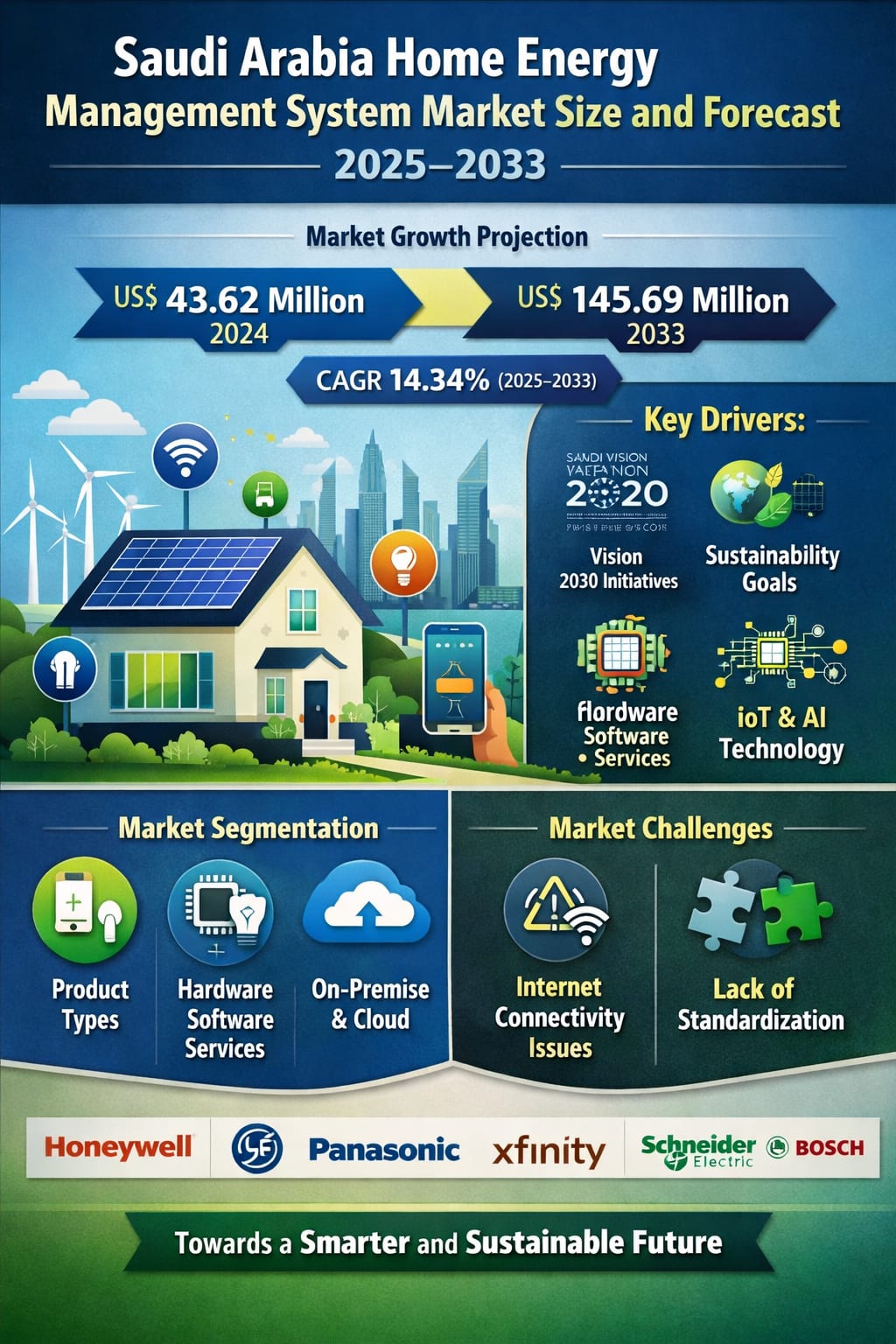
According to Renub Research, the Saudi Arabia Home Energy Management System Market is expected to reach US$ 145.69 million by 2033, up from US$ 43.62 million in 2024, growing at a CAGR of 14.34% from 2025 to 2033. This impressive growth reflects more than just a technology upgrade—it signals a broader change in how Saudi households think about energy consumption, cost control, and environmental responsibility.
Home Energy Management Systems allow homeowners to monitor, analyze, and optimize electricity usage in real time. By integrating smart meters, connected appliances, cloud platforms, and AI-driven analytics, these systems transform traditional homes into intelligent, responsive energy ecosystems. In a country where energy demand continues to rise alongside urbanization and population growth, HEMS offers a practical solution to balance comfort, efficiency, and sustainability.
Market Overview: Technology Meets Vision 2030
The development of the HEMS market in Saudi Arabia is closely tied to the Kingdom’s long-term economic and environmental goals. Vision 2030 emphasizes diversification away from oil, improved energy efficiency, and large-scale adoption of digital technologies across sectors—including residential infrastructure.
Historically, Saudi Arabia benefited from abundant and relatively low-cost energy. However, rising consumption, growing urban populations, and global climate commitments have changed the equation. Today, optimizing energy use is no longer optional—it is a strategic necessity. Home Energy Management Systems address this need by giving households precise control over where, when, and how electricity is used.
Modern HEMS platforms combine hardware such as smart meters, sensors, thermostats, and controllers with software dashboards and cloud-based analytics. These systems allow residents to track usage patterns, receive alerts about inefficiencies, and automate devices to reduce waste. Over time, this not only lowers electricity bills but also reduces strain on the national grid and supports broader sustainability targets.
As smart grids, renewable energy projects, and smart city initiatives expand across Saudi Arabia, HEMS is becoming a natural extension of the country’s evolving energy ecosystem.
Key Factors Driving Market Growth
1. Government Policies and Energy Efficiency Initiatives
One of the strongest drivers of the Saudi HEMS market is government support for energy efficiency. Under Vision 2030, multiple programs encourage reduced energy consumption, better building standards, and smarter use of resources. Organizations such as the National Energy Services Company (Tarshid) play a critical role in promoting energy retrofits, efficiency audits, and smart technology adoption.
New residential developments increasingly integrate smart systems by design, while existing buildings are being encouraged to upgrade through efficiency programs and modernization initiatives. For homeowners, the combination of long-term cost savings and policy support makes HEMS an attractive investment rather than a luxury.
In the coming years, stricter building codes and sustainability benchmarks are likely to further accelerate adoption, especially in urban centers where energy demand is highest.
2. Rising Focus on Sustainability and Carbon Reduction
Saudi Arabia has committed to achieving net-zero emissions by 2060, a goal that requires changes across industries—and within households. Residential energy consumption represents a significant share of overall electricity demand, making homes a crucial battleground for efficiency improvements.
HEMS plays a direct role in this transition. By giving users detailed visibility into their energy usage, these systems encourage more responsible consumption habits. Features such as automated load management, peak-time optimization, and integration with renewable energy sources help reduce both carbon footprints and utility costs.
As environmental awareness grows among Saudi consumers, sustainability is no longer just a government objective—it is becoming a personal priority for many households. This cultural shift is translating into stronger demand for smart energy solutions.
3. Technological Advancements in IoT and AI
The rapid evolution of Internet of Things (IoT) and Artificial Intelligence (AI) technologies has transformed what HEMS can do. Today’s systems go far beyond simple monitoring. AI-powered platforms can analyze usage patterns, predict future consumption, and automatically adjust devices to maximize efficiency.
Smart thermostats can learn user preferences, connected appliances can operate during off-peak hours, and centralized controllers can balance energy loads across the home. These capabilities make HEMS not only more effective but also more convenient—an important factor for consumer adoption.
As Saudi Arabia continues to invest in digital infrastructure and smart city projects, the technological foundation for advanced HEMS solutions will only become stronger.
Challenges Facing the Market
1. Dependence on Reliable Internet Connectivity
Most modern HEMS platforms rely heavily on stable internet connections for cloud analytics, remote control, and real-time monitoring. While urban areas in Saudi Arabia generally enjoy strong connectivity, some rural or remote regions still face limitations.
Inconsistent internet access can reduce system performance, delay data processing, and limit the reliability of automation features. For widespread national adoption, continued investment in broadband infrastructure will be essential to ensure that smart energy technologies are accessible to all households.
2. Lack of Standardization and Market Fragmentation
Another challenge is the fragmented nature of the smart home and HEMS ecosystem. Different manufacturers often use proprietary platforms, which can create compatibility issues when users try to integrate devices from multiple brands.
This lack of standardization can increase system complexity, raise costs, and discourage potential buyers who want simple, plug-and-play solutions. Over time, greater industry collaboration and the development of common interoperability standards will be crucial to improving user experience and accelerating market growth.
Market Segmentation Analysis
By Product Type
Lighting Controls:
These systems allow users to automate and optimize lighting based on occupancy, time of day, or natural light availability. They are among the most widely adopted HEMS components due to their relatively low cost and immediate energy-saving benefits.
Thermostats:
Smart thermostats are a cornerstone of home energy management. By learning user behavior and adjusting temperature settings automatically, they can significantly reduce cooling and heating costs—especially important in Saudi Arabia’s hot climate.
Self-Monitoring Systems:
These solutions focus on providing detailed insights into energy consumption patterns. They empower users with data-driven decision-making, helping identify inefficiencies and unnecessary usage.
Advanced Central Controllers:
Centralized controllers act as the brain of the HEMS ecosystem, coordinating multiple devices and systems to optimize overall energy performance.
Intelligent HVAC Controllers:
Given the high energy demand of air conditioning in Saudi homes, intelligent HVAC controllers play a critical role in reducing electricity consumption while maintaining comfort.
By Component
Hardware:
Includes smart meters, sensors, controllers, and connected devices. Hardware forms the physical backbone of any HEMS installation.
Software:
Software platforms provide dashboards, analytics, automation rules, and user interfaces. As AI and data analytics improve, software is becoming an increasingly important value driver in the market.
Services:
Installation, maintenance, system integration, and consulting services are essential for ensuring optimal performance and long-term reliability of HEMS solutions.
By Deployment Type
On-Premise:
On-premise systems offer greater control and data privacy but may require higher upfront investment and maintenance.
Cloud:
Cloud-based HEMS solutions are gaining popularity due to their scalability, remote access capabilities, and continuous software updates. They also enable more advanced analytics and AI-driven features.
Competitive Landscape: Key Players Shaping the Market
The Saudi Arabia HEMS market features a mix of global technology leaders and diversified industrial companies, all bringing strong expertise in automation, energy management, and smart infrastructure.
Honeywell International, Inc.
A major player in building automation and energy solutions, Honeywell offers advanced systems that integrate HVAC, security, and energy management into unified platforms.
General Electric Company
GE’s expertise in energy systems, grid technologies, and digital solutions positions it as a key contributor to smart energy ecosystems, including residential applications.
Comcast Cable (Xfinity)
Through its smart home and connectivity solutions, Xfinity plays a role in linking energy management with broader home automation and monitoring services.
Panasonic Corporation
Panasonic brings strong capabilities in electronics, smart appliances, and energy-efficient technologies, making it a relevant player in the HEMS space.
Johnson Controls
Known for its building management and HVAC solutions, Johnson Controls offers integrated platforms that focus on efficiency, comfort, and sustainability.
Schneider Electric SE
A global leader in energy management and automation, Schneider Electric provides comprehensive solutions that span hardware, software, and services.
Robert Bosch GmbH
Bosch’s portfolio of smart home devices, sensors, and energy solutions makes it a key innovator in connected living and residential efficiency.
These companies compete not only on technology but also on integration capabilities, reliability, after-sales support, and alignment with Saudi Arabia’s long-term sustainability goals.
Future Outlook: Smart Homes as the New Standard
Looking ahead, the Saudi Arabia Home Energy Management System market is poised for strong and sustained growth. Urbanization, rising electricity demand, smart city initiatives, and increasing consumer awareness will continue to push HEMS adoption forward.
The integration of renewable energy sources such as rooftop solar, the expansion of smart grids, and the use of AI-driven optimization tools will further enhance the value proposition of HEMS. Over time, these systems are likely to shift from being optional upgrades to becoming standard features in modern Saudi homes.
As costs decline, interoperability improves, and digital infrastructure strengthens, HEMS will play a central role in shaping a more efficient, resilient, and sustainable residential energy landscape.
Final Thoughts
The projected rise of the Saudi Arabia Home Energy Management System Market—from US$ 43.62 million in 2024 to US$ 145.69 million by 2033—tells a powerful story about the Kingdom’s energy future. This is not just a technology trend; it is a reflection of a broader national transformation toward smarter living, responsible consumption, and sustainable growth.
Driven by Vision 2030, supported by technological innovation, and reinforced by growing environmental awareness, HEMS is set to become a cornerstone of Saudi Arabia’s residential infrastructure. For homeowners, it means lower bills, greater comfort, and more control. For the nation, it means progress toward a cleaner, more efficient, and more resilient energy system.
About the Creator
Sakshi Sharma
Content Writer with 7+ years of experience crafting SEO-driven blogs, web copy & research reports. Skilled in creating engaging, audience-focused content across diverse industries.
Keep reading
More stories from Sakshi Sharma and writers in Trader and other communities.
United States Automotive Air Suspension Market Size and Forecast 2025–2033
United States Automotive Air Suspension Market Overview The United States Automotive Air Suspension Market is entering a decisive growth phase as automakers and consumers increasingly prioritize ride comfort, vehicle performance, and intelligent mobility features. According to industry estimates, the market is expected to reach US$ 3.64 billion by 2033, rising from US$ 2.17 billion in 2024, registering a compound annual growth rate (CAGR) of 5.91% from 2025 to 2033.
By Sakshi Sharmaa day ago in Trader
Australia’s Supply Chain Management Software Market 2026: Digital Optimization, Business Agility & The Future of Commerce
Australia Supply Chain Management Software Market Overview The Australia supply chain management (SCM) software market is entering a strong growth phase as enterprises modernize operations and prioritize digital resilience. According to IMARC Group, The Australia supply chain management software market size reached USD 646.8 Million in 2025. Looking forward, IMARC Group expects the market to reach USD 1,550.3 Million by 2034, exhibiting a growth rate (CAGR) of 9.89% during 2026-2034. The steady rise reflects increasing demand for automation, predictive analytics, and end-to-end visibility across logistics and procurement networks.
By Amyra Singh5 days ago in Trader



Comments
There are no comments for this story
Be the first to respond and start the conversation.