
Saudi Arabia Household Cleaners Market Size and Forecast 2025–2033
Rising Hygiene Awareness, Urbanization, and Eco-Friendly Trends Fuel Market Expansion

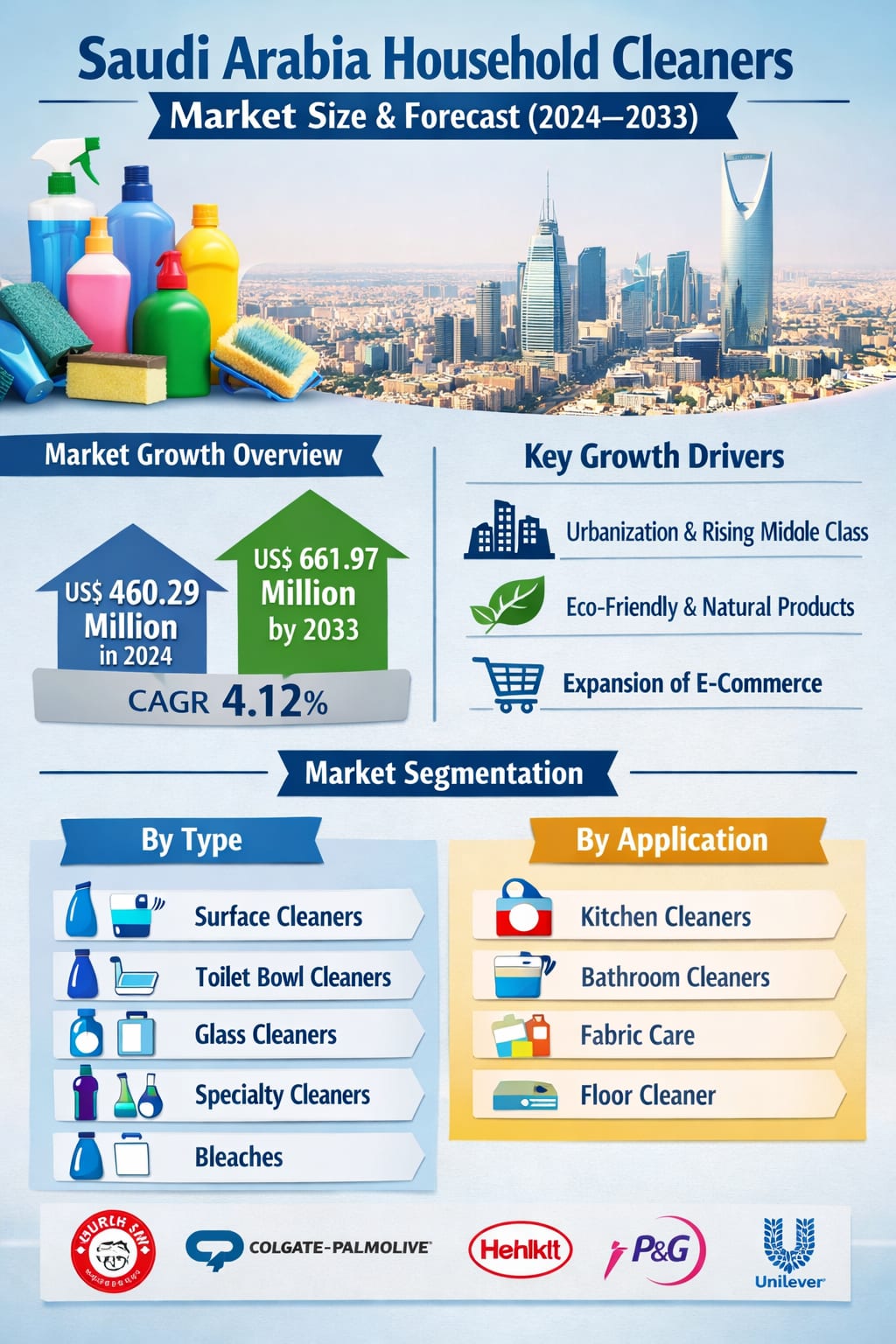
Saudi Arabia Household Cleaners Market Outlook
The Saudi Arabia Household Cleaners Market is expected to reach US$ 661.97 million by 2033, up from US$ 460.29 million in 2024, growing at a CAGR of 4.12% from 2025 to 2033. This steady growth reflects the country’s rising focus on hygiene, wellness, and overall living standards, alongside rapid urbanization and lifestyle modernization.
Household cleaners have moved from being basic utility products to becoming essential components of everyday health and hygiene routines in Saudi households. The demand spans a wide range of products, including surface cleaners, glass cleaners, toilet bowl cleaners, bleaches, and specialty cleaners, used across kitchens, bathrooms, fabric care, and floor cleaning applications.
In recent years, heightened awareness around cleanliness—accelerated during and after the global pandemic—has permanently changed consumer behavior. Saudi consumers are now more conscious of sanitation, germ protection, and indoor hygiene, pushing both volume growth and product innovation in the household cleaners sector.
Saudi Arabia Household Cleaners Industry Overview
Urbanization, a growing middle class, and increased awareness of sanitation and hygiene are driving the continuous rise of the Saudi household cleaners market. As more families move into urban settings and adopt fast-paced lifestyles, the need for convenient, effective, and time-saving cleaning solutions has increased significantly. Products such as multipurpose sprays, disinfectants, toilet cleaners, and kitchen degreasers are now considered daily essentials rather than occasional-use items.
Cultural and religious practices in Saudi Arabia also emphasize cleanliness, which further strengthens long-term demand for household cleaning products. Clean living spaces are not only associated with comfort and health but also with social and cultural values, reinforcing consistent consumption across different income groups.
At the same time, the market is witnessing a clear shift toward environmentally friendly and non-toxic cleaning products. Consumers are increasingly concerned about the health impact of harsh chemicals, especially in homes with children or elderly family members. This has created growing demand for plant-based, biodegradable, and halal-compliant formulations. Manufacturers are responding by reformulating products, highlighting ingredient transparency, and promoting safety certifications.
Retail dynamics are also evolving. While supermarkets and hypermarkets remain dominant sales channels, e-commerce is rapidly gaining traction due to convenience, competitive pricing, and wider product availability. Supported by Saudi Arabia’s digital transformation initiatives and rising smartphone penetration, online platforms are becoming an important growth engine for household cleaner brands.
Overall, the Saudi household cleaners market is well-positioned for continued expansion, supported by changing consumer preferences, innovation in product formulations, and modern retail infrastructure.
Key Factors Driving the Saudi Arabia Household Cleaners Market Growth
1. Urbanization and Growing Middle Class
Saudi Arabia’s rapid urbanization and expanding middle class are major contributors to market growth. Urban consumers typically lead busier lives and prefer ready-to-use, efficient cleaning solutions that save time and effort. With rising disposable incomes, many households are also willing to spend more on premium and specialized products, such as antibacterial cleaners, fragrance-enhanced sprays, and surface-specific solutions.
Exposure to global brands and international lifestyle trends through travel, media, and digital platforms has further influenced purchasing behavior. This is encouraging manufacturers to develop modern, user-friendly, and performance-driven products tailored to urban households and young professionals.
2. Shift Toward Eco-Friendly and Natural Products
Health and environmental awareness are reshaping consumer preferences in Saudi Arabia. A growing segment of consumers is actively seeking non-toxic, eco-friendly, and sustainable cleaning solutions that are safer for families and less harmful to the environment.
This trend aligns with global sustainability movements and is pushing companies to invest in plant-based ingredients, biodegradable formulations, and recyclable packaging. Products that emphasize safety, transparency, and halal compliance are gaining stronger acceptance. For brands that can balance performance with sustainability, this shift offers a powerful long-term growth opportunity.
3. Expansion of Retail and E-Commerce Channels
The expansion of modern retail formats—such as supermarkets and hypermarkets—has significantly improved product accessibility across the Kingdom. These stores offer wide product assortments, promotional pricing, and brand visibility, helping drive both volume sales and brand competition.
At the same time, e-commerce platforms are transforming the way consumers shop for household cleaners. Online channels offer convenience, home delivery, and easy price comparison, making them especially attractive to younger and working consumers. The rise of omnichannel strategies allows brands to reach a broader audience and experiment with digital-first marketing, bundled offers, and subscription-based models.
Challenges in the Saudi Arabia Household Cleaners Market
1. Consumer Skepticism Toward New Products
Brand trust plays a crucial role in purchasing decisions for household cleaning products. Many Saudi consumers prefer established and well-known brands that have proven effectiveness. This creates a barrier for new entrants and innovative products, particularly in categories like natural or eco-friendly cleaners that may still be perceived as less powerful than traditional chemical-based solutions.
To overcome this, companies must invest in strong branding, clear communication, certifications, and consumer education. Without these efforts, adoption of new products can remain slow, limiting innovation-driven growth.
2. Environmental and Sustainability Pressures
While sustainability creates opportunities, it also presents challenges. Developing eco-friendly products often involves higher production costs, supply chain adjustments, and new sourcing strategies. For smaller players, these changes can be financially and operationally demanding.
In addition, consumers must be continuously educated about the effectiveness and long-term benefits of sustainable cleaning products. Balancing cost, performance, and environmental responsibility remains a key challenge for the industry.
Market Segmentation
By Type
Surface Cleaner
Glass Cleaner
Toilet Bowl Cleaner
Specialty Cleaners
Bleaches
Others
By Application
Kitchen Cleaners
Bathroom Cleaners
Fabric Care
Floor Cleaner
Each segment addresses specific household needs, with kitchen and bathroom cleaners typically accounting for a significant share due to their frequent usage and hygiene importance.
Competitive Landscape and Company Analysis
The Saudi Arabia household cleaners market is highly competitive, with the presence of strong multinational players and well-established brands. These companies focus on product innovation, brand building, distribution expansion, and sustainability initiatives to maintain and grow their market positions.
Key players covered include:
Church & Dwight Co. Inc.
Colgate-Palmolive Company
Henkel AG & Company KGaA
Reckitt Benckiser Group plc.
The Procter & Gamble Company
Unilever Plc
Strategic Focus Areas of Leading Companies:
Product Innovation: Introducing specialized, multi-purpose, and eco-friendly cleaners
Brand Trust & Marketing: Emphasizing effectiveness, safety, and hygiene benefits
Distribution Expansion: Strengthening presence across supermarkets, hypermarkets, and online platforms
Sustainability: Investing in greener formulations and packaging solutions
Most major players also focus on localizing product offerings to align with Saudi consumer preferences, cultural expectations, and regulatory requirements, including halal compliance.
Future Outlook
Looking ahead, the Saudi Arabia household cleaners market is expected to maintain steady and resilient growth through 2033. Rising living standards, increasing awareness of hygiene, and ongoing urban development will continue to support demand. At the same time, eco-friendly and health-focused products are likely to gain a larger share of the market as consumers become more conscious about long-term wellness and environmental impact.
Digital retail, direct-to-consumer strategies, and smart marketing campaigns will further reshape how brands engage with customers. Companies that successfully combine performance, safety, sustainability, and convenience will be best positioned to capture future growth opportunities in this evolving market.
Final Thoughts
The Saudi Arabia Household Cleaners Market, projected to grow from US$ 460.29 million in 2024 to US$ 661.97 million by 2033 at a CAGR of 4.12%, reflects a broader transformation in consumer lifestyles, health awareness, and retail behavior. What was once a basic necessity category is now becoming a dynamic, innovation-driven FMCG segment shaped by sustainability, convenience, and performance expectations.
For manufacturers, retailers, and investors, the market offers stable growth, room for product differentiation, and long-term potential, especially in eco-friendly and premium product segments. As Saudi Arabia continues its journey toward modernization and digital transformation, household cleaners will remain a quiet but essential pillar of everyday life—and a steadily growing business opportunity.
About the Creator
Sakshi Sharma
Content Writer with 7+ years of experience crafting SEO-driven blogs, web copy & research reports. Skilled in creating engaging, audience-focused content across diverse industries.
Keep reading
More stories from Sakshi Sharma and writers in Trader and other communities.
Australia O-Ring Seals Market Size and Forecast 2025–2033
Australia O-Ring Seals Market Overview The Australia O-ring seals market is steadily emerging as a vital component of the country’s broader industrial and manufacturing ecosystem. According to Renub Research, the Australia O-ring seals market is expected to reach US$ 394.67 million by 2033, growing from US$ 290.08 million in 2024, at a compound annual growth rate (CAGR) of 3.48% from 2025 to 2033. This growth trajectory reflects the increasing importance of reliable sealing solutions across key industries such as mining, oil and gas, automotive, manufacturing, energy, food processing, and healthcare.
By Sakshi Sharmaabout 12 hours ago in Trader
CrowdStrike Stock Analysis: Is CrowdStrike Leading the Cybersecurity Market?
Introduction CrowdStrike stock has become one of the most recognized names in cybersecurity. CrowdStrike specializes in cloud-native endpoint protection, threat intelligence, and security solutions for enterprises. As cyber threats continue to increase in frequency and sophistication, organizations globally are investing heavily in cybersecurity. This trend has positioned CrowdStrike as a key player in the industry and a stock of interest for investors seeking exposure to digital security growth.
By Hammad Nawaz2 days ago in Trader
Mexico Logistics Market Size, Share, Industry Overview, Growth and Forecast 2026-2034
How the Mexico Logistics Market Is Powering Trade, Mobility, and Economic Integration Logistics is the invisible system that keeps economies functioning. Every product on a store shelf, every online order, and every industrial shipment depends on a chain of transportation, storage, and coordination. The Mexico logistics market reflects the country’s strategic position as a bridge between North and South America, as well as its growing role in global supply networks.
By Jackson Watson5 days ago in Trader




Comments
There are no comments for this story
Be the first to respond and start the conversation.