
Thailand Fertilizer Market Size and Forecast 2025–2033: Nourishing the Future of Sustainable Agriculture
Rising farm productivity, government support, and smarter soil management are reshaping Thailand’s fertilizer industry

Introduction
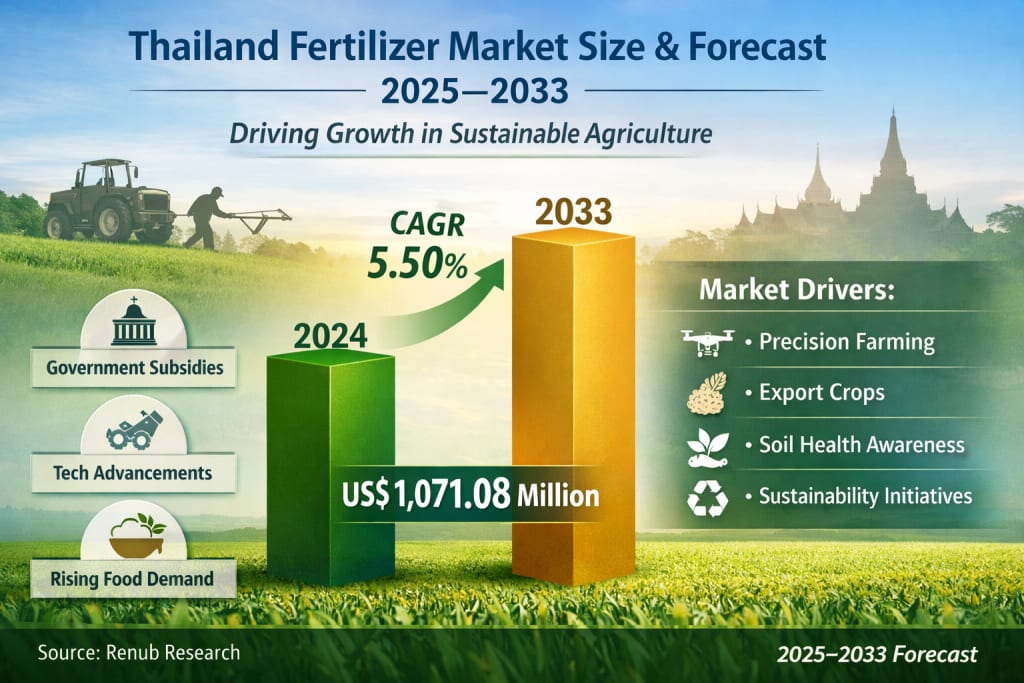
According to Renub Research’s latest industry assessment, the Thailand Fertilizer Market is expected to reach US$ 1,732.51 million by 2033, growing from US$ 1,071.08 million in 2024, at a compound annual growth rate (CAGR) of 5.50% from 2025 to 2033. This steady expansion reflects Thailand’s strong agricultural foundation, rising food demand, increasing export-oriented crop production, and a gradual shift toward more efficient and sustainable farming practices.
Fertilizers play a critical role in modern agriculture. They replenish essential nutrients in the soil, improve crop yields, and help farmers meet the growing food requirements of both domestic and international markets. In Thailand, where agriculture remains a key pillar of the economy and a major source of employment, fertilizers are not just an input cost—they are a strategic investment in food security, rural livelihoods, and export competitiveness.
As the country faces challenges such as limited arable land, climate variability, and fluctuating global input prices, the fertilizer industry is becoming more innovation-driven, policy-supported, and sustainability-focused. This transformation is shaping a market that is not only growing in size but also evolving in structure and technology.
Thailand Fertilizer Industry Overview
Fertilizers are substances applied to soil or plants to supply essential nutrients required for healthy growth and higher productivity. They generally contain primary nutrients such as nitrogen (N), phosphorus (P), and potassium (K)—often referred to as NPK—along with secondary and micronutrients. Fertilizers can be broadly classified into inorganic (chemical) and organic types, including manure, compost, and bio-based inputs.
In Thailand, fertilizers are indispensable for boosting yields of key crops such as rice, sugarcane, cassava, fruits, vegetables, and oilseeds. With increasing pressure on land resources and the need to improve productivity per hectare, the role of fertilizers has become even more important. However, long-term agricultural success also depends on balanced and responsible usage, as over-application can lead to soil degradation, water pollution, and environmental stress.
The Thai fertilizer market is being shaped by a combination of technological progress, supportive government policies, rising awareness of soil health, and growing demand for high-value crops. Precision farming, improved nutrient management, and a gradual shift toward sustainable practices are encouraging farmers to adopt more efficient and targeted fertilizer solutions. At the same time, Thailand’s strong agricultural export sector continues to support consistent demand for fertilizers across different crop segments.
Market Growth Outlook
With the market projected to grow from US$ 1.07 billion in 2024 to US$ 1.73 billion by 2033, the outlook for Thailand’s fertilizer industry remains positive. The 5.50% CAGR reflects a balance between expanding agricultural needs and structural challenges such as price volatility and climate risks.
Several factors are fueling this growth:
Rising food consumption driven by population growth and changing dietary patterns
Government initiatives supporting farmers and stabilizing input costs
Increased adoption of modern farming techniques
Expansion of export-oriented crops and high-value horticulture
Growing awareness of soil fertility management and balanced nutrition
Together, these trends are transforming the fertilizer market from a volume-driven sector into a more technology-oriented and sustainability-focused industry.
Key Growth Drivers
1. Technological Advancements in Agriculture
Technology is playing an increasingly important role in Thailand’s fertilizer industry. Precision farming tools such as GPS-guided equipment, variable-rate application systems, drones, and automated machinery are helping farmers apply fertilizers more accurately and efficiently. This reduces waste, lowers costs, and improves crop performance.
Artificial intelligence and data-driven farming solutions are also being used to monitor soil conditions, predict nutrient requirements, and optimize fertilizer usage. These innovations not only improve productivity but also support sustainable farming by minimizing environmental impact.
Thailand’s alignment with the Bio-Circular-Green (BCG) economic model further encourages the adoption of smart and eco-friendly agricultural technologies. As a result, demand is rising for specialized and high-efficiency fertilizers tailored to specific crops and soil conditions.
2. Increasing Awareness About Soil Health
Another major driver of market growth is the increasing focus on soil health and long-term sustainability. Farmers are becoming more aware that healthy soil is the foundation of consistent productivity. Practices such as crop rotation, conservation tillage, organic amendments, and balanced nutrient management are gaining popularity.
Government-backed initiatives like the Volunteer Soil Doctors Program by the Land Development Department are educating farmers about soil conservation and responsible fertilizer use. This shift is encouraging greater adoption of organic fertilizers, biofertilizers, and integrated nutrient management solutions, expanding the overall fertilizer market while also changing its composition.
The growing recognition that soil health is closely linked to both farm profitability and environmental protection is creating a more resilient and forward-looking fertilizer industry in Thailand.
3. Strong Government Support
Government policy plays a crucial role in shaping Thailand’s fertilizer market. In June 2024, the Thai government introduced a co-payment scheme to support over 4 million rice farmers with fertilizer costs. This program, facilitated through the Bank for Agriculture and Agricultural Cooperatives mobile application, aims to improve affordability and stabilize input expenses.
In addition to direct financial support, the government is also encouraging fertilizer suppliers to collaborate on price harmonization to reduce market volatility. Infrastructure investments, soft loans, and subsidies further strengthen fertilizer adoption, particularly among small and medium-sized farmers.
These measures not only support farmer incomes but also promote sustainable agricultural practices in line with Thailand’s broader BCG economic strategy.
Challenges Facing the Market
1. Price Volatility
One of the biggest challenges in Thailand’s fertilizer market is price volatility, largely due to the country’s dependence on imported raw materials. Global factors such as energy price fluctuations, currency movements, and geopolitical tensions can significantly impact fertilizer costs.
Events like the Russia-Ukraine conflict have disrupted global supply chains and pushed prices higher, putting pressure on farmers—especially smallholders with limited financial buffers. Unpredictable input costs make long-term planning difficult and can reduce fertilizer usage during high-price periods, ultimately affecting crop yields.
To address this issue, policy measures such as diversified sourcing, strategic reserves, and targeted support programs are essential for stabilizing the market and protecting farmers.
2. Climate Variability
Climate change and weather unpredictability pose another serious challenge. Thailand is increasingly affected by droughts, floods, and irregular rainfall patterns, often linked to phenomena such as El Niño. These conditions can disrupt cropping cycles, reduce fertilizer efficiency, and increase the risk of nutrient runoff.
When weather conditions are uncertain, farmers may delay or reduce fertilizer purchases, leading to uneven demand patterns across seasons. Extreme weather can also damage infrastructure and delay distribution, adding further pressure to the supply chain.
Developing climate-resilient farming practices, better forecasting systems, and adaptive fertilizer programs will be crucial to maintaining market stability in the long run.
Recent Developments in the Thailand Fertilizer Industry
In August 2024, Sojitz Corporation announced the establishment of Sojitz Kaset Dee X Co., Ltd. (KDX) as a subsidiary of its agricultural platform in Thailand. The company plans to begin offering farming services to cassava farmers, marking its entry into the agricultural platform business.
Through KDX, Sojitz aims to enhance farming efficiency and sustainability by providing integrated services, which could indirectly boost demand for advanced and more efficient fertilizer solutions. Such initiatives highlight the growing convergence of agriculture, technology, and service-based models in Thailand’s farm sector.
Thailand Fertilizer Market Segmentation
The Thailand fertilizer market is segmented across multiple dimensions, reflecting its diverse applications and product offerings.
By Category
Organic
Inorganic
By Product Type
Nitrogen Fertilizers, including:
Ammonia (N)
Ammonium Nitrate (N)
Ammonium Phosphate (N)
Ammonium Sulphate (N)
Calcium Ammonium Nitrate (N)
Potassium Nitrate (N)
Urea (N)
Urea Ammonium Nitrate (N)
NK (N)
NPK (N)
NP (N)
Others
Phosphate Fertilizers
Potash Fertilizers
By Microorganism
Azospirillum
Cyanobacteria
Phosphate-Solubilizing Bacteria
Azolla
Aulosira
Rhizobium
Azotobacter
Other
By Organic Residues
Farm Yard Manure
Crop Residue
Green Manure
Other Products
By Application
Agriculture
Horticulture
Gardening
Others
By Crop Type
Cereals & Grains
Oilseeds & Pulses
Fruits & Vegetables
Others
By Form
Dry
Liquid
This broad segmentation highlights the increasing diversification of fertilizer products in Thailand, as farmers seek more customized and crop-specific nutrition solutions.
Competitive Landscape and Key Players
The Thailand fertilizer market features both domestic and international players competing across product quality, distribution reach, innovation, and pricing strategies. All companies in the study are analyzed from four key perspectives:
Company Overview
Key Persons
Recent Developments & Strategies
Sales Analysis
Key Players Include:
Yara International ASA
NFC Public Company Limited
Chai Thai Co. Ltd
Thai Central Chemical Public Company Limited
Haifa Group
SAKSIAM GROUP
ICL Group Ltd
Rayong Fertilizer Trading Company Limited (UBE Group)
Grupa Azoty S.A. (Compo Expert)
These companies are focusing on product innovation, strategic partnerships, and supply chain optimization to strengthen their market positions and respond to evolving farmer needs.
Future Outlook
Looking ahead, Thailand’s fertilizer market is expected to continue its steady growth trajectory, supported by modernization of agriculture, policy backing, and rising sustainability awareness. While challenges such as price volatility and climate risks will persist, the industry’s shift toward smarter, more efficient, and more environmentally responsible solutions is likely to create new opportunities.
The increasing integration of digital tools, precision farming, and bio-based inputs suggests that the future of the fertilizer market in Thailand will not just be about higher volumes, but about better outcomes—higher productivity, healthier soils, and more resilient farming systems.
Final Thoughts
The Thailand Fertilizer Market is entering a transformative phase. With the market projected to grow from US$ 1,071.08 million in 2024 to US$ 1,732.51 million by 2033, the industry is clearly positioned for long-term expansion. Driven by technological innovation, supportive government policies, and a growing emphasis on soil health and sustainability, fertilizers will remain a cornerstone of Thailand’s agricultural success.
As farmers, companies, and policymakers work together to balance productivity with environmental responsibility, the fertilizer sector will play a crucial role in shaping the future of Thai agriculture—ensuring food security, strengthening rural economies, and supporting sustainable growth in the years ahead.
About the Creator
Sakshi Sharma
Content Writer with 7+ years of experience crafting SEO-driven blogs, web copy & research reports. Skilled in creating engaging, audience-focused content across diverse industries.
Keep reading
More stories from Sakshi Sharma and writers in Trader and other communities.
Thailand Organic Fertilizer Market Size and Forecast 2025–2033: Cultivating a Sustainable Future
Thailand Organic Fertilizer Market Overview According to Renub Research, the Thailand Organic Fertilizer Market is expected to reach US$ 158.86 million by 2033, rising from US$ 68.33 million in 2024, growing at a compound annual growth rate (CAGR) of 9.83% from 2025 to 2033. This strong growth trajectory reflects a broader shift in Thailand’s agricultural ecosystem—one that is increasingly focused on sustainability, soil health, and environmentally responsible farming practices.
By Sakshi Sharmaabout 12 hours ago in Trader


Comments
There are no comments for this story
Be the first to respond and start the conversation.