
UAE Food Waste Composting Machine Market Size and Forecast 2025–2033
Turning Waste into Wealth: How the UAE Is Building a Circular Future Through Smart Composting Technologies

Introduction
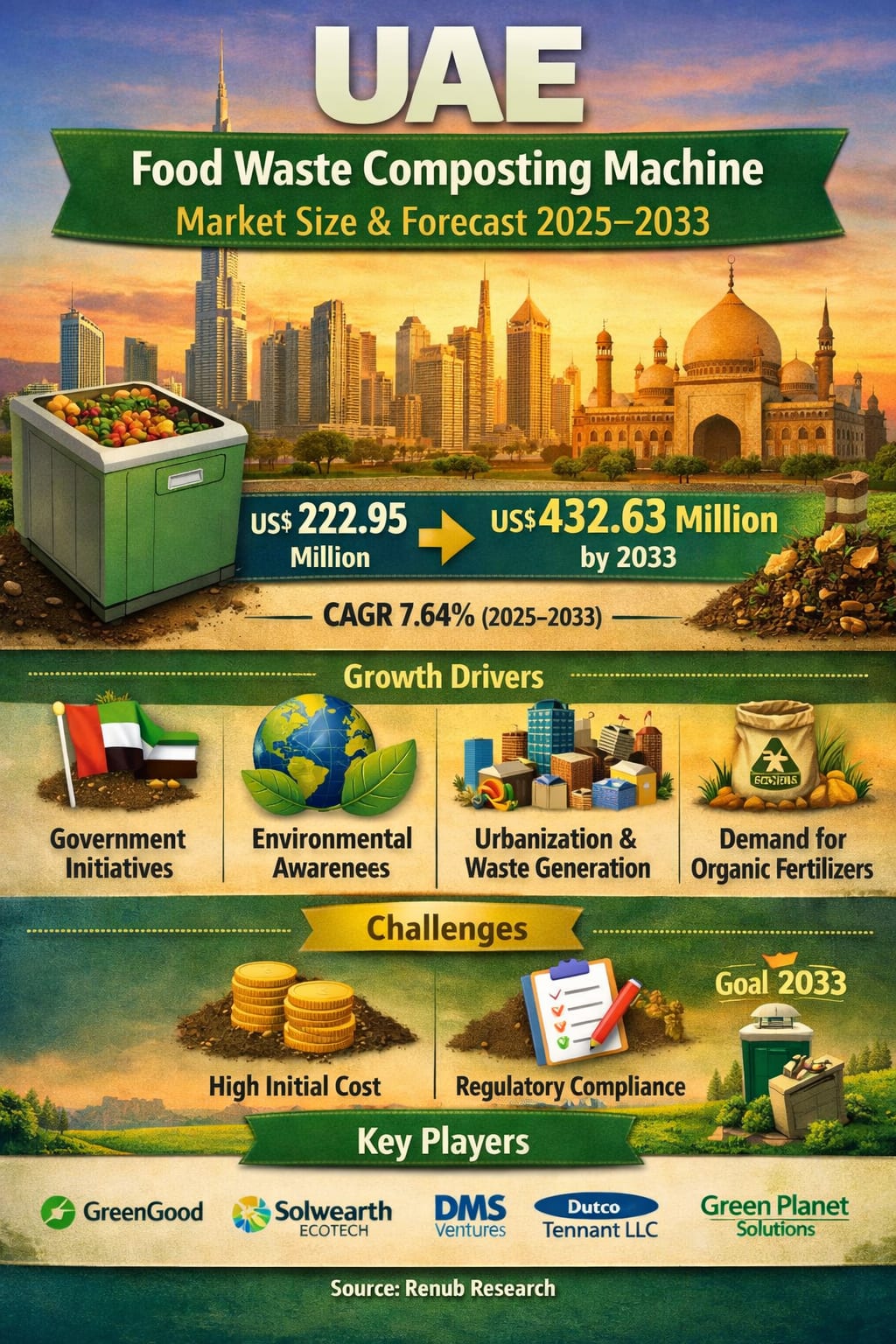
According to Renub Research’s latest industry assessment, the UAE Food Waste Composting Machine Market is expected to grow from US$ 222.95 million in 2024 to US$ 432.63 million by 2033, registering a compound annual growth rate (CAGR) of 7.64% from 2025 to 2033. This steady expansion reflects the country’s rising commitment to sustainable waste management, environmental protection, and circular economy principles.
The United Arab Emirates, known globally for rapid urban development and ambitious sustainability goals, is now focusing more seriously on one of the most pressing challenges of modern cities: food waste. With expanding urban populations, a thriving hospitality sector, and changing consumption patterns, the volume of organic waste generated in the country continues to rise. Food waste composting machines—designed to convert organic waste into useful by-products such as compost or water—are emerging as a practical, scalable, and environmentally responsible solution.
Driven by government initiatives, environmental awareness, technological advancements, and growing demand for organic fertilizers in agriculture and landscaping, the UAE food waste composting machine market is transitioning from a niche sustainability solution into a mainstream infrastructure investment. Businesses, municipalities, and even households are increasingly recognizing composting machines not just as waste treatment tools, but as value-creating assets in the broader sustainability ecosystem.
UAE Food Waste Composting Machine Industry Overview
A food waste composting machine is a system designed to convert organic kitchen and food waste into nutrient-rich compost or reusable by-products in a controlled and accelerated manner. By regulating temperature, moisture, and aeration, these machines significantly speed up the natural decomposition process. The result is a hygienic, efficient, and environmentally friendly method of managing organic waste.
These machines are available in a wide range of capacities—from compact units for households and small restaurants to large industrial systems used in hotels, malls, food processing units, and municipal waste facilities. Beyond reducing landfill dependency, composting machines help cut greenhouse gas emissions, minimize odor and hygiene issues, and transform waste into a useful resource for landscaping, agriculture, and soil enrichment.
In the UAE, the relevance of such technology is growing rapidly. With ambitious sustainability agendas and increasing pressure to reduce landfill waste, composting machines fit perfectly into the country’s long-term environmental and economic strategies. The market is also benefiting from advancements in automation, energy efficiency, and smart monitoring systems, making modern composting machines easier to operate and more cost-effective over time.
Market Growth Drivers
1. Government Initiatives and Regulations
One of the strongest growth catalysts for the UAE food waste composting machine market is government policy support. The UAE has introduced multiple initiatives aimed at reducing landfill waste, improving recycling rates, and promoting sustainable consumption patterns.
For example, in certain emirates such as Ras Al Khaimah, businesses generating large volumes of food waste are encouraged—or required—to develop structured waste management plans, often including on-site composting or organic waste treatment solutions. Abu Dhabi’s Tadweer authority has also adopted biowaste treatment technologies to reduce the burden on landfills and improve resource recovery.
Additionally, national-level programs like the UAE Food Loss and Waste Initiative emphasize responsible consumption, waste reduction, and sustainable disposal practices. These policies create a supportive regulatory environment for composting machine manufacturers and solution providers, while also pushing commercial establishments to adopt modern waste treatment technologies.
Over time, such regulations are expected to normalize composting practices across hospitality, retail, food processing, and municipal sectors—directly supporting long-term market growth.
2. Rising Environmental Awareness
Environmental awareness is becoming a major social and economic force in the UAE. As sustainability moves from a policy goal to a cultural priority, both businesses and individuals are rethinking how they manage waste.
Campaigns aimed at reducing food waste and promoting resource efficiency have increased public understanding of the environmental impact of landfilling organic waste. Composting, in this context, is seen not only as a disposal method but as a positive environmental action that contributes to soil health, urban greening, and carbon reduction.
Several organizations and facilities in the UAE have already begun implementing composting solutions for internal waste management, using the resulting compost for landscaping and green spaces. These real-world success stories are strengthening confidence in composting technologies and encouraging wider adoption across sectors such as hospitality, education, healthcare, and real estate.
3. Urbanization and Rising Waste Generation
The UAE’s rapid urbanization—particularly in cities like Dubai and Abu Dhabi—has led to significant growth in municipal solid waste, with food waste forming a substantial portion of the total. Urban lifestyles, large-scale events, tourism, and a strong food service industry all contribute to higher levels of organic waste generation.
With landfill space becoming more constrained and waste transportation costs rising, composting machines offer a localized, efficient, and sustainable solution. By treating food waste at or near the point of generation, these systems reduce logistical burdens while supporting the UAE’s broader sustainability goals.
Moreover, composting aligns closely with the country’s circular economy vision, where waste is viewed as a resource rather than a liability. This structural shift in how waste is perceived is expected to keep demand for composting machines strong throughout the forecast period.
4. Technological Advancements in Composting Systems
Modern composting machines are far more advanced than earlier generations of waste treatment equipment. Today’s systems feature automation, odor control, energy-efficient operations, and smart monitoring capabilities, making them easier to integrate into commercial and residential environments.
These technological improvements reduce operational complexity, shorten processing times, and improve output quality—factors that significantly enhance the return on investment for end users. As technology continues to evolve, composting machines are becoming more compact, quieter, and more user-friendly, further expanding their potential customer base.
5. Growing Demand for Organic Fertilizers and Landscaping Solutions
The UAE’s focus on urban greening, landscaping, and sustainable agriculture is also supporting the composting machine market. Compost produced from food waste is increasingly used in parks, gardens, golf courses, and agricultural projects, reducing reliance on chemical fertilizers and imported soil conditioners.
This creates a closed-loop system where food waste is converted into a valuable input for green development—perfectly aligning with the country’s environmental and economic objectives.
Key Market Challenges
High Initial Investment
Despite strong long-term benefits, the high upfront cost of composting machines remains a barrier, especially for small businesses, startups, and residential users. The total investment often includes not just the machine itself, but also installation, staff training, and ongoing maintenance.
While operational savings and environmental benefits accumulate over time, the perceived long payback period can discourage adoption. Addressing this challenge will require more flexible financing options, leasing models, or government-backed incentives to make these systems more accessible.
Regulatory Compliance Complexity
Navigating the UAE’s waste management regulations can be challenging, particularly for companies operating across multiple emirates. Differences in local rules, approval processes, and compliance standards can delay project implementation and increase administrative costs.
Simplifying approval procedures, standardizing guidelines, and offering clearer technical frameworks would help accelerate adoption and reduce uncertainty for investors and end users alike.
Market Segmentation Overview
The UAE Food Waste Composting Machine Market is segmented into the following key categories:
B2B Market Assessment – Waste-Food to Fertilizer Equipment
B2C Market Assessment – Waste-Food to Fertilizer Equipment
B2B Market Assessment – Waste-Food to Water Equipment
B2C Market Assessment – Waste-Food to Water Equipment
Additionally, the market analysis includes:
Porter’s Five Forces Analysis
Strategic Recommendations
Each company is evaluated from four perspectives:
Company Overview
Key Persons
Recent Developments & Strategies
Sales Analysis
Competitive Landscape and Key Players
The UAE food waste composting machine market features a mix of regional and international solution providers focused on sustainability, waste management, and green technology. Key players include:
GreenGood
Solwearth Ecotech
DMS Ventures
Dutco Tennant LLC
Green Planet Solutions
These companies are competing through product innovation, strategic partnerships, service expansion, and customized solutions for different end-user segments such as hospitality, municipalities, commercial facilities, and residential communities.
As sustainability becomes a stronger purchasing criterion, companies that can combine performance, reliability, and cost-effectiveness are likely to gain a competitive edge.
Strategic Outlook
Looking ahead, the UAE Food Waste Composting Machine Market is well-positioned for stable and sustained growth through 2033. The combination of policy support, rising environmental awareness, technological progress, and increasing waste volumes creates a strong foundation for long-term expansion.
Strategic priorities for stakeholders include:
Expanding affordable and modular product offerings
Strengthening after-sales service and training support
Partnering with government and municipal bodies
Promoting awareness of economic and environmental benefits
Developing financing and leasing models to reduce adoption barriers
Final Thoughts
The UAE Food Waste Composting Machine Market is no longer just a niche segment of the environmental technology space—it is becoming a core pillar of the country’s sustainability and circular economy strategy. With the market projected to grow from US$ 222.95 million in 2024 to US$ 432.63 million by 2033 at a CAGR of 7.64%, the opportunity for technology providers, investors, and policymakers is both substantial and timely.
As the UAE continues to balance rapid urban development with ambitious environmental goals, composting machines will play a crucial role in transforming waste into value, reducing environmental impact, and building a more resilient, resource-efficient future.
About the Creator
Algorand (ALGO) Blockchain Speed, Market Trends, and Investment Outlook
Introduction Algorand has gained attention in the blockchain space due to its focus on high-speed transactions, low fees, and scalability. Unlike many blockchains struggling with congestion and high costs, Algorand aims to deliver efficient performance while maintaining decentralization and security. From an investment perspective, ALGO provides exposure to a technologically strong platform that addresses practical issues in blockchain adoption. Understanding Algorand’s market behavior, ecosystem growth, and potential risks is critical for making informed investment decisions.
By Hammad Nawazabout 24 hours ago in Trader
Philippines Retail Market 2026: Set for Rapid Expansion on Digital, Urban & Consumer Trends
Philippines Retail Market Overview The Philippines retail market is experiencing significant expansion as rising consumer spending, omnichannel retailing, and modern retail innovations reshape how Filipinos shop. According to the latest IMARC Group report, the market size reached USD 648.2 billion in 2025 and is expected to grow to USD 1,223.1 billion by 2034, exhibiting a compound annual growth rate (CAGR) of 7.31% during 2026–2034 — reflecting robust demand across product segments and distribution channels.
By Manisha Dixit5 days ago in Trader



Comments
There are no comments for this story
Be the first to respond and start the conversation.