
United Kingdom Feed Additives Market Trends & Outlook 2025–2033
How Innovation, Sustainability, and Stricter Food Safety Rules Are Reshaping the UK Feed Industry

United Kingdom Feed Additives Market Size and Forecast
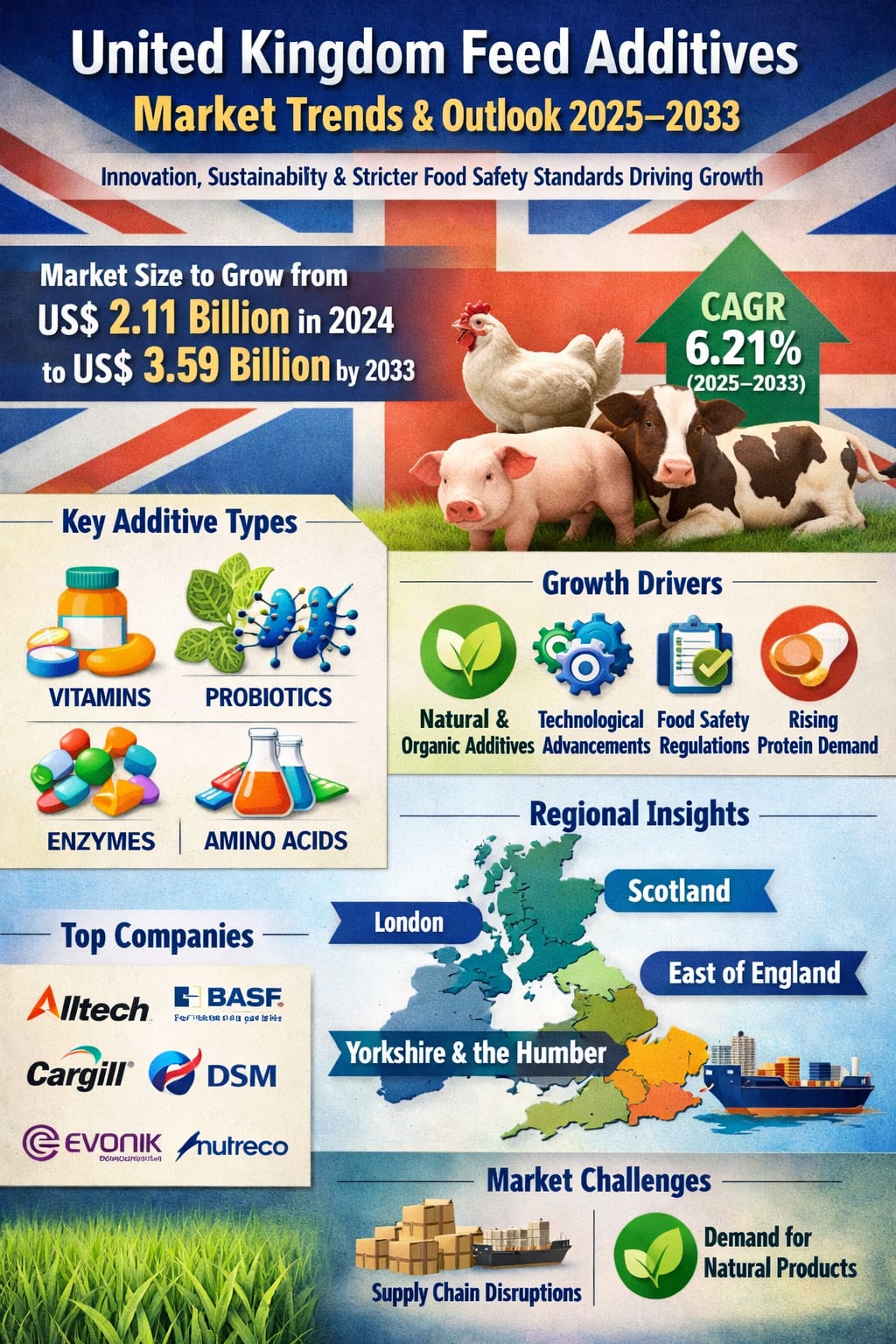
The United Kingdom Feed Additives Market is projected to grow from US$ 2.11 billion in 2024 to US$ 3.59 billion by 2033, registering a compound annual growth rate (CAGR) of 6.21% from 2025 to 2033. This steady expansion reflects the structural transformation underway in the UK’s livestock and animal nutrition sectors.
Growth in the market is being driven by several converging trends: the shift toward natural and organic additives, ongoing technological advancements that enhance feed efficiency, stricter food safety regulations, rising demand for sustainable feed solutions, and a stronger focus on premium and environmentally responsible products. Together, these factors are reshaping how animal feed is formulated, marketed, and consumed across the country.
The UK’s feed additives industry sits at the intersection of agriculture, food security, animal welfare, and sustainability. As consumer expectations around food quality and traceability rise, feed producers and livestock farmers are under increasing pressure to adopt advanced, safe, and efficient nutritional solutions. This evolving landscape positions feed additives not just as supplements, but as strategic tools for productivity, compliance, and long-term competitiveness.
United Kingdom Feed Additives Industry Overview
Feed additives play a vital role in improving the nutritional value, safety, and quality of animal feed in the UK. These products are essential for enhancing animal health, optimizing feed efficiency, and reducing disease risks, especially at a time when demand for high-quality meat, dairy, and poultry products continues to grow.
Commonly used additives include vitamins, minerals, enzymes, probiotics, amino acids, antioxidants, and binders, each serving a specific function in improving digestion, boosting immunity, supporting growth, and ensuring better feed conversion ratios. As farming becomes more data-driven and performance-focused, the role of these additives is becoming increasingly strategic rather than supplementary.
Another major shift shaping the industry is the move toward natural and organic feed additives. Consumers are increasingly concerned about food safety, chemical residues, and environmental impact. This has pushed producers to explore alternatives such as phytogenic additives, prebiotics, and probiotics, which are seen as safer and more sustainable options compared to conventional synthetic or antibiotic-based solutions.
Regulation also plays a crucial role in defining the market. The UK operates under strict feed safety and quality standards, influenced by both legacy EU frameworks and UK-specific regulations. These rules ensure that additives are safe for animals and, by extension, for human consumption. At the same time, concerns about antimicrobial resistance have accelerated the shift away from antibiotic growth promoters and toward more natural performance-enhancing solutions.
Looking ahead, the adoption of precision farming technologies is expected to further boost the effectiveness and customization of feed additives. By aligning nutrition more closely with the specific needs of different animal species and production systems, the industry is moving toward smarter, more efficient, and more sustainable feeding practices.
Rising Consumption of Animal Protein Supports Market Growth
The growing consumption of meat and animal-based products in the UK is a key factor supporting the expansion of the feed additives market. Animal protein continues to be widely recognized as a critical source of essential nutrients, driving consistent demand across poultry, meat, and dairy segments.
For example, poultry meat consumption increased from 2,094.3 thousand metric tons in 2022 to 2,170.3 thousand metric tons in 2023, highlighting the strong and growing preference for chicken and other white meats. Poultry remains the most popular meat category in the country, and it also represents the largest user segment for feed additives due to the intensive nature of poultry production.
Egg consumption trends further reinforce this picture. Between 2021 and 2023, the average annual egg intake per person rose from 169 to 175 eggs, reflecting steady growth in demand. This puts additional pressure on producers to improve productivity, efficiency, and animal health, all of which increase reliance on feed additives such as vitamins, enzymes, and amino acids.
Across all livestock segments, feed additive usage is on an upward trend, with poultry leading, followed by ruminants and swine. The need to produce more while maintaining quality, safety, and sustainability standards is making advanced feed nutrition a necessity rather than an option.
Growth Drivers for the United Kingdom Feed Additives Market
Rising Technological Advancements
Technological innovation is one of the most powerful forces shaping the UK feed additives market. New technologies are significantly improving the stability, bioavailability, and efficiency of feed additives, making them more effective and more economical in the long run.
One major development is encapsulation technology, which protects sensitive nutrients from environmental degradation and ensures they are delivered more efficiently to animals. This improves nutrient absorption and reduces waste, helping farmers achieve better results from smaller quantities of additives.
Precision delivery systems are also transforming the market. These systems allow targeted supplementation based on the specific needs of different species, age groups, or production stages. The result is better animal performance, improved health outcomes, and more efficient use of resources.
In addition, advances in biotechnology are enabling the development of next-generation additives such as advanced probiotics and enzyme-based solutions. These innovations are helping producers create more specialized, high-performance feed formulations that align with the evolving demands of modern agriculture.
Strict Guidelines for Food Safety
The UK’s feed additives market is strongly influenced by stringent food safety regulations. Regulatory bodies enforce strict standards to ensure that feed additives are safe for animals and do not pose risks to human health through the food chain.
These regulations require extensive testing, transparent labeling, and strict compliance with quality standards. As a result, manufacturers are investing heavily in research and development to create products that meet these demanding requirements while still delivering strong performance benefits.
Although compliance increases costs and complexity, it also builds consumer trust and supports the long-term credibility of the industry. In many ways, regulation is acting as both a safeguard and a catalyst for innovation, encouraging the development of safer, more effective, and more sustainable feed additives.
Transition to Organic Feed Ingredients
The shift toward natural and organic feed additives is one of the most important trends in the UK market today. This transition reflects growing consumer awareness around sustainability, animal welfare, and food quality.
Producers are increasingly turning to probiotics, enzymes, herbal extracts, and other natural solutions to reduce reliance on synthetic chemicals and antibiotics. These alternatives are seen as better aligned with both regulatory expectations and consumer preferences.
Manufacturers are responding by expanding their portfolios of natural and organic products and investing in innovation to improve their effectiveness and consistency. While this shift presents challenges, it is also creating new opportunities for differentiation and value creation across the supply chain.
Challenges in the United Kingdom Feed Additives Market
Consumer Demand for Natural Products
While the move toward natural and organic additives is a major growth driver, it also presents significant challenges. Sourcing high-quality natural ingredients can be more expensive and more complex than using synthetic alternatives.
Many plant-based or organic raw materials are subject to supply constraints, seasonal variability, and higher production costs. In addition, ensuring consistent quality and performance often requires stricter testing and quality control, which further increases costs.
Manufacturers must therefore balance rising consumer expectations with economic realities, finding ways to scale up natural solutions without compromising affordability or reliability.
Supply Chain Disruptions
Supply chain disruptions, particularly in the post-Brexit environment, have had a noticeable impact on the UK feed additives market. New trade barriers, administrative requirements, and logistical delays have made it more difficult and more expensive to import key raw materials such as vitamins, minerals, and enzymes.
These challenges have led to higher transportation costs, occasional shortages, and increased price volatility. For manufacturers, this creates uncertainty in production planning and pricing strategies, while for farmers, it can mean less predictable availability of essential feed products.
Managing these disruptions and building more resilient supply chains will be critical for maintaining market stability and supporting long-term growth.
United Kingdom Feed Additives Market Overview by Regions
The UK feed additives market is geographically diverse, covering London, South East, North West, East of England, South West, Scotland, West Midlands, Yorkshire and the Humber, East Midlands, and Others.
London
London’s feed additives market benefits from strong demand for premium meat, dairy, and poultry products and a highly health-conscious consumer base. The focus on animal welfare and sustainable farming is driving interest in innovative and natural additives such as probiotics and enzymes. While the city’s position as a global trade hub supports supply chains, rising costs and logistical challenges remain key concerns.
East of England
With its strong agricultural base, the East of England is a major contributor to the UK feed additives market, particularly in dairy, poultry, and pig farming. Demand is growing for additives that improve efficiency and support sustainable practices. However, fluctuating raw material prices and supply chain pressures can affect availability and pricing.
Scotland
Scotland’s livestock sector, including cattle, sheep, and poultry, is a major driver of feed additive demand. Farmers are increasingly adopting advanced additives to improve feed conversion, animal health, and product quality. Interest in natural and sustainable solutions is strong, although higher input costs remain a challenge.
Yorkshire and the Humber
This region’s large agricultural base, especially in poultry, dairy, and pork, supports steady growth in feed additive usage. Farmers are focusing on productivity, efficiency, and sustainability, boosting demand for probiotics, enzymes, and amino acids. Supply chain stability and cost control are key issues shaping the market here.
United Kingdom Feed Additives Market Segmentation
By Additive Type:
Antibiotics, Vitamins, Antioxidants, Amino Acids, Enzymes, Prebiotics, Probiotics, Binders, Others
By Animal Type:
Ruminants, Swine, Poultry, Others
By Region:
London, South East, North West, East of England, South West, Scotland, West Midlands, Yorkshire and the Humber, East Midlands, Others
Key Players in the United Kingdom Feed Additives Market
Major companies operating in the market include:
Alltech, BASF SE, Novozymes A/S, Archer Daniels Midland Co., Cargill Inc., DSM Nutritional Products Inc., Evonik Industries AG, Nutreco N.V., and DuPont Danisco.
These players compete on innovation, product quality, regulatory compliance, and sustainability, while also expanding their portfolios to meet the growing demand for natural and high-performance feed solutions.
Final Thoughts
The United Kingdom Feed Additives Market is entering a phase of steady and meaningful growth, rising from US$ 2.11 billion in 2024 to US$ 3.59 billion by 2033 at a CAGR of 6.21%. This growth reflects deeper changes in how food is produced, regulated, and consumed across the country.
Driven by technological innovation, stricter safety standards, and a clear shift toward sustainable and natural solutions, feed additives are becoming central to the future of UK livestock farming. While challenges such as supply chain disruptions and higher costs remain, the long-term outlook is positive. Companies that can combine innovation, compliance, and sustainability will be best positioned to lead in this evolving and increasingly strategic market.
About the Creator
Trading Journal: Why Should Every Trader Have One
A Trading Journal is one of the most powerful yet overlooked tools in the financial markets. While many traders focus on strategies, indicators, or signals, few consistently document why they enter and exit trades.
By Ethan Coleabout 2 hours ago in Trader
Vietnam Organic Food Market Size and Forecast 2025–2033
Vietnam Organic Food Market Overview The Vietnam Organic Food Market is entering a decisive growth phase, driven by changing consumer lifestyles, rising health awareness, and stronger focus on environmental sustainability. According to industry estimates, the Vietnam Organic Food Market is expected to reach US$ 2.68 billion by 2033, up from US$ 1.04 billion in 2024, expanding at a robust CAGR of 11.16% from 2025 to 2033. This impressive growth trajectory reflects a deep transformation in how Vietnamese consumers think about food quality, safety, and long-term wellbeing.
By shibansh kumar6 days ago in Trader
Think for Me
"How do you calculate the circumference of a circle? Submit your answer when ready." [Pause] "Excellent! Every student was able to call up the answer electronically very quickly. If I, as a robot had feelings, I would express pride. You may break for lunch. Return to this cyber room in 45 minutes."
By Julie Lacksonen5 days ago in Humans



Comments
There are no comments for this story
Be the first to respond and start the conversation.