
United States Assisted Reproductive Technology Market Size, Growth & Forecast 2025–2033 | Renub Research
How IVF, Genetic Testing, AI, and Fertility Preservation Are Reshaping the Future of Parenthood in America

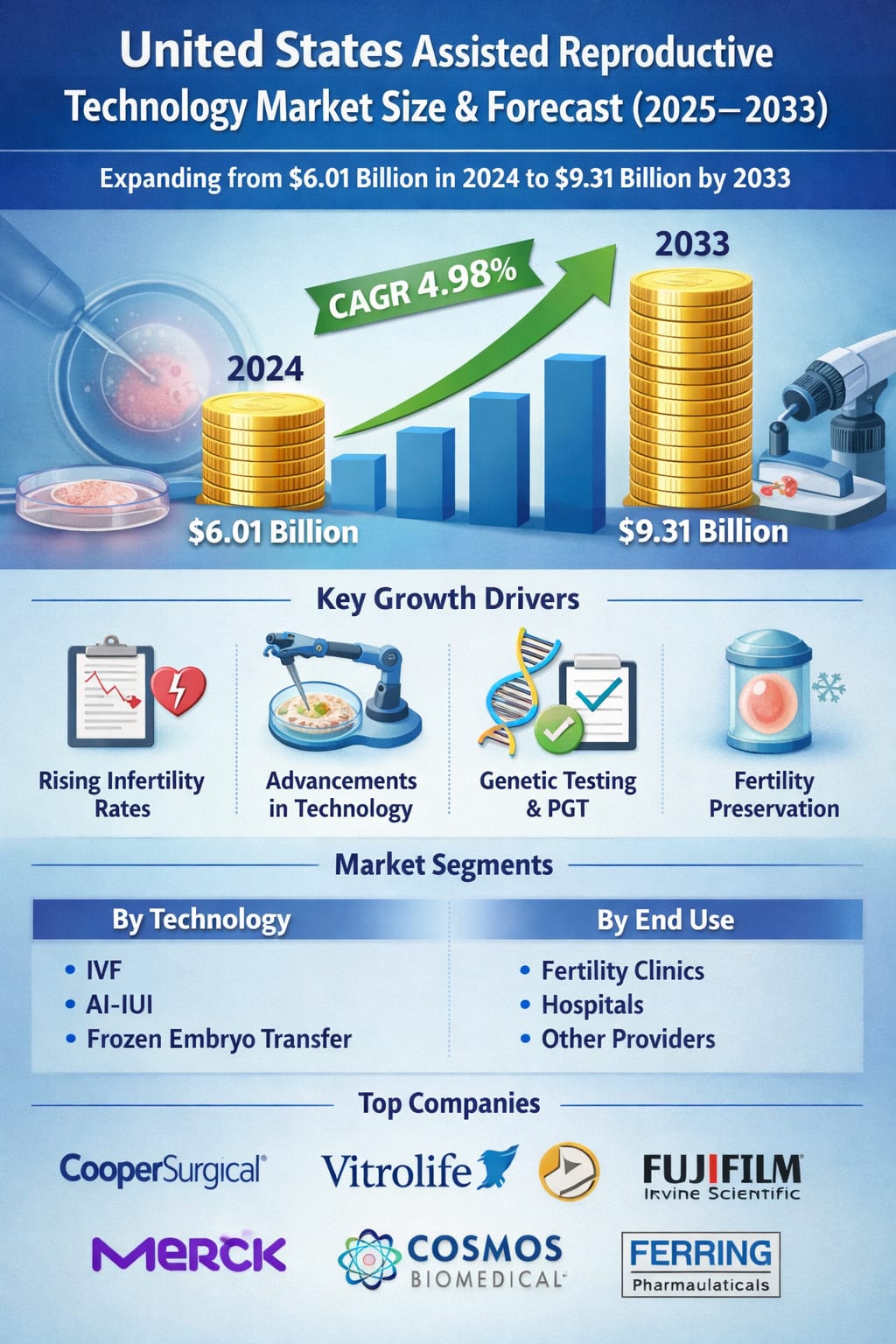
United States Assisted Reproductive Technology Market
The United States Assisted Reproductive Technology (ART) Market is entering a new phase of steady, innovation-driven growth. According to Renub Research, the market is expected to reach US$ 9.31 billion by 2033, up from US$ 6.01 billion in 2024, registering a CAGR of 4.98% from 2025 to 2033. This expansion reflects a powerful mix of social change, medical innovation, and rising awareness around fertility treatments.
Increased infertility rates, broader acceptance of fertility treatments, advances in reproductive technologies, growing insurance coverage, and the rising demand for genetic testing and embryo freezing are all contributing to this upward trend. What was once considered a niche or last-resort medical option has now become a mainstream healthcare solution for millions of individuals and couples across the country.
ART is no longer only about helping couples conceive; it has evolved into a sophisticated medical ecosystem that blends biotechnology, genetics, data science, and personalized medicine. From IVF and embryo cryopreservation to AI-powered embryo selection and fertility preservation, the U.S. ART market is redefining what modern family planning looks like in the 21st century.
United States Assisted Reproductive Technology Industry Overview
Assisted Reproductive Technology (ART) refers to a range of medical procedures used to treat infertility and help individuals or couples achieve pregnancy. These techniques involve handling eggs, sperm, or embryos to improve the chances of conception. Common ART procedures include in vitro fertilization (IVF), intracytoplasmic sperm injection (ICSI), embryo cryopreservation, and egg or sperm donation.
ART is typically recommended when other fertility treatments fail or when patients face specific challenges such as advanced maternal age, genetic disorders, unexplained infertility, or medical conditions affecting reproductive health. These procedures are carried out in specialized fertility clinics and hospitals under the supervision of reproductive endocrinologists and trained embryologists.
Over the past two decades, ART has moved from being a specialized medical option to a widely accepted solution. Millions of babies have been born worldwide through these techniques, and in the United States, ART has become an essential part of modern reproductive healthcare. The industry now sits at the intersection of medicine, technology, ethics, and social change.
The market’s growth is also being fueled by rising public awareness. Government bodies, healthcare organizations, and non-profit institutions regularly run awareness campaigns about infertility, early diagnosis, and available treatment options. Social media and mainstream media coverage—especially stories of celebrities openly discussing IVF, surrogacy, or egg freezing—have further helped reduce stigma and normalize fertility treatments.
At the same time, industry players are expanding their footprints through partnerships, acquisitions, and educational initiatives. A notable example is the collaboration between the Society for Reproductive Biologists and Technologists (SRBT) and the American Society for Reproductive Medicine (ASRM) to establish the ASRM Clinical Embryology Learning Laboratory (CELL), which opened in October 2024. Such initiatives highlight the sector’s focus on skill development, quality standards, and long-term sustainability.
Market Size and Growth Outlook (Renub Research)
Renub Research estimates that the United States Assisted Reproductive Technology Market will grow from US$ 6.01 billion in 2024 to US$ 9.31 billion by 2033, at a CAGR of 4.98% during 2025–2033.
This growth is not explosive, but it is stable, resilient, and structurally strong—driven by long-term demographic and social trends rather than short-term cycles. Key contributors include:
Rising infertility rates linked to lifestyle changes, stress, obesity, and delayed parenthood
Greater acceptance of fertility treatments across age groups and social segments
Technological advancements improving success rates and safety
Expanding insurance coverage and employer-sponsored fertility benefits
Increasing demand for genetic testing, embryo screening, and fertility preservation
Together, these factors are transforming ART from a reactive medical solution into a proactive, planned component of reproductive healthcare.
Growth Drivers for the United States Assisted Reproductive Technology Market
Growing Utilization of PGT and Genetic Testing
One of the most important growth drivers in the U.S. ART market is the rising adoption of Preimplantation Genetic Testing (PGT). This technique allows doctors to screen embryos for chromosomal abnormalities and genetic disorders before implantation, significantly improving the chances of a successful and healthy pregnancy.
With the help of Next-Generation Sequencing (NGS), clinics can now identify even subtle genetic anomalies with high accuracy. PGT-A (aneuploidy testing) is especially popular among older patients and those who have experienced repeated IVF failures, as it helps select the healthiest embryo for transfer.
This shift reflects a broader move toward precision medicine in reproductive care. Instead of relying solely on traditional visual assessments, clinics are increasingly using genetic data to guide decision-making. The result is higher implantation rates, lower miscarriage risks, and better overall outcomes—making PGT a key value driver in the ART market.
Developments in AI and IVF Automation Technology
Artificial Intelligence (AI) and automation are rapidly changing how fertility clinics operate. Technologies such as time-lapse embryo imaging systems allow continuous monitoring of embryo development without disturbing lab conditions. AI algorithms can analyze thousands of data points to predict which embryos have the highest chances of leading to a successful pregnancy.
Companies like TMRW Life Sciences and Alife Health are introducing automated laboratory solutions that reduce human error, improve consistency, and enhance the safety of embryo storage and handling. AI-driven platforms are also helping clinics personalize treatment protocols based on patient history, hormone levels, and genetic data.
In July 2024, Canadian company Hamilton Thorne Ltd. launched EmbryoView Pro, an advanced embryo monitoring system that uses AI-driven analysis for real-time embryo evaluation. This launch aligns with the broader industry goal of improving success rates while streamlining clinical workflows and reducing operational risks.
As these technologies mature, they are expected to make ART procedures more efficient, more predictable, and more accessible—further supporting market growth.
Growing Use of Fertility Preservation and Egg Freezing
Fertility preservation, especially egg freezing, has become one of the most dynamic segments of the U.S. ART market. More women are choosing to delay childbirth due to career goals, education, financial planning, or personal reasons. At the same time, awareness about age-related fertility decline is higher than ever.
Advancements in vitrification techniques have significantly improved egg survival rates after freezing and thawing, making egg freezing a reliable long-term option rather than an experimental procedure. Many large corporations, including major technology firms, now offer egg freezing as part of their employee health benefits, further normalizing the practice.
Fertility clinics are also actively promoting preservation options as a form of “reproductive insurance,” empowering individuals to take control of their reproductive timelines. This shift reflects broader social changes and is expected to remain a strong growth engine for the ART market over the next decade.
Challenges in the United States Assisted Reproductive Technology Market
High Treatment Costs
Despite technological progress, cost remains one of the biggest barriers to ART adoption in the United States. A single IVF cycle can cost anywhere between US$ 12,000 and US$ 20,000, and many patients require multiple cycles to achieve success. Additional expenses for medications, genetic testing, and embryo storage can further increase the financial burden.
While insurance coverage is improving, it is still inconsistent across states and employers. As a result, ART remains out of reach for many middle- and lower-income families, reinforcing socioeconomic disparities in access to reproductive healthcare.
Regulatory Hurdles
The U.S. ART market also faces regulatory complexities. Unlike many other medical fields, ART is largely self-regulated, with varying standards across clinics and states. The lack of uniform federal oversight can lead to inconsistencies in quality, reporting, and patient protection.
Differences in state-level laws regarding insurance coverage, embryo handling, and ethical guidelines further complicate the landscape. These regulatory gaps create uncertainty for both providers and patients and can slow down market expansion and standardization efforts.
United States Assisted Reproductive Technology Market Segmentation
By Technology
In Vitro Fertilization (IVF)
Artificial Insemination (AI-IUI)
Frozen Embryo Transfer (FET)
Others
IVF remains the dominant segment due to its high success rates and wide applicability, while FET is gaining traction as clinics increasingly adopt freeze-all strategies and long-term embryo storage solutions.
By End Use
Hospitals
Fertility Clinics
Other end users/providers
Fertility clinics account for the largest share of procedures, thanks to their specialized infrastructure, expertise, and focus on reproductive care.
Competitive Landscape and Key Players
The U.S. ART market is supported by a mix of global and specialized companies focusing on equipment, consumables, media, and laboratory solutions. Key players include:
Cosmos Biomedical Ltd.
Microm U.K. Ltd.
CooperSurgical, Inc.
FUJIFILM Irvine Scientific, Inc.
Cryolab Ltd.
Vitrolife AB
Merck KGaA
Ferring B.V.
These companies compete on innovation, product quality, clinical outcomes, and partnerships with fertility clinics and hospitals. Strategies such as new product launches, acquisitions, and collaborations are shaping the competitive dynamics of the market.
Future Outlook
Looking ahead, the U.S. ART market is expected to grow steadily, driven by technology integration, personalized medicine, and changing social attitudes toward family planning. AI, genetic testing, and automation will continue to improve success rates and efficiency, while fertility preservation will become an even more mainstream choice.
At the same time, policy reforms, broader insurance coverage, and cost-reduction strategies will play a critical role in determining how accessible these treatments become to the wider population.
Final Thoughts
The United States Assisted Reproductive Technology Market is no longer just about treating infertility—it is about reshaping the future of reproduction. With Renub Research projecting growth from US$ 6.01 billion in 2024 to US$ 9.31 billion by 2033, the sector is clearly on a strong and sustainable path.
Driven by innovation, social change, and rising awareness, ART is becoming an integral part of modern healthcare. While challenges like high costs and regulatory complexity remain, the overall direction of the market points toward greater precision, accessibility, and impact.
In the years ahead, assisted reproductive technology will not only help more families achieve their dreams of parenthood—it will also continue to redefine what is possible in reproductive medicine
About the Creator
JPMorgan Chase Stock Analysis: Is JPMorgan Still the Strongest Bank Stock for Long-Term Investors?
Introduction JPMorgan Chase stock is often considered the benchmark for the global banking industry. As the largest bank in the United States by assets, JPMorgan Chase plays a central role in consumer banking, corporate finance, investment banking, and global markets. Investors frequently turn to JPMorgan during periods of economic uncertainty because of its scale, diversified revenue streams, and disciplined risk management. The key question remains whether JPMorgan stock can continue delivering consistent long-term value in a changing economic and regulatory environment.
By Hammad Nawaza day ago in Trader




Comments
There are no comments for this story
Be the first to respond and start the conversation.