
United States Breast Reconstruction Market Size and Forecast (2025–2033)
How Medical Innovation, Insurance Support, and Rising Awareness Are Reshaping Post-Mastectomy Care in America

Introduction: A Market Driven by Recovery, Resilience, and Results
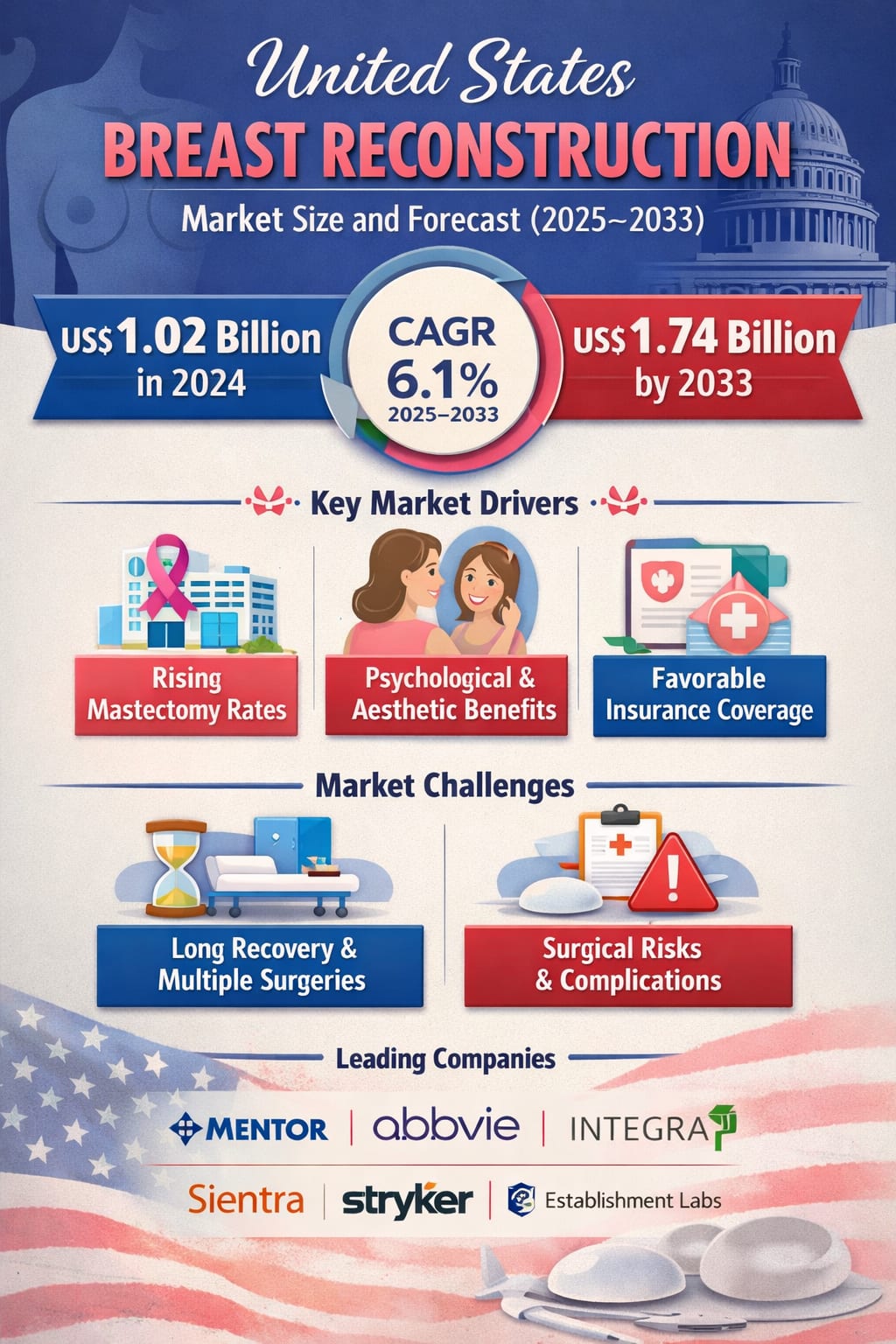
The United States breast reconstruction market is entering a period of steady and meaningful expansion, shaped by a powerful mix of medical progress, rising breast cancer survival rates, and growing awareness of reconstructive options among patients. According to Renub Research, the United States Breast Reconstruction Market is expected to reach US$ 1.74 billion by 2033, up from US$ 1.02 billion in 2024, growing at a compound annual growth rate (CAGR) of 6.1% from 2025 to 2033.
Behind these numbers lies a deeper story—one that blends clinical innovation, policy support, and the evolving expectations of patients who increasingly view breast reconstruction not as a luxury, but as an essential part of cancer recovery and long-term well-being. As mastectomy rates rise and surgical techniques become more refined, the market is steadily transforming from a niche segment into a core component of modern oncological and reconstructive care in the United States.
Market Overview: A Maturing Yet Dynamic Healthcare Segment
Breast reconstruction refers to a range of surgical procedures designed to restore the shape, appearance, and symmetry of the breast following mastectomy or lumpectomy. In the U.S., this field has evolved rapidly over the past two decades, supported by advances in implant technology, tissue-based reconstruction methods, and surgical planning tools.
One of the most notable trends is the growing adoption of autologous tissue reconstruction techniques, such as the DIEP (Deep Inferior Epigastric Perforator) flap procedure. These methods use the patient’s own tissue, offering a more natural look and feel while reducing certain long-term risks associated with implants. At the same time, improvements in implant materials, acellular dermal matrices, and 3D surgical planning are making procedures safer, more predictable, and more personalized.
Policy has also played a crucial role. The Women’s Health and Cancer Rights Act (WHCRA) mandates insurance coverage for breast reconstruction following mastectomy, including procedures to achieve symmetry and address complications. This has significantly lowered financial barriers and expanded access to reconstructive care across the country.
As a result, the U.S. continues to command the largest share of the breast reconstruction market globally, supported by strong healthcare infrastructure, high awareness levels, and a well-established network of specialized surgeons and medical centers.
The Burden of Breast Cancer and Its Market Impact
Breast cancer remains one of the most common cancers among women in the United States. According to widely cited statistics, approximately 1 in 8 American women will develop invasive breast cancer at some point in their lives, and the disease accounts for around 30% of all newly diagnosed cancers in women.
This high incidence has a direct impact on the demand for mastectomy procedures—and, by extension, breast reconstruction. As early detection and treatment outcomes continue to improve, more women are surviving breast cancer and seeking ways to restore not only their health, but also their body image and quality of life.
The growth in reconstructive procedures is not just theoretical. Data from medical literature indicates that the number of breast reconstruction surgeries in the United States increased by around 29% between 2000 and 2018. Additionally, studies suggest that approximately 40% of women undergoing mastectomy in the U.S. now opt for some form of breast reconstruction. These trends highlight a clear and sustained shift toward making reconstruction a standard part of post-cancer care.
Key Drivers of Market Growth
1. Rising Mastectomy Rates
One of the most important growth drivers for the U.S. breast reconstruction market is the increasing number of mastectomy procedures. While breast-conserving surgeries remain common, mastectomies are still widely performed for both therapeutic and preventive reasons. Women with a high genetic risk—such as those carrying BRCA mutations—are increasingly choosing prophylactic mastectomies to reduce future cancer risk.
As more women undergo these procedures, the demand for effective, reliable, and aesthetically satisfying reconstruction options continues to rise. For many patients, reconstruction is not merely about appearance—it is about restoring a sense of wholeness and normalcy after a life-altering diagnosis and treatment journey.
2. Psychological and Aesthetic Benefits
The emotional and psychological impact of breast cancer and mastectomy cannot be overstated. The loss of one or both breasts often affects self-image, confidence, and overall mental well-being. Breast reconstruction plays a critical role in helping patients cope with these challenges.
Beyond the physical restoration, reconstruction can significantly improve self-esteem, reduce anxiety and depression, and help patients feel more comfortable in their own bodies. As awareness of these benefits grows—among both patients and healthcare providers—reconstruction is increasingly viewed as an integral part of holistic cancer care rather than an optional cosmetic procedure.
3. Favorable Insurance Coverage Environment
Insurance coverage has been a game-changer for the U.S. breast reconstruction market. The WHCRA requires most group health plans and insurers to cover breast reconstruction following mastectomy, including procedures needed to achieve symmetry and treat complications.
This legal framework has made reconstructive surgery accessible to a much broader segment of the population. As patients become more aware of their rights and coverage options, more women are choosing to pursue reconstruction without the fear of overwhelming financial burden. This policy support continues to be a strong structural driver of long-term market growth.
4. Technological and Surgical Advancements
Innovation remains at the heart of this market’s expansion. Surgeons now have access to better implant materials, improved acellular dermal matrices, refined microsurgical techniques, and advanced imaging and planning tools. The use of 3D printing and digital surgical planning is also beginning to influence how procedures are designed and executed.
These advances translate into shorter recovery times, fewer complications, and more natural-looking results—factors that further increase patient confidence and acceptance of reconstructive procedures.
Challenges Facing the Market
1. Long Recovery Time and Multiple Surgeries
Despite significant progress, breast reconstruction—especially autologous tissue reconstruction—often involves multiple surgical stages and a lengthy recovery period. Patients may need weeks or even months to fully recover, and in some cases, additional procedures are required to refine results or address complications.
This extended treatment timeline can be physically demanding and emotionally taxing, and it may require time away from work and daily responsibilities. For some women, these factors act as a deterrent, leading them to postpone or entirely avoid reconstruction.
2. Surgical Risks and Complications
Like all major surgeries, breast reconstruction carries inherent risks. These can include infection, poor wound healing, implant-related complications, or issues at the donor site in tissue-based procedures. Patients with existing health conditions or those undergoing chemotherapy or radiation therapy may face higher risks of complications.
While advances in technique have reduced many of these risks, they cannot be eliminated entirely. The possibility of complications—and the potential need for additional corrective surgeries—remains a challenge for both patients and healthcare providers, and it continues to influence decision-making around reconstruction.
Market Segmentation: Understanding Where Growth Is Happening
By Product
Implants: Still one of the most widely used reconstruction options, implants offer shorter initial surgery times and predictable outcomes. Ongoing improvements in implant materials and design continue to support this segment.
Tissue Expanders: Often used as an intermediate step before permanent implant placement, tissue expanders play a crucial role in staged reconstruction procedures.
Acellular Dermal Matrix (ADM): ADMs are increasingly used to support implants and improve aesthetic outcomes, and this segment is benefiting from growing surgeon familiarity and clinical evidence.
By Shape
Round: Popular for their simplicity and predictable volume distribution.
Anatomical: Designed to mimic the natural shape of the breast more closely, these are often chosen for patients seeking a more natural contour.
By End Use
Hospitals: The primary setting for complex reconstruction procedures, especially those involving autologous tissue techniques.
Ambulatory Surgery Centers: Gaining traction for less complex or staged procedures, supported by cost efficiency and patient convenience.
Cosmetology Clinics: Playing a growing role, particularly in implant-based and follow-up reconstructive procedures.
Competitive Landscape: Key Players Shaping the Market
The U.S. breast reconstruction market features a mix of established medical device companies and specialized surgical solution providers. Key players include:
Mentor Worldwide LLC
AbbVie Inc.
Integra LifeSciences
Sientra, Inc.
Stryker Corp.
Establishment Labs
RTI Surgical
TELA Bio, Inc.
These companies are активно (actively) investing in product innovation, surgeon education, and strategic partnerships to strengthen their positions. Their focus areas include improved implant safety, next-generation biomaterials, and solutions that support better surgical outcomes and faster recovery.
Outlook: Where the Market Is Headed
Looking ahead to 2033, the U.S. breast reconstruction market is expected to continue its steady growth trajectory, driven by demographic trends, technological progress, and sustained policy support. The forecasted rise to US$ 1.74 billion reflects not only increasing procedure volumes, but also the growing value placed on quality of life, aesthetics, and psychological recovery in cancer care.
As surgical techniques become more refined and patient education improves, reconstruction is likely to become even more deeply integrated into standard breast cancer treatment pathways. The future of this market will be shaped not just by innovation in devices and materials, but also by a broader cultural shift toward comprehensive, patient-centered care.
Final Thoughts
The United States breast reconstruction market stands at the intersection of medicine, technology, and human resilience. With strong growth projected through 2033, supported by favorable reimbursement policies, rising awareness, and continuous innovation, the sector is poised to play an even more vital role in post-mastectomy care.
Beyond the numbers, this market represents something far more meaningful: the opportunity for millions of women to reclaim confidence, comfort, and a sense of normalcy after one of life’s most challenging experiences. As healthcare systems continue to evolve, breast reconstruction will remain a powerful example of how modern medicine can heal both the body and the spirit.
About the Creator
I Looked Up Where You Rank in Net Worth. The Number Might Surprise You.
You have a number in your head. A rough sense of where you stand financially compared to other people your age. Whether you're "ahead" or "behind." Whether you're doing okay or falling short.
By Destiny S. Harris2 days ago in Trader
The Pride Flag and the Diversion
For nearly a decade, the LGBTQIA Pride Flag rippled in the wind at Christopher Park, a kaleidoscope of color staked into the soil of America’s first national monument to LGBTQIA+ liberation. That flag came down this week. Federal officials, citing new guidance from the Trump Administration, silently lowered the rainbow flag from its pole across the street from the Stonewall Inn. The birthplace of the modern gay rights movement now flies only the United States flag.
By Tim Carmichael7 days ago in Pride


Comments
There are no comments for this story
Be the first to respond and start the conversation.