
United States Cannabis Market Size & Forecast 2026–2034
From Policy Shifts to Product Innovation: How America’s Cannabis Industry Is Entering Its Most Defining Growth Decade

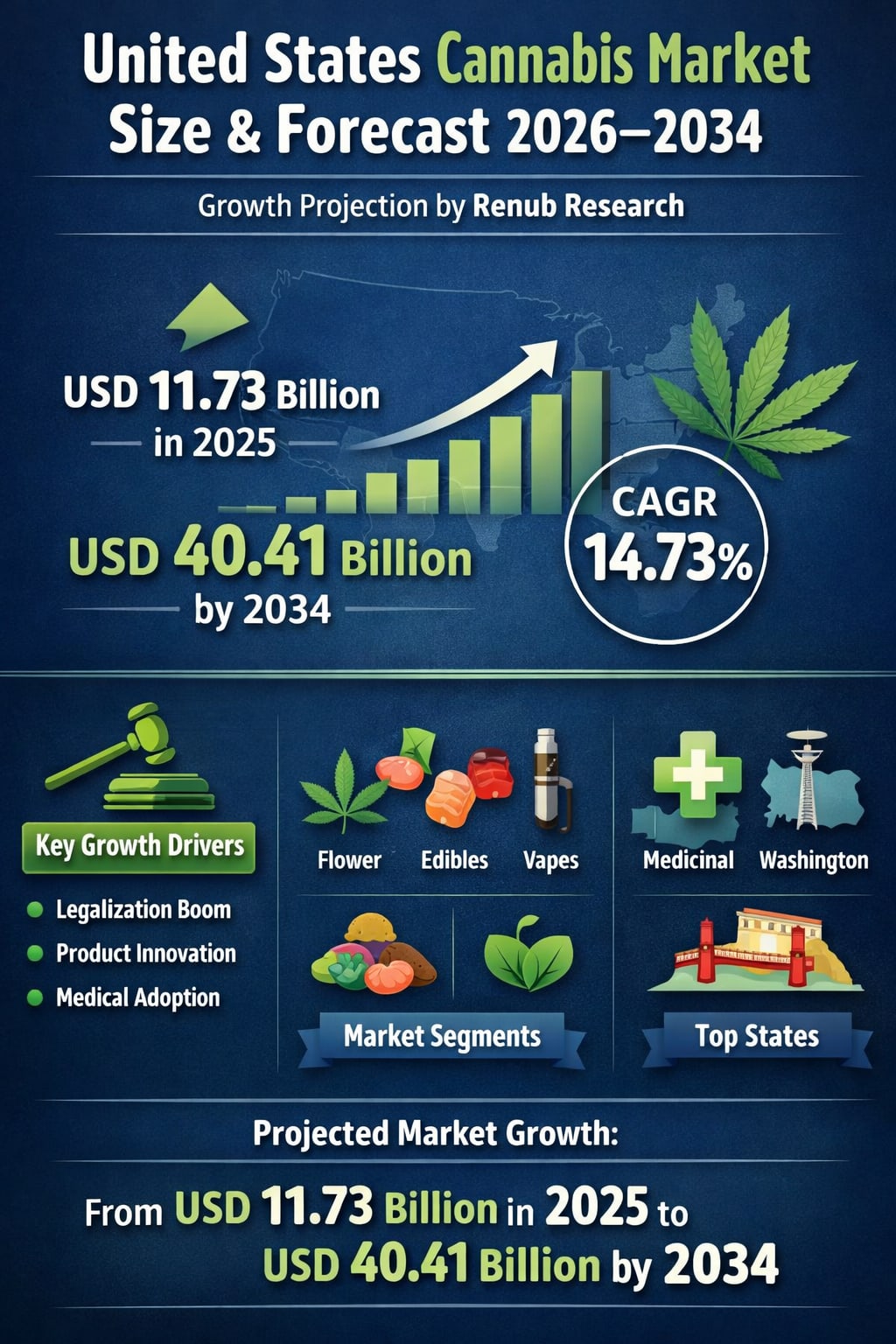
United States Cannabis Market Overview
The United States cannabis market is entering a decisive phase of expansion, driven by a combination of regulatory change, evolving consumer attitudes, medical adoption, and rapid product innovation. According to Renub Research, the U.S. cannabis market is projected to grow from USD 11.73 billion in 2025 to USD 40.41 billion by 2034, registering a compound annual growth rate (CAGR) of 14.73% from 2026 to 2034.
This sharp upward trajectory reflects more than just rising consumption. It signals the transformation of cannabis from a once-marginalized product into a structured, regulated, and increasingly mainstream industry. Investments in cultivation, retail infrastructure, research, branding, and product development are reshaping how cannabis is produced, sold, and consumed across the country.
As more U.S. states legalize cannabis for medical and adult use, and as social stigma continues to fade, the industry is emerging as one of the fastest-growing controlled markets in the nation. From wellness and healthcare applications to lifestyle and recreational consumption, cannabis is steadily embedding itself into the broader consumer economy.
United States Cannabis Market Outlook
Cannabis is a plant containing active compounds known as cannabinoids—most notably THC (tetrahydrocannabinol) and CBD (cannabidiol)—which interact with the body’s endocannabinoid system. These interactions can produce therapeutic, relaxing, or psychoactive effects depending on the formulation, dosage, and method of consumption.
Today, cannabis is available in multiple forms: dried flower, edibles, beverages, oils, tinctures, capsules, topicals, and highly refined extracts. This diversity has helped the industry expand beyond traditional users to include wellness-focused consumers, older demographics, and patients seeking alternatives to conventional pharmaceuticals.
In the United States, the gradual but steady spread of legalization—both medical and recreational—has fundamentally altered the market landscape. Social acceptance, improved regulation, and growing scientific research have all contributed to wider adoption. Millions of Americans now use cannabis for wellness, relaxation, creativity, pain management, and medical support, supported by a fast-evolving retail and product ecosystem.
At the same time, innovation is reshaping how consumers interact with cannabis. Micro-dosed edibles, fast-acting beverages, discreet vape products, and CBD-based wellness offerings have made cannabis more accessible and socially acceptable than ever before. This combination of regulatory momentum and product evolution underpins the strong growth outlook projected by Renub Research through 2034.
Growth Drivers of the United States Cannabis Industry
Increasing Legalization and Mainstream Acceptance
The most powerful driver of the U.S. cannabis market remains the ongoing wave of legalization at the state level. Each new state that approves cannabis for medical or adult use expands the legal consumer base, boosts tax revenues, and encourages investment in cultivation, processing, and retail infrastructure.
Beyond legislation, cultural attitudes have shifted dramatically. Cannabis is no longer viewed solely through a lens of prohibition; instead, it is increasingly seen as a legitimate consumer and wellness product. Public opinion surveys consistently show strong support for legalization, particularly for medical use, reinforcing political and regulatory momentum.
Legal, regulated dispensaries also play a critical role in market growth. They provide consumers with tested, labeled, and quality-controlled products, reducing reliance on illicit markets and increasing trust in legal channels. This transition from informal to formal markets is a key factor behind the industry’s expanding revenue base.
Product Innovation and Consumer Segmentation
Innovation is redefining the cannabis experience. While traditional flower remains popular, new product categories—such as edibles, beverages, concentrates, topicals, and capsules—are attracting consumers who prefer alternatives to smoking or vaping.
Micro-dosed and fast-acting products appeal to users seeking better control over effects, while premium segments focus on terpene-rich strains, solventless extracts, and infused pre-rolls. Meanwhile, growing interest in minor cannabinoids like CBG, CBN, and THCV is opening up new use cases related to sleep, inflammation, focus, and appetite management.
Branding, flavor development, packaging, and lifestyle positioning are also becoming increasingly sophisticated, making cannabis products more competitive with mainstream consumer packaged goods. Strategic partnerships and product launches—such as expansions into hemp-derived THC categories—highlight how companies are diversifying to capture new audiences.
Rising Medical Use and Healthcare Integration
Medical cannabis continues to be a cornerstone of the U.S. market. Patients use cannabis to manage chronic pain, anxiety, inflammation, cancer-related symptoms, epilepsy, PTSD, and sleep disorders—often as an alternative or complement to traditional pharmaceuticals.
The ongoing search for safer pain management solutions, particularly in the context of the opioid crisis, has strengthened interest in cannabis-based therapies. Many states now operate structured medical cannabis programs with defined dosing, physician recommendations, and patient education initiatives.
As clinical research expands and discussions around insurance coverage and standardized treatment protocols continue, cannabis is gaining further legitimacy within the broader healthcare conversation—supporting long-term growth in the medical segment.
Challenges in the United States Cannabis Market
Regulatory Fragmentation and Federal Uncertainty
Despite progress at the state level, cannabis remains illegal under U.S. federal law, creating a complex and fragmented regulatory environment. Each state enforces its own rules regarding licensing, cultivation, distribution, taxation, and product standards, making nationwide expansion costly and operationally challenging.
Interstate commerce is still prohibited, forcing companies to replicate facilities and supply chains in each legal state. In addition, limited access to traditional banking services means many cannabis businesses operate largely in cash, increasing security risks and compliance burdens. These structural barriers continue to limit efficiency and scalability across the industry.
High Taxes, Illicit Markets, and Pricing Pressure
In many states, high excise and local taxes significantly raise retail prices, allowing illicit markets to remain competitive. When legal products are priced well above unregulated alternatives, some consumers continue to buy outside the legal system, slowing the transition to fully regulated markets.
At the same time, overproduction in certain regions has driven down wholesale prices, squeezing margins for cultivators and manufacturers. This combination of tax pressure and pricing volatility remains one of the industry’s most persistent challenges.
Key Market Segments
United States Cannabis Flower Market
Flower remains the largest and most established segment in the U.S. cannabis market. Consumers value its affordability, wide strain selection, terpene profiles, and rapid onset of effects. Both experienced users and newcomers are drawn to flower for its natural, minimally processed appeal.
Innovation in genetics continues to introduce new strains with enhanced potency, aroma, and flavor. While edibles and vapes are growing, flower’s versatility—usable for smoking, vaporizing, or infusing—keeps it central to the market. Premium indoor flower, in particular, commands strong demand among quality-focused consumers.
Pre-rolls, a fast-growing sub-segment, benefit from convenience, portability, and consistent dosing. Infused pre-rolls, multi-packs, and flavored options are turning this category into a lifestyle product with broad appeal.
United States Medical Marijuana Market
Medical cannabis plays a vital role in shaping the national industry. Patients rely on it for chronic pain, cancer support, epilepsy, PTSD, and autoimmune conditions. Compared to recreational products, medical offerings often emphasize precise dosing, tailored formulations, and higher consistency standards.
Popular formats include tinctures, capsules, topicals, and balanced THC/CBD products. As more states expand patient access and improve program structures, the medical segment continues to grow as a credible alternative or complement to traditional pharmaceuticals.
United States Adult-Use (Recreational) Cannabis Market
Adult-use cannabis accounts for the majority of revenues in states where recreational sales are legal. Consumers purchase cannabis for relaxation, socialization, creativity, and general enjoyment, driving demand across flowers, edibles, beverages, vapes, and concentrates.
Retail experience, brand identity, and product variety play major roles in customer loyalty. As more states transition from medical-only to recreational frameworks, the adult-use segment is expected to remain the primary growth engine of the U.S. cannabis market.
THC-Dominant and Minor Cannabinoids Segments
THC-dominant products remain the most popular due to their strong psychoactive effects and therapeutic potential for pain, nausea, and insomnia. These products are tightly regulated in terms of potency, packaging, and labeling but still represent a major share of industry revenues.
At the same time, interest in minor cannabinoids—such as CBG, CBN, CBC, and THCV—is rising rapidly. These compounds are being incorporated into tinctures, capsules, edibles, and wellness drinks, offering more targeted and functional experiences beyond traditional THC and CBD products.
State-Level Market Highlights
California
California remains the largest and most influential cannabis market in the U.S., supported by a massive consumer base, deep-rooted cannabis culture, and advanced cultivation infrastructure. The state leads in premium flower, solventless extracts, infused beverages, and artisanal edibles. Despite high taxes, California continues to serve as a global innovation hub for cannabis products.
New York
New York is emerging as one of the most promising growth markets, driven by its population size, strong consumer demand, and focus on social equity in licensing. With dispensaries gradually expanding and brand-driven retail taking shape, the state is positioned to become a major force in the national cannabis landscape.
Washington
As one of the earliest states to legalize recreational cannabis, Washington has a mature and competitive market. Known for efficient cultivation, strong quality standards, and innovation in concentrates and edibles, the state benefits from an experienced operator base and price-competitive offerings.
Market Segmentation Snapshot
By Product Type:
Flower, Pre-Rolls, Concentrates, Edibles, Beverages, Capsules/Soft-Gels, Topicals & Transdermals, Tinctures/Sublinguals, Others
By Application:
Medical (Rx), Adult-Use/Recreational, Wellness & Nutraceuticals
By Compound Type:
THC-Dominant, CBD-Dominant, Balanced THC:CBD, Minor Cannabinoids, Terpene/Flavonoid-Rich Extracts
Top States:
California, Texas, New York, Florida, Illinois, Pennsylvania, Ohio, Georgia, New Jersey, Washington, Michigan, Colorado, and others across the U.S.
Competitive Landscape
Major companies operating in the U.S. cannabis ecosystem include:
Canopy Growth Corporation, Tilray Brands, Curaleaf, Aurora Cannabis, Jazz Pharmaceuticals, Green Thumb Industries (GTI), Trulieve, Cresco Labs, Organigram Global, and TerrAscend.
These players are evaluated across key dimensions such as company overview, leadership, recent developments, SWOT analysis, and revenue performance, reflecting an increasingly professional and competitive industry structure.
Final Thoughts
The United States cannabis market is no longer a niche or experimental sector—it is rapidly becoming a cornerstone of the modern consumer and healthcare economy. With the market projected by Renub Research to grow from USD 11.73 billion in 2025 to USD 40.41 billion by 2034 at a CAGR of 14.73%, the next decade will be defined by scale, innovation, and regulatory evolution.
While challenges such as federal uncertainty, tax pressure, and illicit competition remain, the long-term fundamentals are strong. Expanding legalization, product diversification, medical integration, and shifting consumer attitudes are steadily pushing cannabis into the mainstream.
For investors, policymakers, and industry participants alike, the U.S. cannabis sector represents not just a high-growth market—but a transformative industry reshaping how consumers think about wellness, recreation, and alternative therapies in the years ahead.
About the Creator
Visa Stock Analysis: Why Visa Remains a Strong Play in the Global Payments Industry
Introduction Visa stock has consistently been one of the most reliable growth investments in the financial technology sector. As a global leader in digital payments, Visa Inc. processes billions of transactions annually, connecting consumers, businesses, and financial institutions across the globe. With the ongoing shift from cash to digital payments, Visa’s business model positions it to benefit from structural growth trends in global commerce. For investors, Visa stock represents a combination of stability, recurring revenue, and long-term growth potential.
By Hammad Nawaz7 days ago in Trader




Comments
There are no comments for this story
Be the first to respond and start the conversation.