
Global PET Scanners Market Size and Forecast 2025–2033
How Advanced Imaging, AI Integration, and Rising Cancer Burden Are Reshaping the Future of Diagnostic Medicine

Introduction: A New Era of Precision Diagnostics
Positron Emission Tomography (PET) scanners have become one of the most powerful tools in modern diagnostic medicine. Unlike conventional imaging systems that focus mainly on anatomical structures, PET scanners reveal what is happening inside the body at a cellular and metabolic level. By detecting gamma rays emitted from radioactive tracers introduced into the body, PET scans provide clinicians with highly detailed insights into organ and tissue function. This capability makes PET imaging indispensable in oncology, cardiology, neurology, and a growing list of other clinical applications.
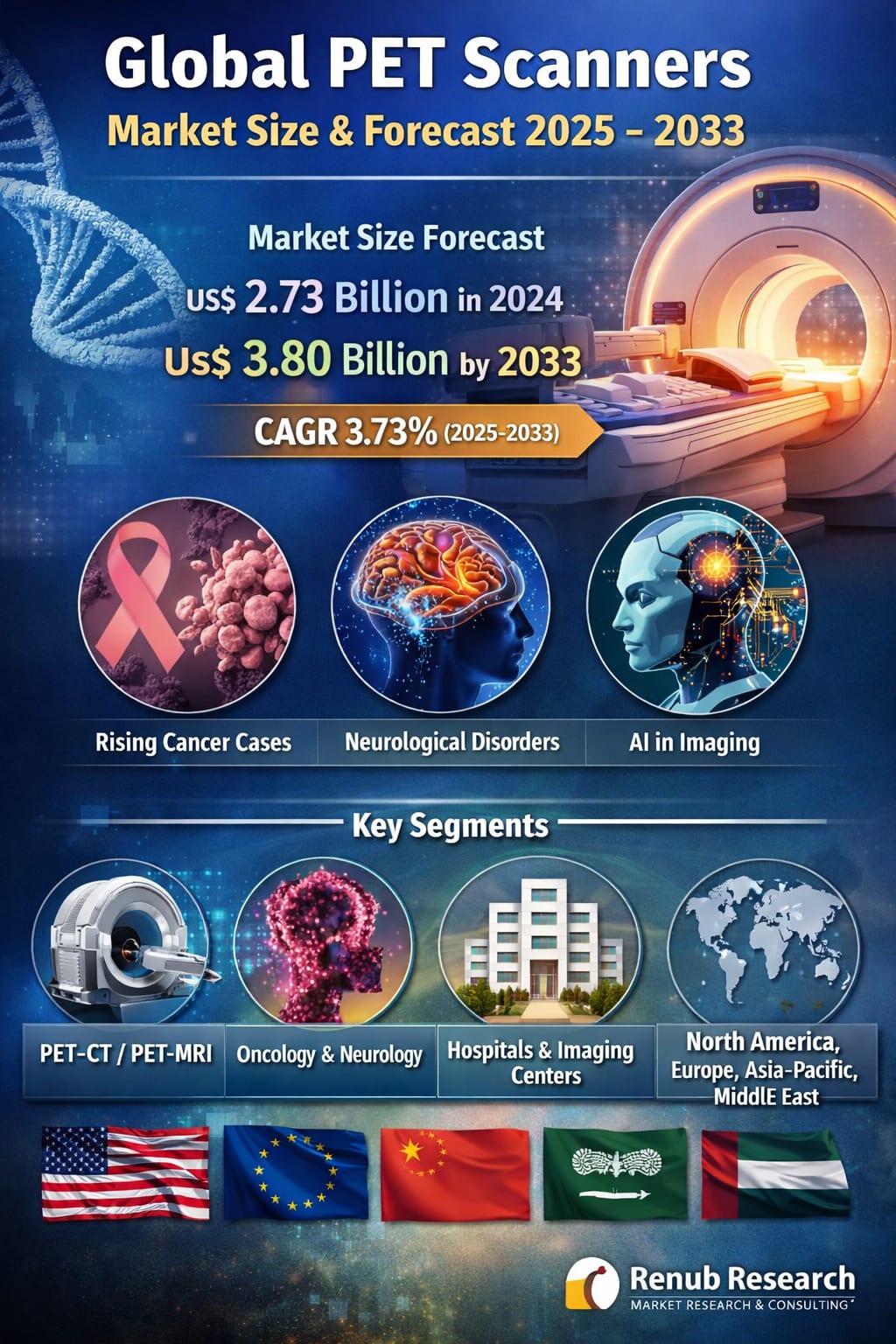
According to industry estimates, the global PET scanners market is expected to reach US$ 3.80 billion by 2033, up from US$ 2.73 billion in 2024, expanding at a compound annual growth rate (CAGR) of 3.73% from 2025 to 2033. This steady growth reflects a healthcare environment increasingly focused on early diagnosis, personalized treatment planning, and outcome-based care.
The rising incidence of cancer and neurological disorders, continuous technological innovation in imaging systems, growing healthcare expenditure, and the integration of artificial intelligence (AI) into diagnostic workflows are all shaping the future of the PET scanners market. Together, these factors are transforming PET imaging from a specialized diagnostic tool into a core component of advanced healthcare systems worldwide.
PET Scanners Market Overview
PET scanners are sophisticated medical imaging devices designed to visualize metabolic processes in the body. By using radiotracers that emit positrons, PET scanners generate high-resolution images that show how tissues and organs function in real time. This functional imaging capability is especially valuable in detecting cancer, evaluating brain disorders such as Alzheimer’s disease, and assessing cardiac health.
In clinical practice, PET scans are often combined with other imaging modalities such as computed tomography (CT) or magnetic resonance imaging (MRI). Hybrid systems like PET/CT and PET/MRI provide both anatomical and functional information in a single scan, significantly improving diagnostic accuracy and efficiency. These combined systems are now widely used for tumor staging, treatment planning, and therapy monitoring.
The global demand for PET scanners is growing steadily due to several converging trends. First, the burden of chronic diseases—especially cancer, cardiovascular diseases, and neurological disorders—continues to rise worldwide. Second, healthcare providers are placing greater emphasis on early and precise diagnosis, which PET imaging supports exceptionally well. Third, technological advances, including digital detectors, time-of-flight (TOF) technology, and AI-powered image analysis, are making PET systems faster, more accurate, and more accessible.
In addition, increasing investments in healthcare infrastructure, supportive government initiatives, and the global shift toward personalized medicine are further strengthening the outlook for the PET scanners market, particularly in emerging economies.
Key Growth Drivers for the PET Scanners Market
Rising Prevalence of Cancer and Neurological Disorders
One of the most important drivers of the PET scanners market is the growing incidence of cancer and neurological diseases across the globe. Cancer remains one of the leading causes of death worldwide, and its early detection and accurate staging are critical for effective treatment. PET imaging plays a central role in oncology by enabling clinicians to identify malignant tissues, evaluate metastasis, and monitor treatment response with high precision.
Neurological disorders, especially Alzheimer’s disease and other forms of dementia, are also increasing rapidly due to aging populations. PET scans are particularly valuable in neurology because they can detect abnormal brain metabolism and identify biomarkers such as amyloid plaques associated with Alzheimer’s disease. As awareness of early diagnosis grows, the demand for PET imaging in neurological applications is expected to rise significantly.
The growing burden of these diseases is pushing healthcare systems to adopt more advanced diagnostic tools, making PET scanners an essential part of modern clinical practice.
Advancements in Imaging Technology
Technological innovation is another powerful growth engine for the PET scanners market. Over the past decade, significant improvements have been made in detector materials, image reconstruction algorithms, and scanning speed. Technologies such as time-of-flight (TOF) imaging and digital PET detectors have greatly enhanced image resolution and sensitivity while reducing scan times and radiation exposure.
Hybrid imaging systems, particularly PET/CT and PET/MRI, have further expanded the clinical value of PET scanners by combining functional and anatomical imaging in one procedure. These systems improve diagnostic confidence and streamline clinical workflows, making them increasingly attractive to hospitals and diagnostic centers.
Artificial intelligence and machine learning are also beginning to play a major role in PET imaging. AI-powered software can assist in image interpretation, automate workflow processes, and improve diagnostic accuracy by identifying subtle patterns that may be missed by the human eye. As these technologies mature, they are expected to make PET imaging more efficient, consistent, and widely adopted.
Expansion of Healthcare Infrastructure
The expansion of healthcare infrastructure, particularly in emerging markets, is another key factor supporting market growth. Governments and private healthcare providers are investing heavily in modernizing hospitals, diagnostic centers, and research institutions. As part of these upgrades, advanced imaging technologies such as PET scanners are being installed to improve diagnostic capabilities and patient outcomes.
Rising healthcare expenditure, increasing insurance coverage, and a greater focus on preventive care are also contributing to the wider adoption of PET imaging. In many countries, the growing middle class and aging population are driving demand for high-quality diagnostic services, creating new opportunities for PET scanner manufacturers and service providers.
Challenges in the PET Scanners Market
High Cost of Equipment and Procedures
Despite its clinical benefits, the high cost of PET scanners remains a significant barrier to market growth. Purchasing a PET scanner requires a substantial capital investment, often running into millions of dollars. In addition to the initial cost, healthcare providers must also account for installation, maintenance, radiation shielding, and the need for specialized staff.
Operating costs are further increased by the requirement for radiotracers, cyclotron facilities, and strict safety protocols. These expenses make PET procedures relatively costly for patients, limiting access in low- and middle-income countries and even in some developed markets. As a result, many smaller hospitals and diagnostic centers are hesitant to invest in PET technology without strong reimbursement support.
Regulatory and Reimbursement Challenges
Regulatory and reimbursement issues also pose challenges for the PET scanners market. The use of radioactive materials in PET imaging means that equipment, procedures, and radiotracers are subject to strict regulatory oversight. Approval processes can be lengthy and complex, delaying the introduction of new technologies to the market.
In addition, reimbursement policies for PET procedures vary widely across countries and healthcare systems. In some regions, limited or inconsistent reimbursement reduces the financial incentive for healthcare providers to offer PET imaging services. This can slow adoption rates and restrict patient access, even where the clinical benefits of PET imaging are well established.
Regional Market Insights
United States PET Scanners Market
The United States represents one of the largest and most technologically advanced markets for PET scanners. The country’s strong focus on precision medicine, oncology care, and advanced diagnostics continues to drive demand for high-performance imaging systems. Digital PET scanners with improved sensitivity and faster scanning capabilities are increasingly being adopted by major hospitals and research centers.
Collaborations between healthcare providers, research institutions, and technology companies are also accelerating the development of new radiotracers and imaging applications. These innovations are expanding the clinical use of PET imaging beyond traditional oncology and cardiology into areas such as immunotherapy monitoring and neurological research.
United Kingdom PET Scanners Market
In the United Kingdom, the PET scanners market is strongly influenced by government initiatives aimed at improving cancer care and diagnostic efficiency. The National Health Service (NHS) has been investing in advanced imaging technologies to reduce diagnostic delays and improve patient outcomes.
The integration of AI-driven analytics into imaging workflows is gaining momentum, helping clinicians make faster and more accurate decisions. Large-scale research initiatives, including national imaging platforms, are also strengthening the country’s position in medical imaging innovation and supporting the broader adoption of PET technology.
China PET Scanners Market
China is emerging as one of the fastest-growing markets for PET scanners, driven by rising healthcare expenditure, rapid urbanization, and a growing burden of chronic diseases such as cancer. The Chinese government’s ongoing healthcare reforms and investments in medical infrastructure are creating strong demand for advanced diagnostic equipment.
Hybrid imaging systems such as PET/CT and PET/MRI are becoming increasingly popular in major hospitals. At the same time, domestic manufacturers are developing more affordable PET solutions, helping to expand access to advanced imaging across a wider range of healthcare facilities.
Saudi Arabia PET Scanners Market
Saudi Arabia’s PET scanners market is expanding steadily as part of the country’s broader efforts to modernize its healthcare system. The rising prevalence of cancer and neurological disorders is driving demand for advanced diagnostic technologies, particularly in major urban centers such as Riyadh and Jeddah.
Government initiatives focused on improving healthcare access and early disease detection are expected to further support market growth. There is also growing interest in both stationary and mobile PET imaging solutions to serve remote and underserved regions.
Recent Developments in the PET Scanners Market
The PET scanners market has seen several notable technological and commercial developments in recent years. In June 2024, a new augmented whole-body scanning technology demonstrated significant improvements in image clarity and system sensitivity for clinical PET/CT imaging. In May 2024, a major imaging center in the United States installed an AI-driven CT system designed to enhance workflow automation and imaging efficiency. In April 2024, a mobile dedicated cardiac PET/CT solution was introduced, aiming to bring advanced imaging services directly to medical facilities on a flexible schedule.
These developments highlight the industry’s ongoing focus on improving image quality, expanding access, and enhancing operational efficiency.
Market Segmentation
By Product Type:
Full Ring PET Scanner
Partial Ring PET Scanner
By Modality:
PET-CT
PET-MRI
By Application:
Oncology
Cardiology
Neurology
Others
By End Use:
Hospitals
Diagnostic Imaging Centers
Academic & Research Institutes
By Region:
North America (United States, Canada)
Europe (France, Germany, Italy, Spain, United Kingdom, Belgium, Netherlands, Turkey)
Asia Pacific (China, Japan, India, Australia, South Korea, Thailand, Malaysia, Indonesia, New Zealand)
Latin America (Brazil, Mexico, Argentina)
Middle East & Africa (South Africa, United Arab Emirates, Saudi Arabia)
Competitive Landscape and Key Players
The global PET scanners market is moderately consolidated, with several leading companies competing on the basis of technology, innovation, and service offerings. Major players include Canon Medical Systems, GE Healthcare, Kindsway Biotech, Koninklijke Philips N.V., Mediso Ltd., PerkinElmer, Positron, Shimadzu Corporation, and Siemens Healthineers AG.
These companies are focusing on product innovation, strategic partnerships, and geographic expansion to strengthen their market positions. Key areas of competition include image quality, system efficiency, AI integration, and total cost of ownership.
Final Thoughts: The Future of PET Imaging Looks Bright
The global PET scanners market is on a steady growth path, driven by the rising burden of chronic diseases, rapid technological innovation, and increasing investment in healthcare infrastructure. With the market expected to grow from US$ 2.73 billion in 2024 to US$ 3.80 billion by 2033, PET imaging is set to remain a cornerstone of advanced diagnostic medicine.
While challenges such as high costs and regulatory complexities persist, ongoing innovation in digital imaging, AI integration, and hybrid systems is making PET scanners more efficient, accessible, and clinically valuable. As healthcare systems worldwide continue to prioritize early diagnosis and personalized treatment, PET scanners will play an increasingly vital role in shaping the future of medical imaging and patient care.
About the Creator
Australia Data Center Market to Grow to USD 7.9 Billion by 2034 on the Back of Cloud, AI and Digital Transformation
The Australia data center market is experiencing sustained expansion as digitalization accelerates across businesses, governments, and consumers. According to the IMARC Group, the market was valued at USD 4.8 billion in 2025 and is forecast to grow to USD 7.9 billion by 2034, exhibiting a compound annual growth rate (CAGR) of 5.59% from 2026 to 2034.
By Rashi Sharma6 days ago in Trader
Saudi Arabia Home Energy Management System Market Size and Forecast 2025–2033
Introduction: A Smarter Way to Power Saudi Homes Saudi Arabia is undergoing a profound transformation in how energy is produced, consumed, and managed. As part of the Kingdom’s ambitious Vision 2030 agenda, sustainability, digital transformation, and energy efficiency have moved to the center of national policy and private investment. One of the most visible results of this shift is the rapid rise of the Home Energy Management System (HEMS) market.
By Sakshi Sharma3 days ago in Trader
Boundless
A geographical map could take you there. To the places I've been, to the sights I've seen, to the landscapes I've climbed. But no compass could point you in the direction of my memories. To the experiences I've lived, to the happiness I've felt, to the wonder I've held so close to my heart.
By Alyssa Mussoabout 8 hours ago in Writers



Comments
There are no comments for this story
Be the first to respond and start the conversation.