
United States Durable Medical Equipment Market Size and Forecast 2025–2033
Aging America, home healthcare, and smart medical devices are reshaping the future of long-term patient care

Introduction
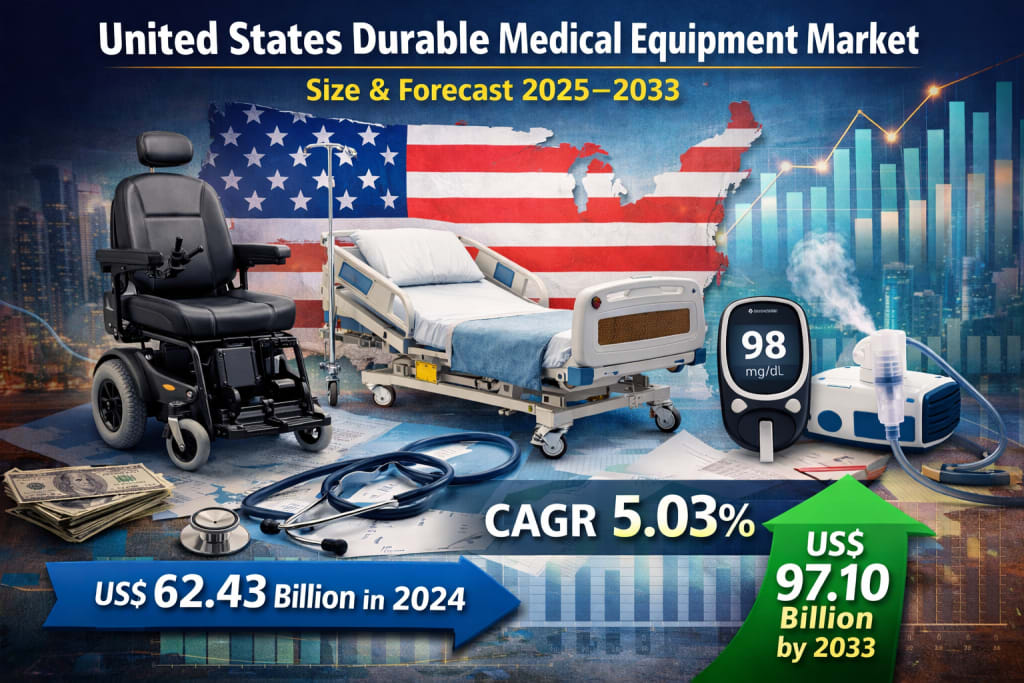
The United States Durable Medical Equipment (DME) market is entering a decisive growth phase as the country’s healthcare system continues its shift toward long-term, patient-centric, and home-based care models. According to Renub Research, the United States Durable Medical Equipment Market is expected to grow at a CAGR of 5.03% from 2025 to 2033, reaching US$ 97.10 billion by 2033, up from US$ 62.43 billion in 2024. This steady expansion is being powered by a combination of demographic, clinical, and technological forces, including the rapid aging of the population, the rising burden of chronic diseases, and continuous innovation in mobility aids, monitoring devices, and therapeutic equipment.
Durable medical equipment refers to medical devices and supplies designed for repeated, long-term use to support patients recovering from illness or injury or managing ongoing health conditions. These products are typically prescribed by healthcare professionals and are built to withstand regular use rather than being disposable. Common examples include wheelchairs, walkers, hospital beds, oxygen equipment, blood glucose monitors, nebulizers, and suction pumps.
In today’s healthcare environment, DME plays a crucial role in improving quality of life, promoting patient independence, and reducing the need for prolonged hospital stays. As healthcare costs rise and systems emphasize efficiency and outcomes, durable medical equipment is increasingly viewed not just as supportive hardware, but as a strategic pillar of modern care delivery in the United States.
United States Durable Medical Equipment Market Overview
Durable medical equipment sits at the intersection of clinical care, rehabilitation, and daily living support. Its primary purpose is to provide therapeutic benefit, enhance mobility, enable monitoring, and support recovery—often in non-hospital settings such as patients’ homes, assisted living facilities, or outpatient care centers.
Under most U.S. insurance programs, including Medicare and Medicaid, DME usually requires a physician’s prescription and documentation of medical necessity. This reimbursement structure reinforces the medical nature of these products while also shaping purchasing behavior across hospitals, clinics, and home healthcare providers.
The importance of DME has grown substantially over the past decade as healthcare systems seek to shorten hospital stays, reduce readmission rates, and manage chronic conditions more effectively outside traditional clinical settings. Devices such as home oxygen concentrators, hospital beds, and remote monitoring tools are now integral to care pathways for millions of Americans.
With Renub Research projecting sustained growth through 2033, the U.S. DME market is increasingly being shaped by innovation, policy reforms, and shifting patient expectations.
Growth Drivers in the United States Durable Medical Equipment Market
Aging Population and Rising Prevalence of Chronic Diseases
One of the most powerful forces driving DME demand in the United States is the rapid aging of the population. As the baby boomer generation moves deeper into senior age brackets, the incidence of mobility limitations, arthritis, cardiovascular disease, diabetes, and respiratory conditions continues to rise. These health challenges frequently require long-term use of equipment such as wheelchairs, walkers, hospital beds, and blood glucose monitors.
At the same time, chronic diseases affect more than half of U.S. adults, creating sustained demand for devices that support daily disease management rather than short-term treatment. In this environment, DME is no longer optional—it is essential to maintaining independence, preventing complications, and improving overall quality of life for millions of patients.
As healthcare increasingly focuses on proactive, supportive, and long-term care, durable medical equipment stands out as a cornerstone of modern chronic disease management in the U.S.
Expansion of Home Healthcare Services
Home healthcare has moved from being a niche alternative to becoming a mainstream care model in the United States. Rising hospital costs, patient preference for home-based recovery, and pressure on healthcare systems to improve efficiency are all accelerating this shift.
Durable medical equipment such as oxygen concentrators, nebulizers, hospital beds, mobility aids, and infusion pumps is central to this transition. Medicare, Medicaid, and private insurers have expanded coverage for home healthcare services, making DME more accessible to a broader patient base.
Technological progress has further strengthened this trend by enabling portable, compact, and user-friendly devices that can be safely used outside hospital settings. Remote monitoring, telehealth integration, and connected devices now allow clinicians to track patient progress without requiring frequent in-person visits.
As more care continues to move into the home, the U.S. DME market is expected to benefit from sustained demand for safe, reliable, and easy-to-use equipment.
Technological Advancements in Medical Devices
Innovation is reshaping the DME landscape. Modern devices are increasingly lighter, smarter, and more patient-friendly than earlier generations. Examples include smart wheelchairs with navigation support, wireless glucose monitoring systems, portable oxygen concentrators, and battery-powered suction pumps.
Integration with smartphones, apps, and telehealth platforms allows real-time data sharing between patients and healthcare providers, improving treatment outcomes and patient engagement. At the same time, advances in materials science have produced equipment that is not only more durable, but also more comfortable and aesthetically acceptable for everyday use.
Manufacturers are investing heavily in research and development to meet rising expectations for performance, usability, and connectivity. This continuous innovation cycle is a key factor supporting long-term growth in the U.S. durable medical equipment market.
United States Durable Medical Equipment Market Challenges
High Costs and Reimbursement Constraints
Despite its importance, DME often comes with high upfront costs, creating financial pressure for both patients and healthcare providers. While many products are covered under Medicare and Medicaid, reimbursement processes can be complex, time-consuming, and subject to frequent policy changes.
Out-of-pocket costs for advanced or non-covered models can discourage adoption, particularly among lower-income patients. For providers, shifting reimbursement rules and coding requirements can affect revenue predictability and investment planning.
These financial and administrative barriers can limit access to essential equipment and create uneven adoption across different patient populations.
Regulatory Compliance and Quality Standards
DME manufacturers and suppliers operate in a highly regulated environment, overseen by agencies such as the FDA and the Centers for Medicare & Medicaid Services (CMS). Compliance with quality standards, labeling rules, safety reporting, and manufacturing guidelines requires significant time and financial resources.
Product approvals, audits, and potential recalls can disrupt operations and damage brand reputation. For smaller companies, keeping pace with evolving regulatory requirements while also investing in innovation and competitive pricing can be particularly challenging.
Nevertheless, these regulations also play a critical role in ensuring patient safety and product reliability, which are essential in a market where equipment is often used daily by vulnerable populations.
Key Product Segments in the U.S. DME Market
United States Medical Wheelchairs Market
The U.S. medical wheelchair segment continues to expand steadily, driven by aging, disability prevalence, and the growing emphasis on independent living. Both manual and powered wheelchairs are widely used across home and clinical settings.
Technological improvements—such as lightweight materials, powered tilt and recline functions, and advanced control systems—have significantly enhanced comfort and usability. With supportive reimbursement policies and rising rehabilitation needs, demand for customized and high-performance wheelchair solutions remains strong.
United States Commodes and Toilets Market
Commodes and adaptive toilet aids play a vital role in preserving dignity, safety, and independence for elderly and mobility-impaired individuals. Demand is rising alongside the growth of home care and post-surgical recovery services.
Modern designs focus on ease of cleaning, adjustable height, mobility, and user comfort, making them suitable for both institutional and home environments. As aging-in-place becomes more common, this segment is expected to see consistent growth.
United States Blood Sugar Monitoring Equipment Market
The high prevalence of diabetes in the U.S. has made blood glucose monitoring devices essential tools for daily health management. From traditional glucometers to advanced continuous glucose monitoring (CGM) systems, these devices help patients track levels, avoid complications, and optimize treatment.
Smartphone integration, real-time alerts, and data analytics have significantly improved user compliance and clinical decision-making. As digital health adoption increases, demand for accurate, user-friendly, and wearable glucose monitoring solutions continues to rise.
United States Nebulizers Equipment Market
Nebulizers are widely used in managing chronic respiratory conditions such as asthma, COPD, and cystic fibrosis. The market is supported by increasing respiratory disease prevalence, environmental factors, and greater awareness of home-based respiratory therapy.
Portable, battery-powered models are gaining popularity, especially in home care settings. The broader focus on respiratory health in recent years has further strengthened this segment’s growth outlook.
United States Suction Pumps Equipment Market
Suction pumps are essential in surgical, emergency, and home care environments for clearing airways and fluids. Demand is rising due to higher procedure volumes, expanded ambulatory care, and increased home-based post-operative care.
Technological improvements in noise reduction, control precision, and portability have made these devices more suitable for non-hospital settings, supporting wider adoption.
End-User Landscape
United States Hospitals Durable Medical Equipment Market
Hospitals remain one of the largest consumers of DME, relying on a wide range of equipment for inpatient, outpatient, and critical care services. Patient safety, infection control, and operational efficiency are key drivers of purchasing decisions.
Post-pandemic infrastructure upgrades and modernization efforts are also contributing to increased investment in smart, reliable, and durable equipment across U.S. hospitals.
United States Home Healthcare Durable Medical Equipment Market
Home healthcare represents one of the most dynamic growth areas for DME. Equipment such as hospital beds, oxygen concentrators, mobility aids, and monitoring devices is increasingly prescribed for in-home use.
This trend aligns with value-based care models, patient preference for comfort, and payer incentives to reduce hospital utilization. As a result, demand for compact, easy-to-use, and connected DME is accelerating nationwide.
State-Level Market Highlights
California Durable Medical Equipment Market
California stands out as one of the largest and most innovative DME markets in the U.S., supported by its large elderly population, advanced healthcare infrastructure, and strong home healthcare ecosystem. Urban centers drive high-volume demand, while rural areas rely more on mobile and home-based solutions. The state’s focus on technology and wellness further supports market growth.
New York Durable Medical Equipment Market
New York’s dense population, extensive hospital network, and strong Medicaid coverage make it a major DME market. Urban areas demand compact, high-performance devices, while other regions benefit from expanding home care services. Despite strict regulatory requirements, consistent demand and policy support continue to drive steady growth.
Market Segmentation Overview
By Product:
Personal Mobility Devices (Wheelchairs, Scooters, Walkers & Rollators, Canes & Crutches, Others)
Bathroom Safety Devices and Medical Furniture (Commodes & Toilets, Mattress & Bedding Devices)
Monitoring and Therapeutic Devices (Blood Sugar Monitors, CPM, Infusion Pumps, Nebulizers, Oxygen Equipment, CPAP, Suction Pumps, Traction Equipment, Others)
Others
By End-User:
Hospitals
Specialty Clinics
Ambulatory Surgical Centers
Diagnostic Centers
Home Healthcare
Skilled Nursing Facilities
Others
Top States:
California, Texas, New York, Florida, Illinois, Pennsylvania, Ohio, Georgia, Washington, New Jersey, and Rest of the United States.
Competitive Landscape
Key players shaping the U.S. DME market include Invacare Corporation, NOVA Medical Products, Inogen, Inc., Thermo Fisher Scientific Inc., Abbott, Medtronic, Baxter, B. Braun SE, Boston Scientific Corporation, and BD. These companies compete on innovation, product quality, distribution reach, and compliance with regulatory standards, while also investing in next-generation technologies and strategic partnerships.
Final Thoughts
The United States Durable Medical Equipment market is on a strong and sustainable growth trajectory, driven by demographic shifts, the rise of home healthcare, and rapid technological innovation. With Renub Research projecting the market to reach US$ 97.10 billion by 2033 at a CAGR of 5.03%, DME is set to remain a cornerstone of modern American healthcare.
As the healthcare system continues to prioritize efficiency, patient independence, and long-term disease management, durable medical equipment will play an even more critical role—not just as supportive tools, but as essential enablers of better, more accessible, and more cost-effective care across the United States.
About the Creator
Australia Workwear Market Outlook: Growth, Trends, and Opportunities Through 2034
The Australia workwear market reached a valuation of USD 552.8 million in 2025 and is projected to grow to USD 753.7 million by 2034, with a compound annual growth rate (CAGR) of 3.36% during 2026–2034, according to the latest report by IMARC Group.
By Amélie Belle5 days ago in Trader
Low Voltage Switchgear Market Overview, Size, Share & Forecast
Low Voltage Switchgear Market Overview Low voltage switchgear refers to assembly or combination of electrical disconnect switches, circuit breakers, fuses, relays, and protection devices designed to control and protect electrical systems operating at voltages up to 1,000 V. These systems serve as a critical interface between power sources and end-equipment, ensuring safety, reliability, and efficient distribution of electricity across applications such as industrial plants, commercial buildings, residential complexes, transportation systems, renewable energy installations, and utility networks.
By James Smith24 minutes ago in Trader
'Till Death We Do Art
There would be nothing divine in this world without art. Nature may surpass the divine to all intents and purposes, but like everything it absorbs and is absorbed by, it remains here, stuck on the surface of this world, ever-present, physically bound to the universe.
By Avocado Nunzella BSc (Psych) -- M.A.P 7 days ago in Art


Comments
There are no comments for this story
Be the first to respond and start the conversation.