
United States Food Allergen Testing Market Trends & Summary
Rising Food Allergy Awareness, Stricter Regulations, and Smarter Testing Technologies Are Reshaping the U.S. Food Safety Landscape (2025–2033)

Introduction: Why Food Allergen Testing Is Now a National Priority
Food has always been central to American life, but in recent years, the conversation around food safety has shifted dramatically. Beyond concerns about contamination and hygiene, one issue has moved firmly into the spotlight: food allergies. From peanuts and shellfish to gluten, milk, and eggs, allergens now represent one of the most serious and immediate risks to consumer health in the modern food system.
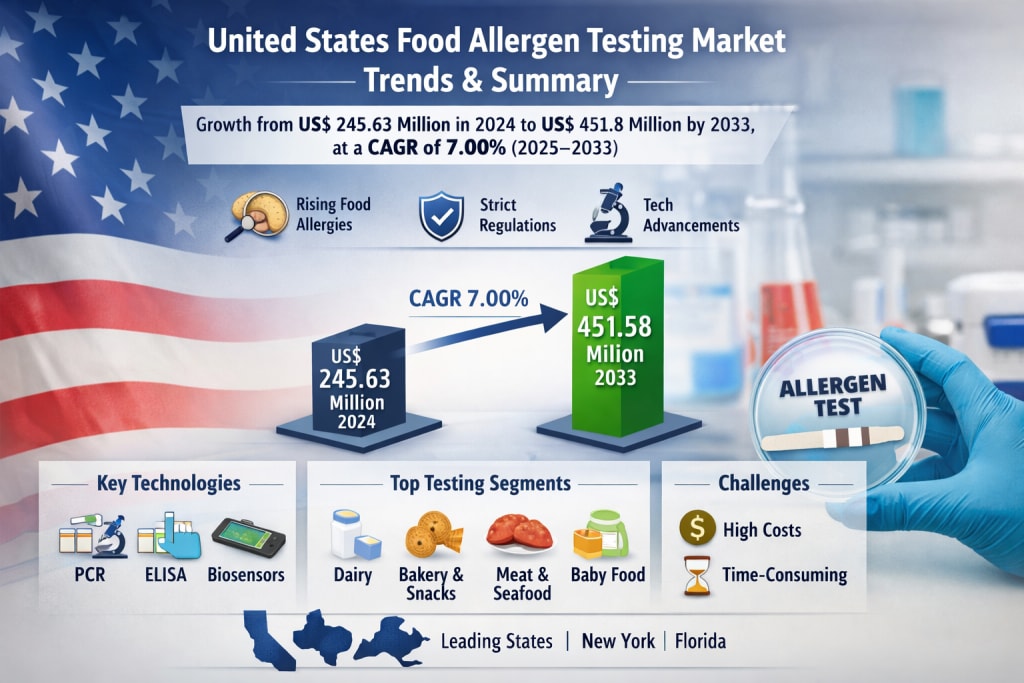
Against this backdrop, the United States Food Allergen Testing Market is entering a phase of sustained and meaningful growth. According to Renub Research, the market is expected to reach US$ 451.58 million by 2033, up from US$ 245.63 million in 2024, expanding at a CAGR of 7.00% from 2025 to 2033. This growth is being driven by a powerful mix of factors: rising consumer awareness, stricter food safety regulations, a growing incidence of food allergies, and continuous improvements in testing technologies.
What was once considered a niche quality-control function has now become a core pillar of the U.S. food industry’s safety and compliance strategy. For manufacturers, retailers, regulators, and consumers alike, allergen testing is no longer optional—it is essential.
United States Food Allergen Testing Industry Overview
Food allergen testing plays a crucial role in identifying specific proteins in food products that can trigger allergic reactions. These reactions can range from mild discomfort to life-threatening anaphylaxis, making accurate detection a matter of public health rather than just regulatory compliance.
Modern allergen testing relies primarily on advanced scientific techniques such as polymerase chain reaction (PCR) and enzyme-linked immunosorbent assays (ELISA). These methods allow laboratories and food producers to detect allergens at trace levels, either by identifying genetic material or by using antibodies that bind to specific allergenic proteins. Common targets include peanuts, tree nuts, shellfish, eggs, milk, soy, and gluten, among others.
In practical terms, allergen testing is used across the entire food value chain—from raw ingredient sourcing and processing to packaging and final labeling. It helps manufacturers prevent cross-contamination, ensures accurate labeling, supports regulatory compliance, and most importantly, protects consumers who rely on clear and truthful allergen information to manage their health.
The U.S. market is benefiting from a convergence of trends. Consumers are more informed and more cautious than ever. Regulators are enforcing stricter standards. And technology is making testing faster, more precise, and more scalable. Together, these forces are turning food allergen testing into one of the most dynamic segments of the broader food safety and diagnostics industry.
Market Size and Growth Outlook
Renub Research estimates that the U.S. Food Allergen Testing Market will grow from US$ 245.63 million in 2024 to US$ 451.58 million by 2033, registering a 7.00% CAGR over the forecast period from 2025 to 2033.
This steady expansion reflects more than just rising testing volumes. It also signals:
Increased adoption of advanced testing platforms
Greater regulatory scrutiny across food categories
Growing demand from processed and convenience food manufacturers
A broader shift toward preventive food safety management systems
In short, allergen testing is becoming deeply embedded in how the U.S. food industry operates—both as a compliance necessity and as a competitive differentiator.
Key Growth Drivers
1. Technological Advancements
Technology is one of the strongest growth engines in the U.S. food allergen testing market. New tools are making tests more accurate, faster, and easier to use, even outside traditional laboratory environments.
A good example is the launch of Gold Standard Diagnostics’ SENSIStrip Gluten PowerLine lateral flow test in March 2024. This test uses a monoclonal antibody with a hook line designed to avoid false negatives, improving reliability across different food matrices. When paired with tools like the RapidScan ST5 lateral flow reader, it also allows for more precise quantitative analysis. The company’s plans to extend this PowerLine technology to peanut and soy allergens further highlight how innovation is expanding the practical reach of allergen detection.
Such advancements are not just improving performance—they are also broadening adoption. Faster and more user-friendly tests make it easier for manufacturers, especially those operating at scale, to integrate allergen testing into routine quality control workflows.
2. Growing Consumer Awareness
Consumer awareness around food allergies has risen sharply over the past decade, and this trend continues to shape the market. According to Food Allergy Research and Education (FARE), approximately 33 million Americans live with potentially life-threatening food allergies, including one in thirteen children. Even more striking is the fact that a food allergy-related emergency room visit occurs every 10 seconds in the United States.
These numbers have transformed how consumers think about food. People are reading labels more carefully, asking more questions, and demanding greater transparency from brands. In response, food manufacturers are under increasing pressure to prove the safety of their products, not just claim it.
This shift in consumer behavior is pushing companies to invest in robust allergen testing programs, both to protect public health and to maintain trust in highly competitive food markets.
3. Strict Regulations Regarding Allergen Testing
Regulation is another powerful driver of market growth. U.S. authorities, particularly the Food and Drug Administration (FDA), have placed strong emphasis on allergen control, labeling, and risk management.
In its draft guidance on food safety laws, the FDA includes a dedicated focus on allergens, covering topics such as supply-chain controls, labeling rules, allergen cross-contact, and advisory statements. While the guidance does not mandate specific procedures, it clearly signals that effective allergen management systems are expected across the industry.
For food manufacturers, this regulatory environment makes advanced testing technologies not just helpful, but strategically necessary. Accurate allergen detection reduces the risk of costly recalls, legal action, and reputational damage—while also supporting compliance with both federal and state-level requirements.
Challenges Facing the Market
1. High Testing Costs
Despite technological progress, cost remains a significant barrier—especially for small and medium-sized food producers. High-sensitivity lateral flow tests and PCR-based methods often require expensive equipment, specialized reagents, and trained personnel.
Because allergen testing must be performed regularly to ensure consistent safety and compliance, these costs can add up quickly. For smaller businesses, this financial burden can limit how frequently they test or which technologies they can afford, potentially creating gaps in safety coverage.
2. Time-Consuming Procedures
Another challenge is turnaround time. Some methods, particularly PCR-based tests, can take hours or even days to deliver results. In fast-moving supply chains, such delays can disrupt production schedules, slow down product releases, and create logistical bottlenecks.
While there is strong demand for faster testing solutions, speed often comes with trade-offs in cost or complexity. Balancing speed, accuracy, and affordability remains one of the key technical and commercial challenges in the market.
State-Level Market Dynamics
The U.S. food allergen testing market is not uniform across the country. Different states show varying levels of demand, driven by factors such as population size, regulatory strictness, industrial activity, and consumer awareness.
California
California stands out due to its strict food safety regulations and large, health-conscious consumer base. The state’s diverse food industry—spanning agriculture, food processing, and packaged goods—relies heavily on accurate allergen testing to prevent cross-contamination and ensure proper labeling. High consumer awareness further encourages manufacturers to invest in advanced testing technologies.
Texas
Texas benefits from its large and diverse food production ecosystem, including major agricultural, processing, and manufacturing operations. As population growth and awareness of food allergies continue to rise, so does the demand for allergen-free products. Texas’s strategic role in the U.S. food supply chain makes it a key market for investments in modern allergen detection systems.
New York
New York’s market is shaped by its dense population, diverse food culture, and strict regulatory environment. From premium restaurants to large food manufacturers and retailers, the need for reliable allergen testing is strong. Public health priorities and detailed labeling requirements are driving continuous adoption of more precise and efficient testing solutions.
Florida
Florida’s role as both an agricultural hub and a major tourism destination supports steady growth in allergen testing demand. A diverse consumer base and high visitor numbers increase the need for safe, clearly labeled, allergen-free food options. The state’s regulatory focus on consumer protection further reinforces the importance of accurate and routine testing.
Market Segmentation Overview
By Technology
Biosensors-based
Immunoassay-based / ELISA
PCR
Other Technologies
By Food Testing Application
Dairy Products
Bakery and Confectionery
Meat and Seafood
Baby Food and Infant Formula
Beverages
Other Processed Foods
By States
California, Texas, New York, Florida, Illinois, Pennsylvania, Ohio, Georgia, New Jersey, Washington, North Carolina, Massachusetts, Virginia, Michigan, Maryland, Colorado, Tennessee, Indiana, Arizona, Minnesota, Wisconsin, Missouri, Connecticut, South Carolina, Oregon, Louisiana, Alabama, Kentucky, and the Rest of the United States.
Competitive Landscape and Company Analysis
The U.S. food allergen testing market features a mix of global leaders and specialized testing service providers. Companies are typically evaluated across four dimensions: overview, key persons, recent developments, and revenue analysis.
Key players include:
Eurofins Scientific SE
SGS S.A.
Bureau Veritas
Intertek Group plc
Romer Labs Diagnostic GmbH
Microbac Laboratories Inc. (U.S.)
Mérieux NutriSciences
Crystal Chem Inc.
These companies compete on the basis of technology innovation, testing accuracy, service reach, turnaround time, and regulatory expertise. Strategic investments in new testing platforms and expanded service offerings are becoming central to maintaining competitive advantage in this growing market.
Final Thoughts: A Market Built on Trust, Science, and Safety
The U.S. Food Allergen Testing Market is no longer just a technical niche—it is a critical foundation of modern food safety. With the market projected to grow from US$ 245.63 million in 2024 to US$ 451.58 million by 2033, the message is clear: allergen testing is becoming more important, more visible, and more deeply integrated into the food industry’s future.
Rising consumer awareness, stricter regulations, and continuous technological innovation are collectively reshaping how food safety is managed in the United States. While challenges such as cost and turnaround time remain, the long-term direction of the market points toward more widespread adoption, smarter testing systems, and higher standards of consumer protection.
About the Creator
Tom Shane
Tom Shane is a content writer specializing in SEO-driven blogs, product descriptions, and thought leadership. He crafts engaging, research-backed content that connects with audiences and drives results.
Australia Diesel Engine Market Set to Reach USD 10.7 Billion by 2034 as Demand Expands Across Key Sectors
The Australia diesel engine market has emerged as a robust and steadily expanding segment within the country’s broader automotive and industrial machinery ecosystem. According to the latest IMARC Group analysis, the market reached USD 6.9 billion in 2025 and is projected to grow to USD 10.7 billion by 2034, registering a compound annual growth rate (CAGR) of 4.75% during 2026–2034.
By Rashi Sharmaa day ago in Trader



Comments
There are no comments for this story
Be the first to respond and start the conversation.