
United States High-Density Polyethylene Market Size & Forecast 2026–2034
Rising Demand for Durable, Recyclable Plastics Strengthens the U.S. HDPE Market Outlook

United States High-Density Polyethylene Market Overview
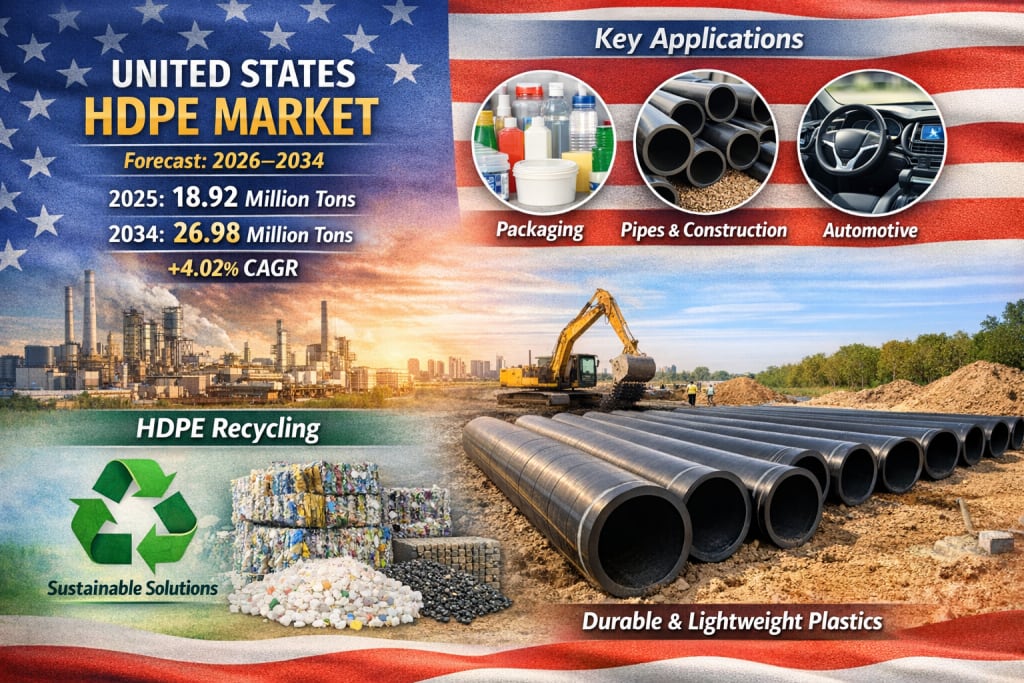
The United States High-Density Polyethylene (HDPE) Market is projected to expand steadily over the forecast period, supported by strong demand from packaging, construction, infrastructure, and automotive applications. According to Renub Research estimates, the market is expected to grow from US$ 18.92 million tons in 2025 at a compound annual growth rate (CAGR) of 4.02% during 2026–2034, reaching approximately US$ 26.98 million tons by 2034.
HDPE is a thermoplastic polymer derived from petroleum feedstocks and is widely valued for its high strength-to-density ratio, excellent chemical resistance, moisture resistance, and long service life. These properties make HDPE a preferred material for bottles, containers, pipes, geomembranes, automotive components, and industrial packaging. In addition, its high recyclability rate places HDPE at the center of sustainability initiatives across the U.S. plastics industry.
The growing emphasis on lightweight materials, cost efficiency, and circular economy practices continues to reinforce HDPE’s importance across both consumer and industrial sectors.
United States High-Density Polyethylene Market Outlook
HDPE plays a critical role in the U.S. plastics value chain due to its versatility and performance reliability. The packaging sector remains the largest consumer, using HDPE extensively for food and beverage containers, household chemical packaging, and personal care products. Its non-reactive nature and durability make it suitable for applications requiring product safety and long shelf life.
In construction and infrastructure, HDPE pipes are increasingly replacing traditional materials such as metal and concrete. Their corrosion resistance, flexibility, and lower installation costs make them ideal for water supply systems, drainage networks, sewage pipelines, and gas distribution lines. Additionally, HDPE geomembranes are widely used in landfills, water containment, and environmental protection projects.
With evolving environmental regulations and rising consumer awareness, HDPE’s recyclability and compatibility with post-consumer recycled content continue to enhance its long-term market appeal.
Key Growth Drivers in the United States HDPE Market
Strong Demand from Packaging and Consumer Goods
The packaging and consumer products industry remains the primary driver of HDPE demand in the United States. HDPE is widely used for manufacturing bottles, caps, closures, containers, and rigid packaging solutions due to its impact resistance, chemical stability, and lightweight nature.
The rise in packaged food consumption, e-commerce, and home delivery services has accelerated the need for durable and lightweight packaging materials that can withstand transportation and handling stresses. HDPE meets these requirements while also supporting sustainability goals through recyclability.
Major technology advancements are also shaping the market. In June 2024, Univation Technologies, LLC launched its UNIGILITY™ Tubular High-Pressure PE Process Technology, enabling the production of LDPE and EVA copolymers, reflecting continued innovation within polyethylene processing technologies.
Infrastructure Development and Construction Applications
Infrastructure modernization across the United States significantly contributes to HDPE market growth. Federal and state investments in water management, sewage systems, and gas distribution networks have increased demand for HDPE piping systems.
Compared to traditional materials, HDPE pipes offer long service life, lower maintenance costs, and resistance to corrosion and chemical degradation. These advantages make HDPE a preferred choice for both public infrastructure projects and private developments.
In April 2024, AmeriTex Pipe & Products began constructing a new HDPE and polypropylene corrugated pipe facility in Conroe, Texas, highlighting growing regional demand and capacity expansion efforts within the U.S.
Recyclability and Sustainability Initiatives
Sustainability is becoming a defining factor in the U.S. HDPE market. HDPE is one of the most widely recycled plastics in the country, and demand for recycled HDPE (rHDPE) continues to rise across packaging, automotive, and construction applications.
Manufacturers and brand owners are setting ambitious circular economy targets, increasing the use of post-consumer recycled content in plastic products. Advancements in recycling technologies now allow the production of high-quality rHDPE suitable for food-grade and industrial applications.
In May 2025, NOVA Chemicals initiated construction of SYNDIGO1, the world’s most advanced polyethylene film recycling facility in Connersville, Indiana, reinforcing the role of recycling infrastructure in shaping future HDPE supply chains.
Challenges Facing the United States HDPE Market
Environmental Concerns and Regulatory Pressure
Despite its recyclability, HDPE remains subject to growing scrutiny regarding plastic waste and environmental impact. Regulatory measures targeting single-use plastics and stricter waste management policies may affect certain HDPE applications, particularly in packaging.
Compliance with environmental regulations often requires additional investment in recycling systems, sustainable materials, and operational upgrades, potentially increasing production costs for manufacturers.
Raw Material Price Volatility
HDPE production relies heavily on petrochemical feedstocks such as crude oil, natural gas, and naphtha. Fluctuations in energy prices create uncertainty in production costs and profit margins.
Sudden changes in feedstock pricing can impact HDPE pricing across downstream industries, posing challenges for long-term supply contracts and market stability.
United States High-Density Naphtha Polyethylene Market
The high-density naphtha polyethylene segment represents a smaller but strategically important portion of U.S. HDPE production. While ethane-based feedstocks dominate due to shale gas availability, naphtha-based HDPE remains essential for producing specialized grades with enhanced stiffness, surface finish, and processing performance.
These grades are commonly used in industrial containers, specialty packaging, and selected automotive components, where balanced mechanical properties are required. As a result, naphtha-based HDPE continues to complement ethane-based production in the U.S. polyethylene landscape.
United States HDPE Market by Processing Technology
Blow Molding HDPE Market
Blow molding remains one of the most prominent processing methods for HDPE in the United States. It is widely used to manufacture bottles, containers, drums, and jerry cans for food, beverages, household chemicals, and industrial fluids.
The growth of packaged goods, personal care products, and e-commerce logistics continues to fuel demand for blow-molded HDPE products. Increasing use of recycled HDPE in blow molding further supports sustainability objectives.
Injection Molding HDPE Market
Injection-molded HDPE is used extensively for caps, closures, crates, pallets, bins, housewares, and automotive components. This process enables high-volume production of precise and durable components, making it ideal for reusable and structural applications.
Rising adoption of reusable packaging and logistics solutions continues to strengthen demand for injection-molded HDPE across the United States.
Solution Process HDPE Market
The solution process is used to produce specialized HDPE grades with controlled molecular structures and enhanced mechanical properties. These grades are commonly used in pressurized pipes, geomembranes, and high-performance industrial packaging.
Although solution processing involves higher costs, it delivers consistent quality and superior performance for demanding applications.
State-Wise Outlook of the U.S. HDPE Market
California HDPE Market
California’s HDPE market is driven by strong demand from packaging, consumer goods, and construction sectors. Strict environmental regulations encourage the use of recyclable and post-consumer recycled HDPE, particularly in food packaging and household products. Infrastructure applications such as pipelines and geomembranes further support market growth.
Texas HDPE Market
Texas remains one of the largest HDPE markets in the United States due to its robust petrochemical infrastructure and abundant feedstock availability. Demand is driven by packaging, industrial containers, pipelines, agriculture, and energy-related projects, supported by strong logistics and export capabilities.
New York HDPE Market
New York’s HDPE demand is fueled by its dense population, high consumption of packaged goods, and expanding e-commerce sector. Infrastructure maintenance and recycling initiatives also contribute to steady market growth.
Washington HDPE Market
Washington benefits from strong environmental awareness and advanced recycling programs. HDPE demand is supported by packaging, water management systems, and environmentally focused construction projects.
United States HDPE Market Segmentation
By Feedstock:
Naphtha
Natural Gas
Others
By Application:
Blow Molding
Film & Sheet
Injection Molding
Pipe & Extrusion
Others
By Manufacturing Process:
Gas Phase Process
Slurry Process
Solution Process
By Geography:
California
Texas
New York
Florida
Illinois
Pennsylvania
Ohio
Georgia
New Jersey
Washington
North Carolina
Massachusetts
Virginia
Michigan
Maryland
Colorado
Tennessee
Indiana
Arizona
Minnesota
Wisconsin
Missouri
Connecticut
South Carolina
Oregon
Louisiana
Alabama
Kentucky
Rest of United States
Competitive Landscape
The U.S. HDPE market is moderately consolidated, with leading players competing on capacity expansion, technology innovation, sustainability initiatives, and regional presence. Each company is evaluated across five viewpoints: overview, key personnel, recent developments, SWOT analysis, and revenue analysis.
Key market participants include:
Dynalab Corp.
The Dow Chemical Company
Exxon Mobil Corporation
LyondellBasell Industries N.V.
INEOS AG
PetroChina Company Ltd.
Braskem SA
Formosa Plastics Corporation
Daelim Co. Ltd
Mitsui Chemicals Inc.
Final Thoughts
The United States High-Density Polyethylene Market is positioned for consistent growth through 2034, supported by expanding demand from packaging, infrastructure, and sustainable material applications. While environmental regulations and raw material price volatility pose challenges, advancements in recycling technologies and strong downstream demand continue to strengthen market fundamentals.
As sustainability, durability, and cost efficiency remain top priorities across industries, HDPE is expected to maintain its role as a critical material within the evolving U.S. plastics ecosystem.
About the Creator
Bitcoin drops below $80,000 amid investor uncertainty as the crypto market sell-off accelerates.
On January 31, 2026, the world's largest cryptocurrency, Bitcoin, fell sharply below the psychological level of $80,000, signaling a significant decline in digital asset markets and raising concerns about investor confidence in the context of broader economic uncertainty. Underscoring a shift in sentiment among both retail and institutional investors, the drop comes as Bitcoin continues its multi-month decline from its peak in October 2025. By midday trading in New York, Bitcoin had dipped to roughly $78,159 — its lowest point since April 2025 — before modestly stabilizing near similar levels. The sharp decline erased billions from the overall crypto market and reflected increased selling pressure across major tokens, including Ether and Solana, which suffered steeper percentage losses.
By Raviha Imran2 days ago in Trader
United States Lingerie Market Size and Forecast 2025–2033
United States Lingerie Market Overview The United States lingerie market is entering a dynamic phase of growth, innovation, and cultural transformation. According to Renub Research, the market is expected to expand from US$ 21.34 billion in 2024 to US$ 33.19 billion by 2033, registering a steady CAGR of 5.03% during 2025–2033. This growth is driven by a powerful combination of evolving consumer values, rising digital engagement, and the redefinition of lingerie as a form of self-expression rather than just a functional garment.
By shibansh kumarabout 21 hours ago in Trader




Comments
There are no comments for this story
Be the first to respond and start the conversation.