
United States Lingerie Market Size and Forecast 2025–2033
Body Positivity, Digital Commerce, and Innovation Reshape America’s Intimate Apparel Industry

United States Lingerie Market Overview
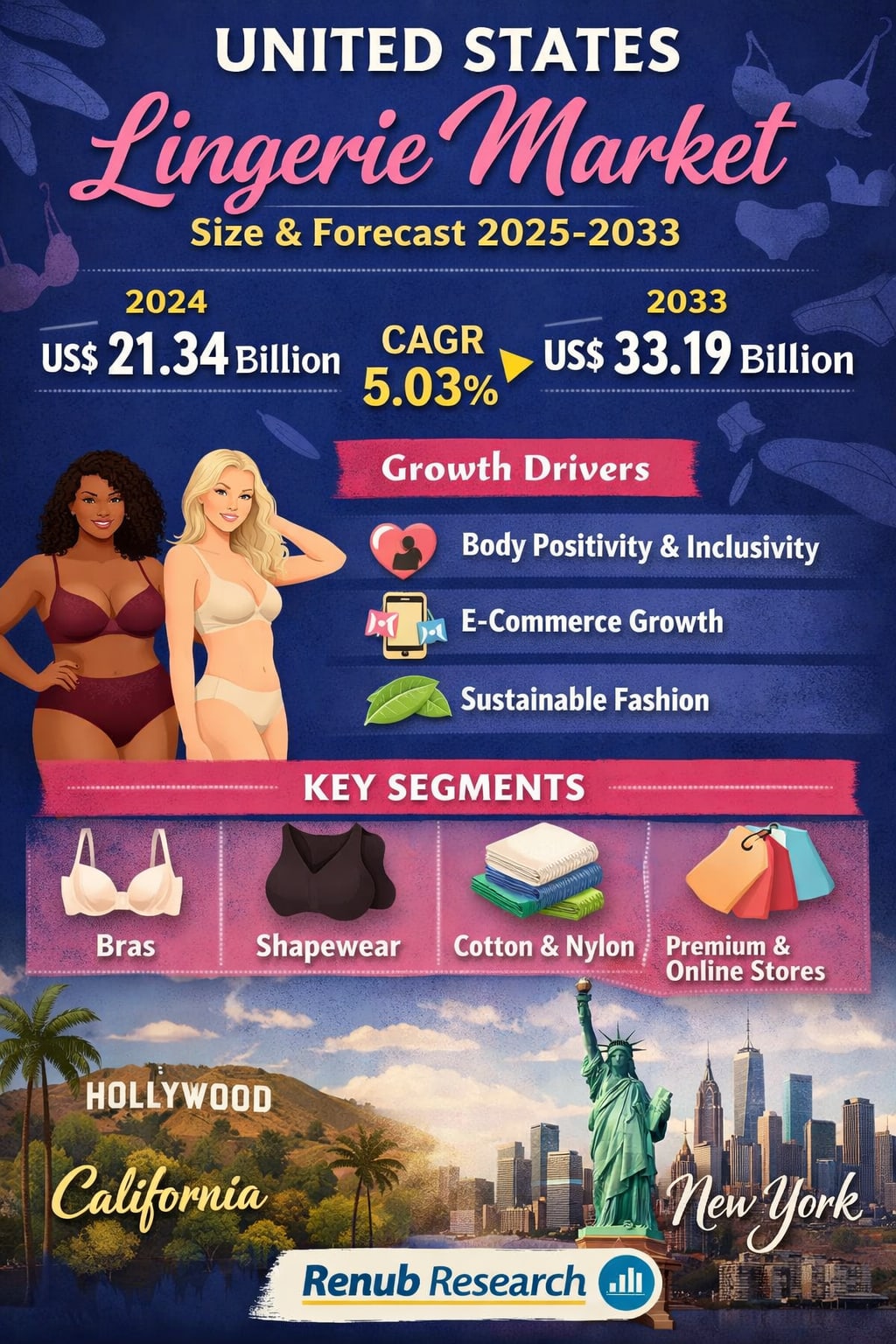
The United States lingerie market is entering a dynamic phase of growth, innovation, and cultural transformation. According to Renub Research, the market is expected to expand from US$ 21.34 billion in 2024 to US$ 33.19 billion by 2033, registering a steady CAGR of 5.03% during 2025–2033. This growth is driven by a powerful combination of evolving consumer values, rising digital engagement, and the redefinition of lingerie as a form of self-expression rather than just a functional garment.
Lingerie in the U.S. includes bras, panties, shapewear, camisoles, and other intimate apparel made from cotton, lace, satin, silk, nylon, and blended fabrics. Over the past decade, the category has evolved dramatically. What was once designed primarily for function or visual appeal is now deeply connected to comfort, identity, confidence, and inclusivity.
Social media, celebrity culture, and the body-positivity movement have accelerated this shift, making lingerie a mainstream fashion category and an everyday essential. Women increasingly purchase lingerie for themselves, focusing on fit, comfort, and emotional satisfaction rather than for special occasions alone. As a result, the U.S. lingerie market continues to thrive at the intersection of fashion, technology, and empowerment.
United States Lingerie Market Outlook
The outlook for the U.S. lingerie industry remains robust through 2033. Brands are investing heavily in innovation, sustainable materials, digital tools, and inclusive design strategies. Consumers now expect lingerie to support diverse body types, lifestyles, and personal aesthetics.
The rise of direct-to-consumer (D2C) brands has disrupted traditional retail, while legacy brands are reinventing themselves through technology and modern storytelling. In parallel, experiential retail, online personalization, and ethical manufacturing are becoming competitive necessities rather than optional differentiators.
As lingerie becomes more lifestyle-oriented and wellness-focused, demand will continue to grow across product categories, materials, and price ranges. The industry’s ability to adapt to changing consumer values will define its long-term success.
Growth Drivers in the United States Lingerie Market
Rising Focus on Comfort and Body Positivity
One of the strongest growth drivers is the shift toward comfort, inclusivity, and body confidence. The body-positivity movement has reshaped both product development and marketing strategies. Consumers now demand lingerie that fits real bodies, not idealized ones.
Brands have expanded size ranges, improved fit testing, and adopted unretouched advertising to build trust and emotional connection. The commercial success of inclusive campaigns has proven that representation is not just ethical but profitable. Comfort-driven designs, such as wireless bras, breathable fabrics, and adaptive features, are now mainstream.
This cultural shift has transformed lingerie into a symbol of empowerment, making consumers more loyal to brands that reflect their values and individuality.
Online Retail Expansion and Digital Engagement
E-commerce has revolutionized lingerie shopping in the U.S. Online channels provide privacy, convenience, and endless choice, which are especially valuable for intimate apparel purchases. Virtual fitting tools, AI-powered size recommendations, and easy return policies have significantly reduced purchasing friction.
Digital-first brands use social media, influencer partnerships, and real-time feedback to build communities rather than just customer bases. Personalization, subscription models, and “try-before-you-buy” programs have further boosted online sales.
In July 2025, Victoria’s Secret launched the Body by Victoria FlexFactor Bra featuring flexible titanium underwire and adaptive memory foam, showcasing how innovation is driving digital buzz and consumer excitement.
Growing Demand for Sustainable and Ethical Lingerie
Sustainability has become a core purchase driver, particularly among younger consumers. Shoppers now actively seek transparency in sourcing, labor practices, and materials. Brands are responding with organic cotton, recycled nylon, bamboo, and biodegradable packaging.
Ethical production and eco-conscious storytelling help brands build credibility and long-term loyalty. In August 2025, Wacoal introduced its Autumn/Winter 2025 collection featuring sustainable fabrics combined with luxury lace and seasonal tones, demonstrating how sustainability and premium design can coexist.
Challenges in the United States Lingerie Market
Intense Competition and Pricing Pressure
The U.S. lingerie market is highly competitive, with global brands, fast-fashion players, and D2C startups fighting for market share. Price pressure is intense, especially in the mid-range segment where differentiation is difficult.
Fast-fashion brands can replicate designs quickly at lower costs, forcing established brands to balance innovation, marketing investment, and profitability. Frequent promotions and discount-driven consumer behavior also erode margins.
Premium brands attempt to defend their position through craftsmanship, sustainability, and personalization, but maintaining long-term brand value remains a constant challenge.
Sizing Inconsistencies and Fit Issues
Sizing remains one of the biggest operational challenges. Lack of standardization leads to confusion, high return rates, and customer dissatisfaction—especially online. Inclusive sizing further complicates manufacturing and inventory management.
While virtual fitting, body scanning, and AI tools are improving accuracy, consistency across collections remains difficult. Brands that solve the fit challenge effectively will gain a major competitive advantage in customer retention and cost efficiency.
Product Segment Analysis
United States Brassiere Lingerie Market
Bras remain the backbone of the U.S. lingerie market. Demand is shifting toward wireless, seamless, and multi-functional designs suitable for work, leisure, and movement. T-shirt bras, bralettes, and adaptive styles are particularly popular.
Consumers expect bras to combine support, comfort, and aesthetics without compromise. Smart fabrics, moisture control, and ergonomic structures are increasingly common. As perceptions evolve, bras are now seen as empowering essentials rather than restrictive garments.
United States Shapewear Lingerie Market
Shapewear has transitioned from compression-focused garments to comfort-enhancing, performance wear. Modern shapewear emphasizes flexibility, breathability, and natural contouring.
The crossover between shapewear and athleisure—seen in bodysuits, leggings, and control briefs—has significantly expanded demand. Influencer culture and size inclusivity have normalized shapewear as everyday wear, making it one of the fastest-growing lingerie segments in the U.S.
Material Segment Analysis
United States Cotton Lingerie Market
Cotton lingerie remains a staple due to its softness, breathability, and skin-friendly properties. It is especially popular for everyday wear, warm climates, and sensitive skin. The shift toward organic and ethically sourced cotton further strengthens demand.
Modern cotton lingerie blends classic comfort with contemporary silhouettes, appealing to both younger and mature consumers. Its affordability ensures continued relevance across all income groups.
United States Nylon Lingerie Market
Nylon lingerie is prized for its smooth finish, durability, and design versatility. It allows for intricate lacework, bold colors, and sleek silhouettes. Blended with spandex, nylon offers improved stretch, fit, and performance.
Advances in fiber technology have improved breathability and comfort, eliminating past concerns about synthetic fabrics. Nylon remains essential for fashion-forward and premium lingerie collections in the U.S.
Price Segment Analysis
United States Premium Lingerie Market
The premium segment represents craftsmanship, indulgence, and emotional value. Consumers here prioritize quality, fit, and brand prestige over price. Self-purchase is a key driver, with lingerie viewed as an expression of confidence and self-care.
Limited editions, celebrity collaborations, and sustainable luxury lines enhance brand appeal. Personalized fittings and customized designs further strengthen the premium experience. Despite higher prices, demand remains strong due to durability and emotional connection.
Distribution Channel Analysis
United States Specialized Lingerie Stores Market
Specialty stores continue to thrive through personalized service, expert fittings, and curated collections. These stores offer experiences that online platforms cannot replicate, building trust and long-term loyalty.
Digital integration—such as virtual fittings and appointment booking—helps boutiques stay competitive. Their emphasis on consultation and community ensures continued relevance despite e-commerce growth.
United States Lingerie Online Stores Market
Online stores are now the dominant channel in the U.S. lingerie market. AI sizing tools, flexible payments, and easy returns drive confidence and convenience. Digital-native brands use data analytics to personalize marketing and predict demand more accurately.
Subscription boxes, influencer marketing, and inclusivity-driven campaigns resonate strongly with modern consumers, making online platforms the engine of future market growth.
State-Level Market Insights
California Lingerie Market
California leads innovation in sustainable, minimalist, and lifestyle-oriented lingerie. The state’s wellness culture and digital-savvy consumers favor breathable fabrics, ethical sourcing, and versatile designs that transition from active to casual wear.
New York Lingerie Market
New York remains the heart of luxury and fashion-forward lingerie. High-end boutiques, designer labels, and fashion events drive innovation, while urban lifestyles sustain demand for stylish yet practical intimate wear.
Washington Lingerie Market
Washington’s market is shaped by sustainability, inclusivity, and online-first shopping behavior. Consumers favor ethically made, functional lingerie suited for professional and casual lifestyles, supported by strong e-commerce adoption.
Market Segmentation Summary
By Product Type:
Brassiere, Knickers/Panties, Shapewear, Others
By Material:
Cotton, Silk, Satin, Nylon, Others
By Price Range:
Economy, Premium
By Distribution Channel:
Mass Merchandizers, Specialized Stores, Online Stores, Others
By Top States:
California, Texas, New York, Florida, Illinois, Pennsylvania, Ohio, Georgia, New Jersey, Washington, and others
Company Analysis
The U.S. lingerie market features a mix of global leaders and agile innovators, including:
Fashion Nova LLC
Hanesbrands Inc.
H & M Hennes & Mauritz AB
Hunkemöller International B.V.
Jockey International Inc.
MAS Holdings
PVH Corp.
The Gap Inc.
The Groupe Chantelle
Triumph International Ltd.
Each company is analyzed through five viewpoints: overview, key person, recent developments, SWOT, and revenue analysis.
Final Thoughts
The United States lingerie market is evolving beyond fashion into a reflection of identity, comfort, and values. With steady growth projected through 2033, brands that embrace inclusivity, sustainability, digital innovation, and personalization will define the next era of intimate apparel.
As consumers continue to prioritize self-expression and well-being, lingerie will remain one of the most resilient and emotionally connected segments of the U.S. fashion industry.
About the Creator
Keep reading
More stories from shibansh kumar and writers in Trader and other communities.
Germany Silicon Carbide (SiC) Wafer Market Size & Forecast 2025–2034
Introduction The Germany Silicon Carbide (SiC) Wafer Market is entering a decisive growth phase as the country accelerates electrification, clean-energy deployment, and advanced semiconductor manufacturing. According to Renub Research, the market was valued at US$ 48.49 million in 2025 and is projected to grow at a compound annual growth rate (CAGR) of 12.41% between 2026 and 2034, reaching US$ 138.96 million by 2034.
By shibansh kumar17 minutes ago in Trader
A Letter to the Firestarter
Dear Firestarter, We can all see you, we've been watching you since you began. In case you didn't know we were here before you and we will be here after. We witnessed your rise, your setbacks, your guilt and your lies. We witnessed you start the fire.
By Donny Foley3 days ago in Poets



Comments
There are no comments for this story
Be the first to respond and start the conversation.