
United States Medical Ceramics Market Size & Forecast 2026–2034
How Advanced Biomaterials Are Reshaping Orthopedics, Dentistry, and Modern Healthcare in America

Introduction: A Material Quietly Transforming Modern Medicine
Medical ceramics may not dominate headlines, but they are rapidly becoming one of the most critical material classes in modern healthcare. From hip replacements and dental implants to surgical tools and reconstructive procedures, these advanced biomaterials are redefining how long medical devices last, how safely they interact with the human body, and how well patients recover after surgery.
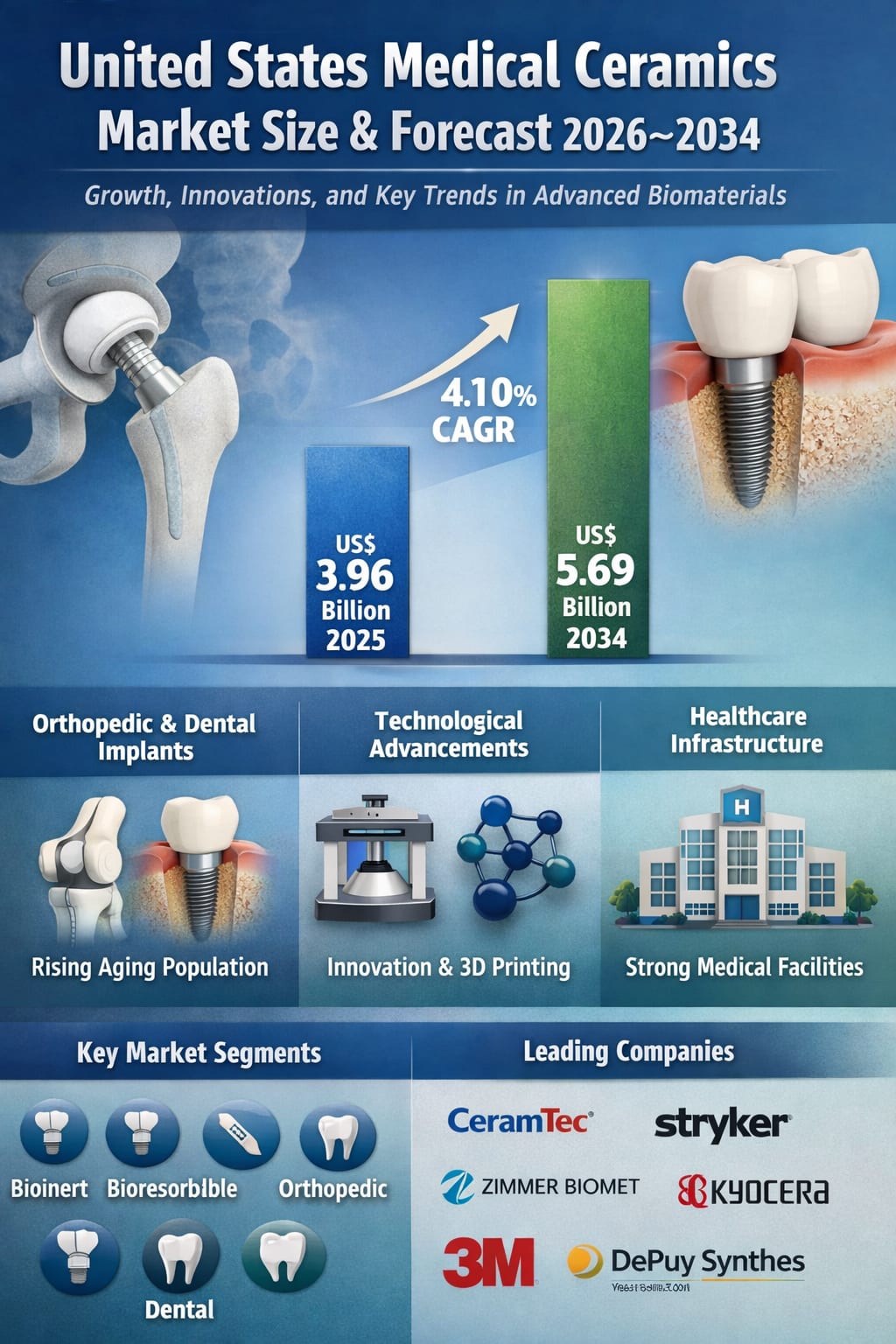
According to Renub Research, the United States medical ceramics market is set for steady expansion, growing from US$ 3.96 billion in 2025 to US$ 5.69 billion by 2034, registering a compound annual growth rate (CAGR) of 4.10% between 2026 and 2034. This growth is being fueled by a powerful combination of factors: rapid technological progress, a steadily aging population, rising volumes of orthopedic and dental procedures, and increasing reliance on biocompatible, high-performance materials in medical devices.
In a healthcare system that prioritizes durability, safety, and long-term patient outcomes, medical ceramics are no longer a niche solution—they are becoming a core pillar of advanced medical treatment in the United States.
United States Medical Ceramic Market Outlook
Medical ceramics are specialized ceramic materials designed specifically for use in medical and healthcare applications. Common types include alumina ceramics, zirconia, calcium phosphate ceramics, and bioactive glass ceramics. These materials are valued for their biocompatibility, exceptional hardness, corrosion resistance, and wear resistance, making them ideal for use inside the human body.
Unlike conventional metals and polymers, medical ceramics offer superior performance in many implant applications. They do not corrode, they generate less wear debris, and they provide excellent mechanical stability over long periods. This makes them particularly suitable for joint replacements, orthopedic prosthetics, dental implants, bone grafts, and surgical instruments.
The United States has been at the forefront of adopting medical ceramics, thanks to its advanced healthcare infrastructure, strong research ecosystem, and high demand for innovative medical technologies. Rising incidences of bone disorders, dental problems, and age-related joint issues have further accelerated the demand for high-quality implantable components. At the same time, strict regulatory standards and the presence of leading medical device manufacturers have helped ensure that only high-performance, clinically proven ceramic materials enter the market.
Key Growth Drivers of the U.S. Medical Ceramics Market
1. Rising Demand for Orthopedic and Dental Implants
One of the strongest growth engines for the U.S. medical ceramics market is the surging demand for orthopedic and dental implants. As life expectancy increases and the population continues to age, conditions such as arthritis, osteoporosis, and degenerative joint diseases are becoming more common. This has led to a steady rise in hip replacements, knee replacements, spinal surgeries, and dental restoration procedures.
Medical ceramics such as alumina, zirconia, and calcium phosphate are widely used in these applications due to their high biocompatibility, low friction, and excellent wear resistance. Compared to older materials, ceramic components offer smoother articulation in joints, reduced inflammation risk, and longer implant lifespans.
Demographic trends strongly support this trajectory. The U.S. population aged 65 and older is projected to increase significantly over the coming decades, which will naturally translate into higher volumes of joint replacement and dental implant procedures. On the dental side, tooth loss and oral health issues remain prevalent among older adults, further strengthening demand for ceramic-based dental solutions.
As surgical volumes continue to rise, medical ceramics are expected to play an increasingly central role in improving patient outcomes and long-term implant performance.
2. Technological Advancements and Material Innovation
Innovation is another powerful force shaping the U.S. medical ceramics market. Advances in manufacturing techniques, surface modification technologies, and 3D printing have dramatically improved the mechanical properties and functional performance of ceramic materials.
Today’s medical ceramics are not only stronger and more durable, but they can also be custom-designed to match patient-specific anatomical requirements. This has opened the door to more personalized implants, better osseointegration, and longer service life for medical devices.
Research into bioactive and bioresorbable ceramics is also expanding, particularly in fields such as regenerative medicine and tissue engineering. These next-generation materials are designed to interact more naturally with the human body, promoting bone growth and, in some cases, gradually dissolving as natural tissue regenerates.
In early 2025, CeramTec introduced a new range of lead-free piezoceramics for medical sensors and diagnostic devices, reflecting the industry’s push toward safer and more environmentally responsible materials. Such innovations highlight how regulatory trends, sustainability goals, and technological progress are collectively reshaping the medical ceramics landscape in the U.S.
3. Strong Healthcare Infrastructure and High Adoption of Advanced Technologies
The United States benefits from one of the world’s most advanced and well-funded healthcare systems. High healthcare spending, strong insurance coverage frameworks, and widespread adoption of advanced surgical techniques create a highly supportive environment for the growth of medical ceramics.
Surgeons and healthcare providers in the U.S. are generally quick to adopt next-generation materials that offer better performance and improved patient outcomes. This has significantly accelerated the integration of ceramic components in orthopedic, dental, reconstructive, and cosmetic procedures.
Major medical device companies also play a crucial role in driving market expansion. In late 2025, Stryker Corporation launched a new series of advanced ceramic implants aimed at enhancing precision in orthopedic surgeries and improving patient recovery times. Such product launches underscore the industry’s strong commitment to innovation and continuous improvement.
With patient expectations rising and healthcare providers seeking more durable and reliable solutions, medical ceramics are increasingly viewed as a standard rather than a premium option.
Challenges Facing the U.S. Medical Ceramics Market
High Manufacturing and Material Costs
Despite their advantages, medical ceramics come with a significant cost challenge. Producing medical-grade ceramics requires highly specialized equipment, precision processing techniques, and strict quality control systems. Raw materials such as high-purity alumina and zirconia are also expensive, which directly impacts the final cost of ceramic-based medical devices.
These higher costs can put pressure on manufacturers, hospitals, and healthcare providers, particularly in a system that is already sensitive to pricing and reimbursement issues. Improving production efficiency and optimizing manufacturing processes remain key priorities for industry players.
Stringent Regulatory and Approval Processes
In the United States, medical ceramics used in implants and devices must pass through rigorous regulatory evaluations, primarily overseen by the FDA. While these standards are essential for ensuring patient safety, they can also lead to longer approval timelines, higher development costs, and increased complexity, especially for smaller or emerging companies.
Regulatory uncertainty and evolving compliance requirements can further complicate market entry, making it critical for manufacturers to invest heavily in testing, documentation, and clinical validation.
Segment Insights: A Closer Look at Key Market Categories
Bioinert Medical Ceramics
Bioinert ceramics, such as alumina and zirconia, form a major segment of the U.S. medical ceramics market. These materials are chemically stable and do not react with surrounding biological tissues, making them ideal for weight-bearing orthopedic and dental applications.
Their exceptional hardness, wear resistance, and long-term durability make them especially popular in hip and knee replacements. With the aging population and rising demand for joint surgeries, bioinert ceramics are expected to maintain strong and stable growth across the forecast period.
Bioresorbable Medical Ceramics
Bioresorbable ceramics, particularly calcium phosphate-based materials like hydroxyapatite and tricalcium phosphate, are gaining attention for their role in bone grafts, dental fillers, and tissue engineering. These materials are designed to gradually dissolve in the body while supporting natural bone regeneration, eliminating the need for secondary surgeries.
As minimally invasive procedures and regenerative medicine gain momentum in the U.S., demand for bioresorbable ceramics is expected to increase steadily, supported by active collaboration between research institutions and medical device companies.
Medical Ceramics in Plastic and Reconstructive Surgery
The U.S. remains one of the world’s largest markets for cosmetic and reconstructive surgery, and medical ceramics are playing a growing role in this field. Materials such as zirconia and bioactive ceramics are valued for their strength, aesthetic appeal, and biocompatibility, making them suitable for facial reconstruction, dental prosthetics, and other cosmetic applications.
As patients increasingly seek long-lasting, natural-looking, and allergy-free solutions, ceramic-based options are becoming more attractive to both surgeons and patients.
Orthopedic Medical Ceramics
Orthopedics represents one of the largest application areas for medical ceramics in the United States. Ceramic-on-ceramic and ceramic-on-polymer combinations are widely used in joint replacements due to their low friction, high wear resistance, and long-term stability.
With arthritis cases on the rise and an aging population driving higher surgical volumes, the orthopedic segment is expected to remain a cornerstone of market growth through 2034.
Regional Spotlight: Key State Markets
California
California stands out as a major hub for medical ceramics due to its advanced healthcare infrastructure, strong research ecosystem, and high concentration of medical device companies. The state’s leadership in orthopedic, dental, and cosmetic procedures continues to drive strong demand for ceramic-based medical solutions.
Texas
Texas benefits from a large population, expanding healthcare infrastructure, and growing demand for orthopedic and dental treatments. Major cities such as Houston, Dallas, and Austin host advanced medical centers that increasingly rely on ceramic-based implants and instruments.
New York
New York’s well-developed healthcare system, high surgical volumes, and strong focus on specialty care make it a key market for medical ceramics. The state’s aging population and strong presence in reconstructive and cosmetic surgery further support steady demand growth.
Market Segmentation Overview
By Material Type:
Bioinert, Bioactive, Bioresorbable, Piezo Ceramics
By Application:
Surgical Instruments, Plastic Surgery, Orthopedic, Dental
By Top States:
California, Texas, New York, Florida, Illinois, Pennsylvania, Ohio, Georgia, New Jersey, Washington, North Carolina, Massachusetts, Virginia, Michigan, Maryland, Colorado, Tennessee, Indiana, Arizona, Minnesota, Wisconsin, Missouri, Connecticut, South Carolina, Oregon, Louisiana, Alabama, Kentucky, Rest of United States
Competitive Landscape: Key Companies Covered
The market includes leading global and regional players analyzed across multiple dimensions such as overview, leadership, recent strategies, product portfolios, and financial insights. Key companies include:
CeramTec GmbH
Kyocera Corporation
Morgan Advanced Materials
3M
DSM
NGK Spark Plug Co. Ltd
DePuy Synthes
Zimmer Biomet Holding Inc.
Straumann
BioMérieux SA
Final Thoughts: A Market Built on Precision, Performance, and Patient Outcomes
The United States medical ceramics market is entering a phase of steady, innovation-driven growth. With the market projected to rise from US$ 3.96 billion in 2025 to US$ 5.69 billion by 2034, the role of advanced ceramic materials in healthcare is set to become even more prominent.
Driven by demographic trends, technological progress, and the constant pursuit of better patient outcomes, medical ceramics are no longer just an alternative to metals and polymers—they are becoming a standard of care in many critical applications. While challenges related to cost and regulation remain, ongoing innovation and strong institutional support suggest a resilient and promising future for this high-performance materials market in the United States.
About the Creator
Sakshi Sharma
Content Writer with 7+ years of experience crafting SEO-driven blogs, web copy & research reports. Skilled in creating engaging, audience-focused content across diverse industries.
Keep reading
More stories from Sakshi Sharma and writers in Trader and other communities.
Barbeque Grill Market Size and Forecast 2025–2033: Outdoor Cooking Fuels a Global Lifestyle Shift
Barbeque Grill Market Set to Sizzle with Steady Growth Through 2033 The Barbeque Grill Market is expected to reach US$ 10.25 billion by 2033, rising from US$ 6.86 billion in 2024, growing at a CAGR of 4.56% from 2025 to 2033. This steady expansion reflects more than just rising sales of cooking equipment—it highlights a broader lifestyle transformation centered on outdoor living, social gatherings, and experiential dining at home.
By Sakshi Sharmaa day ago in Trader




Comments
There are no comments for this story
Be the first to respond and start the conversation.