
United States Next-Generation Sequencing Market Size & Forecast, 2026–2034
How Precision Medicine, Oncology, and Genomics Innovation Are Powering America’s NGS Boom

United States Next Generation Sequencing Market Overview
Next-Generation Sequencing (NGS), often called next-gen or second-generation sequencing, represents one of the most transformative technologies in modern life sciences. Unlike traditional sequencing methods that analyze DNA or RNA in a slow, linear manner, NGS enables the simultaneous sequencing of millions of fragments, producing massive amounts of genetic data in a fraction of the time and at a significantly lower cost per sample.
This leap in efficiency has made NGS indispensable across multiple domains—cancer genomics, rare disease diagnostics, infectious disease surveillance, reproductive health, and drug discovery. What once took years and millions of dollars can now be achieved in days or even hours, opening new doors for both research and clinical care.
In the United States, the adoption of NGS has accelerated rapidly. The country’s strong ecosystem of academic institutions, biotechnology companies, pharmaceutical giants, clinical laboratories, and government-funded research programs has created fertile ground for genomics innovation. The rise of precision medicine, combined with growing demand for early and accurate diagnosis, has pushed NGS from research labs into mainstream healthcare.
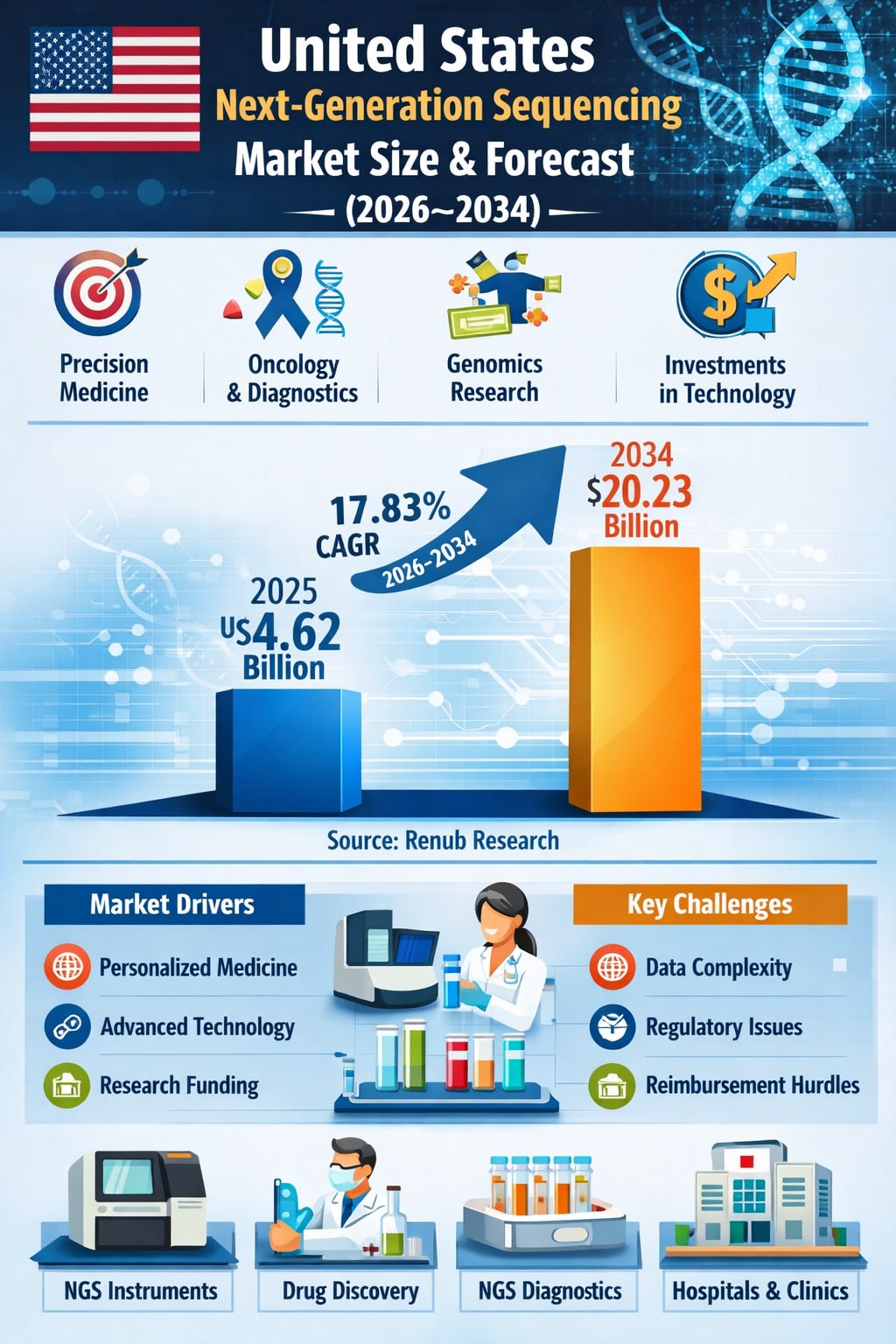
According to Renub Research, the U.S. Next Generation Sequencing market is projected to grow from US$ 4.62 billion in 2025 to US$ 20.23 billion by 2034, at a compound annual growth rate (CAGR) of 17.83% from 2026 to 2034. This remarkable expansion reflects not only technological progress but also a fundamental shift in how medicine is practiced in the United States.
Next Generation Sequencing in the USA: Market Analysis
The United States stands at the forefront of the global genomics revolution. NGS has become a cornerstone technology in oncology, genetic testing, infectious disease research, and population genomics projects. Its ability to deliver comprehensive, high-resolution genetic insights makes it uniquely suited for today’s data-driven healthcare environment.
One of the biggest drivers of adoption is the increasing integration of genomics into routine clinical decision-making. Physicians are no longer limited to symptom-based diagnosis; instead, they can analyze a patient’s genetic profile to identify disease risks, select targeted therapies, and predict treatment responses. This shift is especially visible in oncology, where NGS-based tumor profiling is now widely used to guide personalized cancer treatments.
Beyond clinical care, NGS plays a critical role in biomedical research and pharmaceutical development. From identifying new drug targets to understanding disease mechanisms at the molecular level, sequencing technologies are accelerating discovery pipelines and reducing the time it takes to bring new therapies to market.
The U.S. also benefits from a supportive policy and funding environment. Federal initiatives, large-scale genomics programs, and sustained venture capital investment continue to strengthen the country’s leadership in sequencing technologies and applications.
Key Growth Drivers in the United States Next Generation Sequencing Market
1. Rising Adoption of Precision Medicine
Precision medicine is one of the most powerful forces shaping the U.S. NGS market. Instead of relying on one-size-fits-all treatments, healthcare providers are increasingly using genetic information to tailor therapies to individual patients. NGS enables comprehensive genomic profiling, making it essential for personalized treatment strategies in cancer, rare diseases, and inherited disorders.
Pharmaceutical companies are also leveraging NGS to develop companion diagnostics and to stratify patients in clinical trials, improving success rates and reducing development risks. In November 2025, for example, Precision Medicine Group announced the launch of its global expert networking forum, highlighting the growing industry focus on collaborative, genomics-driven drug development.
As precision medicine continues to expand across the U.S. healthcare system, demand for high-throughput, accurate, and cost-effective sequencing platforms is expected to rise sharply.
2. World-Class Research Infrastructure and Genomics Funding
The United States possesses one of the most advanced genomics research ecosystems in the world. Government agencies, academic institutions, and private biotech firms invest heavily in large-scale sequencing projects, cancer genomics, infectious disease surveillance, and population health studies.
NGS is now a standard tool in cancer research, functional genomics, and translational medicine. Continuous funding ensures not only the adoption of existing technologies but also the development of next-generation platforms and analytical tools.
In February 2025, Foundation Medicine launched new germline tests in the U.S. aimed at identifying inherited cancer risks, underlining how research-driven innovation continues to expand clinical applications of sequencing technologies.
3. Technological Progress and Cost Reductions
Rapid technological advancements are another major growth engine for the U.S. NGS market. Improvements in sequencing chemistry, automation, data analysis software, and bioinformatics pipelines have significantly enhanced accuracy, speed, and scalability.
At the same time, the cost per genome has fallen dramatically, making NGS more accessible to hospitals, diagnostic labs, and smaller research institutions. The emergence of benchtop and compact sequencers has further simplified adoption in clinical settings, enabling faster turnaround times and decentralized testing.
In January 2024, QIAGEN Digital Insights released an upgraded version of its genomics analysis platform, highlighting how software and data interpretation tools are evolving alongside hardware innovations.
Challenges Facing the U.S. Next Generation Sequencing Market
1. Data Management and Interpretation Complexity
While NGS generates valuable insights, it also produces enormous volumes of complex data. Many healthcare organizations struggle with data storage, integration, and analysis, particularly when advanced bioinformatics infrastructure is lacking.
There is also a shortage of skilled bioinformaticians and genetic counselors, which can slow adoption and increase costs. For smaller hospitals and laboratories, these challenges can become significant barriers to entry.
2. Regulatory and Reimbursement Uncertainty
Regulatory approval pathways and reimbursement policies for NGS-based tests in the U.S. remain complex and sometimes inconsistent. Differences between public and private insurers create financial uncertainty for diagnostic providers, while evolving regulations can delay the commercialization of new tests.
Although progress is being made, regulatory and reimbursement clarity will be crucial for sustaining long-term market growth.
United States Next Generation Sequencing Market by Product and Application
NGS Instruments Market
The U.S. market for NGS instruments is driven by demand from research institutions, clinical laboratories, and pharmaceutical companies. Both high-throughput and benchtop systems are widely used for applications such as whole-genome sequencing, cancer profiling, and infectious disease testing. Continuous upgrades and performance improvements support steady growth in this segment.
NGS Services Market
NGS services are increasingly popular among organizations looking to avoid high capital investments. Outsourcing sequencing and data analysis has become common in pharmaceutical research, clinical trials, and academic studies. This trend is expected to continue as data complexity and sample volumes grow.
NGS Diagnostics Market
NGS-based diagnostics are now widely used for cancer characterization, rare disease diagnosis, prenatal screening, and pathogen detection. Growing clinical acceptance, expanding test menus, and improving reimbursement for certain applications are driving strong growth in this segment.
NGS in Drug Discovery
In drug discovery, NGS is transforming target identification, biomarker development, pharmacogenomics, and companion diagnostics. U.S. pharmaceutical and biotech companies rely heavily on sequencing to understand disease mechanisms and optimize clinical development strategies. Rising investment in biologics and precision therapies is further accelerating adoption.
Technology Landscape: Sequencing Platforms in the U.S.
Sequencing by Synthesis (SBS)
Sequencing by synthesis currently dominates the U.S. NGS market due to its high accuracy, scalability, and versatility. It is widely used for whole-genome, whole-exome, RNA, and targeted sequencing. Continuous improvements in automation and bioinformatics have strengthened its position as the leading commercial technology.
Ion Semiconductor Sequencing
Ion semiconductor sequencing is gaining traction in applications that require rapid turnaround and targeted analysis. By measuring hydrogen ions released during DNA synthesis, this technology avoids complex optical systems, enabling faster and simpler workflows. While its market share is smaller than SBS, it is increasingly favored in clinical and time-sensitive settings.
End-User Trends: Hospitals, Clinics, and Beyond
Hospitals and clinics are becoming one of the fastest-growing end-user segments in the U.S. NGS market. The push toward precision medicine has encouraged many healthcare providers to establish in-house sequencing capabilities or partner with specialized service providers.
NGS is now commonly used in hospitals for oncology profiling, rare disease diagnosis, prenatal testing, and infectious disease detection. Improvements in ease of use, automation, and reimbursement coverage are expected to further accelerate adoption across the U.S. healthcare system.
State-Level Market Highlights
California
California remains one of the most dynamic NGS markets in the country, supported by a dense concentration of biotech firms, research institutions, and venture capital investment. The state leads in applications such as cancer genomics, rare disease research, and drug development.
New York
New York’s strong academic and medical ecosystem drives widespread use of NGS in precision medicine, oncology, and population health studies. Large patient populations and world-class medical centers make the state a key hub for clinical genomics.
New Jersey
New Jersey benefits from its pharmaceutical and life sciences cluster, with NGS widely used in drug discovery, biomarker research, and clinical trials. Proximity to regulatory bodies also supports innovation and collaboration.
Texas
Texas is one of the fastest-growing regional markets, driven by expanding healthcare infrastructure, rising cancer incidence, and increased investment in biotechnology. Major cities like Houston, Dallas, and Austin are becoming important centers for genomics research and clinical adoption.
Market Segmentation Overview
By Product:
Instruments
Reagents & Consumables
Services
By Application:
Diagnostics
Agriculture & Animal Research
Drug Discovery
Personalized Medicine & Genetic Screening
Others
By Technology:
Sequencing by Synthesis
Ion Semiconductor Sequencing
Single Molecule Real-Time Sequencing
Nanopore Sequencing
Others
By End User:
Academic & Clinical Research Centers
Pharmaceutical & Biotechnology Companies
Hospitals & Clinics
Others
Top States Covered:
California, Texas, New York, Florida, Illinois, Pennsylvania, Ohio, Georgia, New Jersey, Washington, North Carolina, Massachusetts, Virginia, Michigan, Maryland, Colorado, Tennessee, Indiana, Arizona, Minnesota, Wisconsin, Missouri, Connecticut, South Carolina, Oregon, Louisiana, Alabama, Kentucky, and Rest of the United States.
Competitive Landscape
Major companies profiled (each with Overview, Key Person, Recent Developments, SWOT, and Revenue Analysis):
Illumina
Thermo Fisher Scientific
Pacific Biosciences
QIAGEN N.V.
Roche
Bio-Rad Laboratories, Inc.
Takara Bio Inc.
Hamilton Company
Geneious
BioMérieux SA
These players continue to shape the market through innovation, partnerships, platform upgrades, and expansion of clinical and research applications.
Conclusion: A Defining Decade for U.S. Genomics
The United States Next-Generation Sequencing market is entering a golden era of growth and impact. With the market expected to surge from US$ 4.62 billion in 2025 to US$ 20.23 billion by 2034, at a CAGR of 17.83%, NGS is no longer just a research tool—it is becoming a cornerstone of modern healthcare.
From precision oncology and rare disease diagnosis to drug discovery and population health, sequencing technologies are reshaping the future of medicine in the United States. While challenges remain in data management and regulation, the long-term outlook is overwhelmingly positive. The next decade will likely see NGS move even deeper into routine clinical practice, cementing its role as one of the most transformative technologies of the 21st century.
About the Creator
Tom Shane
Tom Shane is a content writer specializing in SEO-driven blogs, product descriptions, and thought leadership. He crafts engaging, research-backed content that connects with audiences and drives results.
Philippines Co-Working Office Space Market 2026: Hybrid Work Momentum, Startup Growth and Flexible Workplace Innovation
Philippines Co-Working Office Space Market Overview The market is rapidly gaining traction as businesses, freelancers and distributed teams increasingly prioritise flexibility and cost efficiency in workplace decisions. Co-working environments offer scalable office solutions, shared infrastructure and collaborative ecosystems that appeal to startups, SMEs and multinational organisations alike. As traditional long-term leases become less attractive in a hybrid work era, co-working spaces are emerging as a strategic component of workplace transformation across major Philippine business hubs.
By Manisha Dixitabout 22 hours ago in Trader


Comments
There are no comments for this story
Be the first to respond and start the conversation.