
United States Non-Invasive Prenatal Testing Market Size & Forecast 2025–2033
How Safer Genetics, Better Coverage, and Advanced Sequencing Are Transforming Prenatal Care in America

United States Non-Invasive Prenatal Testing Market: A New Era of Safer Prenatal Screening
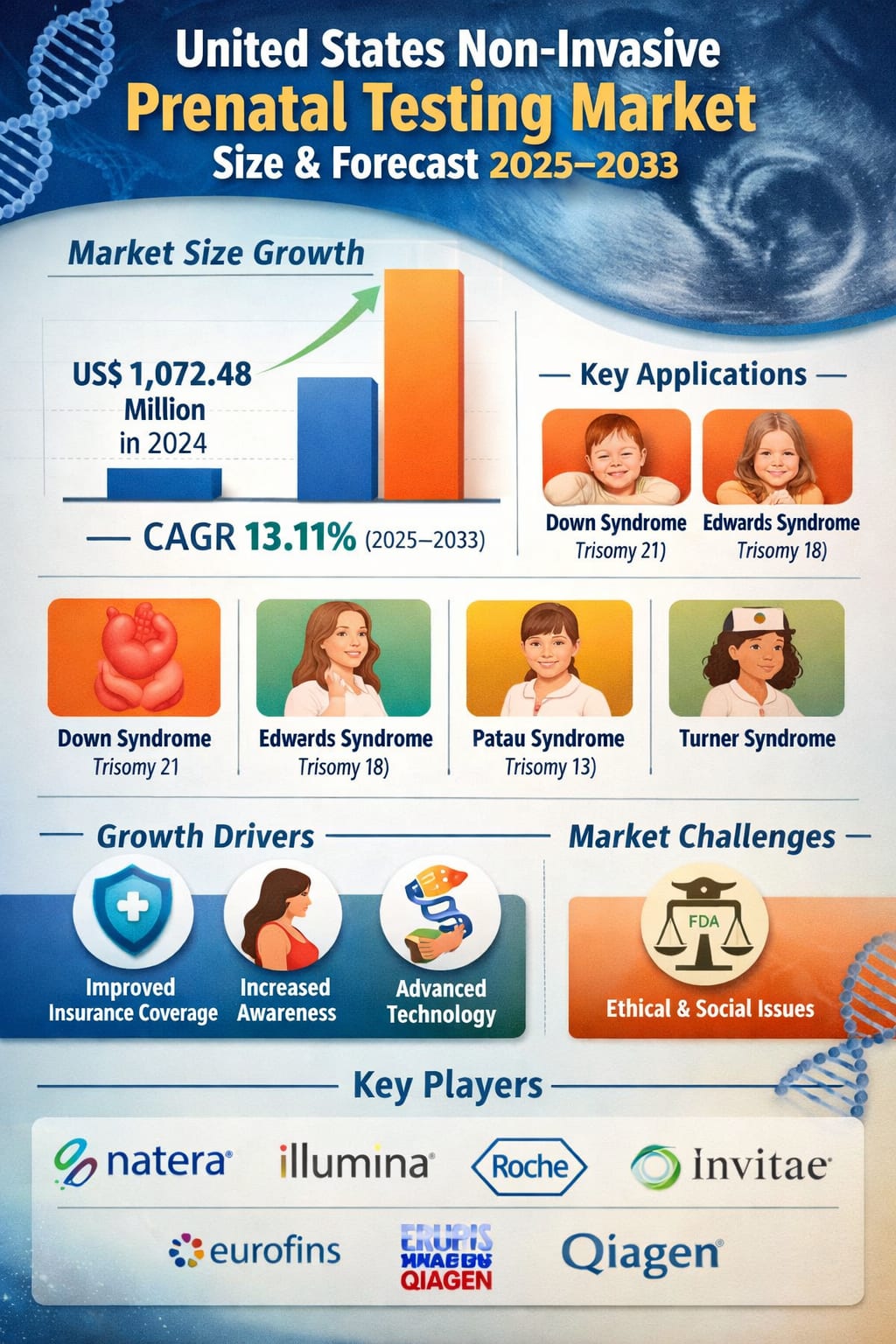
The United States Non-Invasive Prenatal Testing (NIPT) Market is entering a phase of remarkable expansion, driven by rapid technological progress, increasing awareness among expectant parents, and growing support from healthcare systems. According to Renub Research, the market is expected to grow from US$ 1,072.48 million in 2024 to US$ 3,249.94 million by 2033, registering a strong compound annual growth rate (CAGR) of 13.11% from 2025 to 2033.
This impressive growth trajectory reflects a fundamental shift in how prenatal screening is approached in the United States. Traditionally, prenatal genetic testing relied heavily on invasive procedures such as amniocentesis and chorionic villus sampling (CVS). While effective, these methods carry a small but real risk of miscarriage and other complications. NIPT, by contrast, uses a simple maternal blood draw to analyze cell-free fetal DNA, offering a safer, highly accurate, and far less stressful alternative for expectant parents.
Over the past decade, NIPT has evolved from a specialized test primarily recommended for high-risk pregnancies into a mainstream, first-line screening option. Advances in next-generation sequencing (NGS) and bioinformatics have significantly improved test accuracy, expanded the range of detectable conditions, and reduced turnaround times. As a result, NIPT is increasingly viewed not just as a premium option, but as a standard component of modern prenatal care in the United States.
Understanding Non-Invasive Prenatal Testing (NIPT)
Non-invasive prenatal testing is a screening method that analyzes small fragments of fetal DNA circulating in the mother’s bloodstream. These fragments, known as cell-free DNA (cfDNA), can be detected as early as the ninth or tenth week of pregnancy. By examining this genetic material, clinicians can assess the risk of certain chromosomal abnormalities without exposing the fetus or mother to invasive procedures.
NIPT is most commonly used to screen for conditions such as Down syndrome (Trisomy 21), Edwards syndrome (Trisomy 18), and Patau syndrome (Trisomy 13). In many cases, it is also used to detect sex chromosome abnormalities such as Turner syndrome, along with a growing list of microdeletions and single-gene disorders, depending on the test panel used.
It is important to note that NIPT is a screening test rather than a diagnostic one. A positive result does not confirm the presence of a genetic disorder but indicates a higher risk, which is typically followed up with diagnostic testing. Even so, the high sensitivity and specificity of modern NIPT assays have made them a trusted tool in prenatal care pathways across the United States.
Market Outlook: Strong Growth Through 2033
The United States NIPT market’s projected rise from US$ 1.07 billion in 2024 to over US$ 3.24 billion by 2033 underscores the speed at which this technology is being adopted. Several converging trends are fueling this expansion:
First, the average maternal age in the U.S. continues to rise, and advanced maternal age is associated with a higher risk of chromosomal abnormalities. This demographic shift naturally increases demand for reliable prenatal screening tools.
Second, healthcare providers and professional bodies are increasingly recommending NIPT for a broader population, not just high-risk pregnancies. This has dramatically expanded the addressable market.
Third, continuous innovation in sequencing technologies and data analysis has improved test performance while gradually reducing costs, making NIPT more accessible to a wider range of patients.
Together, these factors are transforming NIPT from a niche service into a core component of routine prenatal care in the United States.
The Growing Importance of Down Syndrome Screening
Among the various applications of NIPT, Down syndrome (Trisomy 21) screening remains the largest and most influential segment. Down syndrome is the most common chromosomal condition in the United States. According to data frequently cited by public health authorities, approximately 6,000 babies are born with Down syndrome each year in the U.S., or about 1 in every 700 births.
This consistent prevalence means that demand for accurate, early, and safe screening methods remains strong. NIPT has proven particularly valuable in this context because of its high detection rate and low false-positive rate compared to traditional screening methods. For many expectant parents, the ability to receive early risk information through a simple blood test provides both reassurance and time to make informed medical and personal decisions.
As awareness continues to grow and screening guidelines evolve, the Down syndrome segment is expected to remain a major driver of overall market growth throughout the forecast period.
Key Growth Drivers Shaping the U.S. NIPT Market
Improved Reimbursement Policies
One of the most important catalysts for wider NIPT adoption in the United States has been the improvement in reimbursement policies. In the past, the relatively high cost of NIPT limited its use primarily to high-risk pregnancies or patients who could afford to pay out of pocket.
Today, coverage from Medicaid and commercial insurers has expanded significantly. This shift has reduced financial barriers for many families and made NIPT a more realistic option for routine prenatal screening. As more insurers recognize the long-term clinical and economic benefits of early, accurate screening, reimbursement support is expected to continue expanding, further boosting market growth.
Increased Awareness and Professional Recommendations
Professional medical organizations have played a crucial role in accelerating NIPT adoption. The American College of Obstetricians and Gynecologists (ACOG) and other bodies now recommend NIPT as a first-line screening option for all pregnant women, regardless of age or risk profile.
This represents a major change from earlier guidelines, which focused primarily on high-risk groups. As these recommendations become more deeply embedded in clinical practice, NIPT is increasingly viewed as a standard part of prenatal care rather than a specialized test.
Public awareness has also risen, supported by educational efforts from healthcare providers, diagnostic companies, and patient advocacy groups. Expectant parents today are more informed than ever about their screening options, and many actively ask for NIPT based on its safety and accuracy profile.
Safety and Non-Invasiveness
The core appeal of NIPT lies in its non-invasive nature. Unlike amniocentesis or CVS, which carry a small risk of miscarriage, NIPT requires only a routine blood draw from the mother. This eliminates procedure-related risks and significantly reduces anxiety for many expectant parents.
In an era where patient safety and comfort are increasingly prioritized, this advantage cannot be overstated. The ability to obtain highly reliable genetic risk information without endangering the pregnancy has positioned NIPT as a preferred first step in prenatal screening strategies across the United States.
Challenges Facing the U.S. NIPT Market
Regulatory Oversight and the Risk of False Results
Despite its many advantages, the NIPT market in the United States faces important challenges, particularly around regulatory oversight. Many NIPT assays are offered as laboratory-developed tests and are not subject to the same level of premarket approval as other medical devices regulated by the FDA.
While modern NIPT tests are generally highly accurate, false positives and false negatives can still occur. In some cases, incorrect results may lead to unnecessary anxiety, additional invasive testing, or even life-altering decisions based on incomplete or inaccurate information.
The lack of uniform regulatory standards raises concerns about test quality, consistency, and transparency across providers. Addressing these issues through clearer guidelines, quality benchmarks, and improved patient counseling will be essential for sustaining long-term trust in NIPT technologies.
Ethical and Social Implications
The expanding use of genetic screening also brings complex ethical and social questions to the forefront. Because NIPT enables the early detection of certain genetic conditions, it may influence decisions about pregnancy continuation in ways that spark debate about disability rights, social inclusion, and the value placed on different lives.
Additionally, interpreting genetic risk information can be emotionally challenging for expectant parents. Even when results are uncertain or represent only a probability, they can create significant psychological stress. This highlights the importance of genetic counseling and clear communication, ensuring that families understand what NIPT results do and do not mean before making decisions.
Market News: Innovation Continues to Reshape the Landscape
In May 2024, Natera, Inc., a global leader in cell-free DNA and genetic testing, announced the launch of a new cfDNA-based fetal RhD test. This development was particularly timely given the ongoing shortage of Rho(D) immune globulin (RhIg) treatment in the United States.
The test allows clinicians to determine fetal RhD status using a maternal blood sample as early as nine weeks into pregnancy. It also includes analysis of complex pseudogene and RhD-CE-D hybrid variants, helping improve clinical decision-making. Innovations like this demonstrate how the NIPT field is expanding beyond traditional aneuploidy screening into broader areas of prenatal and maternal-fetal care.
United States Non-Invasive Prenatal Testing Market Segmentation
By Component
Instruments
Kits and Reagents
Services
By Application
Down Syndrome (Trisomy 21)
Edwards Syndrome (Trisomy 18)
Patau Syndrome (Trisomy 13)
Turner Syndrome
Other Applications
By End User
Hospitals
Diagnostic Laboratories
Hospitals and diagnostic labs remain the primary settings for NIPT services, with laboratories playing a particularly important role in test processing, data analysis, and result interpretation.
Competitive Landscape: Key Companies Shaping the Market
The U.S. NIPT market is characterized by strong competition, continuous innovation, and strategic partnerships. Major players covered in the market include:
Eurofins Scientific
F. Hoffmann-La Roche Ltd
Invitae Corporation
Illumina Inc.
Natera Inc.
Centogene NV
Qiagen
These companies compete on the basis of test accuracy, breadth of test panels, turnaround time, data interpretation capabilities, and relationships with healthcare providers and insurers. Ongoing investment in research and development remains a critical factor in maintaining competitive advantage in this rapidly evolving field.
The Road Ahead: What to Expect Through 2033
Looking ahead, the United States NIPT market is poised for sustained, double-digit growth. Continued improvements in sequencing technology, expanding reimbursement coverage, and broader clinical acceptance will likely keep demand strong across both urban and rural healthcare settings.
At the same time, the industry will need to address challenges related to regulation, ethical considerations, and patient education. Strengthening quality standards, improving access to genetic counseling, and ensuring responsible use of genetic information will be essential to maximizing the benefits of NIPT while minimizing potential harms.
Final Thoughts
The rise of non-invasive prenatal testing represents one of the most significant advancements in modern prenatal care. With the market projected to grow from US$ 1,072.48 million in 2024 to US$ 3,249.94 million by 2033, according to Renub Research, NIPT is clearly moving from a specialized option to a mainstream standard in the United States.
Driven by safety, accuracy, better coverage, and technological innovation, NIPT is reshaping how expectant parents and clinicians approach genetic screening. While ethical, regulatory, and social questions remain important topics of discussion, there is little doubt that non-invasive prenatal testing will continue to play a central role in the future of maternal and fetal healthcare in America.
As science, policy, and public awareness continue to evolve together, the U.S. NIPT market stands as a powerful example of how technology can make healthcare not only more advanced, but also safer and more patient-centered.
About the Creator
Keep reading
More stories from shibansh kumar and writers in Trader and other communities.
United States Full Service Restaurants Market Size & Growth Outlook 2025–2033
Introduction: A New Golden Era for Full Service Dining The United States Full Service Restaurants (FSR) sector is entering a transformative growth phase, fueled by changing consumer lifestyles, rising demand for experiential dining, and rapid adoption of digital technologies across the hospitality industry. According to Renub Research, the U.S. Full Service Restaurants market is expected to expand dramatically from USD 336.22 billion in 2024 to USD 807.83 billion by 2033, registering a robust CAGR of 10.23% from 2025 to 2033.
By shibansh kumar2 days ago in Trader
Cellulose Acetate Market Set to Soar to 2.70 Million Tons by 2033 | CAGR 3.07%
Overview Cellulose Acetate Market Cellulose acetate is a thermoplastic material produced through the chemical modification of cellulose. It is commonly used in manufacturing fibers, films, filtration membranes, cigarette filter tow, and molded plastics. Its biodegradability, strength, thermal stability, and transparency make it suitable for diverse applications across multiple industries. Increasing focus on green chemistry and circular economy initiatives is encouraging manufacturers to adopt cellulose-derived materials. Additionally, advancements in production technology and increasing R&D investments are expanding the scope of cellulose acetate in medical and filtration applications.
By James Smith5 days ago in Trader



Comments
There are no comments for this story
Be the first to respond and start the conversation.