
United States Vacuum Truck Market Size and Forecast 2025–2033
Infrastructure Renewal, Environmental Compliance, and Industrial Expansion Drive Steady Growth Across the U.S. Vacuum Truck Industry

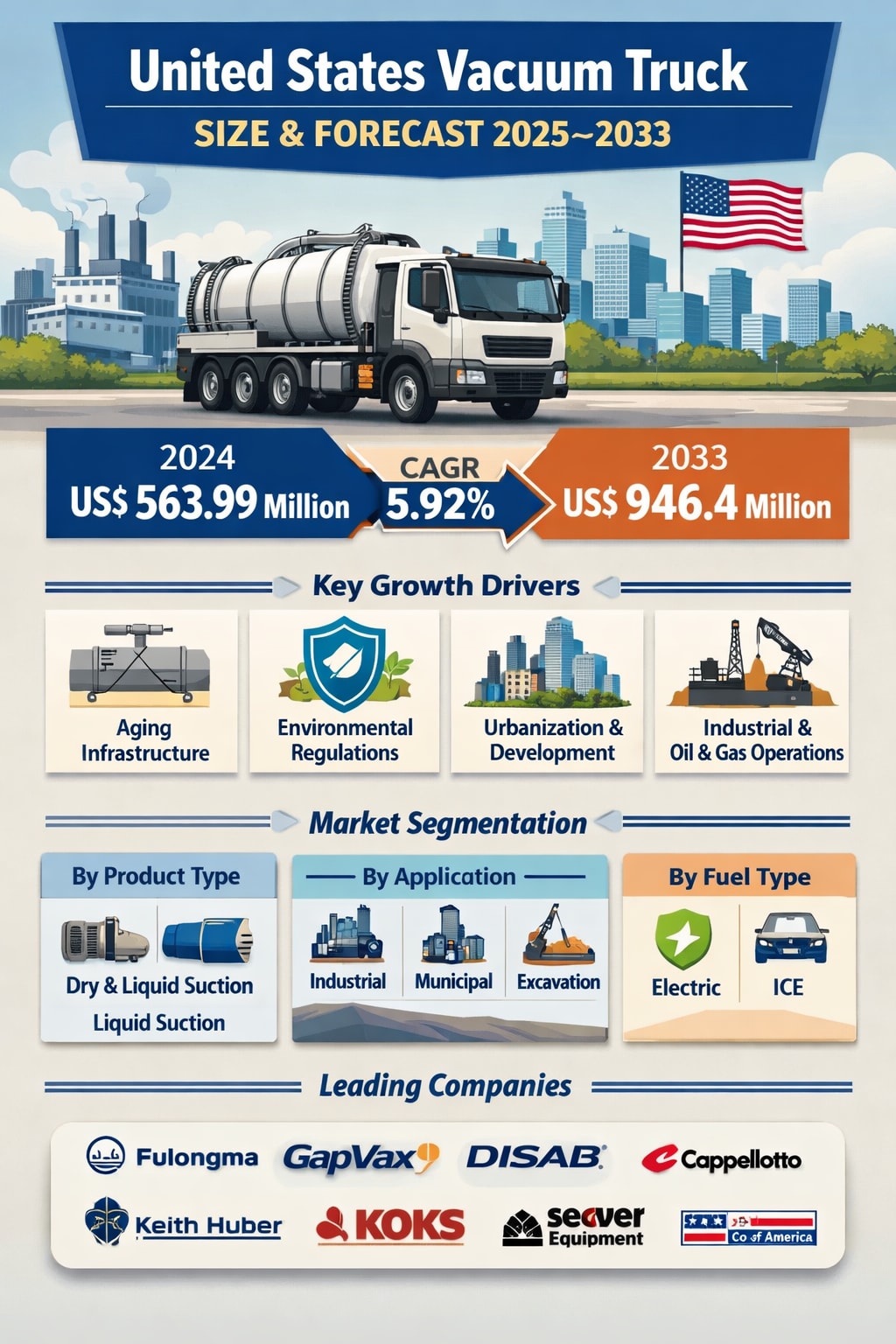
United States Vacuum Truck Market Overview
The United States vacuum truck market plays a vital role in supporting industrial operations, infrastructure maintenance, and environmental services across the country. These specialized vehicles are essential for tasks such as sewer cleaning, septic tank pumping, storm drain maintenance, hydro excavation, and hazardous waste removal. In an economy where infrastructure reliability, public health, and environmental compliance are increasingly critical, vacuum trucks have become indispensable tools for both public and private sector operations.
According to Renub Research, the United States Vacuum Truck Market is expected to reach US$ 946.4 million by 2033, growing from US$ 563.99 million in 2024, at a CAGR of 5.92% from 2025 to 2033. This steady growth reflects the rising importance of efficient waste management, infrastructure upkeep, and industrial cleaning services across the nation.
Several macro trends are shaping the market’s expansion. Aging infrastructure across many U.S. cities is creating sustained demand for maintenance and rehabilitation services, particularly for sewer systems, pipelines, and drainage networks. At the same time, rapid urbanization and continued construction activity are increasing the need for excavation support, debris removal, and site cleaning services—areas where vacuum trucks are uniquely effective.
In addition, stricter environmental regulations are compelling industries and municipalities to adopt safer, cleaner, and more compliant waste handling methods. Vacuum trucks, with their ability to safely collect, transport, and dispose of both liquid and solid waste, have become a preferred solution for meeting these regulatory requirements. Their versatility across sectors such as oil and gas, construction, manufacturing, municipal services, and emergency response further strengthens their market relevance.
Technological advancements are also reshaping the industry. Modern vacuum trucks are increasingly equipped with features such as GPS tracking, remote diagnostics, advanced filtration systems, and improved tank and pump designs. These innovations enhance operational efficiency, reduce downtime, and help operators comply with environmental standards. Moreover, the gradual introduction of electric and hybrid models aligns with the broader shift toward sustainability and lower emissions in heavy-duty vehicles.
Despite these positive trends, the market is not without challenges. High equipment costs, the need for skilled operators, and complex regulatory compliance requirements continue to pose barriers for some operators. Nevertheless, the essential nature of vacuum trucks in maintaining public health, environmental safety, and industrial efficiency ensures that demand will remain strong over the forecast period.
Market Size and Growth Outlook
The growth trajectory of the U.S. vacuum truck market is closely tied to long-term infrastructure investment, industrial activity, and environmental policy enforcement. With the market projected to grow at a 5.92% CAGR between 2025 and 2033, the industry demonstrates a healthy balance between stability and expansion.
One of the most significant growth drivers is the renewed focus on infrastructure modernization. The U.S. government has announced large-scale investments exceeding US$ 1.2 trillion for infrastructure upgrades, including roads, bridges, water systems, and public utilities. These projects require extensive excavation, cleaning, and waste removal services—tasks for which vacuum trucks are ideally suited.
Additionally, industrial expansion in sectors such as oil and gas, chemicals, manufacturing, and utilities continues to support demand. In these environments, vacuum trucks are used for tank cleaning, spill response, sludge removal, and routine maintenance, making them critical assets for operational continuity and safety.
Emergency response and disaster recovery efforts also contribute to market growth. In the aftermath of floods, hurricanes, and industrial accidents, vacuum trucks are frequently deployed to remove contaminated water, debris, and hazardous materials, helping communities recover more quickly and safely.
Key Factors Driving the United States Vacuum Truck Market Growth
Increased Environmental Regulations
Stricter environmental and waste management regulations are one of the most powerful drivers of the U.S. vacuum truck market. Federal, state, and local authorities continue to tighten rules governing the handling, transport, and disposal of hazardous and non-hazardous waste. Industries are now required to adopt cleaner, safer, and more traceable waste management practices.
Vacuum trucks, equipped with high-capacity storage tanks and advanced filtration systems, provide a reliable solution for meeting these regulatory demands. They help prevent spills, reduce contamination risks, and ensure that waste is transported and disposed of in compliance with environmental standards. As regulatory scrutiny increases, the demand for compliant and efficient waste-handling equipment is expected to rise, directly benefiting the vacuum truck market.
Urbanization and Infrastructure Development
Ongoing urban expansion across the United States is placing increasing pressure on existing infrastructure systems. Cities must regularly maintain and upgrade sewer lines, stormwater systems, and underground utilities to keep pace with population growth and urban development.
Vacuum trucks play a crucial role in these efforts by enabling efficient cleaning, desilting, and maintenance of underground systems. They are also widely used in hydro excavation projects, where precise and non-destructive digging is required around sensitive infrastructure such as gas lines, fiber optic cables, and water pipes.
As construction activity and infrastructure investment continue, the reliance on vacuum trucks for safe, efficient, and cost-effective operations is expected to grow steadily.
Rising Need for Waste Management Solutions
The growing emphasis on sustainability and responsible waste management is driving increased investment in modern waste collection and disposal technologies. Municipalities, industrial facilities, and commercial establishments are all seeking more efficient ways to manage sewage, sludge, industrial waste, and hazardous materials.
Vacuum trucks are central to this transition because they offer a versatile and environmentally friendly method of collecting and transporting waste. Their ability to handle a wide range of materials—from liquids and slurries to dry solids—makes them indispensable in modern waste management systems. As environmental awareness and regulatory pressure continue to rise, the demand for vacuum trucks is expected to remain strong.
Challenges in the United States Vacuum Truck Market
Technological Advancements and Integration
While technological innovation is improving the performance and sustainability of vacuum trucks, it also presents challenges. The adoption of electric and hybrid models, advanced telematics, and automated systems requires significant upfront investment. For many operators, especially small and medium-sized businesses, the cost of upgrading fleets and training personnel can be a major barrier.
In addition, the availability of charging infrastructure for electric vehicles and the long-term reliability of newer technologies remain concerns. Companies must carefully balance the short-term financial burden of adopting new technologies against the long-term benefits of lower operating costs, improved efficiency, and regulatory compliance.
Competition and Market Saturation
As demand for vacuum trucks grows, the market is becoming increasingly competitive. More manufacturers and service providers are entering the space, intensifying price competition and putting pressure on profit margins.
In such an environment, differentiation becomes critical. Companies must invest in product innovation, service quality, and operational efficiency to maintain their market position. However, continuous investment in innovation and customer service can strain resources, particularly for smaller players. Navigating this competitive landscape will be a key challenge for industry participants over the coming years.
Market Segmentation
By Product Type
Dry and Liquid Suctioning
Liquid Suctioning
Dry and liquid suctioning vacuum trucks are widely used in industrial and municipal applications where both solid and liquid waste need to be handled. Liquid-only suctioning trucks are more commonly used in sewage, septic, and liquid waste management operations.
By Application
Industrial
Excavation
Municipal
General Cleaning
Others
Industrial applications account for a significant share of the market, driven by demand from manufacturing, oil and gas, and chemical processing industries. Municipal applications, including sewer cleaning and storm drain maintenance, also represent a major segment due to ongoing urban infrastructure needs.
By Fuel Type
Electric
ICE (Internal Combustion Engine)
While ICE-powered vacuum trucks currently dominate the market due to their power and range, electric models are gradually gaining attention as sustainability and emission reduction become higher priorities.
Competitive Landscape and Company Analysis
The U.S. vacuum truck market features a mix of global and regional players, all competing on technology, reliability, service support, and customization capabilities. Key companies covered in the market include:
Fulongma Group Co. Ltd.
Kanematsu Engineering Co. Ltd.
Cappellotto S.p.A.
DISAB Vacuum Technology AB
GapVax
Keith Huber Corporation
Koks Group B.V.
Sewer Equipment Co. of America
These companies focus on product innovation, expanding service networks, and developing more efficient and environmentally friendly vacuum truck solutions. Recent developments across the industry include improvements in pump efficiency, enhanced filtration systems, and the gradual introduction of alternative fuel models.
Revenue analysis and company strategies indicate a strong focus on long-term growth through technology upgrades, strategic partnerships, and expansion into high-demand application areas such as municipal services and industrial maintenance.
Future Outlook
Looking ahead, the United States vacuum truck market is well-positioned for sustained growth through 2033. The combination of infrastructure investment, industrial expansion, and stricter environmental regulations creates a strong and stable demand environment for vacuum truck solutions.
Technological innovation will continue to play a central role in shaping the industry, with greater emphasis on efficiency, automation, and sustainability. While challenges related to cost, competition, and technology adoption remain, the essential role of vacuum trucks in maintaining public health, environmental safety, and industrial productivity ensures their continued relevance in the U.S. economy.
Final Thoughts
The United States vacuum truck market is entering a phase of steady and resilient growth, supported by infrastructure modernization, rising environmental standards, and expanding industrial activity. With the market projected to grow from US$ 563.99 million in 2024 to US$ 946.4 million by 2033, the industry reflects both the increasing complexity of waste management needs and the critical importance of efficient, compliant, and reliable service solutions.
As cities grow, industries expand, and environmental expectations rise, vacuum trucks will remain at the heart of America’s efforts to maintain clean, safe, and functional infrastructure. For manufacturers, service providers, and investors alike, the coming decade presents significant opportunities to innovate, expand, and contribute to a more sustainable and efficient future.
About the Creator
Tom Shane
Tom Shane is a content writer specializing in SEO-driven blogs, product descriptions, and thought leadership. He crafts engaging, research-backed content that connects with audiences and drives results.




Comments
There are no comments for this story
Be the first to respond and start the conversation.