
Vacuum Insulation Panel Market Size and Forecast 2026–2034
Rising Demand for Energy-Efficient Buildings, Sustainable Refrigeration, and Advanced Thermal Insulation Fuels Global Growth

Introduction: A New Era of High-Performance Insulation
The global push toward energy efficiency, sustainability, and smarter infrastructure is reshaping how industries think about insulation. From residential towers and commercial complexes to cold storage facilities and high-performance appliances, the need for advanced thermal solutions has never been more critical. Against this backdrop, the Vacuum Insulation Panel (VIP) market is emerging as one of the most promising segments within the broader insulation industry.
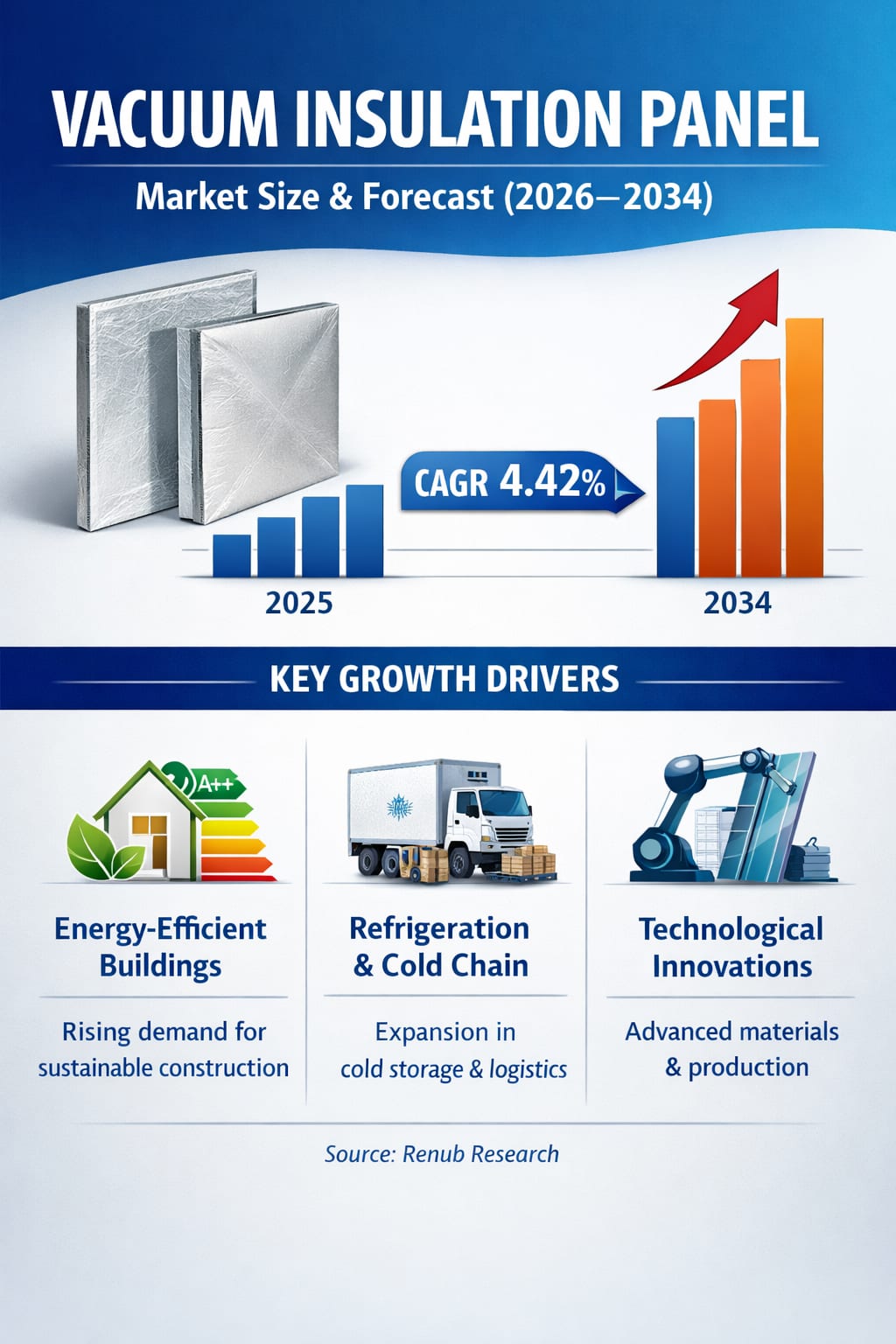
According to Renub Research, the Vacuum Insulation Panel Market is expected to reach US$ 15.72 billion by 2034, up from US$ 10.65 billion in 2025, growing at a compound annual growth rate (CAGR) of 4.42% from 2026 to 2034. This steady growth reflects a structural shift toward high-performance materials that can deliver superior insulation while occupying minimal space.
Unlike conventional insulation materials such as polyurethane, polystyrene, or fiberglass, VIPs offer exceptionally low thermal conductivity due to their unique structure—a core material sealed within an airtight envelope from which air is evacuated to create a vacuum. This design dramatically reduces heat transfer, making VIPs ideal for applications where space, energy efficiency, and performance are all critical.
As governments tighten energy regulations, businesses prioritize sustainability, and consumers become more conscious of energy costs, vacuum insulation panels are steadily moving from niche applications into mainstream construction, refrigeration, logistics, and industrial use.
Vacuum Insulation Panel Industry Overview
The vacuum insulation panel industry has evolved rapidly over the past decade, driven by the growing demand for high-performance thermal insulation solutions across multiple sectors. VIPs are designed to provide five to ten times better insulation performance than traditional materials at a fraction of the thickness. This makes them especially valuable in modern buildings and appliances where space optimization is as important as energy efficiency.
In the construction sector, VIPs are increasingly used in walls, roofs, floors, and facades to meet stringent energy-efficiency standards and green building certification requirements. In urban environments where space is limited, VIPs allow architects and engineers to achieve high insulation performance without sacrificing usable floor area.
In refrigeration and cold chain logistics, VIPs play a crucial role in maintaining stable temperatures in transport containers, cold storage facilities, and appliances. By reducing heat transfer, these panels help lower energy consumption, improve storage efficiency, and extend the shelf life of temperature-sensitive products such as food and pharmaceuticals.
Technological progress has further strengthened the market. Improvements in core materials, barrier films, and edge-sealing techniques have enhanced durability, thermal performance, and cost efficiency. At the same time, research into flexible and lightweight VIPs has expanded their application into appliances, portable refrigeration units, and advanced building materials.
Manufacturers are also focusing on sustainable and recyclable core materials, aligning product development with global environmental goals and stricter regulations. As a result, the vacuum insulation panel industry is no longer limited to niche, high-end applications—it is becoming a strategic component of the global energy-efficiency ecosystem.
Key Growth Drivers for the Vacuum Insulation Panel Market
1. Rising Demand for Energy-Efficient Buildings
One of the strongest drivers of the VIP market is the global push for energy-efficient residential and commercial buildings. Governments across North America, Europe, and Asia are introducing stricter building codes and energy performance standards to reduce carbon emissions and overall energy consumption.
VIPs, with their extremely low thermal conductivity, enable builders to achieve superior insulation performance even in thin wall structures. This is especially valuable in urban developments, renovation projects, and high-rise buildings where space is limited.
The growing popularity of green building certifications and sustainability-focused construction practices is further accelerating adoption. Developers are increasingly choosing VIPs to meet energy targets, improve building ratings, and enhance long-term operational efficiency. In parallel, homeowners and businesses are becoming more aware of the long-term cost savings associated with reduced heating and cooling needs, strengthening the business case for premium insulation solutions.
2. Expansion of Refrigeration and Cold Chain Applications
The rapid growth of global cold chain logistics is another major factor driving demand for vacuum insulation panels. From food and beverages to pharmaceuticals and biotechnology products, temperature-controlled storage and transportation have become essential components of modern supply chains.
VIPs provide exceptional insulation performance in compact spaces, allowing manufacturers to design thinner walls for refrigerators, freezers, and transport containers while maintaining or even improving thermal efficiency. This results in higher internal storage capacity, lower energy consumption, and improved temperature stability.
The rise of e-commerce, online grocery delivery, and pharmaceutical distribution has further increased the need for reliable, energy-efficient cold chain infrastructure. As companies seek to reduce operational costs and carbon footprints, VIPs are increasingly seen as a strategic investment rather than a premium add-on.
3. Technological Advancements and Material Innovations
Continuous innovation is playing a central role in expanding the reach of the VIP market. Advances in core materials, barrier films, and sealing technologies have significantly improved panel performance, durability, and lifespan.
New generations of flexible and lightweight VIPs are making installation easier and opening doors to applications in appliances, retrofitting projects, and portable refrigeration systems. At the same time, improvements in manufacturing processes and automation are helping reduce production costs, making VIPs more accessible to a wider range of projects.
Sustainability is also shaping innovation. The development of eco-friendly and recyclable core materials is aligning the VIP industry with broader environmental goals, increasing acceptance among regulators, developers, and environmentally conscious consumers.
Challenges Facing the Vacuum Insulation Panel Market
High Manufacturing and Installation Costs
Despite their performance advantages, VIPs remain significantly more expensive than conventional insulation materials. The production process requires advanced materials, precision engineering, and airtight sealing technologies, all of which increase costs.
Installation also demands skilled labor and careful handling, as even minor damage can compromise panel performance. While VIPs deliver long-term energy savings, the high upfront investment continues to limit adoption in cost-sensitive projects, particularly in the residential sector.
Durability and Sensitivity Issues
VIPs are highly efficient but also physically sensitive. A small puncture or seal failure can destroy the vacuum, drastically reducing insulation performance. This makes transportation, storage, and installation more complex compared to traditional insulation materials.
Environmental factors such as moisture, temperature fluctuations, and mechanical stress can also affect long-term reliability if not properly managed. These challenges highlight the importance of quality control, protective packaging, and proper installation practices—but they also add complexity and cost to large-scale deployment.
Regional Market Insights
United States Vacuum Insulation Panel Market
The United States market is experiencing strong growth, driven by energy-efficient construction, green building initiatives, and advanced refrigeration technologies. With rising demand for sustainable buildings and high-performance appliances, VIPs are increasingly being adopted across residential, commercial, and industrial sectors.
The expansion of cold chain logistics and high-efficiency appliances is further boosting demand for compact, high-performance insulation solutions. Supported by technological innovation and growing regulatory emphasis on energy conservation, the U.S. market is expected to remain a key contributor to global growth.
Germany Vacuum Insulation Panel Market
Germany represents one of Europe’s most advanced markets for energy-efficient construction. Strict regulations, government incentives, and strong sustainability policies are driving widespread adoption of VIPs in both new buildings and renovation projects.
In addition to construction, VIPs are gaining traction in refrigeration, cold storage, and logistics, where energy efficiency and space optimization are critical. With continued technological progress and strong regulatory support, Germany is set to remain a leading European market for vacuum insulation panels.
China Vacuum Insulation Panel Market
China’s rapid urbanization, industrialization, and infrastructure development are fueling strong demand for advanced insulation materials. Government policies promoting energy efficiency and green buildings are accelerating the adoption of VIPs in residential and commercial construction.
At the same time, China’s booming cold chain and logistics sector, driven by e-commerce and pharmaceutical distribution, is creating significant opportunities for VIP applications in refrigeration and transport. With ongoing investment in technology and manufacturing capacity, China is poised to be one of the fastest-growing markets globally.
Saudi Arabia Vacuum Insulation Panel Market
In Saudi Arabia, the demand for VIPs is being driven by extreme climate conditions, rising energy costs, and a growing focus on sustainable construction. High-performance insulation is becoming increasingly important for reducing cooling loads in buildings and improving energy efficiency in cold storage facilities.
Government initiatives supporting energy efficiency and sustainability, along with the expansion of cold chain logistics and pharmaceutical storage, are strengthening the market outlook. As awareness of energy conservation grows, VIP adoption in the region is expected to rise steadily.
Recent Developments in the Vacuum Insulation Panel Market
The market has seen several notable strategic moves and investments in recent years:
March 2023: Hutchinson and va-Q-tec announced a collaboration to develop scalable, high-performance VIP solutions aimed at improving thermal management in eMobility vehicles.
March 2022: NEVEON’s Specialties business unit expanded VIP production at a new facility in Něrsko, Czech Republic, featuring a fully automated production line.
February 2022: Recticel agreed to acquire Trimo, strengthening its position in the European insulated panels market and expanding its geographic and product reach.
These developments highlight the industry’s focus on capacity expansion, technological advancement, and strategic partnerships.
Market Segmentation
By Type:
Flat Panel
Special Shape Panel
By Raw Material:
Plastics
Metal
By Core Material:
Silica
Fiberglass
Others
By Application:
Construction
Cooling and Freezing Devices
Logistics
Others
By Region:
North America: United States, Canada
Europe: France, Germany, Italy, Spain, United Kingdom, Belgium, Netherlands, Turkey
Asia Pacific: China, Japan, India, Australia, South Korea, Thailand, Malaysia, Indonesia, New Zealand
Latin America: Brazil, Mexico, Argentina
Middle East & Africa: South Africa, United Arab Emirates, Saudi Arabia
Key Players in the Global Vacuum Insulation Panel Market
Avery Dennison Corporation
BASF SE
Kingspan Group plc
Etex Building Performance NV (Etex Group)
Panasonic Corporation
Morgan Advanced Materials
Kevothermal Ltd
Knauf Insulation
OCI Company Ltd.
Evonik Industries AG (RAG-Stiftung)
These companies are analyzed across company overview, key personnel, recent developments, SWOT analysis, and sales performance, reflecting a competitive and innovation-driven market landscape.
Final Thoughts: A Market Built for Efficiency and the Future
The global vacuum insulation panel market is no longer just about premium insulation—it is about building a more energy-efficient, sustainable, and space-optimized future. With the market projected to grow from US$ 10.65 billion in 2025 to US$ 15.72 billion by 2034, the long-term outlook remains strong.
While challenges such as high costs and durability concerns persist, continuous technological innovation, expanding cold chain infrastructure, and stricter energy regulations are steadily tipping the balance in favor of VIP adoption. As industries and governments alike prioritize energy efficiency and sustainability, vacuum insulation panels are set to become a core material in next-generation buildings, appliances, and logistics systems.
About the Creator
Sakshi Sharma
Content Writer with 7+ years of experience crafting SEO-driven blogs, web copy & research reports. Skilled in creating engaging, audience-focused content across diverse industries.
Keep reading
More stories from Sakshi Sharma and writers in Trader and other communities.
Netherlands Diabetes Device Market Size and Forecast 2026–2034
Introduction: A Market Moving Toward Smarter Diabetes Care The Netherlands has long been recognized for its strong healthcare infrastructure, early adoption of medical technology, and emphasis on preventive care. These strengths are now clearly reflected in the country’s diabetes devices market, which is entering a phase of sustained and technology-driven growth. According to Renub Research, the Netherlands diabetes-care devices market is projected to expand from US$ 392.4 million in 2025 to US$ 737.3 million by 2034, registering a compound annual growth rate (CAGR) of 7.27% during 2026–2034.
By Sakshi Sharma3 days ago in Trader




Comments
There are no comments for this story
Be the first to respond and start the conversation.