
Worldwide Outboard Motor Market Forecast: Powering the Future of Marine Mobility
From recreational boating to commercial marine operations, the global outboard motor industry is set for steady growth as technology, sustainability, and tourism reshape the waters

Introduction: A Market That Keeps the World Moving on Water
The global marine industry is undergoing a quiet but powerful transformation, and at the heart of this shift lies a crucial piece of equipment: the outboard motor. Compact, efficient, and increasingly sophisticated, outboard motors have become indispensable for both recreational and commercial boating worldwide. From fishing boats and patrol vessels to leisure crafts and water sports platforms, these engines continue to define how people and goods move across water.
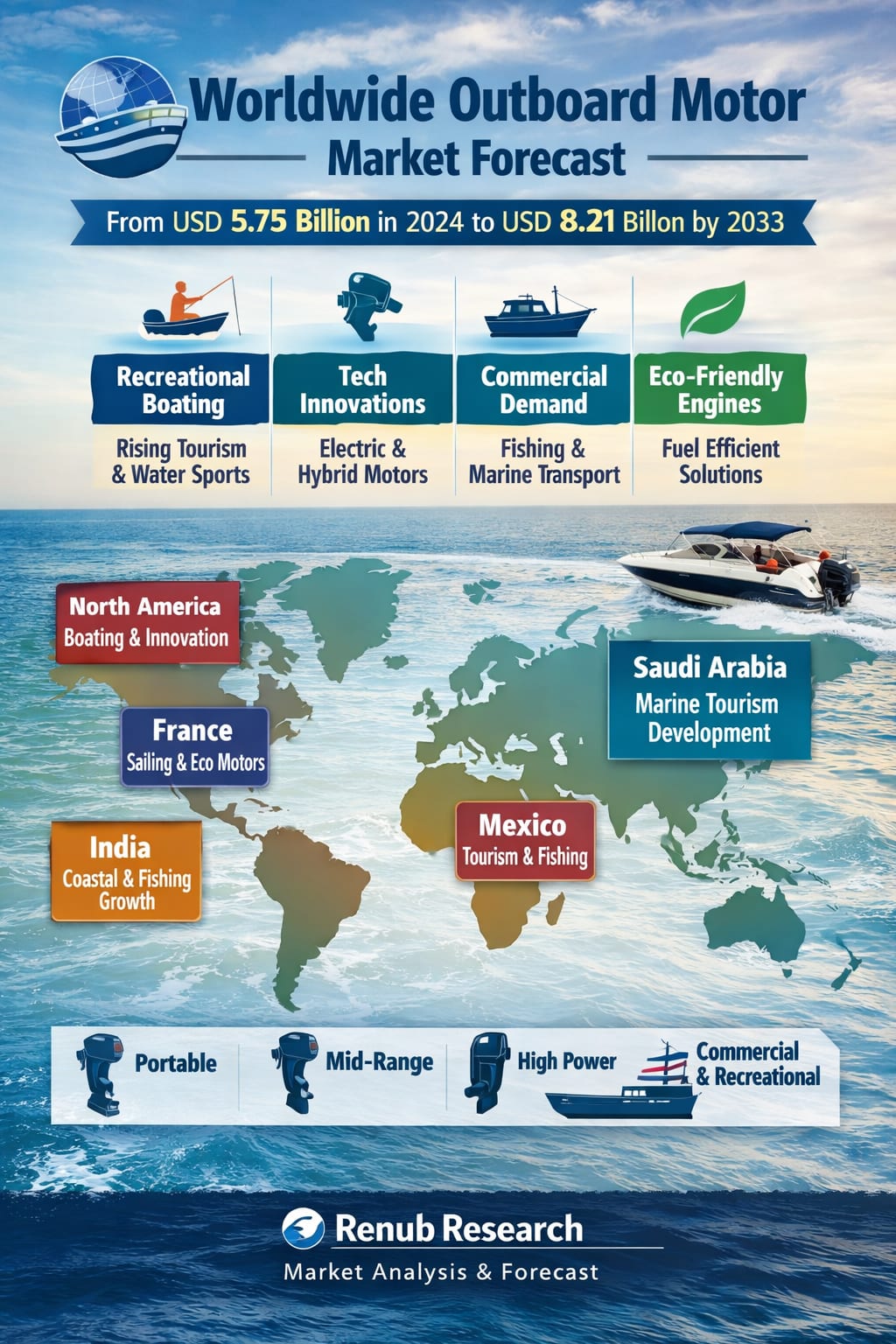
According to Renub Research, the Global Outboard Motor Market is expected to grow from USD 5.75 billion in 2024 to USD 8.21 billion by 2033, driven by rising recreational boating activities, increasing demand for efficient marine transportation, and continuous advancements in motor technology. The growing popularity of tourism, water sports, and lightweight, fuel-efficient engines is further accelerating adoption across regions.
In an era where sustainability, performance, and user experience matter more than ever, outboard motors are no longer just mechanical tools—they are becoming smart, cleaner, and more aligned with the future of marine mobility.
What Is an Outboard Motor and Why It Matters
An outboard motor is a self-contained propulsion system that includes an engine, gearbox, and propeller or jet drive, mounted externally on a boat’s transom. Its popularity stems from several practical advantages: compact size, ease of maintenance, straightforward installation, and superior maneuverability compared to inboard engines.
Outboard motors are widely used for recreational cruising, fishing, water sports, and small-scale commercial activities such as ferrying and patrolling. Over the years, technological improvements have made them more fuel-efficient, quieter, and environmentally friendly. The emergence of electric and hybrid outboard motors is particularly notable in regions with strict environmental regulations.
Because they are easier to replace and upgrade than inboard systems, outboard motors have become the preferred choice for many boat owners, fleet operators, and tourism businesses. Today, they form a cornerstone of modern maritime transportation, supporting both lifestyle activities and essential commercial operations across the globe.
Key Growth Drivers Shaping the Global Outboard Motor Market
1. Rising Demand for Recreational Boating
One of the strongest growth engines for the global outboard motor market is the surge in recreational boating. Activities such as fishing, leisure cruising, and water sports are becoming increasingly popular, especially in North America and Europe. Higher disposable incomes and a growing preference for outdoor and experience-based leisure have encouraged more consumers to invest in personal watercraft.
Tourism hubs are also expanding boating infrastructure, including marinas and rental fleets, which further boosts demand for reliable and efficient outboard motors. This trend is expected to continue as boating becomes more accessible and appealing to a broader age group worldwide.
A notable example of innovation in this space came in January 2024, when Mercury Marine introduced its new Verado 600 engine, featuring improved fuel economy, advanced digital controls, and reduced emissions. Such launches are setting new benchmarks for performance and sustainability in the industry.
2. Technological Advancements and Product Innovation
Technology is rapidly redefining what outboard motors can do. Manufacturers are focusing on producing lighter, more fuel-efficient, and environmentally friendly engines. Electric and hybrid models are gaining traction as both regulators and consumers push for cleaner marine solutions.
Features like intelligent control systems, noise-reduction technologies, and digitally integrated performance monitoring are enhancing user experience and operational efficiency. These innovations not only improve product appeal but also open new opportunities in environmentally regulated markets.
A strong signal of this shift came in February 2022, when All American Marine and SWITCH Maritime introduced “Sea Change,” the world’s first commercial hydrogen fuel cell passenger ferry. This 70-foot vessel represents a major step toward zero-emission maritime transport and highlights the direction in which marine propulsion technologies are heading.
3. Expansion of Commercial Marine Activities
Beyond leisure, outboard motors play a vital role in commercial marine operations, including fishing, coastal defense, transport, and patrol services. In many developing economies, small boats powered by outboard motors remain essential for livelihoods and local trade.
Government initiatives supporting fisheries, maritime safety, and coastal development are further strengthening demand. As aquaculture and marine trade continue to grow, the need for durable, efficient, and cost-effective outboard motors is expected to rise steadily.
In December 2023, India commissioned Barracuda, its fastest solar-electric boat, built by Navalt. This vessel, capable of transporting passengers and cargo in rough seas, reflects the increasing focus on clean and efficient marine transport solutions, even in emerging markets.
Challenges Facing the Global Outboard Motor Industry
High Costs and Maintenance Concerns
Despite strong demand, high upfront costs remain a key barrier, particularly in price-sensitive markets. Advanced engines with eco-friendly and high-performance features tend to be expensive, limiting adoption among budget-conscious buyers.
Maintenance, spare parts, and servicing costs also add to the total cost of ownership. In emerging economies, these factors can slow market penetration and push consumers toward lower-cost or second-hand alternatives.
Stringent Environmental Regulations
Environmental regulations on emissions and marine pollution are becoming increasingly strict worldwide. While this is driving innovation, it also raises compliance costs for manufacturers due to the need for continuous research and development.
Failure to meet standards such as those set by the EPA and the European Union can result in product restrictions or recalls. Balancing regulatory compliance with competitive pricing remains an ongoing challenge for industry players.
Market Segmentation: Understanding Where Growth Is Coming From
By Application Type
Commercial:
The commercial outboard motor segment is driven by fishing, transport, and maritime security applications. Lightweight yet powerful engines are preferred for operational efficiency and reliability. Growth in small-scale fisheries and government support for marine trade in coastal regions are key demand drivers.
Recreational:
Recreational boating remains the largest segment by volume. Rising tourism, increasing disposable incomes, and growing interest in water sports are fueling demand. Manufacturers are focusing on user-friendly designs, quieter operation, and eco-friendly technologies to attract leisure users.
By Thrust Category
Portable Outboard Motors:
Portable models are popular for their compact size, lightweight design, and ease of use. Ideal for small boats and as backup power sources, they appeal to occasional and entry-level users seeking affordability and convenience.
Mid-range Outboard Motors:
Typically ranging from 30 to 150 horsepower, mid-range motors strike a balance between power, efficiency, and cost. They are widely used for cruising, fishing, and small transport activities, with demand boosted by improvements in fuel efficiency and digital controls.
High Power Outboard Motors:
High power motors (above 150 horsepower) are designed for larger boats used in sports, commercial transport, and rescue operations. Although more expensive, demand is rising due to increased offshore recreational activities and the growing popularity of luxury boats.
Regional Insights: How Key Markets Are Evolving
United States
The United States leads the global outboard motor market, supported by its extensive coastline, large freshwater lakes, and strong boating culture. High technology adoption, robust infrastructure, and rising disposable incomes continue to drive growth. Strict environmental regulations are also accelerating the shift toward electric and sustainable outboard motors.
In October 2024, TEMO established its subsidiary, TEMO USA Inc., in Delaware, with operations in Maine to strengthen logistics, after-sales support, and brand expansion across North America.
France
France benefits from a strong boating tradition, with extensive coastlines and inland waterways. Recreational boating and competitive sailing drive demand, while environmental priorities are encouraging the adoption of electric and hybrid motors. Commercial fishing along the Atlantic and Mediterranean coasts also supports market growth.
In January 2025, Mercury Marine France appointed the Lethiec family company as the sole distributor of its Mercury Racing brand, reinforcing its presence in the French high-performance boating segment.
India
India’s growing coastal economy and expanding fishing industry are key drivers of outboard motor demand. Government initiatives promoting marine trade, fisheries, and water tourism are creating new opportunities. While price sensitivity remains a factor, rising middle-class consumption and interest in recreational boating are boosting demand for portable and mid-range motors.
Mexico
With long coastlines along the Pacific Ocean and the Gulf of Mexico, Mexico offers strong growth potential. Tourism, recreational boating, and fishing are the main demand drivers. Government efforts to modernize fishing fleets and promote maritime tourism are further encouraging the adoption of advanced outboard motors.
Saudi Arabia
Under its Vision 2030 program, Saudi Arabia is investing heavily in tourism and maritime infrastructure. New marinas, coastal resorts, and marine tourism projects are increasing demand for outboard motors. The country’s traditional fishing sector is also modernizing, driving interest in durable, high-performance engines suitable for harsh marine environments.
Competitive Landscape: Key Players in Focus
The global outboard motor market is competitive and innovation-driven. Major companies covered in the market analysis include:
DEUTZ Aktiengesellschaft
Parsun Power Machine Co. Ltd
Honda Motor Co. Ltd
Tohatsu Corporation
Brunswick Corporation
Yamaha Motor Co. Ltd
LEHR LLC
Suzuki Motor Corporation
Selva SpA
Hidea Power Machinery Co. Ltd
Each of these companies is analyzed across four viewpoints: Overview, Key Persons, Recent Developments & Strategies, and Financial Insights, reflecting a market where technology, branding, and distribution strength play crucial roles in long-term success.
Market Segmentation Snapshot
Application Type:
Commercial
Recreational
Thrust:
Portable
Mid-range
High Power
Countries Covered:
North America: United States, Canada
Europe: France, Germany, Italy, Spain, United Kingdom, Belgium, Netherlands, Turkey
Asia Pacific: China, Japan, India, Australia, South Korea, Thailand, Malaysia, Indonesia, New Zealand
Latin America: Brazil, Argentina, Mexico
Middle East & Africa: South Africa, Saudi Arabia, United Arab Emirates
Final Thoughts: A Steady Course Toward a Smarter Marine Future
The global outboard motor market is on a clear upward trajectory. With the market projected by Renub Research to grow from USD 5.75 billion in 2024 to USD 8.21 billion by 2033, the industry is being reshaped by recreational demand, commercial expansion, and rapid technological progress.
While challenges such as high costs and regulatory pressures remain, innovation in electric, hybrid, and fuel-efficient technologies is opening new pathways for sustainable growth. From luxury leisure boats in the U.S. and Europe to fishing fleets in Asia and coastal development projects in the Middle East, outboard motors are becoming smarter, cleaner, and more essential than ever.
In many ways, the future of marine mobility will not just be about moving faster on water—but about moving smarter, cleaner, and more efficiently. And outboard motors will continue to be right at the center of that journey.
About the Creator
MSFT Stock: Microsoft’s Market Performance and Global Insights
MSFT Stock, representing Microsoft Corporation, is one of the most influential technology stocks in global financial markets. Microsoft has evolved from a software company into a technology powerhouse, with business lines spanning Windows, Office, cloud computing through Azure, AI technologies, and gaming with Xbox. This diversification has made MSFT Stock a favorite for both retail and institutional investors seeking long-term growth and stability.
By Hammad Nawaza day ago in Trader


Comments
There are no comments for this story
Be the first to respond and start the conversation.