
How to Choose the Best Healthcare AI Company for Your Organization
A practical guide to evaluating healthcare AI vendors based on expertise, compliance, scalability, and real-world healthcare outcomes.
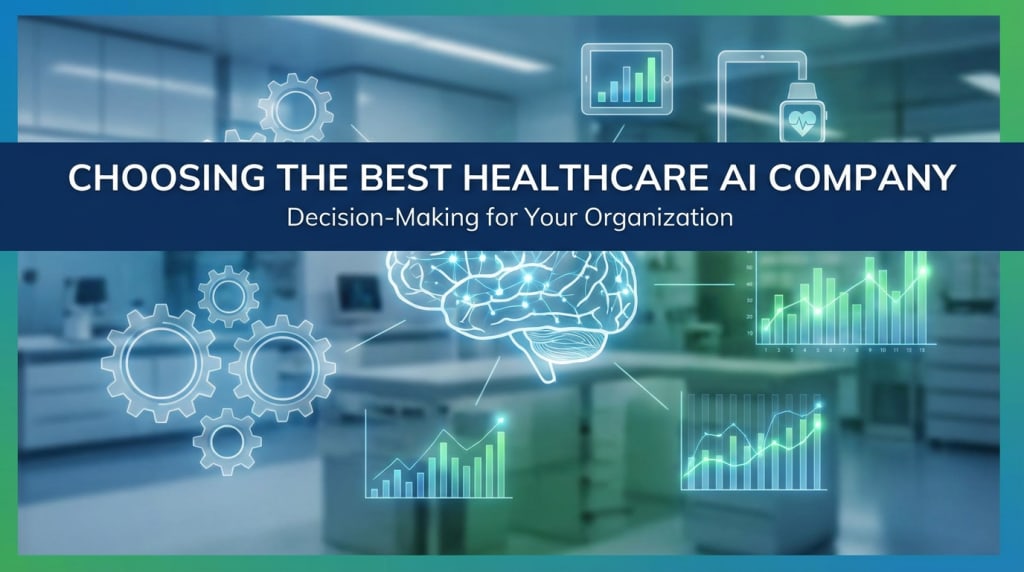
Artificial intelligence is rapidly transforming healthcare operations — from diagnostics and clinical documentation to revenue cycle management and patient engagement. But with hundreds of Healthcare AI companies entering the market, choosing the right partner for your organization can feel overwhelming.
Selecting the right AI partner is not just about technology it’s about healthcare expertise, compliance readiness, scalability, and long-term value.
Let’s break down how to make the right decision.
Understand Your Organization’s AI Goals First
Before evaluating vendors, clearly define what you want AI to solve.
Common healthcare AI implementation areas include:
- Clinical documentation automation
- Medical coding and billing optimization
- Predictive analytics for patient outcomes
- Imaging and diagnostics AI
- Revenue cycle automation
- Patient engagement tools
When your internal goals are clear, evaluating Healthcare AI companies becomes much easier and more strategic.
Organizations that skip this step often invest in tools that don’t integrate well into existing workflows.
Look for Healthcare-Specific AI Experience
Healthcare is not like other industries. It requires:
- HIPAA-compliant systems
- Understanding of clinical workflows
- Experience with EHR integrations
- Knowledge of medical coding standards
- Regulatory compliance expertise
The best AI vendors demonstrate real healthcare implementation experience, not just general AI development capabilities.
Ask for:
- Case studies
- Healthcare client references
- Measurable ROI examples
- Workflow integration examples
Domain expertise reduces implementation risk significantly.
Evaluate Data Security and Compliance
Healthcare AI solutions process sensitive patient data, making security non-negotiable.
Your AI partner should provide:
- HIPAA compliance documentation
- Secure cloud infrastructure
- Encryption standards
- Audit logging
- Access control policies
Strong compliance practices are a major differentiator among Healthcare AI companies, especially for hospitals and RCM organizations.
Assess Integration Capabilities
AI tools must integrate smoothly with existing systems such as:
- EHR platforms
- Medical billing software
- Practice management systems
- Radiology information systems
- Claims processing platforms
Poor integration leads to workflow disruption instead of efficiency.
Ask vendors:
- What systems have you integrated with?
- Do you support APIs or FHIR standards?
- How long does integration typically take?
The best AI implementations feel invisible inside existing workflows.
Prioritize Explainable and Transparent AI
Healthcare providers must trust AI recommendations.
Look for vendors offering:
- Explainable AI outputs
- Audit trails
- Human-in-the-loop workflows
- Confidence scoring
- Model transparency
Black-box AI is rarely acceptable in healthcare environments.
Trust and accountability matter as much as accuracy.
Evaluate Scalability and Long-Term Support
AI adoption is a long-term investment. Your vendor should support:
- Model updates
- Workflow optimization
- Performance monitoring
- Ongoing training
- Scaling across departments
Many organizations start with one AI use case (like coding automation) and expand across departments later.
The right partner grows with your organization.
Compare ROI, Not Just Pricing
Healthcare AI success should be measured through:
- Reduced claim denials
- Faster documentation turnaround
- Improved coding accuracy
- Lower operational costs
- Increased staff productivity
The lowest-cost vendor rarely delivers the highest ROI.
Instead, focus on value delivered over time.
Final Thoughts
Choosing among Healthcare AI companies requires balancing technical capability, healthcare expertise, compliance readiness, and integration strength. The right partner will not only deploy AI tools but also help your organization transform workflows, improve outcomes, and reduce operational complexity.
Healthcare AI adoption is accelerating, and organizations that choose the right partner today will be better positioned for the future of intelligent healthcare operations.
About the Creator
Keep reading
More stories from Lilly Scott and writers in Writers and other communities.
How Leading Healthcare Analytics Companies Are Shaping the Industry
Healthcare is undergoing one of the most significant digital transformations in its history. Hospitals, insurers, and healthcare providers are moving away from intuition-based decisions toward data-driven care models powered by analytics and AI. At the center of this transformation are healthcare analytics companies, which are helping organizations turn complex medical and operational data into actionable insights.
By Lilly Scott13 days ago in Writers
Draft Deleting? Don't Do It!
Today, I had a little time. I decided that I would have a look at the drafts that I have on Vocal. This is part of a long-term wish to have everything I've written on paper rather than virtually. I've not looked at them for weeks and something drew me to them, just to browse and see what was there.
By Rachel Deeming2 days ago in Writers
Behind the Cabin: The Supply Chain Powering Aircraft Interior Manufacturing
Introduction: The Hidden Infrastructure of Aircraft Interiors Aircraft cabins may appear refined and visually seamless, but behind every panel, partition, and composite structure lies a carefully engineered production process. Interior manufacturing in aerospace is not decorative craftsmanship it is regulated, precision-driven fabrication.
By Beckett Dowhan4 days ago in Writers



Comments
There are no comments for this story
Be the first to respond and start the conversation.