Challenge
AI Jobocalypse
Artificial intelligence has sparked intense debate about the future of human employment. While headlines warn of mass job displacement and corporate leaders predict shrinking workforces, the reality is far more nuanced. AI isn't simply replacing workers - it's fundamentally transforming how we work, what we do, and the skills we need to succeed.
By Narghiza Ergashova7 months ago in Writers
Whispers of forbidden desire
The early morning sun cast long, golden rays over the quiet town of Pinebrook, illuminating the sprawling campus of Brightstone High School. Students hustled through the parking lot, their backpacks bouncing and chatter filling the air—a mix of excitement and nerves. For some, today was just another day; for others, it was the beginning of a new chapter.
By doreen mbise7 months ago in Writers
Come on Ralf give us the pure character creation.
Ok ok I getcha your probably all like so we get all that roleplaying stuff but what about with out it. And I had a friend (Myra a great editor writer storyteller) who was reading say the same thing or something similar at least. And what she said was…
By WrittenWritRalf7 months ago in Writers
The Etsy Shop That Started With a Breakup
When Daniel walked out of our apartment, he left with only a suitcase, a half-used bottle of cologne, and my sense of direction. We’d been together for nearly six years, the kind of relationship that had grown roots deep into every corner of my life—shared Spotify playlists, matching towels, joint savings, holiday traditions, even a name reserved for our future dog.
By Muhammad Sabeel7 months ago in Writers
Song in a Room Without Light. Top Story - July 2025.
I wasn’t okay, but I got good at performing the illusion, which made me an ideal freshman and unfit to survive. I escaped a small town by playing dead. I earned high grades, played a good kid, kept my voice tucked low. When I reached the university, no one looked twice. I dissolved into lecture halls and tried to stay visible enough not to vanish, quiet enough not to be pulled apart.
By Fatal Serendipity7 months ago in Writers
You had to be there
This was the soundtrack to Sunday nights. At 6:30 pm, the lights dimmed inside Durham’s Riverside rink. The bass throbbed, an electronic ‘plink’ sent a shiver down the spine. Spotlights swirled, the melody kicked in, and the Wasps took to the ice.
By Andy Potts7 months ago in Writers
The Echo Returns
Author's Note: This story isn’t just hers. It belongs to every soul who loved deeply, gave sincerely, and still ended up lost in silence. It’s the echo of hopes that were nurtured yet never bloomed. It’s the quiet ache of those who did everything right— but still wonder, where did I go wrong?
By Saffron Realm7 months ago in Writers
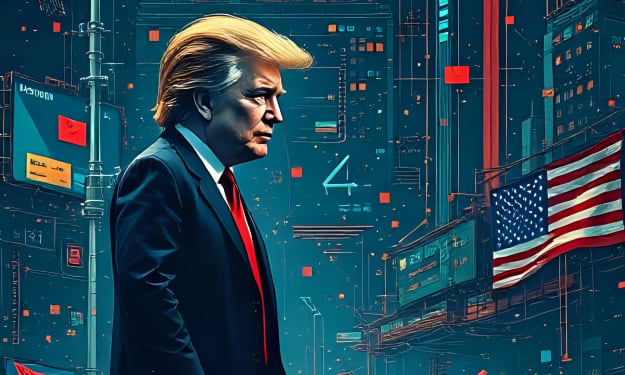
Trump Demands Tech Firms Prioritize U.S. Al Jobs
In July 2025, former U.S. President Donald Trump, during a high-profile AI Summit in Washington, D.C., made a bold call for American technology companies to prioritize U.S. workers over foreign labor, particularly from countries like India and China. This directive was part of a broader push to enhance American dominance in artificial intelligence (AI) and secure economic and national security through domestic innovation and job creation. Trump’s remarks, coupled with three executive orders and an “AI Action Plan,” underscored his administration’s focus on reshaping the tech industry’s labor practices, reducing reliance on global outsourcing, and fostering a nationalist approach to technological development. This essay explores the context, implications, and potential impacts of Trump’s demands, analyzing the motivations behind his policies, the economic and geopolitical factors at play, and the broader consequences for the tech industry, American workers, and global markets.Context and BackgroundTrump’s statements came at a time when the U.S. was engaged in a fierce global race to lead in AI, a technology with profound implications for economic competitiveness, national security, and societal transformation. The AI Summit, co-hosted by the Hill and Valley Forum and the “All-In” podcast, brought together tech industry leaders, policymakers, and Trump administration officials to discuss strategies for advancing U.S. AI capabilities. Trump’s remarks targeted major tech giants like Google, Microsoft, Meta, and Amazon, accusing them of pursuing “radical globalism” by outsourcing jobs to countries like India and China while benefiting from American freedoms and markets. He argued that this practice had left millions of Americans feeling “distrustful and betrayed,” emphasizing the need for “patriotism and national loyalty” from Silicon Valley. The backdrop to Trump’s demands is rooted in decades-long concerns about outsourcing in the tech industry. American companies have historically relied on foreign labor, particularly through programs like the H-1B visa, to fill specialized roles in software development, engineering, and AI research. Countries like India have been major beneficiaries, with Indian IT professionals constituting a significant portion of the U.S. tech workforce. Trump’s critique aligns with his broader “America First” agenda, which seeks to prioritize domestic job creation and reduce dependence on foreign labor and manufacturing. His administration’s actions build on earlier policies, such as the 2019 executive order on “Maintaining American Leadership in Artificial Intelligence,” which emphasized AI innovation rooted in American values and economic priorities. The Executive Orders and AI Action PlanAt the AI Summit, Trump signed three executive orders aimed at bolstering U.S. AI leadership while addressing labor and regulatory concerns:Expediting AI Infrastructure Development: This order focuses on streamlining permitting processes for AI-related infrastructure, such as data centers and supercomputers. By revising regulations like the National Environmental Policy Act (NEPA), the administration aims to reduce compliance costs and accelerate construction, addressing the massive energy demands of AI systems. Boosting Exports of U.S.-Made AI Technologies: The second order promotes the export of American AI tools to allied nations, positioning the U.S. as a global leader in secure-by-design AI solutions. This includes leveraging institutions like the International Development Finance Corporation and the Export-Import Bank to facilitate market access for U.S. firms. Banning Federal Procurement of Biased AI Systems: The third order prohibits federal agencies from contracting with AI companies whose systems exhibit “partisan bias,” defined as promoting ideologies like diversity, equity, and inclusion (DEI), critical race theory, or other progressive frameworks. This reflects Trump’s broader cultural critique of “woke AI” and aims to ensure AI models align with what he describes as “American values.” The accompanying “AI Action Plan” further outlines a deregulatory framework to foster innovation, reduce bureaucratic barriers, and prioritize American job creation. It calls for a single federal standard for AI regulation, limiting state-level laws deemed “burdensome” to the industry. The plan also emphasizes countering China’s growing influence in AI, criticizing previous restrictions on AI exports under the Biden administration as overly restrictive and alienating to U.S. allies. Motivations Behind the PolicyTrump’s demand for tech firms to prioritize U.S. AI jobs is driven by a combination of economic, political, and geopolitical factors:Economic Nationalism: Trump’s “America First” philosophy seeks to revitalize domestic industries by bringing jobs back to the U.S. The tech sector, a cornerstone of the American economy, is seen as a critical battleground. By pressuring companies to hire locally, Trump aims to create high-paying jobs, particularly in AI-related fields like data science and engineering, which are projected to grow significantly. For instance, the Stargate initiative, a private-sector-led project involving OpenAI, SoftBank, and Oracle, is expected to create over 100,000 jobs through a $500 billion investment in AI infrastructure. Geopolitical Competition: The global AI race, particularly against China, is a central concern. Trump’s policies aim to counter China’s state-driven AI model by accelerating U.S. innovation and restricting Chinese access to advanced AI technologies, such as chips and foundation models. This includes closing loopholes that allow Chinese firms to use U.S.-based cloud computing services for AI development. Political Appeal: Trump’s rhetoric resonates with his political base, which has long viewed globalization and outsourcing as threats to American workers. By targeting tech giants and their reliance on foreign labor, Trump taps into populist sentiments, positioning himself as a defender of the American workforce against corporate elites. His criticism of “radical globalism” and calls for patriotism appeal to voters disillusioned with the tech industry’s practices. Implications for the Tech IndustryTrump’s demands pose both opportunities and challenges for U.S. tech companies:Opportunities: The deregulatory approach and expedited permitting processes could reduce costs and accelerate the development of AI infrastructure. Companies like Microsoft and Amazon, which dominate the cloud computing market, stand to benefit from increased investment and relaxed environmental regulations. The focus on exports also enhances their global competitiveness, particularly in emerging markets. Challenges: The push to prioritize U.S. workers could strain companies reliant on foreign talent. The H-1B visa program, which Trump’s administration has targeted for restrictions, is a critical pipeline for skilled workers in AI and tech. Reducing access to this talent pool may lead to labor shortages, higher costs, and delays in innovation. Additionally, the ban on “biased” AI systems could complicate federal contracts for companies like OpenAI and Google, requiring them to adjust their models to meet vague standards of impartiality. Impact on American WorkersThe policy’s focus on domestic job creation could benefit American workers in the short term, particularly those with skills in AI, data science, and engineering. The Stargate initiative and other investments promise thousands of high-paying jobs, including blue-collar roles in data center construction and maintenance. However, the tech industry’s reliance on foreign talent suggests that a sudden shift away from outsourcing could create gaps in the workforce, as the U.S. struggles to produce enough qualified professionals to meet demand. Critics argue that Trump’s immigration policies, including restrictions on H-1B visas, may exacerbate these challenges by limiting access to global talent. Global and Environmental ConcernsTrump’s policies have sparked concerns about their global and environmental implications. The emphasis on fossil fuels to power AI data centers, including a $70 billion investment tied to oil and gas, has drawn criticism from climate advocates who argue it undermines efforts to combat global warming. The United Nations has called for tech firms to transition to renewables by 2030, a goal at odds with Trump’s strategy. Internationally, the push for U.S.-made AI exports and restrictions on foreign labor could strain relations with allies like India, a key partner in tech outsourcing. The European Union’s stricter AI regulations, such as the AI Act, may also create friction with Trump’s deregulatory approach, potentially limiting U.S. firms’ access to European markets.
By Faheem ullah7 months ago in Writers