Holianyk Ihor
Bio
Stories (450)
Filter by community
Light Launch Vehicles for Microsatellites: Ushering in a New Era of Space Access
In recent years, the space industry has undergone a dramatic transformation. Gone are the days when building and launching a satellite meant massive budgets, years of preparation, and hardware the size of a car. Today, we are witnessing the rise of microsatellites compact, lightweight, and relatively inexpensive spacecraft, some no bigger than a shoebox. These tiny machines are capable of performing sophisticated tasks, from monitoring climate patterns to providing internet connectivity in remote regions. But with this miniaturization came a new challenge: how to get these small satellites into orbit quickly, affordably, and independently?
By Holianyk Ihor7 months ago in Futurism
Electromagnetic Catapults: A Breakthrough in Space Logistics
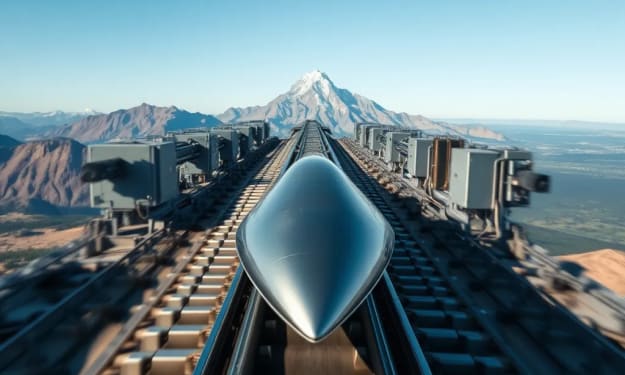
A rocket launch is one of the most dramatic spectacles of modern science. Fire, thunder, and sheer force dominate the moment—but behind the awe lies an expensive truth. Sending just one kilogram of cargo into orbit can cost anywhere from several thousand to tens of thousands of dollars. Rockets are incredibly complex, mostly single-use machines that require tons of fuel and meticulous planning. For decades, engineers and scientists have been searching for cheaper, more efficient ways to reach orbit. One of the most promising alternatives? Electromagnetic catapults.
By Holianyk Ihor7 months ago in Futurism
Horizontal Takeoff: Aerospace Planes and the Revolution at the Edge of Space
For most of human history, the edge of Earth’s atmosphere was seen as an impenetrable barrier. Reaching space meant building enormous rockets, launching them vertically with thunderous force and staggering costs. But today, a new era is emerging the era of horizontal takeoff. Aerospace planes are rewriting the rulebook, promising to make access to space as routine as boarding an international flight. But what exactly are these futuristic machines, and how could they reshape our world?
By Holianyk Ihor7 months ago in Futurism
Galactic Winds Beyond the Stars: How Intergalactic Stellar Winds Affect Space Travel
When we imagine space travel, especially journeys between galaxies, we tend to think of vast distances, faster than light technology, and undiscovered alien worlds. But there is a powerful force silently at play in the cosmic ocean that rarely gets attention stellar wind. And surprisingly, even beyond the bounds of galaxies, in the emptiness between them, stellar wind continues to shape the environment. It takes on a new and mysterious form, influencing not only how ships travel but possibly even offering new ways to navigate and move.
By Holianyk Ihor7 months ago in Futurism
Can Gravity Help Us Travel Faster Between Galaxies?
In the vastness of space, distances are measured not in kilometers or miles, but in light-years. Even our nearest galactic neighbor, the Andromeda Galaxy, lies a staggering 2.5 million light-years away. With current technology, such a journey is far beyond our reach. But what if the universe itself could lend us a hand? What if the very force we usually associate with slowing things down gravity could actually accelerate us across the stars?
By Holianyk Ihor7 months ago in Futurism
How Time Changes During Intergalactic Acceleration: A Journey Through Space and Einstein’s Physics
Time is one of the most mysterious concepts in the universe. It seems to march forward endlessly and predictably... or does it? When it comes to intergalactic travel, especially under acceleration, our familiar ideas about time begin to unravel. We enter the realm of relativity, where a single second aboard a spaceship might equal years back on Earth. But what exactly happens to time when we accelerate through the stars?
By Holianyk Ihor7 months ago in Futurism
What Is an Alcubierre Drive, and Could We Ever Build One?
The speed of light is often considered the ultimate speed limit of the universe. According to Einstein's theory of relativity, nothing with mass can travel faster than light. But in 1994, a Mexican physicist named Miguel Alcubierre proposed a radical idea that could bypass this limitation without breaking any physical laws. His concept became known as the Alcubierre drive, or warp drive, a hypothetical engine capable of faster-than-light travel by warping space-time itself.
By Holianyk Ihor7 months ago in Futurism
Could Dark Matter and Dark Energy Be the Key to Intergalactic Jumps?
Our universe is filled with mysteries vast, puzzling enigmas that defy our understanding. Among the greatest of them are dark matter and dark energy. Together, they make up about 95% of the total mass energy content of the cosmos, yet we can't see them, touch them, or measure them directly. They are the invisible architecture of reality. But what if these elusive forces are more than just curiosities for astrophysicists? What if they’re the missing link in our quest to leap between galaxies?
By Holianyk Ihor7 months ago in Futurism
Could Humans Survive a 1,000-Year Journey?
Imagine embarking on a journey so long that no one who starts it will ever see its end. A voyage lasting not decades or centuries, but an entire millennium. As humanity begins to dream more seriously about interstellar travel, the idea of a 1,000 year mission once the stuff of science fiction is becoming a question of science, engineering, psychology, and even philosophy. Could we really survive such a journey?
By Holianyk Ihor7 months ago in Futurism
How to Navigate Intergalactic Space: The Future of Cosmic Navigation
Traveling between galaxies isn’t just the stuff of science fiction it’s one of the most complex scientific and engineering challenges humanity may ever face. Among the many hurdles we’ll have to overcome, one of the biggest is this: how do you know where you’re going when you’re surrounded by near total emptiness? Without familiar reference points like planets, stars, or even nearby galaxies, how can we determine our direction in the vast void between galactic realms?
By Holianyk Ihor7 months ago in Futurism
Can We “Put a Crew to Sleep” During a Galactic Voyage?
When we imagine humanity’s future among the stars, our minds leap to advanced propulsion systems, cosmic radiation shields, and the challenges of navigating the vastness of space. But there’s one fundamental problem that overshadows all the others: time. Even with the most cutting edge propulsion technology we can conceive, a journey to the nearest star could take decades or longer. And that’s just the beginning if we’re talking about galactic travel spanning thousands of light years.
By Holianyk Ihor7 months ago in Futurism
Could Galaxies Be Connected by Hidden Pathways — Like a Galactic Subway?
Imagine the universe as an enormous megacity, with galaxies as glowing metropolises scattered across a vast cosmic landscape. Each galaxy shines with its own light, brimming with stars, nebulae, and mysteries. At first glance, these galaxies seem isolated floating islands in an endless sea of darkness. But what if they’re not? What if they’re secretly connected by invisible structures like tunnels or subway lines linking city centers?
By Holianyk Ihor7 months ago in Futurism