Holianyk Ihor
Bio
Stories (450)
Filter by community
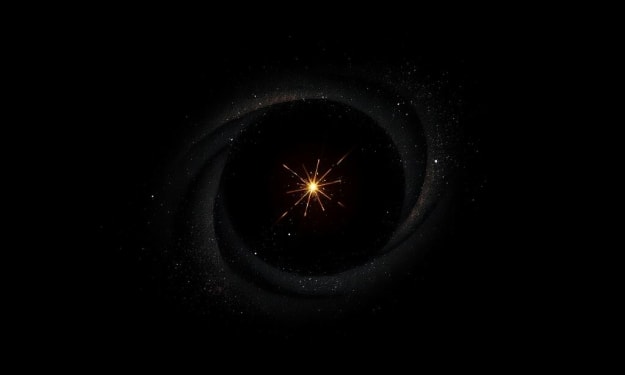
How Did Time Begin? The Mystery Embedded in Existence Itself
When we glance at a clock, plan our day, or reminisce about the past, we rarely stop to ask: What is time itself? Where did it come from? Does time exist independently, or is it merely a product of our perception? Philosophers, physicists, and cosmologists have long debated these questions. Surprisingly, they have answers though incomplete, they are fascinating.
By Holianyk Ihor8 months ago in Futurism
Could Our Universe Be Not the First?
The idea that something as vast and magnificent as the Universe might not be the only one, and even more astonishing, that it might not be the first, is hard to grasp. Yet, an increasing number of scientists, philosophers, and cosmologists are seriously pondering this very question. Could our Universe be just one chapter in an endless cosmic saga?
By Holianyk Ihor8 months ago in Futurism
How the Universe Could Have Emerged from "Nothing": The Mystery of Creation
One of the most captivating and at the same time deeply unsettling questions humanity has ever asked is this: How did it all begin? Where did the Universe come from? What existed before it? And is it really possible that everything we see, such as stars, galaxies, time, and space itself, once emerged from literally nothing?
By Holianyk Ihor8 months ago in Futurism
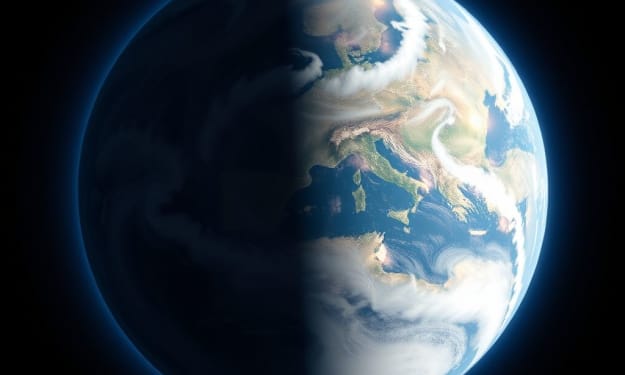
What Would Happen If the Earth Suddenly Stopped Spinning?
Earth is spinning at an incredible speed around 1,670 kilometers per hour (over 1,000 mph) at the equator. Yet we don’t feel it. Like passengers on a smooth, fast-moving train, we’re moving with the planet, unaware of the tremendous velocity beneath our feet. But what if one day, Earth’s rotation came to a sudden stop? What would happen if the world hit the cosmic brakes?
By Holianyk Ihor8 months ago in Futurism
Where Are the Oldest Particles in the Universe?
When we think of ancient things, our minds usually wander to fossils, ancient ruins, or long extinct creatures. But the concept of "old" goes far beyond Earth's surface. What if we told you that some of the oldest pieces of the universe are still around and might even be inside you? The story of the oldest particles in the cosmos is a journey through time, stretching all the way back to the first fractions of a second after the Big Bang.
By Holianyk Ihor8 months ago in Futurism
Can We Create Artificial Gravity? The Future of Gravity in Space
Gravity is the invisible force that keeps our feet on the ground, makes apples fall from trees, and holds entire planets and galaxies together. It’s such a constant in our lives that we barely notice it until it’s gone. In space, gravity disappears, and astronauts enter a world of weightlessness. But as cool as zero gravity looks, it comes at a cost. Extended time in microgravity weakens bones, shrinks muscles, disrupts blood flow, and confuses the body’s balance system.
By Holianyk Ihor8 months ago in Futurism
Why Everything We See Is Actually the Past: A Journey Through Space and Time
Every time you open your eyes, you become a time traveler or at least an archaeologist of light. What we see isn’t the present. It’s the past, captured and delivered to us by one of the universe’s most reliable messengers: light. This idea may sound poetic, even philosophical, but it’s grounded in solid physics. Our entire visual experience is a reflection of what was, not what is. And understanding why begins with the nature of light and the limits of its speed.
By Holianyk Ihor8 months ago in Futurism
How Solar Cycles Affect Our Harvests: The Cosmic Link Between Sunlight and Survival
At first glance, the connection between the Sun and agriculture seems obvious: plants need sunlight to grow. But the relationship between our star and our crops runs much deeper — and stranger — than just photosynthesis. Solar energy doesn't merely warm the Earth; it shapes the climate, influences weather patterns, and, over time, has played a significant role in determining the success or failure of entire harvest seasons.
By Holianyk Ihor8 months ago in Futurism
Why the Moon Smells Like Gunpowder: The Strange Mystery of Lunar Dust
When the Apollo astronauts first set foot on the Moon, they were prepared for almost everything — the eerie silence, the harsh beauty, the low gravity. But no one expected the Moon to have a smell. And yet, the moment they returned to the safety of their lunar landers, an unmistakable scent filled the cabin. What did it smell like? Burnt gunpowder.
By Holianyk Ihor8 months ago in Futurism
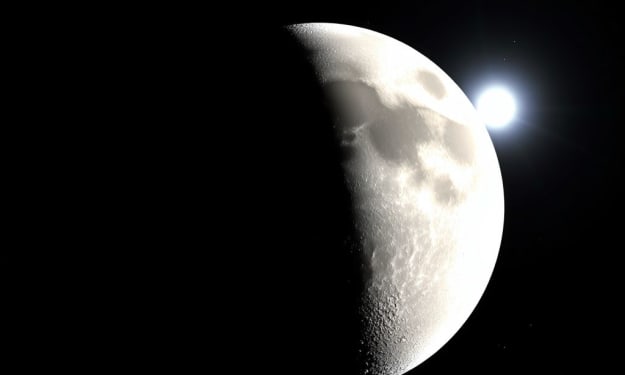
The “Dark Side” of the Moon Isn’t Always Dark: A Closer Look at a Cosmic Misunderstanding
When we hear the phrase “the dark side of the Moon,” it conjures up images of a cold, mysterious world hidden from Earth — a place forever cloaked in shadows, untouched by sunlight. But as intriguing as that sounds, the reality is far less mystical — and far more fascinating.
By Holianyk Ihor8 months ago in Futurism
Planets That Spin Faster Than Dawn: Where Night Lasts Just a Blink
Imagine a world where the sunrise is gone before you even have time to say “good morning.” A planet where day and night whirl past in a matter of minutes—or even seconds. These are not scenes from a sci-fi movie, but real cosmic possibilities in our universe. Welcome to the extraordinary worlds where rotation happens so fast, the sun barely peeks over the horizon before vanishing again. Let’s take a journey to planets where a full day is shorter than an hour.
By Holianyk Ihor8 months ago in Futurism
The Block Universe Theory: Has Everything Already Happened?
Time is one of the most mysterious and elusive concepts that human consciousness grapples with. We experience it as a flowing river: the past is behind us, the present unfolds right now, and the future lies ahead, unwritten and uncertain. But physics especially Einstein’s theory of relativity paints a very different picture. Perhaps time doesn’t flow at all. Welcome to the concept of the block universe or block time, where past, present, and future all exist simultaneously in a timeless whole.
By Holianyk Ihor8 months ago in Futurism