
Fyodor Dostoevsky: A Writer Too Honest for Comfort
Fyodor Dostoevsky: A Writer Too Honest for Comfort

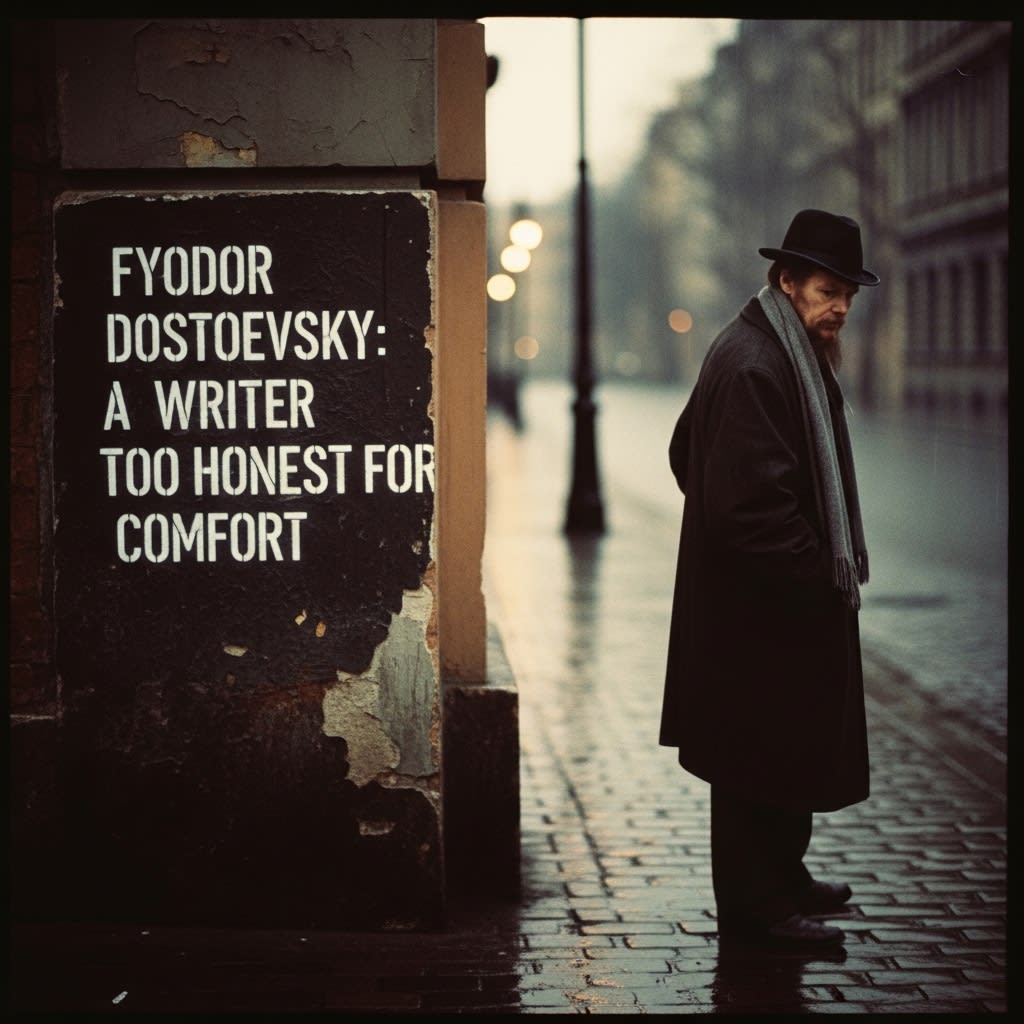
Fyodor Dostoevsky didn’t just write stories—you could say he wrote autopsies of the human soul. His novels don’t entertain you from a safe distance; they pull you into moral chaos, force you to sit with uncomfortable questions, and then quietly ask, “So—who are you, really?” More than a century later, his work still feels uncomfortably modern because the conflicts he explored never went away: guilt, freedom, faith, resentment, pride, and the terrifying power of ideas.
Dostoevsky’s life reads like one of his own plots. Born into poverty and raised in a strict household, he developed early empathy for suffering. As a young man, he was arrested for involvement with a reformist group and sentenced to death—only to be reprieved at the last moment, in a staged execution meant to psychologically break the prisoners. He spent years in a Siberian labor camp, where hunger, illness, and brutality stripped life down to its rawest essentials. That experience didn’t crush him; it sharpened him. When he returned to writing, he brought with him a deep understanding of what humans become when everything comfortable is taken away.
What makes Dostoevsky hit so hard is his refusal to simplify people. His characters are rarely purely good or purely evil. They are contradictory, impulsive, self-deceiving, and capable of shocking tenderness. He understood that humans don’t just commit crimes with their hands—we commit them first with our thoughts. Long before psychology became mainstream, Dostoevsky was mapping the terrain of obsession, shame, pride, and moral rationalization. His novels feel like courtroom trials inside the mind, where the prosecution and defense are both played by the same person.
Take his most famous themes: guilt and redemption. Dostoevsky believed that suffering, while cruel, can be transformative when faced honestly. This doesn’t mean he romanticized pain. He saw suffering as unavoidable—and the real question was whether a person would turn that suffering into bitterness or into responsibility. His stories ask whether redemption comes from punishment, confession, love, or faith. He never gives easy answers. Instead, he places characters in moral pressure cookers and lets their choices expose who they truly are.
Another reason Dostoevsky feels modern is his warning about ideas. He lived during a time when radical political theories were spreading through Russia, promising utopia through reason alone. Dostoevsky wasn’t anti-change; he was anti-illusion. He feared that abstract ideologies, when detached from compassion and humility, could justify cruelty in the name of progress. In his novels, characters intoxicated by “pure logic” often end up dehumanizing others—or themselves. Sound familiar? In an age of online radicalization and ideological echo chambers, his caution feels prophetic.
Then there’s his obsession with freedom. Dostoevsky believed humans crave freedom but also fear it. True freedom means responsibility, guilt, and the burden of choice. Many of his characters secretly long to surrender that burden—to rules, to leaders, to systems that promise comfort in exchange for conscience. He saw this temptation as one of humanity’s greatest dangers: the desire to trade moral agency for the relief of obedience. That tension between freedom and security is still at the heart of modern politics, workplaces, and even relationships.
Yet for all his darkness, Dostoevsky was not a nihilist. He believed fiercely in the possibility of compassion. In his world, the smallest acts of kindness—listening to someone, forgiving someone, standing by someone when it costs you—carry enormous moral weight. He suggests that redemption doesn’t arrive through grand speeches or perfect systems, but through flawed people choosing to care anyway. This is not sentimental hope; it’s hard-won hope, forged in prisons, poverty, and failure.
Why does Dostoevsky matter today? Because we live in an era of distraction, hot takes, and moral shortcuts. His work slows you down and asks you to think painfully carefully about your motives. It challenges the idea that being “right” is the same as being good. It exposes how easily we excuse our own cruelty when it’s wrapped in clever logic. And it insists that inner honesty—facing your own darkness—is the first step toward any real change.
Reading Dostoevsky isn’t comfortable. It’s confronting. But that’s the point. He believed that truth doesn’t flatter us; it wakes us up. In a world obsessed with appearances, productivity, and instant certainty, Dostoevsky still stands as a dangerous kind of writer—the kind who makes you pause, look inward, and ask whether the story you tell about yourself is actually true.
About the Creator
Fred Bradford
Philosophy, for me, is not just an intellectual pursuit but a way to continuously grow, question, and connect with others on a deeper level. By reflecting on ideas we challenge how we see the world and our place in it.
Keep reading
More stories from Fred Bradford and writers in BookClub and other communities.
Ray Bradbury: The Man Who Set the Future on Fire
There are writers who predict the future. And then there are writers who feel it coming. Ray Bradbury was not a scientist. He wasn’t a technologist. He didn’t write hard equations into his stories or obsess over mechanical accuracy. Instead, he wrote about something far more dangerous and far more human: what happens to the soul when the world changes too fast.
By Fred Bradford2 days ago in BookClub
Book Review: Atmosphere by Taylor Jenkins Reid
I flipped the book over in my hands in the centre of the small airport book shop. Although I had heard promising reviews of Atmosphere by Taylor Jenkins Reid, I hesitated. The synopsis didn’t compel me - I wasn’t much of a space girly. In high school it made me cringe when my peers would talk about the stars.
By sleepy drafts12 days ago in BookClub
Out Of The Doll's House
This is such an interesting book! I’m fascinated by history but when it’s connected with women’s progress in history — I literally couldn’t put the book down. It isn’t just about the Suffragettes but goes from the Victorian Era right up to the 1980s, when the book was first published.
By Ruth Elizabeth Stiffabout 16 hours ago in BookClub
I Don't Need My Phone... Wait, Is That Actually True?
My parents gave me my first cell phone when I was twelve years old. It wasn't a fancy iPhone or anything, not even close. Just a simple black flip phone for when I needed to call or text them after school.
By Madison "Maddy" Newton2 days ago in Humans

Comments
There are no comments for this story
Be the first to respond and start the conversation.