
When the Sky Turned Red: The Science Behind Blood Rain
Exploring the rare phenomenon where rain falls tinted with dust, algae, or sand—and the myths it created.
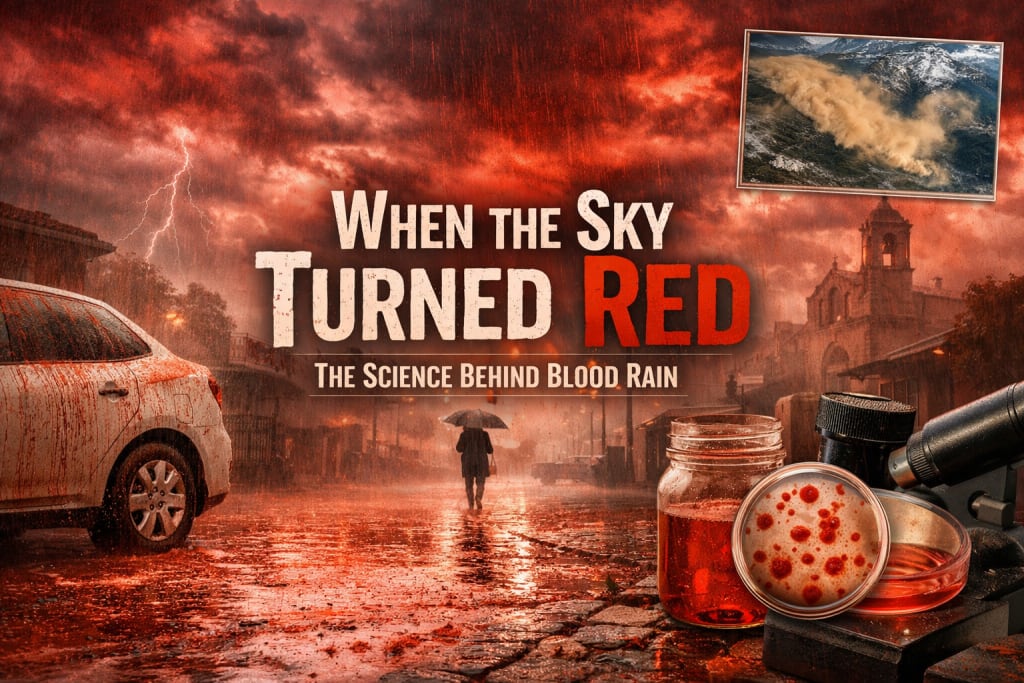
There are moments in history when nature has seemed to step straight out of myth.
Imagine standing beneath dark clouds as rain begins to fall—not clear, not gray, but red. Puddles form like diluted crimson ink. Roofs, streets, and clothing stain pinkish-scarlet. To ancient witnesses, this was not weather. It was a warning.
For centuries, people called it “blood rain.” Some believed it foretold war. Others thought it was divine punishment. In medieval Europe, red rainstorms were recorded alongside plagues and battles, reinforcing the belief that the sky itself was bleeding.
Today, science offers explanations far less supernatural—but no less fascinating.
What Is Blood Rain?
“Blood rain” is not actually rain made of blood. It is rainwater colored red by particles suspended in the atmosphere. When raindrops fall through air filled with red-tinted dust, spores, or microorganisms, they absorb these particles, turning the rainfall red, pink, or rust-colored.
Depending on the material involved, the rain can appear:
Deep crimson
Rust red
Orange
Pink
Brownish scarlet
The intensity of the color depends on particle concentration and the amount of rainfall.
A History Written in Red Skies
Historical records of blood rain stretch back more than two thousand years.
Ancient Roman writers described red rain as a terrifying omen. Livy, the Roman historian, documented multiple instances where “it rained blood,” events often followed by rituals meant to appease the gods.
In medieval Europe, monks recorded crimson rainfall in monastery chronicles. One 8th-century account from France described rain that “stained garments as though dipped in blood.”
Without scientific tools, observers interpreted what they saw through religion, folklore, and fear. Red rain became linked to:
War and political upheaval
Epidemics
Divine anger
Apocalyptic prophecy
It wasn’t until the rise of atmospheric science that investigators began to look upward—not spiritually, but physically—for answers.
The Role of Desert Dust
One of the most common causes of blood rain is mineral dust, especially from large deserts like the Sahara.
Strong winds can lift billions of tons of fine sand and dust into the atmosphere. These particles travel thousands of miles across continents and oceans.
When this dust mixes with storm systems, it becomes embedded in raindrops.
How It Works
Dust Uplift – Storm winds lift desert particles high into the atmosphere.
Long-Distance Transport – Jet streams carry the dust across regions.
Cloud Integration – Dust becomes trapped inside rain clouds.
Colored Rainfall – Rain pulls particles down, tinting the water red or orange.
Southern Europe frequently experiences this phenomenon. Cars, buildings, and sidewalks can be coated in reddish residue after rainfall.
It’s sometimes called “Saharan rain” or “mud rain.”
When Algae Fell from the Sky: The Kerala Mystery
One of the most famous modern blood rain events occurred in Kerala, India, in 2001.
Between July and September, residents reported localized red rainfall. The water looked like diluted blood. Clothes were stained. Containers filled with pinkish liquid.
Initial reactions ranged from curiosity to fear.
Early Theories
Scientists and media proposed multiple explanations:
Meteor dust from a comet
Desert sand
Industrial pollution
Volcanic ash
But microscopic analysis revealed something surprising.
The red particles were biological cells—specifically spores from airborne algae, later identified as Trentepohlia, a type of green algae rich in red carotenoid pigments.
These spores had likely been lifted into the atmosphere by strong winds and then concentrated in rain clouds.
When rain fell, billions of spores colored the water red.
This discovery shifted blood rain from myth into microbiology.
Microorganisms in the Clouds
The Kerala case revealed an important truth: the atmosphere is alive.
Clouds are not just water vapor—they contain:
Bacteria
Fungal spores
Algae cells
Pollen
Viruses
Some microbes can survive extreme conditions:
UV radiation
Freezing temperatures
Low oxygen
High altitude
They travel globally through air currents, sometimes crossing oceans.
When rain forms, these microscopic travelers return to Earth—occasionally in visible quantities.
If pigmented organisms dominate, rainfall can appear colored.
Other Colors of Rain
Blood rain is only one example of unusual precipitation.
Nature has produced rainfall in a surprising range of hues:
Yellow Rain – Often caused by pollen clouds.
Black Rain – Linked to volcanic ash or heavy pollution.
Green Rain – Associated with copper particles or algae.
Brown Rain – Caused by soil dust.
One notable case occurred after volcanic eruptions, when ash mixed with rainfall, producing dark, ink-like precipitation.
These events remind us that rain is not chemically pure—it reflects what’s floating in the sky above us.
The Chemistry of Red
Why does dust or algae look red in rain?
It comes down to pigments and minerals.
In Desert Dust
Red coloration often comes from iron oxides, especially hematite—the same compound that gives Mars its reddish surface.
When iron-rich dust dissolves slightly in water, it produces rust-colored rain.
In Algae and Spores
Certain microorganisms produce carotenoid pigments, which can appear:
Red
Orange
Pink
These pigments protect cells from UV radiation, making them more likely to survive high-altitude transport.
When billions accumulate in rainwater, the color becomes visible to the naked eye.
Can Blood Rain Be Dangerous?
In most cases, blood rain is harmless.
However, its safety depends on the particles involved.
Generally Safe Sources
Desert sand
Natural soil dust
Plant pollen
Algae spores
These may stain surfaces but pose little health risk.
Potentially Harmful Cases
Rarely, colored rain can contain:
Industrial pollutants
Heavy metals
Toxic ash
For example, after major fires or eruptions, rainwater may carry hazardous particles.
Scientists often analyze unusual rainfall to rule out environmental threats.
Blood Rain in Modern Monitoring
Today, satellites and atmospheric sensors track dust movement globally.
Scientists can predict blood rain events by observing:
Saharan dust plumes
Wind trajectories
Storm system paths
Aerosol concentrations
This data helps:
Protect air quality
Forecast visibility
Study climate systems
Understand nutrient transport
Yes—nutrients.
Dust carried in blood rain can fertilize ecosystems. Saharan dust, for instance, delivers phosphorus to the Amazon rainforest, supporting plant growth thousands of miles away.
What once seemed like an omen of death can actually sustain life.
Blood Rain Beyond Earth?
Interestingly, colored precipitation isn’t unique to Earth.
Other planets and moons experience exotic rainfall:
Mars – Iron dust storms tint the sky red.
Titan (Saturn’s moon) – Methane rain falls through orange haze.
Venus – Sulfuric acid droplets form corrosive clouds.
While not “blood rain” in the biological sense, these phenomena show how atmospheric chemistry shapes precipitation across the solar system.
They also help scientists understand Earth’s own atmospheric evolution.
Why the Myth Persisted
If blood rain has natural explanations, why did supernatural beliefs last so long?
Three reasons stand out:
1. Rarity
Blood rain is uncommon and localized, making it seem extraordinary.
2. Visual Shock
Red water triggers instinctive alarm—humans associate the color with injury and danger.
3. Timing Bias
When unusual weather coincided with war or plague, people linked the events causally.
Without microscopes or atmospheric science, myth filled the gaps left by observation.
Science Replaces Fear with Wonder
Modern analysis of blood rain involves multiple scientific fields:
Meteorology
Microbiology
Atmospheric chemistry
Geology
Climate science
Researchers collect rain samples, filter particles, and examine them under microscopes or spectrometers.
Each event becomes a data point—revealing wind patterns, ecological transport, and even microbial survival strategies.
Rather than omens, blood rains are now viewed as atmospheric messages—carrying information about Earth’s interconnected systems.
A Sky That Connects the World
One of the most profound lessons from blood rain is planetary connectivity.
Dust from the Sahara can fall in London.
Spores from Indian forests can ride monsoon winds.
Ash from volcanoes can circle the globe.
The sky is not empty space—it is a highway.
Every rainfall tells a story about where the air has been.
When the Sky Turns Red Today
If blood rain falls today, the reaction is very different from centuries ago.
People photograph it. Scientists sample it. Satellites track it.
Social media fills with images of red-stained cars and crimson puddles—but fear is replaced by curiosity.
We now ask:
Where did the particles come from?
What are they made of?
How far did they travel?
The mystery remains—but it is a mystery science can explore, not superstition must explain.
Conclusion: From Omen to Insight
When ancient observers saw red rain, they saw prophecy.
When modern scientists see it, they see process.
Blood rain is a reminder that nature can appear eerie without being supernatural. It shows how deserts, oceans, forests, and skies interact in vast atmospheric cycles.
It reveals that clouds carry life. That winds connect continents. That even rain can hold microscopic travelers from thousands of miles away.
So the next time the sky turns red, it is not bleeding.
It is speaking—telling a story of dust, wind, biology, and planetary motion.
And thanks to science, we finally understand its language.
About the Creator
Keep reading
More stories from Aiman Shahid and writers in Confessions and other communities.
When Being Busy Becomes a Way to Avoid Yourself
Busyness is often praised as a virtue. We wear it like a badge of honor. When someone asks how we’re doing, we answer, “Busy,” as if it explains everything—and excuses us from saying more. In a world that rewards productivity and movement, being busy feels safe. It feels responsible. It feels like proof that we matter.
By Aiman Shahid2 days ago in Confessions
Lately, I'm empty
Lately, I feel an emptiness inside of me that doesn’t make any sense. I was fine a week ago and now I’m numb to the pain that I’ve been carrying around. Numb to the idea of me existing. I wish I could go to a place where I can hear happy positive thoughts and surround myself with joy. The medication I’m on doesn’t seem to work anymore. I still feel pain from existing, why am I here anyways? Merely to exist. I don’t feel like I’m making any differences being here.
By Cerina Galvan3 days ago in Confessions




Comments
There are no comments for this story
Be the first to respond and start the conversation.