mafia
Don’t mess with the mob; a look into organized crime networks and mafia families, the real-life gangsters that inspired The Godfather.
The Fall of "El Jefe": From Olympic Athlete to FBI Most Wanted
The man in custody before you is the subject of today’s most viral story! Ryan Wedding, 44, was one of the FBI's Top Ten Most Wanted fugitives. After a 15-year manhunt and a $15 million reward on his head, he has finally been apprehended.
By Hossam Gamal8 days ago in Criminal
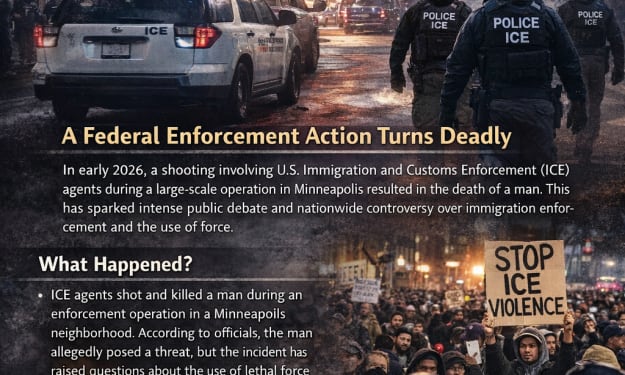
The ICE Shooting in Minneapolis A Closer Look at Federal Enforcement and Rising Tensions
The ICE Shooting in Minneapolis A Closer Look at Federal Enforcement and Rising Tensions In early 2026, Minneapolis found itself at the center of national attention following a shooting involving agents from U.S. Immigration and Customs Enforcement, widely known as ICE. The incident quickly moved beyond a single law enforcement encounter and became a symbol of broader debates surrounding immigration policy, federal authority, and the use of force in American cities. As details emerged, the shooting sparked intense public discussion, protests, and renewed scrutiny of federal operations carried out within local communities.
By America today 9 days ago in Criminal
Robert William Fisher: The Unresolved Mystery Behind One of America’s Most Notorious Fugitives. AI-Generated.
Few criminal cases in the United States have remained as haunting and unresolved as that of Robert William Fisher. More than two decades after his disappearance, Fisher’s name continues to appear on the FBI’s Most Wanted list, symbolizing both a tragic family crime and one of the longest-running manhunts in modern American history. His case blends elements of domestic violence, psychological profiling, forensic investigation, and unanswered questions that still trouble law enforcement and the public alike.
By Salaar Jamali15 days ago in Criminal
New Turquoise Alert Issued: Latest in Isabella Comas Case | Morning News Brief. AI-Generated.
In today’s Morning News Brief, we turn our focus to the developing case of Isabella Comas, a young girl whose disappearance has captured national attention. A new Turquoise Alert has been issued, signaling a critical update in the case. The alert system, designed to assist in the rapid recovery of missing minors, has brought renewed attention to the efforts surrounding Isabella’s whereabouts. As investigators continue to piece together details, the community remains on edge, hoping for a breakthrough.
By Salaar Jamali17 days ago in Criminal
A Real Story: The Day Ameneh Bahrami Lost Her Sight. AI-Generated.
In 2005, Tehran woke up to what seemed like an ordinary morning. Buses were running, offices were opening, and students were heading to their universities. The city was moving through its usual routine. No one knew that, in one small part of the city, a tragedy was about to occur—one that would later shock the entire world.
By shakir hamid18 days ago in Criminal
Donald Trump Withdrawing U.S. Forces From Qatar Amid Fears of Iranian Escalation
Donald Trump Considers Withdrawing U.S. Forces From Qatar Amid Fears of Iranian Escalation The recent killing of approximately 2400 protesters in Iran has once again drawn global attention to the deep political and security crisis inside the country. These deaths, linked to widespread demonstrations against economic hardship, political repression, and government authority, have intensified regional tensions and raised serious concerns about Iran’s internal stability. As unrest grows and the risk of external escalation increases, the security balance in the Middle East has come under renewed scrutiny.
By America today 19 days ago in Criminal
Donald Trump and the Iranian File: Policies, Tensions, and Public Questions
Donald Trump and the Iranian File: Policies, Tensions, and Public Questions Donald Trump’s approach to the Iranian file marked one of the most controversial chapters in modern US foreign policy. During his presidency, relations between the United States and Iran shifted dramatically, moving away from diplomacy toward pressure and confrontation. Trump’s decisions reshaped the Middle East landscape, affected global energy markets, and sparked intense debate both inside and outside the United States. Understanding Trump and the Iranian file requires examining his strategy, its consequences, and the questions people most frequently ask.
By America today 21 days ago in Criminal
Donald Trump Threatens to Strike Mexico: A New Escalation in Political Rhetoric
Donald Trump Threatens to Strike Mexico: A New Escalation in Political Rhetoric Recent statements attributed to former US President Donald Trump have sparked widespread debate after he suggested the possibility of military action against Mexico. The comments, framed around combating drug cartels and cross-border crime, immediately drew attention from media outlets, political analysts, and the public. While such remarks are not entirely new in Trump’s political style, the idea of striking a neighboring sovereign nation has raised serious concerns about diplomacy, international law, and regional stability.
By America today 24 days ago in Criminal
Minneapolis ICE Shooting Updates. AI-Generated.
In recent weeks, Minneapolis has found itself at the center of a growing legal and political controversy following a shooting involving Immigration and Customs Enforcement (ICE) agents. What initially appeared to be a straightforward federal use-of-force investigation has evolved into a broader dispute between state authorities and federal officials, raising serious questions about transparency, jurisdiction, and accountability. The most significant development so far is the state’s claim that it has been denied access to key evidence related to the incident. As public attention intensifies, the case is no longer just about what happened during the shooting. It is increasingly about who controls the facts, who gets to investigate them, and how justice is supposed to function when federal and state systems collide. What We Know About the Minneapolis ICE Shooting The shooting occurred during a federal immigration enforcement operation in Minneapolis. ICE agents were reportedly conducting official duties when gunfire erupted, resulting in injuries and immediate emergency response. Federal authorities confirmed the incident and stated that internal protocols were activated, including an automatic review by federal oversight bodies. From the beginning, details were limited. Officials cited the ongoing nature of the investigation and concerns about officer safety. This lack of information, while not unusual in federal cases, quickly became a point of friction for Minnesota state authorities, who argued that the public deserved clarity and that the state had a legal role to play in examining the incident. State Authorities Push for Transparency Minnesota state officials, including investigators and legal representatives, formally requested access to evidence connected to the shooting. This evidence reportedly includes body camera footage, surveillance recordings, forensic reports, and internal communication logs from the operation. According to state representatives, these requests were either delayed or denied outright. The state has since gone on record stating that it cannot independently assess the legality of the shooting without full access to the materials. This denial has fueled concerns that federal agencies are operating without sufficient external oversight, especially in incidents involving potential civilian harm. State leaders emphasized that their position is not adversarial by default. Rather, they argue that cooperation between federal and state agencies is essential to maintain public trust, particularly in communities already wary of immigration enforcement. Federal Response and Jurisdictional Limits Federal officials, for their part, maintain that the investigation falls squarely under federal jurisdiction. ICE operates as a federal agency, and shootings involving federal officers are typically reviewed internally and, when appropriate, by federal prosecutors or inspectors general. In statements released following the controversy, federal representatives cited legal restrictions that limit the sharing of evidence during an active investigation. They also stressed that premature disclosure could compromise witness testimony or investigative integrity. This explanation, while legally grounded, has done little to ease state frustrations. Critics argue that “ongoing investigation” has too often been used as a blanket justification for withholding information, even in cases where transparency could prevent misinformation and public unrest. Community Reaction and Public Trust The Minneapolis community has responded with a mix of concern, anger, and fatigue. For many residents, particularly in immigrant and marginalized communities, the shooting has reopened long-standing fears about aggressive enforcement tactics and lack of accountability. Community leaders and advocacy groups have called for the immediate release of non-sensitive evidence, arguing that transparency is a prerequisite for trust. Peaceful demonstrations and public forums have highlighted a broader demand: that no law enforcement agency, federal or otherwise, should be beyond scrutiny. Local officials echoed these concerns, noting that Minneapolis has spent years attempting to rebuild trust between residents and law enforcement. The perception that evidence is being withheld threatens to undermine that progress. Legal Implications of Denied Evidence From a legal standpoint, the state’s inability to access evidence raises complex questions. While federal agencies do have authority over their operations, states also have a responsibility to investigate deaths or injuries occurring within their borders. Legal experts suggest that this dispute could set a precedent. If states are routinely blocked from reviewing evidence in federal use-of-force cases, it may limit their ability to pursue independent inquiries or bring charges under state law when applicable. Some analysts believe the issue could ultimately be resolved in court, with judges determining whether the state has a legal right to access certain materials. Such a ruling could have national implications, influencing how future federal-state conflicts are handled. Political Dimensions of the Case The Minneapolis ICE shooting has also taken on a political dimension. Immigration enforcement remains a deeply divisive issue, and incidents like this tend to amplify existing ideological divides. State officials critical of federal immigration policies view the denial of evidence as symptomatic of a larger lack of accountability. Meanwhile, supporters of strict federal enforcement argue that state interference could hinder effective operations and put officers at risk. This political tension complicates the path forward. What might otherwise be a procedural disagreement risks becoming a symbolic battle over immigration, law enforcement authority, and states’ rights. What Happens Next? As of now, the investigation continues under federal oversight, while the state explores its legal options. Negotiations between state and federal officials have reportedly not been ruled out, suggesting that a compromise could still be reached. Potential next steps include limited evidence sharing under confidentiality agreements, congressional inquiries, or judicial review. Each option carries its own risks and consequences, both legally and politically. What remains clear is that public pressure is unlikely to fade. Minneapolis residents, like many Americans, are demanding clarity, fairness, and accountability in cases involving law enforcement use of force. A Broader Conversation About Accountability The Minneapolis ICE shooting is no longer just a single incident under investigation. It has become a lens through which broader issues are being examined: the balance of power between federal and state authorities, the limits of transparency, and the role of public oversight in a democratic society. Whether or not the state ultimately gains access to the evidence, the controversy has already sparked an important conversation. How that conversation translates into policy, practice, or reform remains to be seen, but its impact will likely extend far beyond Minneapolis. In the end, accountability is not only about assigning blame. It is about ensuring that systems function openly and fairly, especially when lives are affected. The outcome of this case may help determine how well those principles are upheld in the future.
By Saboor Brohi 25 days ago in Criminal
Federal Law Enforcement Shooting in Minneapolis Sparks National Debat
## **Federal Law Enforcement Shooting in Minneapolis Sparks National Debate** In early 2026, a serious incident unfolded in Minneapolis when federal law enforcement officers shot a civilian during a large-scale operation in the city. The event immediately drew public attention and ignited widespread discussion about the role of federal agencies, public safety, and accountability. The shooting occurred in a residential area, creating fear and confusion among residents and prompting strong reactions from local leaders and community groups.
By America today 26 days ago in Criminal