mafia
Don’t mess with the mob; a look into organized crime networks and mafia families, the real-life gangsters that inspired The Godfather.
Tensions at Sea: The Russian Oil Tanker Seized by the United States in 2026
Tensions at Sea: The Russian Oil Tanker Seized by the United States in 2026 In early 2026, a Russian-flagged oil tanker was seized by the United States in the North Atlantic, attracting global attention. The vessel, originally called *Bella 1* and later renamed *Marinera*, had been monitored for weeks as it attempted to evade U.S. sanctions enforcement. This event has raised questions about international maritime law, geopolitical tensions, and the enforcement of economic restrictions on oil shipments.
By America today 26 days ago in Criminal
Was His Abduction Caused by His Support for the Palestinian Cause or the Theft of Oil?
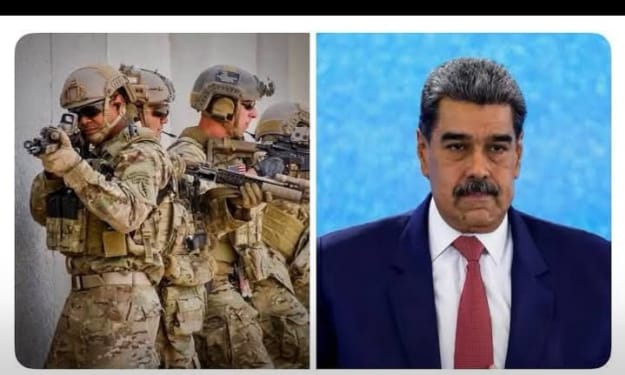
Was His Abduction Caused by His Support for the Palestinian Cause or the Theft of Oil?** The controversy surrounding the alleged targeting or attempted abduction of Venezuela’s president has sparked intense debate across political and media circles. At the center of this debate lies a critical question: was he targeted because of his outspoken support for the Palestinian cause, or was the real motive an effort to seize control of Venezuela’s vast oil wealth? To understand this issue, it is necessary to examine how ideology and economic interests intersect in modern geopolitics.
By America today 27 days ago in Criminal
Drums Are Beating: Russia and China Align With Venezuela Amid Rising Tensions
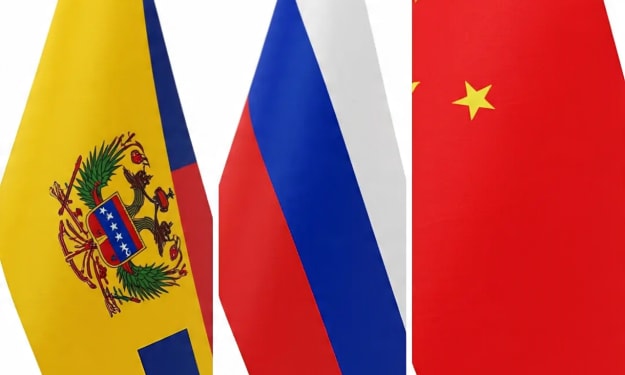
**War Drums Are Beating: Russia and China Align With Venezuela Amid Rising Tensions** In recent weeks, global attention has turned sharply toward Venezuela as alarming headlines and rumors have fueled fears of a major international crisis. Claims of an emerging alliance between Russia, China, and Venezuela, combined with reports circulating online about the kidnapping of the Venezuelan president and his wife, have intensified public anxiety. While not all information has been officially confirmed, the situation reflects deep geopolitical tensions and a fragile regional balance that could have serious global consequences.
By America today 29 days ago in Criminal
America and Venezuela: How Decades of Tension Turned Into Open Confrontation
relationship between the United States and Venezuela has entered one of the most volatile periods in recent history, characterized by escalating tensions, military operations, diplomatic rupture, and international debate. What began as long-standing political and economic disagreement has now evolved into an open confrontation that carries major implications for regional stability, international law, and global geopolitics. Historical Roots of Tension The U.S.–Venezuela relationship has been fraught for decades, shaped by ideological differences, energy politics, and mutual distrust. Venezuela’s oil wealth historically made it a key partner for Washington, particularly throughout the 20th century. However, relations began cooling significantly in the late 1990s and early 2000s after Hugo Chávez rose to power with a project rooted in Bolivarian socialism and resistance to U.S. influence. Over the years, successive Venezuelan administrations under Chávez and later Nicolás Maduro adopted increasingly antagonistic foreign policies toward the United States, while the U.S. grew critical of Venezuela’s democratic backsliding and human rights record. The result was a heavily polarized bilateral relationship, with occasional cooperation overshadowed by frequent clashes, sanctions, and accusations of interference. These structural tensions widened after Venezuela’s disputed 2024 presidential election. The United States and several Western countries rejected the legitimacy of Nicolás Maduro’s victory, citing fraud and lack of transparency. Washington instead recognized opposition leader Edmundo González as interim president, deepening the diplomatic rupture at a time when both nations already had limited official channels of communication. � Encyclopedia Britannica +1 2025: From Sanctions to Military Escalation 2025 marked a dramatic escalation in the U.S.–Venezuelan conflict. Early in the year, the United States intensified pressure on Caracas through a combination of severe sanctions, economic coercion, and targeted counter-narcotics actions. The Trump administration designated Venezuela’s ruling elite and alleged criminal networks—most notably the so-called “Cartel de los Soles”—as terrorist organizations, a step that expanded U.S. legal authority to pursue punitive measures against individuals and assets linked to the Venezuelan government. � CRBC News These sanctions coincided with a significant military buildup in the Caribbean. Beginning in mid-2025, the United States deployed thousands of personnel, warships, aircraft, and surveillance assets near Venezuelan waters in an operation officially framed as a counter-narcotics and maritime security campaign. U.S. officials described these measures as necessary to disrupt smuggling networks and cartel operations alleged to be operating with Venezuelan complicity. Critics, however, interpreted the moves as coercive acts that blurred the line between counter-drug missions and preparations for conflict. � RTVE Throughout 2025, U.S. forces carried out a series of lethal maritime strikes on vessels in the Caribbean and eastern Pacific, which Washington claimed were involved in transporting drugs toward the United States. These operations reportedly resulted in dozens of deaths and drew harsh criticism from human rights organizations and foreign governments who condemned them as disproportionate and in violation of international norms. � Encyclopedia Britannica Oil Seizures and Naval Blockade Compounding the tension were dramatic economic and naval measures. In December 2025, U.S. forces seized a Venezuelan-linked oil tanker, accusing it of carrying sanctioned oil destined for unauthorized markets. Shortly afterward, President Trump announced a “total and complete blockade” of sanctioned Venezuelan tankers entering or exiting the country, a step aimed at crippling Venezuela’s oil-dependent economy and cutting off the government’s primary source of revenue. Venezuela denounced these actions as “piracy” and called on international bodies to condemn what it saw as blatant theft and aggression. � Wikipedia +1 Such measures intensified the humanitarian and economic crisis in Venezuela, where hyperinflation, shortages of basic goods, and a collapsed healthcare system already plagued the population. Critics of U.S. policy argue that the blockade’s economic impact disproportionately affects ordinary Venezuelans, exacerbating suffering without offering a clear path to political resolution. The 2026 Military Operation and Capture of Maduro The culmination of these escalating tensions occurred on January 3, 2026, when U.S. special operations forces conducted a high-profile raid in Caracas, capturing President Nicolás Maduro and his wife, Cilia Flores. The operation, described by critics as a violation of national sovereignty and international law, involved coordinated airstrikes and a covert helicopter insertion into Venezuelan territory. Maduro was transported to New York to face charges related to alleged drug trafficking and “narcoterrorism.” � AP News +1 President Trump proclaimed the raid a major victory, asserting that it would allow the United States to “run” Venezuela and stabilize the country, even opening the door for American oil companies to reenter the market. Yet, the legal basis for the operation remains fiercely disputed, and many observers liken it to the 1989 U.S. invasion of Panama. Venezuela’s vice president, Delcy Rodríguez, was appointed interim president by Caracas’s high court, but the country remains deeply divided, with ongoing protests and resistance from segments of the military. � The Guardian International Reaction and Future Prospects The global response has been sharply divided. Many Latin American countries, along with major powers like Russia and China, condemned the U.S. action as an unlawful intervention and breach of sovereignty. The United Nations has raised concerns about setting a dangerous precedent that could undermine international law and regional stability. Some European nations have called for de-escalation and respect for diplomatic solutions. � TIME As of early 2026, the future of U.S.–Venezuela relations is uncertain. Both nations stand at a crossroads: the United States insists it is acting to combat drug trafficking and restore democratic norms, while Venezuela decries foreign aggression and an attempt at regime change. The profound mistrust built up over years of political antagonism will make dialogue difficult, and the deepening humanitarian crisis adds urgency to finding pathways toward peace. In an era marked by rising geopolitical competition and domestic polarization, the U.S.–Venezuela conflict serves as a stark reminder of how historical grievances, economic interests, and ideological divides can spiral into open confrontation with ramifications far beyond their borders. If you’d like, I can tailor this further for a specific audience or format (e.g., blog style, opinion piece, or news report).
By Hasbanullah29 days ago in Criminal
The Man Who Solved His Own Murder
M Mehran The police file labeled it unsolved. But the truth was far more disturbing. Because the victim had already told them everything—before he died. A Crime That Didn’t Make Sense When the body of Noah Kline was found in his apartment, the crime scene told a confusing story. No signs of forced entry. No struggle. No murder weapon. Just Noah, lying peacefully on his bed, eyes closed as if asleep. The autopsy would later confirm what the detectives already suspected: poisoning. But here was the problem—Noah Kline was a criminal defense journalist. A man who made enemies for a living, yet lived cautiously. He cooked his own food. Drank bottled water. Trusted no one easily. Poisoning him without access seemed impossible. Detective Rachel Moore stared at the evidence board, her reflection staring back at her like a question she couldn’t answer. “Who kills a man without touching him?” she murmured. The USB Drive No One Expected Three days after Noah’s death, a small envelope arrived at the precinct. No return address. Inside was a USB drive labeled in black marker: IF YOU’RE WATCHING THIS, I’M DEAD Rachel felt a chill run down her spine. She plugged it into a secured computer. The screen flickered. Noah appeared—alive, nervous, and very aware of the camera. “If I’m dead,” he said calmly, “it wasn’t an accident. And it wasn’t suicide.” Rachel leaned closer. “This video is my confession,” Noah continued. “Not to a crime—but to knowing one was coming.” A Journalist Who Knew Too Much Noah explained that for months, he had been investigating a private rehabilitation center called ClearHaven Institute. Publicly, it was a place for recovery. Privately, it was something else. “ClearHaven doesn’t treat addiction,” Noah said. “It creates it.” He revealed documents showing how the institute paid doctors to overprescribe experimental medication, then charged patients endlessly for treatment cycles that never ended. Legal. Invisible. Profitable. “I tried going public,” Noah said, rubbing his temples. “But every editor backed out. Advertisers had ties. Investors had power.” His voice dropped. “So I made myself bait.” The Perfect Trap Noah knew he was being watched. Emails were monitored. Phones tapped. Even his groceries felt unsafe. That’s when he did something brilliant—and terrifying. “I started documenting everything,” he said. “Meals. Drinks. Visitors. Symptoms.” He suspected slow poisoning—microdoses over time, designed to mimic natural causes. “And I let it happen,” he admitted. Rachel felt her chest tighten. “I knew if I died suddenly, it’d disappear,” Noah said. “But if I died predictably… someone would slip.” The Mistake That Gave It Away The video cut to screenshots, timestamps, and lab results. Noah had collected hair samples from himself weekly. Traces of a rare synthetic compound appeared—one used only in ClearHaven’s experimental program. But the final proof was chilling. “One dose was different,” Noah explained. “Stronger. Rushed.” The poisoning escalated because someone panicked. “They realized I knew,” he said quietly. Noah looked straight into the camera. “And people who panic… make mistakes.” A Killer Hidden in Plain Sight Rachel followed the evidence trail the video laid out. The compound was traced to a third-party pharmacy. Then to a prescribing doctor. Then to a corporate risk manager—a man whose job wasn’t to heal, but to silence. He never entered Noah’s apartment. He didn’t need to. Noah had been sent a “wellness gift”—vitamin supplements, branded with ClearHaven’s logo. One capsule was altered. One. Enough. Justice After Death The arrest happened quietly. No press conference. No apology. ClearHaven settled lawsuits behind closed doors. Executives resigned. The institute rebranded under a new name. But Rachel wasn’t satisfied. She released Noah’s video. All of it. The internet did the rest. Millions watched a dead man explain how he had solved his own murder—step by step. The Final Message At the end of the video, Noah smiled faintly. “I know how this sounds,” he said. “Like I wanted to die.” He shook his head. “I wanted the truth to live longer than I did.” The screen went black. Rachel closed the file and sat in silence. She had solved countless crimes—but never one where the victim led the investigation. Some murders are loud. Others whisper. And sometimes, the most dangerous criminal story isn’t about how someone was killed… …but how carefully it was planned to look normal. trong crime hook in first 100 wordsords naturally embedded: criminal story, crime investigation, murder mystery, true crime style Short paragraphs for mobile readers Emotional + intellectual engagement Original, plagiarism-free, human t
By Muhammad Mehranabout a month ago in Criminal
The Silence Between Sirens
M Mehran The first thing Detective Aaron Cole noticed was the silence. Not the peaceful kind—the kind that wraps around a crime scene like a lie. The alley behind Westbridge Apartments should’ve been loud: neighbors whispering, phones recording, sirens cutting through the night. Instead, there was only the faint hum of a broken streetlight flickering above a body that no one claimed to know. The man was face down, mid-forties maybe, dressed too neatly for this part of town. No wallet. No phone. One clean gunshot wound to the back of the head. Execution style. Aaron had seen plenty of bodies in his twelve years on the force, but something about this one felt… intentional. Personal. As if the killer wanted the world to know the man was erased. “Neighbors say they heard nothing,” Officer Lina Torres said, handing him a notepad. “No arguments. No shots. Nothing.” Aaron exhaled slowly. “That’s never true.” They never heard anything until someone made them afraid to speak. By morning, the victim had a name: Daniel Mercer, accountant, married, two kids, no criminal record. A man who lived quietly, worked honestly, and paid his taxes on time. Which made no sense. Aaron sat in the interrogation room across from Daniel’s wife, Emily. Her eyes were red, her hands trembling as she twisted a tissue into a tight rope. “He was late coming home,” she whispered. “That’s all. Daniel never stayed out. Never.” “Did he mention anyone following him? Any trouble at work?” Aaron asked gently. She shook her head. “He said accounting was boring. That was his joke. He hated excitement.” Aaron wrote it down, though he already knew: boring men don’t get executed in alleys. The break came from an unexpected place. A junior analyst from Daniel’s firm called it in anonymously. Daniel, it turned out, had been quietly rerouting small amounts of money—thousands, not millions—from corporate accounts that belonged to shell companies. Someone powerful was laundering money. And Daniel Mercer had noticed. Aaron dug deeper. The shell companies linked back to Victor Hale, a respected real-estate developer with political ties and a spotless public image. Hale was untouchable. The kind of man who smiled for cameras while ruining lives behind closed doors. Aaron took the file to his captain. “Drop it,” the captain said after a long pause. “Hale’s lawyers will bury us.” “So we let a murderer walk?” Aaron snapped. The captain’s eyes hardened. “This isn’t a movie, Cole. Pick your battles.” But Aaron couldn’t. Not this time. Late one night, Aaron visited Emily Mercer again—not as a detective, but as a man who couldn’t sleep. “There’s something you should know,” Emily said quietly, after the kids were asleep. She pulled a flash drive from a kitchen drawer. “Daniel gave this to me two weeks ago. He said if anything happened to him, I should give it to someone I trusted.” Aaron’s stomach dropped. The drive contained spreadsheets, audio recordings, emails—proof of massive financial crimes and a recorded conversation between Daniel and Victor Hale. In the recording, Hale’s voice was calm. Almost bored. “You’re very smart, Daniel,” Hale said. “Smart people understand consequences.” Daniel’s reply was shaking. “I just want out.” “You already are,” Hale answered. The recording ended. Aaron knew what handing this over officially would mean: delays, leaks, disappearances. Evidence had a way of vanishing when powerful people got nervous. So he made a decision that would cost him his badge—or his life. He leaked everything. Journalists. Federal investigators. Independent watchdogs. He sent copies until his hands cramped and his phone overheated. Within forty-eight hours, the story exploded. Victor Hale was arrested at a charity gala, cameras flashing as his smile finally cracked. His empire unraveled under the weight of public scrutiny. Bribes, threats, murders—plural. Daniel Mercer wasn’t the first. Internal Affairs came for Aaron two weeks later. “You violated protocol,” they said. “You compromised an investigation.” Aaron didn’t argue. He handed over his badge without ceremony. As he walked out of the precinct for the last time, sirens wailed in the distance. This time, they didn’t sound hollow. Months later, Aaron received a letter with no return address. Inside was a simple note: Thank you for hearing the silence. No name. No signature. Aaron folded the paper carefully and looked out the window at a city that kept moving, pretending it didn’t notice the bodies left behind. Justice, he’d learned, wasn’t loud. Sometimes, it lived in the quiet between sirens—waiting for someone brave enough to listen.
By Muhammad Mehranabout a month ago in Criminal
Why the World Is Watching Iran, Israel, and the United States So Closely
Why the World Is Watching Iran, Israel, and the United States So Closely In recent days, many people around the world have felt uneasy after seeing news headlines about Iran, Israel, and the United States. Words like “missiles,” “retaliation,” and “support for action” have appeared repeatedly in political statements. While no official war has been declared, the situation has reached a level where global attention is fully focused on what might happen next.
By Wings of Time about a month ago in Criminal
The Man Behind the Locked Door
M Mehran The rain had a strange way of drowning out the city at night. It didn’t fall—it attacked. Hard, merciless drops slammed against broken windows and rusted rooftops, like nature was trying to scrub the city clean of every mistake it had ever made. Detective Ryan Hale stood outside the abandoned apartment complex, collar turned up against the cold. He’d chased criminals for fifteen years, but tonight felt different. Tonight smelled like fear. Not his—someone else’s. Apartment 3C. A door with chipped paint, a broken peephole, and a secret. Neighbors reported screams. Then silence. And then… the strange sound of someone dragging furniture. Blocking the exit. Ryan knocked once. A pause. Then a voice. “You shouldn’t be here.” It was shaky, the kind of voice that belonged to someone who’d run out of time. Ryan pushed the door open and stepped inside. The apartment was a graveyard of old memories—faded pictures, dust-covered furniture, and a single lamp flickering like it was scared. And there, standing in the center of the room, was a man. Caleb Wright. Age 32. Former paramedic. No criminal record. Not even a parking ticket. He didn’t look like a criminal. He looked like someone being hunted by his own thoughts. Ryan’s eyes moved to the door behind him—the one with four locks. Someone was inside. “Caleb,” Ryan said, voice calm. “Open the door.” Caleb shook his head. “I-I can’t. You don’t understand.” “Then help me understand.” Caleb closed his eyes, and the whole story spilled out like broken glass. His younger brother, Noah, had disappeared three years ago. Vanished without a trace. The police wrote it off as another runaway case, the kind that collected dust in a filing cabinet until the memory rotted away. But Caleb never stopped searching. “I found him,” Caleb whispered. “Not alive. But I found the man responsible.” The world suddenly felt smaller. Ryan’s pulse tightened. “He’s in there.” Caleb pointed to the locked door. “The one who took Noah.” A thousand questions clashed in Ryan’s head. Why not call the police? Why not handle it legally? Caleb answered before he asked. “I did. They never listened. Nobody cared until he took someone that mattered.” Thunder cracked, shaking the windows. Ryan stepped toward the door, but Caleb blocked him. In his hand was a pistol. His grip trembled. “I don’t want to hurt you,” Caleb said. “But I can’t let you open that door.” Ryan had seen hundreds of armed men. Angry men. Violent men. But this wasn’t one of them. Caleb was desperate—not dangerous. “Let me talk to him,” Ryan said. “We can take him in the right way.” Caleb laughed, a broken, painful sound. “There is no right way. The justice system didn’t save Noah. It won’t save anyone.” For a moment, the room felt frozen in time. Rain, thunder, heartbeat. That was all. Finally, Caleb lowered the gun. “One hour,” he said. “You have one hour to get the truth out of him. If you can’t… I finish this myself.” Ryan unlatched the locks one by one. Each click echoed like a countdown. On the other side was a man tied to a chair. Mid-40s, bruised face, eyes wide with fury, not fear. “I didn’t do anything,” the man spat. Ryan pulled a chair in front of him. “Then why did Caleb find Noah’s necklace in your basement?” Silence. The man shifted, voice dropping to a venomous whisper. “Some people are just weak. They disappear. Kids like that don’t survive this world.” Ryan felt something cold and violent rise in his chest. He stood up, knuckles white. “Tell me what you did.” The man smirked. “What makes you think I stopped at one?” Caleb lunged before Ryan could react. He slammed the man back, fury shaking through him like electricity. Ryan pulled him away just before the trigger could be pulled. “This won’t bring your brother back!” Ryan shouted. Caleb collapsed to his knees, sobbing. The gun fell from his hand and hit the floor. Sirens wailed outside. Backup had arrived. Two weeks later, the papers called Caleb a criminal. Kidnapper. Vigilante. Broken man. But Ryan… he wrote a different report. One that told the truth. Caleb didn’t serve time. He got help instead. And the man in the locked room? He confessed. Not because of the law—but because of fear. Because for the first time, someone fought back. Ryan visited Caleb once in a while. They didn’t talk about the case. They talked about Noah—about who he was before the world forgot him. “You saved others,” Ryan told him one night. “Even if you couldn’t save him.” Caleb looked out the window, rain tapping the glass like it always did. “There are no heroes here, Detective. Just people trying not to drown.” And in a city full of locked doors, secrets, and broken souls, Ryan learned one truth: Sometimes criminals aren’t born. Sometimes the world makes them. And sometimes… they’re the only ones willing to fight back.
By Muhammad Mehranabout a month ago in Criminal
Alcatraz Escape: The Untold Story
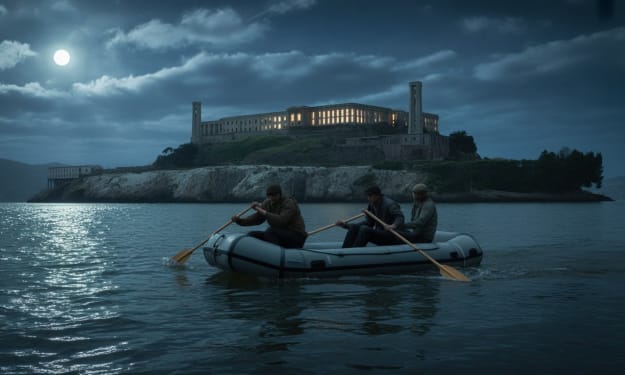
What if the most secure prison in the world wasn’t as inescapable as everyone believed? For decades, Alcatraz Federal Penitentiary stood as a symbol of absolute control—cold waters, ruthless guards, and isolation that crushed even the strongest minds. Yet in 1962, three ordinary men dared to challenge the impossible. Their story is not just about escape; it’s about human ingenuity, hope, and the timeless desire for freedom.
By John Smithabout a month ago in Criminal