
The Face Behind the Number: What We Lose When We Reduce People to Their Worst Moment
Every Inmate Is Someone's Child, Someone's Parent, Someone's Possibility—And We Have Forgotten How to See
The number stays with you. Once you have been processed, counted, filed, you are no longer quite a person. You become a case file, a statistic, a category. You become the crime you committed, reduced to a single moment that will define you forever in the eyes of the world. The humanity you carried before—the child you were, the person you loved, the dreams you had—all of it becomes invisible, irrelevant, erased by the thing you did.
We do this because we need to. We need to believe that the people who commit terrible acts are fundamentally different from us. We need to draw a line between "them" and "us," to convince ourselves that we could never do what they did, that we belong to a separate category of human being. This belief protects us from the uncomfortable truth that the capacity for harm lives in every human heart, that the circumstances that lead to crime could, under different conditions, touch anyone. We need monsters so we can feel safe.
But the people behind the numbers are not monsters. They are people. They are someone's child, someone's parent, someone's friend. They carry childhoods that shaped them, wounds that never healed, opportunities that never came. They made choices—terrible choices, destructive choices, choices that caused real harm. But they are more than those choices, just as we are more than our best moments and our worst. The reduction of a human being to a single act is a violence of its own, a second wound added to the first.
I think about a man I came to know through letters, years ago. He was serving a life sentence for a crime committed in his early twenties—a moment of rage, a fight that escalated, a death that was never intended. By the time I knew him, he was in his fifties. He had spent half his life inside. He had earned a degree through correspondence courses. He had become a mentor to younger inmates, a listener, a source of wisdom. He had done everything possible to become someone different from the person who had caused that death. But to the outside world, he was still just his crime. Still just the number. Still just the worst thing he ever did.
His letters were full of longing—for trees he could not touch, for sunsets he could not see, for his mother who visited when she could and was now too old to make the trip. He wrote about the small pleasures of prison life—a cup of coffee shared, a book that transported him, a moment of kindness from a guard. He wrote about regret, endless regret, the kind that hollows you out and never stops. And he wrote about hope, somehow, still hope—that he might matter to someone, that his life might count for something, that the person he had become might be seen by someone, somewhere.
I never met him in person. The letters stopped after a while, as such things do. But I have never forgotten him. He taught me that the people we lock away are still people, still capable of change, still deserving of dignity. He taught me that the worst moment does not have to be the whole story. He taught me that redemption is possible, even when the world refuses to see it.
The system we have built does not believe in redemption. It is designed for punishment, not transformation. It warehouses human beings in conditions that often make them worse, then releases them into a world that gives them no chance to succeed. It spends billions on incarceration and pennies on the things that actually prevent crime—education, mental health care, addiction treatment, economic opportunity. It creates a permanent underclass of people marked by their past, unable to find work, housing, or community, and then wonders why so many return.
This is not justice. This is revenge dressed in procedure. This is a system that has forgotten that the people it processes are human beings, with human potential, capable of human change. This is a system that reduces people to their worst moment and then ensures they can never escape it.
The alternatives exist. We know what works. Programs that focus on rehabilitation rather than punishment have dramatically lower recidivism rates. Restorative justice practices that bring offenders face-to-face with those they have harmed create real accountability and real healing. Education and job training inside prisons prepare people for life outside. Mental health and addiction treatment address the underlying causes of much crime. Community support for returning citizens—housing, employment, connection—makes the difference between success and failure. These approaches are not soft; they are smart. They recognize that public safety depends not on building more prisons but on building more whole human beings.
But these approaches require us to see the person behind the crime. They require us to hold two truths at once: that harm was done and must be accounted for, and that the person who did it is more than that harm. They require us to believe in the possibility of change, even when change is hard, even when it seems unlikely, even when the person themselves has forgotten how to hope.
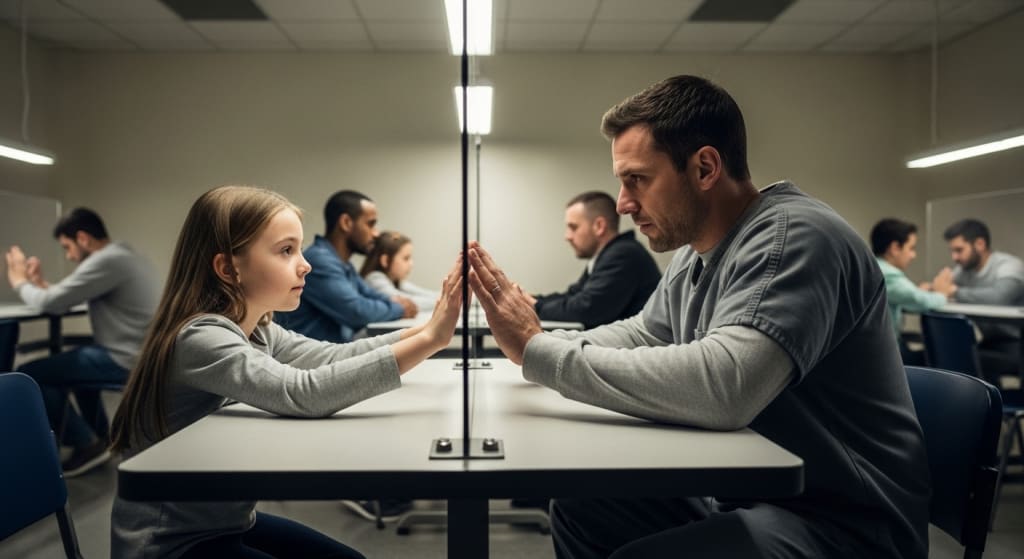
The young girl pressing her hand against the Plexiglas, trying to touch her father—she sees the person behind the number. She does not know about the crime, or if she knows, she does not understand it the way adults do. She knows that this is her father, the man who taught her to ride a bike, who sang her silly songs, who loved her before she was born. She knows that he is more than the worst thing he ever did. She knows because she has not yet learned to reduce people to a single moment. She knows because she still sees with a child's eyes, eyes that have not been trained to judge, to categorize, to condemn.
We were all that child once. We all knew how to see whole people, complex people, people who were more than their mistakes. Somewhere along the way, we unlearned it. We learned to reduce, to label, to dismiss. We learned to believe that people are defined by their worst moment, that the past is permanent, that change is impossible. We learned these things from a culture that prefers simple stories to complex truths, that finds it easier to condemn than to understand, that would rather build prisons than build people.
But we can unlearn. We can choose to see differently. We can look at the person behind the crime and ask not just what they did but who they are, who they might become, what they need to change. We can support programs that offer real rehabilitation, real education, real hope. We can advocate for policies that address the root causes of crime rather than just punishing its symptoms. We can refuse to reduce human beings to their worst moment, insisting instead that every person contains multitudes, that every life is more than a single act.
The face behind the number is waiting to be seen. The child inside the adult is waiting to be remembered. The possibility of change is waiting to be believed. And we, all of us, have a choice about whether we will be the ones who see, who remember, who believe.
The prison visiting room holds countless stories. Each table is a world of connection surviving against impossible odds. Each hand pressed against glass is a declaration that love transcends judgment, that relationship outlasts punishment, that the person behind the number is still a person, still loved, still capable of being seen. These stories do not excuse the harm done. They do not erase the pain caused. But they remind us that the full truth is always more complicated than the simple story we prefer to tell.
The young girl will grow up. She will learn, as we all do, to see the world in more complicated ways. She will have to reconcile her love for her father with the knowledge of what he did. That will be hard, perhaps the hardest work of her life. But if she can hold both—the love and the knowledge, the person and the act—she will have achieved something most of us never do. She will have learned to see fully, to judge carefully, to love without illusion. She will have learned what we all need to learn: that people are more than their worst moment, that change is possible, that every life contains the potential for something better.
The face behind the number is every person who has been reduced, labeled, dismissed. It is the formerly incarcerated person who cannot find work. It is the teenager marked by a mistake that will follow them forever. It is the parent whose child only sees them through glass. It is all of us, in our worst moments, hoping that someone will see past them.
Let us be those who see. Let us be those who remember that every number has a face, every face has a story, every story contains the possibility of redemption. Let us build a system that believes in change because change is real, that invests in people because people matter, that refuses to reduce anyone to their worst moment because no one is only that. The face behind the number is waiting. Let us finally learn to see.
About the Creator
HAADI
Dark Side Of Our Society
The Murders of Edmund & Maude Kemper
It’s well-known that Edmund Kemper killed six college students, his mom, and his mom’s best friend. But, did you know the serial killer also killed his grandparents as a teenager, eight years before his murder spree began?
By Criminal Mattersabout 3 hours ago in Criminal



Comments
There are no comments for this story
Be the first to respond and start the conversation.