
Mysteries of the Lost Isles: Five Enigmatic Islands That Vanished
The Vanishing Islands of Legend and History

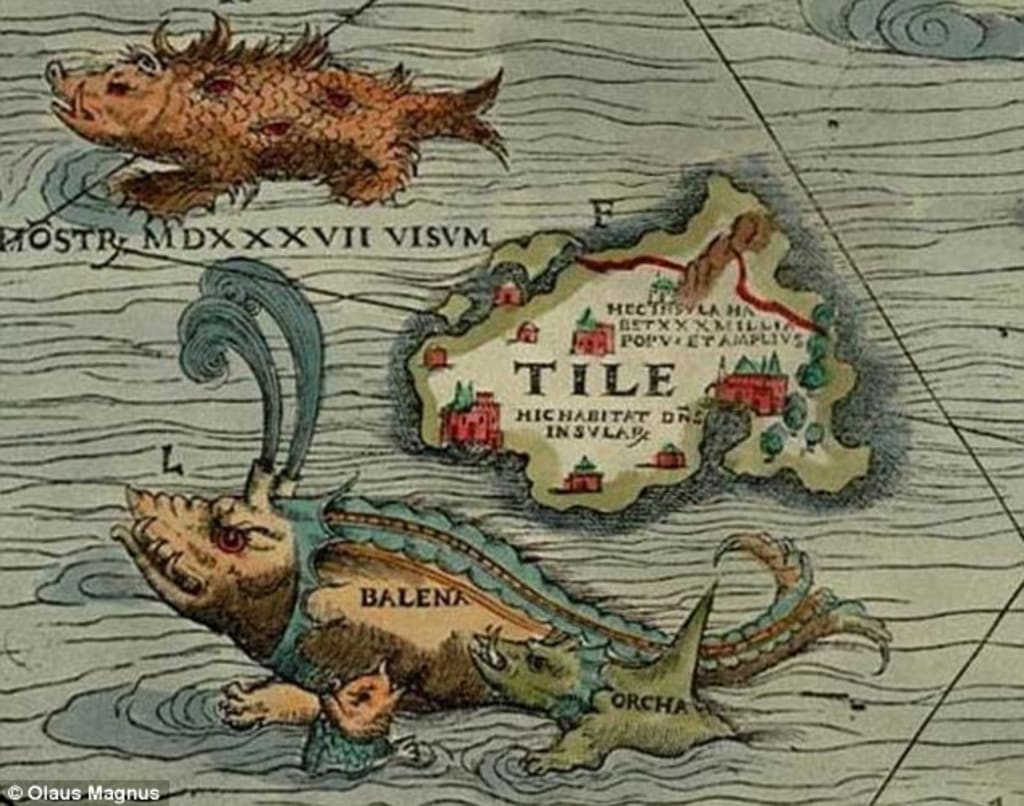
The ocean, vast and mysterious, covers over two-thirds of our planet's surface. It's a realm where many things can remain hidden, but the notion of an island disappearing from our maps altogether seems like a tale from ancient myth or an old sailor's yarn. Surprisingly, there are several accounts of so-called phantom islands, reported by numerous witnesses. Some of these islands were even thought to be inhabited, only to vanish without a trace when later expeditions sought them out. Whether due to human error or overactive imaginations, these stories are undeniably fascinating. Here are five such islands that seem to have disappeared from the face of the Earth.
Hy-Brasil: The Phantom Island of Ireland
Hy-Brasil first appeared on maps as early as 1325, located just west of Ireland. What makes this island particularly intriguing is that it wasn’t just a singular, isolated sighting. Notable figures such as Saint Barand and Saint Brendan, along with various other travelers, reported seeing Hy-Brasil, all describing it similarly in terms of its location and shape. It quickly earned the moniker "the promised land."
However, expeditions in the 1480s failed to find the island, despite claims that John Cabot spotted it in 1497. No subsequent sightings were documented until 1674 when Captain John Nesbit, an Irish explorer familiar with the waters west of Ireland, claimed to have anchored his ship near the island. His crew reportedly visited the island, returning a day later with gold and silver given by an old man who lived there. They also described the island as being inhabited by large black rabbits and a solitary old man residing in a castle.
The last documented sighting of Hy-Brasil was in 1872 by the author T.J. Westrop, who took his mother and friends to verify his previous encounters. They claimed the island appeared and then vanished before their eyes. Following this, Hy-Brasil slipped into the realm of Irish myth. Interestingly, in 1980, Jim Penniston, who was involved in the Rendlesham Forest UFO incident, reportedly received binary code messages from an alien spacecraft. When translated, the first part of this binary code pointed to the coordinates where Hy-Brasil was originally mapped, alongside other notable locations like the Nazca Lines in Peru and the Pyramids of Giza. This adds an eerie twist to the already mysterious tale of Hy-Brasil.
Antillia: The Island of the Seven Cities
According to legend, Antillia was an island you couldn’t leave once you arrived. The story dates back to the 15th century, when it was also known as the Isle of Seven Cities. Positioned west of Spain and Portugal on nautical charts, the island is tied to the Muslim conquest of Hispania in 714. Seven Christian Visigothic bishops fled the Muslim invaders, sailing westward into the Atlantic Ocean with their followers. They found and settled on Antillia, establishing seven cities.
Despite being marked on maps, subsequent voyages failed to locate Antillia. Sailors of the 15th century often reported seeing the island from a distance, only for it to disappear as they approached. By the end of the 15th century, as the North Atlantic became a regular sailing route, the island was never seen again and gradually disappeared from charts, leaving many to question if Antillia ever existed at all.
Sarah Ann Island: The Vanishing Guano Treasure
Sarah Ann Island was first discovered in 1858 by a ship from the New York Guano Company. Rich in guano—a valuable natural fertilizer made from bird and bat feces—the island was quickly claimed under the Guano Islands Act. Located in the South Pacific Ocean, northeast of Christmas Island, it was marked on marine charts. However, after its initial discovery and claim, no one returned to Sarah Ann for 15 years.
When the USS Portsmouth voyaged to the coordinates in search of the island, it was nowhere to be found. Despite this, U.S. mapmakers refused to believe the island had disappeared, given its frequent mention in ship logs. It wasn’t until the 1930s, when astronomers sought the island for an ideal eclipse viewing site, that its absence was finally confirmed. The prevailing theory is that there was a mix-up with the original coordinates, leading to a massive cartographical error. The island might be Independence Island instead, but the mystery remains.
Tuanahe: The Submerged Cook Island
Tuanahe is a more puzzling case, as it wasn’t just a map dot but an inhabited island. Part of the Cook Islands, located south of Rarotonga in the South Pacific Ocean, Tuanahe reportedly vanished along with its entire community. One of the earliest accounts is from 1842, when a sailor spent six days with the natives. Two years later, a group from a nearby island tried to find Tuanahe but failed. In 1863, a sailor named J. Hammet struck rocks at the approximate location of Tuanahe. These rocks, later known as the Hammet Rocks, were speculated by oceanographer Henry Stommel in 1984 to be the remnants of the submerged island.
However, the existence of the Hammet Rocks has been questioned over the years, keeping the mystery of Tuanahe's fate and its inhabitants unresolved.
Atlantis: The Legendary Lost City
No list of disappearing islands would be complete without mentioning Atlantis, the most famous of them all. First described over 2,000 years ago by the Greek philosopher Plato, Atlantis was a powerful sea kingdom located in the Atlantic Ocean. Plato's detailed and specific writings described Atlantis as a noble civilization, rich and advanced, but ultimately punished by the gods for their greed and corruption. In one catastrophic surge, Atlantis was swallowed by the ocean, never to be seen again.
Despite numerous searches and advanced deep-sea explorations, no trace of Atlantis has ever been found. In 2015, researchers discovered a shipwreck off the coast of Sicily containing 39 ingots of what was believed to be orichalcum, a metal associated with Atlantis. While the true nature of the metal remains debated, some suggest it might lend credence to the ancient tale. Like Troy, which was once thought mythical but is now considered historical, Atlantis's existence remains hotly debated among historians and archaeologists.
These five islands were once mapped and believed to exist, only to vanish from records and charts. Whether due to navigational errors, natural disasters, or something else entirely, the stories of these islands remain captivating. They remind us of a time when the world was less known, and the boundaries between reality and myth were often blurred.
About the Creator
Nathan Talek
Welcome to a world where the cosmos meets curiosity! I’m Nathan, an avid explorer of the universe's wonders and a passionate storyteller who makes the mysteries of space accessible and exciting.
Keep reading
More stories from Nathan Talek and writers in Earth and other communities.
The Frozen Frontier: Discovering Antarctica's Hidden Secrets
Antarctica, once a lush green land teeming with dinosaurs, is now a vast frozen continent larger than the United States and Europe combined. Located at the South Pole within the Antarctic Circle, it's the largest ice mass on Earth. Despite its size, Antarctica was only officially discovered in 1820, with confirmation as a continent and naming following decades later. The name Antarctica, meaning "opposite of the Arctic," reflects its position on the globe.
By Nathan Talek2 years ago in Education
Meteorologists Sound the Alarm as Early February Arctic Anomaly Rattles Climate Models
An unusual atmospheric disturbance in early February has sent shockwaves through the global meteorological community. What began as a cluster of irregular data points over the Arctic quickly evolved into something more troubling: a large-scale anomaly disrupting temperature patterns, jet stream flow, and seasonal forecasts across the Northern Hemisphere.
By Sadaqat Ali3 days ago in Earth
What Happens To Your Brain When You Stop Multitasking
Digital technology is the culprit that is causing us to doom scroll when tired, disengaged and unmotivated with the content that motivated you to log onto your device to consume in the first place. That is only the beginning. In the modern workplace (and even when filing cabinets were around, I confirmed this with my adopted parents to get my facts right); reading files while you are supposed to be present to the caller on the other end of the phone line is another classic example of multitasking that causes your brain (although adaptable and intelligent) to lose focus and concentration.
By Justine Crowley6 days ago in Psyche


Comments (1)
Awesome piece